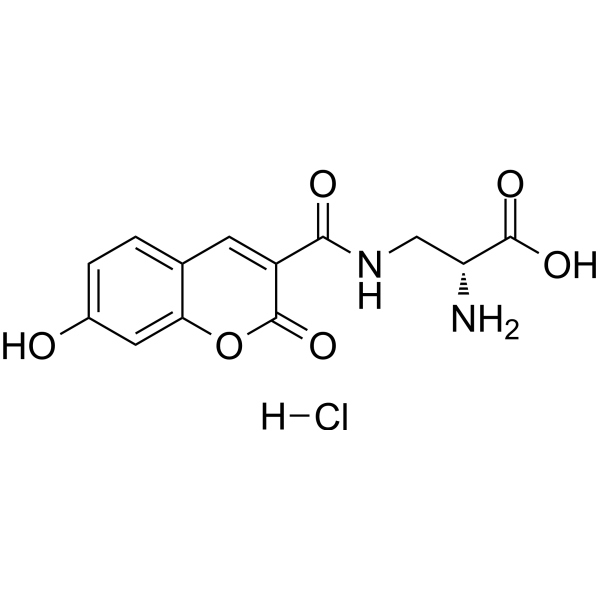
HADA hydrochloride (HCC-Amino-D-alanine hydrochloride) is a blue-emitting (λem ≈ 450 nm) fluorescent D-amino acid (FDAA) used for labeling bacterial cell walls. FDAAs are incorporated into peptidoglycan (PG) at sites of active biosynthesis through the action of native transpeptidases, enabling specific and covalent labeling of growing bacterial cells with minimal disruption to normal physiology.
HADA hydrochloride provides high spatial and temporal resolution for visualizing bacterial growth dynamics, cell wall synthesis, and morphogenesis in live-cell imaging studies, making it a powerful tool in microbiology and antibiotic mechanism research.
HADA hydrochloride (HCC-Amino-D-alanine hydrochloride) is a blue-emitting (λem ≈ 450 nm) fluorescent D-amino acid (FDAA) used for labeling bacterial cell walls. FDAAs are incorporated into peptidoglycan (PG) at sites of active biosynthesis through the action of native transpeptidases, enabling specific and covalent labeling of growing bacterial cells with minimal disruption to normal physiology.
HADA hydrochloride provides high spatial and temporal resolution for visualizing bacterial growth dynamics, cell wall synthesis, and morphogenesis in live-cell imaging studies, making it a powerful tool in microbiology and antibiotic mechanism research.
Store lyophilized at -20ºC, keep desiccated. In lyophilized form, the chemical is stable for 36 months. In solution, store at -20ºC and use within 1 months to prevent loss of potency. Aliquot to avoid multiple freeze/thaw cycles.
This calculator helps you calculate mass of compound based on solution concentration, volume and molecular weight in a specific solution using the formula: