Breast cancer targeting peptide 18–4

Catalog No.: A54954
KRT1 Receptor-targeting Peptide
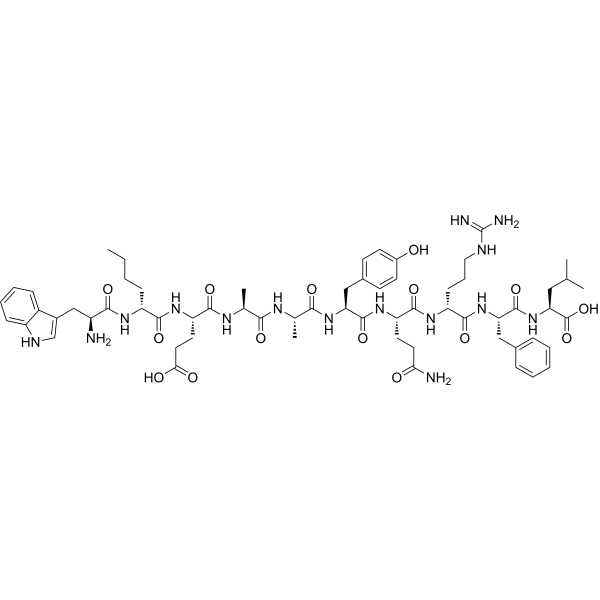
Breast cancer targeting peptide 18–4 is a KRT1 receptor-targeting peptide characterized by a binding affinity (Kd) of 0.98 μM. This peptide, with the amino acid sequence WxEAAYQrFL, serves as an analogue of the P160 peptide. When covalently conjugated with the anticancer peptide MccJ25, it significantly enhances the cellular uptake of MccJ25 in breast cancer cells, thereby improving its anticancer efficacy. The resulting conjugate demonstrates IC50 values of 14.2, 20, and 25 μM against MCF-7, MDA-MB-435, and MDA-MB-435-MDR cell lines, respectively, making it valuable for research in breast cancer therapy.
Grouped product items
Size Stock
5mg
10mg
50mg
Bulk Size
Bulk Discount
Free Delivery on orders over $500
Research use only. We do not sell to patients.

Loading distributor info...

Adooq Products cited in reputable paper
Science VOLUME 380, ISSUE 6663 (2023)
Science VOLUME 369, ISSUE 6510 (2020)
Science VOLUME 356, ISSUE 6336 (2017)
Cell Vol. 185 Issue 23 p4428-4447.e28
Cell Vol 177, Issue 7, p1933-1947.e25
Cell Vol 156, Issue 5, p857-1114
Nature Volume 622 Issue 7982 (2023)
Nature volume 620, pages890-897 (2023)
Nature volume 610, pages540-546 (2022)
Nature volume 588, pages83-88 (2020)
Nature volume 574, pages268-272 (2019)
Nature volume 573, pages539-545 (2019)
Nature volume 567, pages118-122 (2019)
Nature volume 551, pages639-643 (2017)
Nature volume 551, pages247-250 (2017)
Nature volume 548, pages356-360 (2017)
Nature volume 545, pages187-192 (2017)
Biological Activity
DescriptionBreast cancer targeting peptide 18–4 is a KRT1 receptor-targeting peptide characterized by a binding affinity (Kd) of 0.98 μM. This peptide, with the amino acid sequence WxEAAYQrFL, serves as an analogue of the P160 peptide. When covalently conjugated with the anticancer peptide MccJ25, it significantly enhances the cellular uptake of MccJ25 in breast cancer cells, thereby improving its anticancer efficacy. The resulting conjugate demonstrates IC50 values of 14.2, 20, and 25 μM against MCF-7, MDA-MB-435, and MDA-MB-435-MDR cell lines, respectively, making it valuable for research in breast cancer therapy.
Product Information
Catalog NumA54954
FormulaC63H89N15O15
Molecular Weight1296.47
CAS Number1332850-08-4
SequenceTrp-{d-Nle}-Glu-Ala-Ala-Tyr-Gln-{d-Arg}-Phe-Leu
Sequence shorteningW-{d-Nle}-EAAYQ-{d-Arg}-FL
SMILESC([C@@H](C(N[C@@H](C(N[C@H](C(N[C@H](C(N[C@H](C(N[C@@H](CC1=CC=C(O)C=C1)C(N[C@H](C(N[C@@H](C(N[C@@H](CC2=CC=CC=C2)C(N[C@@H](CC(C)C)C(O)=O)=O)=O)CCCNC(=N)N)=O)CCC(N)=O)=O)=O)C)=O)C)=O)CCC(O)=O)=O)CCCC)=O)N)C=3C=4C(NC3)=CC=CC4
Useful Calculator

This calculator helps you calculate mass of compound based on solution concentration, volume and molecular weight in a specific solution using the formula:


Mass (mg) = Concentration (mM) × Volume (mL) × Molecular Weight (g/mol)

  • Mass

    Concentration

    Volume

    Molecular Weight

Please check COA/MSDS for correct molecular weight.

Calculate the dilution required to prepare a stock solution.
This equation is commonly abbreviated as: C1V1 = C2V2

  • C1

    V1

    C2

    V2