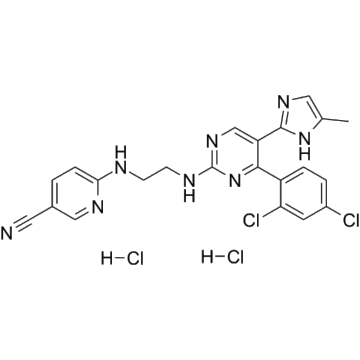
Fig. 1 · Structure

Documents & Downloads

Laduviglusib (CHIR-99021)

Cat. No. A10199 CAS 252917-06-9

GSK-3 Inhibitor

Also available in: 3i Stem Cell Reprogramming and Maintenance Kit, DFICBY Astrocyte-to-Neuron Reprogramming Kit

CHIR99021 is an aminopyrimidine derivative that inhibits GSK3α and GSK3β with IC50 values of 10 and 6.7 nM, respectively.

In Stock

Publications for Laduviglusib

13 publications citing this product

  1. Peilin Li, .et al. , Ecotoxicol Environ Saf, 2024, Dec:288:117330 PMID: 39571255
  2. Peilin Li, .et al. , Stem Cell Res Ther, 2024, Aug 26;15(1):269 PMID: 39183353
  3. Andreea Manole, .et al. , Cell Rep, 2023, Dec 26;42(12):113466 PMID: 38039131
  4. Claudia Z Han, .et al. , Immunity, 2023, Sep 12;56(9):2152-2171 PMID: 37582369
  5. Eric Lian, .et al. , STAR Protoc, 2023, May 22;4(2):102314 PMID: 37220001
  6. Tomoki Murata, .et al. , Int Immunol, 2023, Apr 13 PMID: 37052267
  7. Shunsuke Murakami, .et al. , Regen Ther, 2022, Nov 25;21:574-583 PMID: 36475025
  8. Adam Pietrobon, .et al. , Cell Rep, 2022, Jul 5;40(1):111048 PMID: 35793620
  9. Takayuki Miyoshi, .et al. , J Gastroenterol, 2022, Jun;57(6):441-452 PMID: 35294680
  10. Tomoki Kamatani, .et al. , Inflamm Regen, 2022, Feb 2;42(1):4 PMID: 35105370

Free Aliquoting for Your Order

Tell us your preferred amount per vial. We’ll confirm the options.

Biological Activity

Bioactivity / Mechanism

CHIR-99021 (CT 99021) inhibits GSK3β in biochemical assays. In one kinase panel, 1 μM CT 99021 left 1±2% GSK3β activity, compared with 53±3% for CDK2–cyclin A, 41±2% for PLK1 and 45±5% for MELK. Selectivity depends on assay conditions; these results do not support an absolute absence of other kinase effects. [1]

Literature-reported observations and conditions; not Adooq-tested protocols or general treatment recommendations.

Target & Activity

Target Activity Value
GSK-3β 6.7 nM
GSK-3α 10 nM

Cellular Effect

Cell Line Activity Value Description Reference
CHO EC50 0.13 μM Inhibition of GSK3 in CHO cells expressing insulin receptor assessed as activation of glycogen synthase measured after 30 mins in presence of glucose-6-phosphate by filter paper assay [PMID: 31926786]
HepG2 EC50 1.5 μM Inhibition of GSK3-beta in human HepG2 cells assessed as incorporation of [3H]glucose into glycogen after 3 hrs by liquid scintillation counting [PMID: 22261023]

In Vitro Studies

CHIR99021 activated a TCF/LEF transcriptional reporter in HEK293 and HT-22 cells. The reported HEK293 EC50 was 1.5 μM. A representative overnight comparison used 25 μM CHIR99021; lithium showed substantially different responses between the two cell lines. These findings describe reporter signaling in cultured cells. [2]

Kinase-panel inhibition and selectivity limits

Biochemical assay · Biochemical protein kinase panel including human GSK3β, CDK2–cyclin A, PLK1 and MELK [1]

At 1 μM, CT 99021 strongly inhibited GSK3β, with partial inhibition of CDK2–cyclin A, PLK1 and MELK. Results are assay-specific and do not establish universal target exclusivity.

Measured endpoints — not treatment concentrations
EndpointReported resultReference
GSK3β activity relative to inhibitor-omitted controlPercentage activity remaining 1±2%[1]
CDK2–cyclin A activity relative to inhibitor-omitted controlPercentage activity remaining 53±3%[1]
PLK1 activity relative to inhibitor-omitted controlPercentage activity remaining 41±2%[1]
MELK activity relative to inhibitor-omitted controlPercentage activity remaining 45±5%[1]

Literature-Reported Treatment Conditions

Treatment concentration
1 μM CT 99021
Exposure duration
30 min
Method
Radiometric kinase activity assay at 21 °C; inhibitor-omitted controls.
Reported limits
Final assay vehicle and the meaning of ± in Table 3 are not defined in the read assay text/caption.
Methods and source locations

Compound reported in the paper: CHIR-99021; Compound label in the paper: CT 99021

Evidence concerns the named inhibitor in the reported assays; no salt equivalence or lot-specific performance claim.

Table 3, CT 99021 (1 μM) column, GSK3β/CDK2–cyclin A/PLK1/MELK rows and caption; Materials and methods, Protein kinase assays
GSK3β activity relative to inhibitor-omitted control: Radiometric protein kinase assay; 1 μM CT 99021, 30 min, 21 °C; ATP 5 μM. Caption: averages of duplicate determinations, experiment repeated two or three times with similar results. The read caption does not define the ± statistic. — Table 3, CT 99021 (1 μM) column, GSK3β/CDK2–cyclin A/PLK1/MELK rows and caption; Materials and methods, Protein kinase assays

CDK2–cyclin A activity relative to inhibitor-omitted control: Radiometric protein kinase assay; 1 μM CT 99021, 30 min, 21 °C; ATP 20 μM. Caption: averages of duplicate determinations, experiment repeated two or three times with similar results. The read caption does not define the ± statistic. — Table 3, CT 99021 (1 μM) column, GSK3β/CDK2–cyclin A/PLK1/MELK rows and caption; Materials and methods, Protein kinase assays

PLK1 activity relative to inhibitor-omitted control: Radiometric protein kinase assay; 1 μM CT 99021, 30 min, 21 °C; ATP 5 μM. Caption: averages of duplicate determinations, experiment repeated two or three times with similar results. The read caption does not define the ± statistic. — Table 3, CT 99021 (1 μM) column, GSK3β/CDK2–cyclin A/PLK1/MELK rows and caption; Materials and methods, Protein kinase assays

MELK activity relative to inhibitor-omitted control: Radiometric protein kinase assay; 1 μM CT 99021, 30 min, 21 °C; ATP 50 μM. Caption: averages of duplicate determinations, experiment repeated two or three times with similar results. The read caption does not define the ± statistic. — Table 3, CT 99021 (1 μM) column, GSK3β/CDK2–cyclin A/PLK1/MELK rows and caption; Materials and methods, Protein kinase assays

TCF/LEF reporter activation in HEK293 and HT-22 cells

Cell-based study · Human HEK293 and mouse hippocampal HT-22 stable TCF/LEF firefly-luciferase reporter cells with EF1α Renilla normalization [2]

CHIR99021 activated the reporter in both cell lines. HEK293 EC50 was 1.5 μM; the representative comparison used 25 μM CHIR99021 and 10 mM LiCl. Lithium activated HEK293 but showed little response in HT-22. Reporter activation alone does not establish a neuronal therapeutic effect.

Measured endpoints — not treatment concentrations
EndpointReported resultReference
Half-maximal TCF/LEF reporter activation in HEK293EC50 1.5 μM[2]
TCF/LEF reporter activity in HEK293 and HT-22Qualitative response Activation in both cell lines at 25 μM CHIR99021[2]

Literature-Reported Treatment Conditions

Treatment concentration
25 μM CHIR99021 in Figure 5c; concentration-response assay summarized separately by EC50.
Exposure duration
Overnight
Method
Stable reporter cells; Dual-Glo assay with EF1α Renilla normalization.
Vehicle
DMSO stock solutions; final DMSO fraction not specified in the read reporter methods.
Reported limits
Concentration series and fit details for the summarized HEK293 EC50 are not supplied in Figure 5b. Representative treatment concentration must not be confused with EC50.
Methods and source locations

Compound reported in the paper: CHIR-99021; Compound label in the paper: CHIR99021

Named-compound evidence only; no Adooq lot validation or equivalence to hydrochloride preparations.

Figure 5b–c and caption; Results, Direct GSK-3 Inhibition; Methods, Compounds and TCF/LEF Reporter Transcriptional Assay

Half-maximal TCF/LEF reporter activation in HEK293: Dual-Glo firefly luciferase normalized to EF1α Renilla luciferase; reported in Figure 5b. — Figure 5b–c and caption; Results, Direct GSK-3 Inhibition; Methods, Compounds and TCF/LEF Reporter Transcriptional Assay

TCF/LEF reporter activity in HEK293 and HT-22: Figure 5c: CHIR99021 compared with LiCl (10 mM); relative reporter activity. Mean±SEM from at least three independent experiments. No exact bar heights extracted. — Figure 5b–c and caption; Results, Direct GSK-3 Inhibition; Methods, Compounds and TCF/LEF Reporter Transcriptional Assay

In Vivo Studies

In male C57BL/6J and DBA/2J mice, CHIR99021 (12.5 mg/kg, intraperitoneally) given 60 min before an amphetamine challenge reduced subsequent hyperlocomotion by approximately 30% and 60%, respectively. The authors reported no significant change in baseline motor activity across the systemic dose groups in a supplementary control. The findings are limited to an acute mouse behavioral assay. [2]

Acute systemic treatment in mouse hyperlocomotion assay

Animal study · Male C57BL/6J and DBA/2J mice challenged with d-amphetamine [2]

A single 12.5 mg/kg intraperitoneal CHIR99021 pretreatment reduced amphetamine-induced hyperlocomotion in both strains. The supplementary caption reports no significant differences in baseline motor activity across the systemic dose groups. These are acute behavioral-model outcomes.

Measured endpoints — not treatment concentrations
EndpointReported resultReference
Total distance traveled during 80 min after amphetamineAuthor-reported approximate reduction ∼30% in C57BL/6J; ∼60% in DBA/2J[2]
Baseline motor activity during 20 min before amphetamineNegative control result No significant group differences; Ftreatment(4,21)=2.50, p>0.05[2]

Conditions shared by the study groups

Route
Intraperitoneal
Frequency
Single pretreatment
Treatment course
60 min before d-amphetamine; locomotion quantified for 80 min after challenge.
Vehicle
45% polyethylene glycol 400, 45% saline, 10% DMSO
Study groups and reported outcomes
Group / doseComparatorObserved resultReference
C57BL/6J systemic treatment
12.5 mg/kg CHIR99021
Vehicle pretreatment followed by d-amphetamine (3.5 mg/kg, intraperitoneal). vehicle n=6; CHIR99021 n=5.Approximately 30% reduction in amphetamine-induced hyperlocomotion relative to matched strain vehicle group (author-reported approximations).[2]
DBA/2J systemic treatment
12.5 mg/kg CHIR99021
Vehicle pretreatment followed by d-amphetamine (3.5 mg/kg, intraperitoneal). vehicle n=6; CHIR99021 n=5.Approximately 60% reduction in amphetamine-induced hyperlocomotion relative to matched strain vehicle group (author-reported approximations).[2]
C57BL/6J systemic treatment
Model: Male C57BL/6J mice; purchased at 10 weeks, acclimated for one week before behavioral procedures.
Reported limits: Exact numerical group means were not extracted from bars.
DBA/2J systemic treatment
Model: Male DBA/2J mice; purchased at 10 weeks, acclimated for one week before behavioral procedures.
Reported limits: Exact numerical group means were not extracted from bars.
Methods and source locations

Compound reported in the paper: CHIR-99021; Compound label in the paper: CHIR99021

Named-compound evidence only; no Adooq lot validation or equivalence to hydrochloride preparations.

Figure 6b and caption; Results, Direct GSK-3 Inhibition; Methods, Compounds, Animals, Behavioral Procedures and Statistical Analysis; Supplementary Figure S6E caption (SI pp.12–13)

Total distance traveled during 80 min after amphetamine: Figure 6b; two-way ANOVA Ftreatment(1,18)=41.21, p=0.001; Fstrain(1,18)=15.60, p=0.001; Finteraction(1,18)=8.11, p=0.011. Mean±SEM; per strain vehicle n=6, CHIR99021 n=5. — Figure 6b and caption; Results, Direct GSK-3 Inhibition; Methods, Compounds, Animals, Behavioral Procedures and Statistical Analysis; Supplementary Figure S6E caption (SI pp.12–13)

Baseline motor activity during 20 min before amphetamine: Caption reports CHIR99021 25, 12.5, 6.1 and 3 mg/kg intraperitoneally versus vehicle; mean±SEM. Caption read; no supplementary bar values or image-based claims extracted. — Supplementary Figure S6E caption, SI pp.12–13; main Results citing S6E

C57BL/6J systemic treatment · Figure 6b and caption; Results, Direct GSK-3 Inhibition; Methods, Compounds, Animals, Behavioral Procedures and Statistical Analysis; Supplementary Figure S6E caption (SI pp.12–13)

DBA/2J systemic treatment · Figure 6b and caption; Results, Direct GSK-3 Inhibition; Methods, Compounds, Animals, Behavioral Procedures and Statistical Analysis; Supplementary Figure S6E caption (SI pp.12–13)

Specifications

Manufacturer Adooq Bioscience
Actions Inhibitor
CAS Number 252917-06-9
Applications GSK-3 Inhibitor
Formula C22H18Cl2N8
Molecular Weight 465.3
Synonyms GSK-3 Inhibitor XVI; CT 99021; CHIR-99021
SMILES
CC1=CN=C(N1)C2=CN=C(N=C2C3=C(C=C(C=C3)Cl)Cl)NCCNC4=NC=C(C=C4)C#N

Storage & Solubility

In Vitro Solubility

Reported Solubility

SolventReported Solubility
DMSO 93 mg/mL (199.85 mM)
Water Insoluble
Ethanol Insoluble

Preparing Stock Solutions

Stock preparation is unavailable for this product molecular weight.

Calculated stock concentrations do not establish solvent solubility. Refer to the reported solubility data for experimental guidance.

In Vivo Preparation

Concentration
3.3 mg/mL
Vehicle
4% DMSO+30% PEG 300+ddH2O

Storage

Store powder at -20°C, keep desiccated.
In powder form, the chemical is stable for 36 months.
In solution, store at -20°C and use within 1 month to prevent loss of potency. Aliquot to avoid multiple freeze/thaw cycles.

Research References

  1. [1] Jenny Bain, Lorna Plater, Matt Elliott, et al. The selectivity of protein kinase inhibitors: a further update Biochemical Journal (2007). PMID: 17850214 DOI: 10.1042/BJ20070797 Source material
  2. [2] Jen Q Pan, Michael C Lewis, Josh K Ketterman, et al. AKT Kinase Activity Is Required for Lithium to Modulate Mood-Related Behaviors in Mice Neuropsychopharmacology (2011). PMID: 21389981 DOI: 10.1038/npp.2011.24 Source material

Publications

13 publications citing this product

  1. Peilin Li, .et al. , Ecotoxicol Environ Saf, 2024, Dec:288:117330 PMID: 39571255
  2. Peilin Li, .et al. , Stem Cell Res Ther, 2024, Aug 26;15(1):269 PMID: 39183353
  3. Andreea Manole, .et al. , Cell Rep, 2023, Dec 26;42(12):113466 PMID: 38039131
  4. Claudia Z Han, .et al. , Immunity, 2023, Sep 12;56(9):2152-2171 PMID: 37582369
  5. Eric Lian, .et al. , STAR Protoc, 2023, May 22;4(2):102314 PMID: 37220001
  6. Tomoki Murata, .et al. , Int Immunol, 2023, Apr 13 PMID: 37052267
  7. Shunsuke Murakami, .et al. , Regen Ther, 2022, Nov 25;21:574-583 PMID: 36475025
  8. Adam Pietrobon, .et al. , Cell Rep, 2022, Jul 5;40(1):111048 PMID: 35793620
  9. Takayuki Miyoshi, .et al. , J Gastroenterol, 2022, Jun;57(6):441-452 PMID: 35294680
  10. Tomoki Kamatani, .et al. , Inflamm Regen, 2022, Feb 2;42(1):4 PMID: 35105370
  11. Dan Zhao, .et al. , Poult Sci, 2022, Mar; 101(3): 101642 PMID: 35016046
  12. Otsuka R, .et al. , Sci Rep, 2020, Jan 14;10(1):224 PMID: 31937817
  13. Yu Huang, .et al. , Stem Cells Int, 2019, 2019: 3975689 PMID: 31565060

Showing 10 of 13 publications

Added to your cart

View Cart Checkout
Loading...