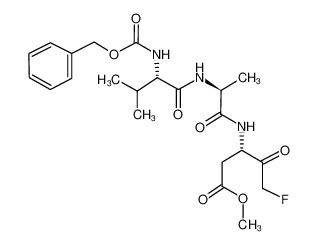
Z-VAD-FMK is a cell-permeable, irreversible pan-caspase inhibitor. Inhibits caspase processing and apoptosis induction in tumor cells in vitro (IC50 = 0.0015 - 5.8 mM). Active in vivo.
Z-VAD-FMK is a cell-permeable, irreversible pan-caspase inhibitor. Inhibits caspase processing and apoptosis induction in tumor cells in vitro (IC50 = 0.0015 - 5.8 mM). Active in vivo.
Targets
Target
Value
In Vitro
Z-VAD-FMK is provided as a lyophilized powder. For preparation of a 10 mM stock solution, reconstitute 1 mg of the compound in 213.9 μL of DMSO. Working concentrations and treatment duration may vary depending on the experimental design and desired biological outcome. Z-VAD-FMK is commonly applied as a pre-treatment at concentrations ranging from 5–100 μM for approximately 1 hour prior to stimulation or induction conditions.
Store lyophilized at -20ºC, keep desiccated. In lyophilized form, the chemical is stable for 36 months. In solution, store at -20ºC and use within 1 months to prevent loss of potency. Aliquot to avoid multiple freeze/thaw cycles.
Solubility
In vitro (25°C)
DMSO
80 mg/mL (171.12 mM)
Water
Insoluble
Ethanol
Insoluble
In vivo
2% DMSO+35 %PEG 300+2%Tween 80+ddH2O
5 mg/mL
* <1 mg/ml means slightly soluble or insoluble. * Please note that Adooq tests the solubility of all compounds in-house, and the actual solubility may differ slightly from published values. This is normal and is due to slight batch-to-batch variations.
This calculator helps you calculate mass of compound based on solution concentration, volume and molecular weight in a specific solution using the formula:
Please check COA/MSDS for correct molecular weight.
Calculate the dilution required to prepare a stock solution.This equation is commonly abbreviated as: C1V1 = C2V2
Frequently Asked Questions
When preparation of Z-VAD-FMK DMSO solution, Should I use standard grade or Sterile, Anhydrous DMSO for stock solutions?
It is highly recommended to use Cell Culture Grade, Anhydrous DMSO.
Why Anhydrous? The FMK (fluoromethyl ketone) group is susceptible to hydrolysis over time. Using anhydrous DMSO minimizes moisture-induced degradation, extending the shelf life of your stock.
Why Sterile? Since Z-VAD-FMK is often used in long-term cell culture assays, starting with a sterile solvent prevents contamination risks. If you use non-sterile DMSO, you may need to filter the final working solution, which introduces potential loss of the compound.
What is the ideal volume to prevent activity loss from freeze-thaw cycles when preparation of Z-VAD-FMK solution?
The best practice is to aliquot in 10μL to 20μL volumes.
Stability: Z-VAD-FMK is sensitive to repeated temperature fluctuations. Smaller aliquots ensure that you only thaw exactly what you need for a single set of plates.
Concentration Tip: Most researchers prepare a 10μL or 20μL stock. A 10μL aliquot of a 20μL stock can treat 20 mL of medium at a final concentration of 10μM, which is usually sufficient for a few 6-well plates or a 96-well plate.
Cathepsin Off-target Effects – How do I ensure results are not due to Z-VAD-FMK inhibiting lysosomal enzymes?
At high concentrations (typically > 50 μM ), Z-VAD-FMK is known to inhibit certain Cathepsins (B, L, and S). To distinguish these effects:
Concentration Control: Keep your Z-VAD-FMK working concentration as low as possible (e.g., $10-20 μM).
Alternative Inhibitors: Use a more specific inhibitor like Q-VD-OPh alongside Z-VAD-FMK. Q-VD-OPh has significantly lower cross-reactivity with Cathepsins.
Functional Rescue: If your phenotype is purely Caspase-dependent, adding a Cathepsin-specific inhibitor (like E-64) should not mimic the exact effect of Z-VAD-FMK.
Cell Line Specificity – Are there differences in Z-VAD-FMK permeability or metabolism between T cells and HeLa cells?
Yes, significantly.Permeability: HeLa cells (epithelial) generally require higher concentrations of Z-VAD-FMK (20-50 μM) due to their robust membrane structure. Primary T cells are much more sensitive and may achieve complete Caspase blockade with Z-VAD-FMK at 5-10 μM.Metabolism: Immune cells often have higher metabolic turnover of peptide-based inhibitors like Z-VAD-FMK. You may need to "refresh" the Z-VAD-FMK if your assay exceeds 24–48 hours.
Will Z-VAD-FMK trigger a shift to programmed necrosis?
This is a critical consideration for Z-VAD-FMK.The Switch: In RIPK1/RIPK3-expressing cell lines, inhibiting Caspase-8 with Z-VAD-FMK can unleash necroptosis if a death stimulus (like TNF-alpha) is present.Co-treatment: To prove apoptosis, test a group with Z-VAD-FMK + Necrostatin-1 (Nec-1). If the combination rescues the cells but Z-VAD-FMK alone does not (or makes it worse), your cells are switching to necroptosis.
What is the optimal time point to measure Caspase activity after Z-VAD-FMK treatment?
The window is narrow and induction-dependent:
Pre-incubation: Always pre-treat cells with Z-VAD-FMK for 30–60 minutes before adding the apoptosis inducer.
Early Detection: For Caspase activity assays, the peak signal usually occurs 2–6 hours post-induction in the presence of Z-VAD-FMK.
Stability: If you wait too long (e.g., 24 hours), Z-VAD-FMK might lose its potency due to degradation, allowing Caspases to reactivate.