






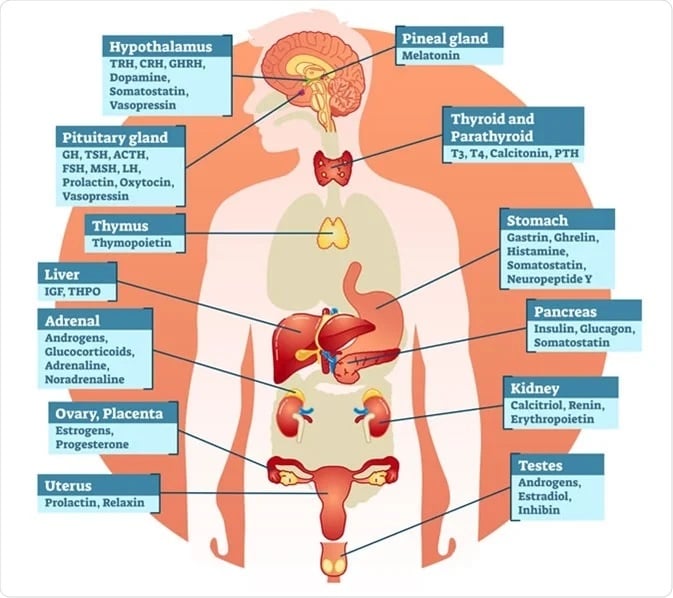
Endocrinology-Hormones

Small molecules play a pivotal role in Endocrinology Research. These are low molecular weight compounds that have a significant impact on the endocrine system, hormones, and their receptors. Here are some key aspects of how small molecules are involved in this field:

  • Hormone Mimetics and Inhibitors: Small molecules are used to develop synthetic compounds that mimic the actions of hormones or inhibit their effects. For example, drugs like metformin for diabetes management and selective estrogen receptor modulators (SERMs) for breast cancer treatment are used to either mimic or block hormonal activity.
  • Receptor Modulation: Small molecules can bind to hormone receptors and modulate their activity. This is crucial in developing drugs that target specific hormone receptors, like the use of small molecule agonists and antagonists to regulate thyroid hormone receptors.
  • Metabolism Regulation: Endocrinology research often focuses on metabolism and how hormones like insulin regulate it. Small molecules are employed to understand and develop drugs targeting enzymes involved in metabolism, such as glucagon-like peptide-1 (GLP-1) agonists for diabetes treatment.
  • Steroid Hormone Production: Small molecules may be utilized to influence the production of steroid hormones in the adrenal glands or gonads. This is essential for conditions like Cushing's syndrome or polycystic ovary syndrome (PCOS).
  • Hormone Assays: In laboratory research, small molecules are used as tracers or markers in hormone assays. For instance, small molecule fluorophores can be attached to antibodies to detect hormone levels in blood samples.

Drug Development: Endocrinology research relies on small molecules as potential drug candidates. Researchers design and test small molecules for their effectiveness in modulating hormonal pathways, with the goal of developing new therapies for endocrine disorders.
In summary, small molecules are indispensable tools in Endocrinology Research, enabling scientists to better understand the endocrine system's intricacies and develop novel treatments for a wide range of hormonal disorders and conditions. Their versatility and specificity make them valuable assets in advancing our knowledge of endocrinology and improving patient care.


Endocrinology Disease Products


Endocrinology Research Products

Kisspeptin Receptor

Leptin Receptors

Melanocortin (MC) Receptors

Mineralocorticoid Receptors

Ghrelin Receptors

Natriuretic Peptide Receptors

NPY Receptors

Motilin Receptor

PTH Receptor

Shop By

Items 51-100 of 129

Page
per page
Set Descending Direction
Catalog No.
Product Name
Application
Product Information
Citations
  1. Estrogen receptor agonist

    (R)-Equol is an agonist of both ERα and ERβ with Kis of 27.4 and 15.4 nM, respectively.
  2. FAA1 agonist

    FAA1 agonist-1 is a potent free fatty acid receptor 1 (FFA1/ GPR40) agonist with a pEC50 of 7.54.
  3. GPR39 agonist

    TM N1324 is an agonist of G-Protein-Coupled Receptor 39 (GPR39) with EC50s of 9 nM/5 nM in the presence of Zn2+, and 280 nM/180 nM in the absence of Zn2+ for human/murine GPR39.
  4. glucocorticoid receptor agonist

    Dexamethasone Phosphate disodium is a is a water-soluble form of the synthetic glucocorticoid dexamethasone.
  5. glucocorticoid agonist

    Beclometasone dipropionate is a potent glucocorticoid agonist; it is a prodrug of the free form, beclometasone.
  6. Na/K ATPase partial agonist

    Canrenone is a metabolite of spironolactone, Na/K ATPase partial agonist and aldosterone and androgen receptor antagonist used as a diuretic.
  7. GnRH/LHRH receptor agonist

    Leuprorelin is a Gonadotropin-releasing hormone (GnRH, luteinizing hormone-releasing hormone, LHRH) receptor agonist. Suppresses estradiol, LH and FSH serum levels and represses the growth of experimental rat endometriosis.
  8. GnRH agonist

    Nafarelin is a gonadotropin-releasing hormone agonist (GnRH agonist) which acts as an analog of GnRH.
  9. glucocorticoid receptor agonist

    Beclometasone, also known as Beclomethasone, is an anti-inflammatory, synthetic glucocorticoid. It is used topically as an anti-inflammatory agent and in aerosol form for the treatment of asthma.
  10. gonadotropin-releasing hormone agonist

    Buserelin Acetate is a gonadotropin-releasing hormone agonist (GnRH agonist).
  11. TRH-R agonist

    Taltirelin (TA0910) is a superagonist at thyrotropin-releasing hormone receptor (TRH-R) with an IC50 of 910 nM and EC50 of 36 nM for stimulating an increase in cytosolic Ca2+ concentration (Ca2+ release).
  12. FFA4/GPR120 agonist

    TUG-891 is a potent and selective agonist of the free fatty acid receptor 4 (FFA4/GPR120), which demonstrates both potential opportunity and possible challenges to therapeutic agonism.
  13. Glucocorticoid receptor agonist

    GW-870086 is a potent anti-inflammatory agent, acting as a glucocorticoid receptor agonist, with a pIC50 of 10.1 in A549 cells expressing NF-κB.
  14. RORγ inverse agonist

    XY101 is a potent, selective, metabolically stable and orally available RORγ inverse agonist with an IC50 of 30 nM and a Kd of 380 nM.
  15. glucocorticoid receptor agonist

    Dexamethasone palmitate (DXP) is a prodrug of Dexamethasone, which is a glucocorticoid receptor agonist. Dexamethasone palmitate (DXP) has a 47-fold lower affinity for the glucocorticoid receptor than Dexamethasone. Anti-inflammatory agent.
  16. ROR agonist

    ROR agonist-1 is a potent and orally bioavailable inverse agonist of the retinoic acid receptor-related orphan receptor C2 (RORC2), inhibition of IL-17A production from human primary TH 17 cells with a pIC50 of 7.5.
  17. RORγ agonist

    AZD-0284 is a potent, selective, inverse agonist of the nuclear receptor RORγ for the potential treatment of Plaque psoriasis.
  18. GPRC6A agonist

    DJ-V-159 is an agonist for G protein-coupled receptor family C group 6 member A (GPRC6A).
  19. GPR27 agonist

    CID 1375606 is a GPR27 agonist.
  20. glucocorticoid receptor agonist

    AZD2906 is a selective glucocorticoid receptor (GR) agonist, increases micronucleated immature erythrocytes in the bone marrow of rats. AZD2906 shows IC50s of 2.2, 0.3, 41.6 and 7.5 nM at GR in human, rat PBMC and human, rat whole blood, respectively.
  21. ERRα inverse agonist

    PROTAC ERRα ligand 2 is an estrogen-related receptor α (ERRα) inverse agonist with an IC50 of 5.67 nM. PROTAC ERRα ligand 2 (IC50=5.67 nM) displays a ~11-fold improved potency than XCT790 (IC50=61.3 nM).
  22. apelin agonist

    Apelin agonist 1 is an oral selective apelin agonist AM-2995, a agonist of the APJ (APLNR, angiotensin receptor like-1) receptor, may be used in the treatment of cardiovascular conditions.
  23. RORγt inverse agonist

    A-9758 is a RORγ ligand and a potent, selective RORγt inverse agonist (IC50=5 nM), and exhibits robust potency against IL-17A release.
  24. GPR40 full agonist

    GPR40 agonist 1 is a potent and novel GPR40 full agonist with an EC50 of 2 nM and 17 nM for hGPR40 and rGPR40, respectively.
  25. GPR52 agonist

    FTBMT is a selective GPR52 agonist with an EC50 of 75 nM. Antipsychotic and procognitive properties.
  26. full progesterone receptor agonist

    Nomegestrol is a potent and orally available progestin, acts as a selective full progesterone receptor agonist, with a Kd of 5.44 nM for rat uterine progesterone receptor, and has moderate antiandrogenic activity and strong antiestrogenic activity.
  27. GPR120 agonist

    GPR120 Agonist 2 is a GPR120 agonist extracted from patent US 20110313003 A1, example 209.
  28. GPR139 agonist

    TC-O 9311 is a potent orphan G protein-coupled receptor 139 (GPR139) agonist with an EC50 of 39 nM.
  29. GPR119 agonist

    Firuglipel (DS-8500a) is an orally available, potent and selective GPR119 agonist.
  30. ERRγ agonist

    GSK5182 is a highly selective inverse agonist of estrogen-related receptor γ (ERRγ) with an IC50 of 79 nM and does not interact with other nuclear receptors, including ERRα or ERα.
  31. apelin receptor agonist

    MM 07 is a biased apelin receptor agonist, with a KD of 300 nM in CHO-K1 cells and a KD of 172 nM in human heart.
  32. RORγt inverse agonist

    PF-06747711 is a potent, selective, and orally active retinoic acid receptor-related orphan C2 (RORC2, also known as RORγt) inverse agonist, with an IC50 of 4.1 nM. Anti-skin inflammatory activity.
  33. RORγt inverse agonist

    TAK-828F is a potent, selective, and orally available retinoic acid receptor-related orphan receptor γt (RORγt) inverse agonist (binding IC50=1.9 nM, reporter gene IC50=6.1 nM).
  34. GPR120 agonist

    GPR120 Agonist 1 is a potent and selective GPR120 agonist, and possesses promising antidiabetic effect and good safety profile to be a development candidate.
  35. APJ agonist

    CMF019 is a potent and small molecule agonist at Apelin receptor (APJ) with G protein bias.
  36. CB1 agonist

    Leelamine hydrochloride is a tricyclic diterpene molecule that is extracted from the bark of pine trees. Leelamine hydrochloride is a cannabinoid receptor type 1 (CB1) agonist and a inhibitor of SREBP1-regulated fatty acid/lipid synthesis in prostate cancer cells that is not affected by androgen receptor status.
  37. RORγt inverse agonist

    (Rac)-TMP778 is the racemate of TMP778. TMP778 is a potent and selevtive RORγt inverse agonist, with an IC50 of 7 nM in FRET assay.
  38. GPR35/CXCR8 agonist

    Kynurenic acid sodium, an endogenous tryptophan metabolite, is a broad-spectrum antagonist targeting NMDA, glutamate, α7 nicotinic acetylcholine receptor. Kynurenic acid sodium is also an agonist of GPR35/CXCR8.
  39. Androgen receptor partial agonist

    YK11 is a partial agonist of androgen receptor, with osteogenic activity.
  40. GPR40/FFAR1 agonist

    GPR40/FFAR1 modulator 1 is an agonist and an allosteric modulator for Gq-coupled free fatty acid receptor 1 (GPR40/FFAR1).
  41. RORγt inverse agonist

    RORγt Inverse agonist 2 is a selective, orally active RORγt inverse agonist with an EC50 of 119 nM.
  42. Gpr120 agonist

    GPR120-IN-1 is a selective Gpr120 agonist with a logEC50 of ?7.62.
  43. RORγt agonist

    SR0987, a SR1078 analog, is a RORγt agonist, with an EC50 of 800 nM. SR0987 increases IL17 expression while repressing the expression of PD-1.
  44. ERRβ agonist

    WAY-200070 is a selective estrogen receptor β (ERRβ) agonist with an IC50 of 2.3 nM.
  45. PTHR1 agonist

    PCO371 is an orally active full agonist of parathyroid hormone receptor 1 (PTHR1), with no effect on PTH type 2 receptor.
  46. EBI2 inverse agonist

    GSK682753A is a selective and highly potent inverse agonist of the epstein-barr virus-induced receptor 2 (EBI2) with an IC50 of 53.6 nM.
  47. TR-β agonist

    MB-07344 is a thyroid hormone receptor (TR)-β agonist with a binding affinity Ki of 2.17 nM.
  48. ERβ agonist

    ERB-196 is a nonsteroidal selective estrogen receptor-β (ERβ) agonist.
  49. RORγ(RORc) agonists

    GNE-6468 is a potent and selective RORγ(RORc) agonists with an EC50 value of 13 nM for HEK-293 cell.
  50. RORγ( RORc) agonist

    GNE-0946 is a potent and selective RORγ( RORc) agonist with an EC50 value of 4 nM for HEK-293 cell.

Items 51-100 of 129

Page
per page
Set Descending Direction