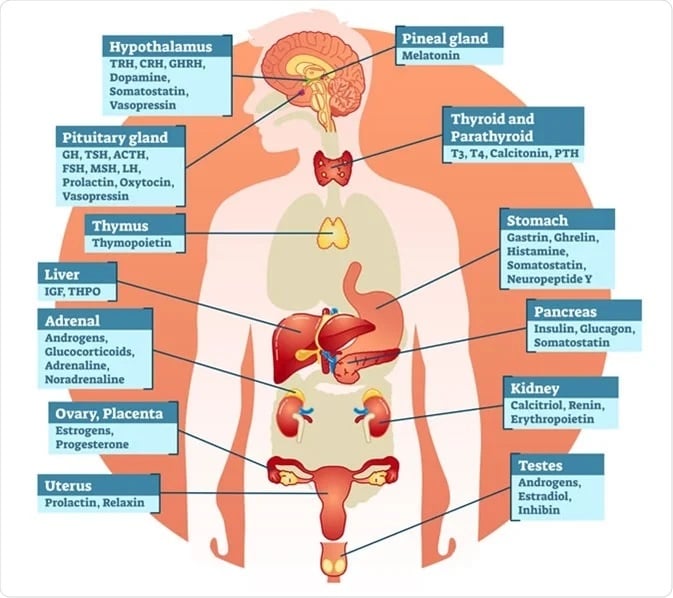
Endocrinology-Hormones

Small molecules play a pivotal role in Endocrinology Research. These are low molecular weight compounds that have a significant impact on the endocrine system, hormones, and their receptors. Here are some key aspects of how small molecules are involved in this field:

  • Hormone Mimetics and Inhibitors: Small molecules are used to develop synthetic compounds that mimic the actions of hormones or inhibit their effects. For example, drugs like metformin for diabetes management and selective estrogen receptor modulators (SERMs) for breast cancer treatment are used to either mimic or block hormonal activity.
  • Receptor Modulation: Small molecules can bind to hormone receptors and modulate their activity. This is crucial in developing drugs that target specific hormone receptors, like the use of small molecule agonists and antagonists to regulate thyroid hormone receptors.
  • Metabolism Regulation: Endocrinology research often focuses on metabolism and how hormones like insulin regulate it. Small molecules are employed to understand and develop drugs targeting enzymes involved in metabolism, such as glucagon-like peptide-1 (GLP-1) agonists for diabetes treatment.
  • Steroid Hormone Production: Small molecules may be utilized to influence the production of steroid hormones in the adrenal glands or gonads. This is essential for conditions like Cushing's syndrome or polycystic ovary syndrome (PCOS).
  • Hormone Assays: In laboratory research, small molecules are used as tracers or markers in hormone assays. For instance, small molecule fluorophores can be attached to antibodies to detect hormone levels in blood samples.

Drug Development: Endocrinology research relies on small molecules as potential drug candidates. Researchers design and test small molecules for their effectiveness in modulating hormonal pathways, with the goal of developing new therapies for endocrine disorders.
In summary, small molecules are indispensable tools in Endocrinology Research, enabling scientists to better understand the endocrine system's intricacies and develop novel treatments for a wide range of hormonal disorders and conditions. Their versatility and specificity make them valuable assets in advancing our knowledge of endocrinology and improving patient care.


Endocrinology Disease Products


Endocrinology Research Products

Kisspeptin Receptor

Leptin Receptors

Melanocortin (MC) Receptors

Mineralocorticoid Receptors

Ghrelin Receptors

Natriuretic Peptide Receptors

NPY Receptors

Motilin Receptor

PTH Receptor

Items 351-400 of 1456

Page
per page
Set Descending Direction
Catalog No.
Product Name
Application
Product Information
Citations
  1. Calcipotriol Impurity C is the impurity of Calcipotriol, Calcipotriol is a ligand of VDR-like receptors.
  2. TR-β agonist

    MB-07344 is a thyroid hormone receptor (TR)-β agonist with a binding affinity Ki of 2.17 nM.
  3. Topilutamide is a topical nonsteroidal antiandrogen (NSAA).
  4. ERβ agonist

    ERB-196 is a nonsteroidal selective estrogen receptor-β (ERβ) agonist.
  5. RORγ(RORc) agonists

    GNE-6468 is a potent and selective RORγ(RORc) agonists with an EC50 value of 13 nM for HEK-293 cell.
  6. RORγ( RORc) agonist

    GNE-0946 is a potent and selective RORγ( RORc) agonist with an EC50 value of 4 nM for HEK-293 cell.
  7. GPR40 agonist

    Setogepram sodium salt (PBI-4050 sodium salt) acts as an orally active agonist for GPR40 and as an antagonist or inverse agonist for GPR84.
  8. angiotensin II receptor type 1 antagonist

    Azilsartan medoxomil monopotassium is an orally administered angiotensin II receptor type 1 antagonist with IC50 of 0.62 nM, which used in the treatment of adults with essential hypertension.
  9. angiotensin II and endothelin A receptor antagonist

    Sparsentan (RE-021) is a highly potent dual angiotensin II and endothelin A receptor antagonist with Kis of 0.8 and 9.3 nM, respectively.
  10. GPR119 receptors agonist

    PSN632408 is an optimized agonist of GPR119 receptors that shows similar potency to OEA at both recombinant mouse and human GPR119 receptors, exhibiting EC50 values of 5.6 and 7.9 uM, respectively.
  11. estrogen receptor modulator

    4-Hydroxytamoxifen is a selective estrogen receptor modulator (SERM).
  12. synthetic GnRH agonist

    Alarelin acetate is a synthetic GnRH agonist.
  13. angiotensin-(1-7) receptor agonist

    AVE 0991 is a nonpeptide and orally active angiotensin-(1-7) receptor agonist with an IC50 of 21 nM.
  14. progesterone receptor modulator

    Ulipristal (acetate) is a novel selective progesterone receptor modulator (SPRM) for the treatment of benign gynecological conditions such as uterine myoma.
  15. angiotensin-converting enzyme inhibitor

    Lisinopril (MK-521) is angiotensin-converting enzyme inhibitor, used in treatment of hypertension, congestive heart failure, and heart attacks.
  16. IP receptor agonist

    Ralinepag is a potent, orally bioavailable and non-prostanoid prostacyclin (IP) receptor agonist, with EC50s of 8.5 nM, 530 nM and 850 nM for human and rat IP receptor and human DP1 receptor, respectively.
  17. androgen receptor modulator

    GLPG0492 is a novel selective androgen receptor modulator; exhibited anabolic activity on muscle, strongly dissociated from the androgenic activity on prostate after oral dosing.
  18. PGE2 agonist

    Evatanepag (CP-533536) is an EP2 receptor selective prostaglandin E2 (PGE2) agonist that induces local bone formation with EC50 of 0.3 nM.
  19. VDR activator

    Alfacalcidol-D6, a deuterated Alfacalcidol (1-hydroxycholecalciferol; Alpha D3; 1.alpha.-Hydroxyvitamin D3), is a non-selective VDR activator medication.
  20. FFAR1/GPR40 activator

    GPR40 Activator 1 is a potent GPR40 activator for treatment of type 2 diabetes.
  21. FFAR1/GPR40 agonist

    AMG 837 is a potent GPR40 agonist (EC50=13 nM) with a superior pharmacokinetic profile and robust glucose-dependent stimulation of insulin secretion in rodents.

  22. Androgen receptor antagonist

    Nilutamide (Nilandron) is a non-steroidal anti-androgen drug proposed in the treatment of metastatic prostatic carcinoma.
  23. GnRHR antagonist

    Elagolix is a highly potent, selective, orally-active, short-duration, non-peptide antagonist of the gonadotropin-releasing hormone receptor (GnRHR) (KD = 54 pM).
  24. GnRH agonist

    Goserelin(ICI 118630) is an injectable gonadotropin releasing hormone superagonist (GnRH agonist).
  25. androgen receptor modulator

    RAD140 is a potent, orally bioavailable, nonsteroidal selective androgen receptor modulator (SARM).
  26. 24R-Calcipotriol(PRI 2202) is an impurity of Calcipotriol; Calcipotriol (MC 903; Calcipotriene) is a ligand of VDR-like receptors.
  27. Impurity F of Calcipotriol; Calcipotriol (MC 903; Calcipotriene) is a ligand of VDR-like receptors.
  28. MC 1046(Impurity A of Calcipotriol) is an impurity of Calcipotriol; Calcipotriol (MC 903; Calcipotriene) is a ligand of VDR-like receptors.
  29. ERbeta agonist

    Prinaberel(ERB-041) is a potent and selective ERbeta agonist; being >200-fold selective for ERbeta.
  30. Aromatase inhibitor

    Fadrozole hydrochloride is a potent, selective and nonsteroidal inhibitor of aromatase with an IC50 of 6.4 nM.
  31. Cholecalciferol(Vitamin D3) is a naturally occuring form of vitamin D; Reported that upon metabolic activation, Cholecalciferol induces cell differentiation and prevents proliferation of cancer cells.
  32. nuclear estrogen receptor modulator

    Estetrol, a natural estrogen synthesized exclusively during pregnancy by the human fetal liver, is a selective nuclear estrogen receptor modulator.
  33. dissociated glucocorticoid receptor agonist

    Fosdagrocorat (PF-04171327) is a dissociated glucocorticoid receptor agonist.
  34. glucocorticoid receptor agonist

    Dagrocorat (PF-00251802) is a novel and dissociated glucocorticoid receptor agonist.
  35. DPN

    ER β ligand

    DPN (Diarylpropionitrile) is a non-steroidal estrogen receptor β(ER β) selective ligand.
  36. Betamethasone (hydrochloride) is a glucocorticoid steroid with anti-inflammatory and immunosuppressive properties.
  37. FFA2/GPR43 antagonist

    GLPG0974 is a free fatty acid receptor-2 (FFA2/GPR43) antagonist with an IC50 of 9 nM.
  38. DP1 antagonist

    L 888607 Racemate is a selective prostaglandin D2 receptor subtype 1 (DP1) antagonist, with Kis of 132 nM and 17 nM for DP1 and thromboxane A2 receptor (TP), respectively.
  39. GPR40/FFA1 full agonist

    AM-1638 is a potent and orally bioavailable GPR40/FFA1 full agonist with an EC50 of 0.16 μM.
  40. estrogen receptor degrader

    GDC-0927 Racemate (SRN-927 Racemate) is a degrader of estrogen receptor, potently inhibits ER-α activity, with an IC50 of 0.2 nM, and is used in the research of ER-related diseases.
  41. glucocorticoid receptor agonist

    (S)-Mapracorat is a selective and less active glucocorticoid receptor agonist.
  42. testosterone 5-alpha-reductase inhibitor

    Finasteride (acetate) is an orally active testosterone 5-alpha-reductase inhibitor.
  43. estrogen receptor antagonist

    Fulvestrant R enantiomer (ICI 182780 R enantiomer; ZD 9238 R enantiomer; ZM 182780 R enantiomer) is the less active R enantiomer of Fulvestrant. Fulvestrant is a potent estrogen receptor antagonist with an IC50 of 9.4 nM.
  44. GPR3 inverse agonist

    AF64394 is a GPR3 inverse agonist, with a pIC50 of 7.3.
  45. Angiotensin-II subtype 2 receptor(AT2 R) agonist

    CGP-42112(CGP-42112A) is a potent Angiotensin-II subtype 2 receptor(AT2 R) agonist.
  46. angiotensin II receptor antagonist

    Losartan D4 Carboxylic Acid is the deuterium labeled Losartan(EXP-3174), which is an angiotensin II receptor antagonist.
  47. angiotensin II type 1 receptor antagonist

    Azilsartan D5 is the deuterium labeled Azilsartan(TAK-536), which is a specific and potent angiotensin II type 1 receptor antagonist.
  48. PGD2) receptor type 2 (DP2) antagonist

    AM211 is a potent, selective and orally bioavailable prostaglandin D2 (PGD2) receptor type 2 (DP2) antagonist, with IC50s of 4.9 nM, 7.8 nM, 4.9 nM, 10.4 nM for human, mouse, guinea pig, and rat DP2, respectively.

  49. estrogen receptor modulators

    Pipendoxifene hydrochloride is a selective estrogen receptor modulators (SERMs).
  50. estrogen receptor covalent antagonist

    H3B-6545 Hydrochloride is an oral, selective estrogen receptor covalent antagonist (SERCA).

Items 351-400 of 1456

Page
per page
Set Descending Direction