






-
mAChR Antagonist
Dexetimide hydrochloride is a muscarinic acetylcholine receptor (mAChR) antagonist that effectively mitigates neuroleptic-induced Parkinson's syndrome. This compound is utilized primarily to alleviate movement disorders associated with neuroleptic treatment. As a selective inhibitor of cholinergic receptors, Dexetimide hydrochloride provides insights into cholinergic system modulation, making it a valuable tool for research in neuropharmacology and movement disorder therapies. -
mAChR Agonist
(±)-Muscarine chloride is an agonist of muscarinic acetylcholine receptors (mAChRs). As a prototype compound, it exhibits key biological activity by mimicking the action of acetylcholine, leading to varied physiological responses. This reagent is useful for research applications exploring mAChR signaling pathways, neurobiology, and the modulation of cholinergic activity. -
Cardiac Muscarinic Receptor Antagonist
Propylbenzilylcholine mustard is a selective, irreversible antagonist targeting cardiac muscarinic receptors in rats. It covalently modifies these receptors in a dose- and time-dependent manner, demonstrating stability across various ionic strengths and GTP-containing buffers. This reagent is valuable for investigating the structure and function of cardiac muscarinic receptors, particularly their heterogeneity and implications in cardiovascular pharmacology. -
Imidafenacin Metabolite
Imidafenacin Metabolite M4 is a key metabolite of the muscarinic acetylcholine receptor antagonist Imidafenacin. This compound retains biological activity that may contribute to the pharmacological effects observed with the parent drug. It serves as a valuable tool for investigating the metabolism and pharmacokinetics of muscarinic antagonists in various research applications. -
Muscarinic Agonist
A-72055 is a partial agonist of muscarinic receptors, specifically targeting M1 and M2 subtypes with Ki values of 32 nM and 30 nM, respectively. This compound enhances cognitive function and has potential applications in addressing learning and memory deficits. A-72055 is valuable for research focused on neurological disorders, particularly those associated with cognitive impairment. -
M1 Receptor Agonist
YM-796 dihydroxybutanedioate is a selective agonist of the muscarinic M1 receptor. It has demonstrated potential in enhancing cognitive function and reducing amyloid plaque accumulation, making it relevant in the study of cognitive impairment diseases, particularly Alzheimer’s disease. This compound serves as a valuable tool for researchers investigating therapeutic strategies for cognitive deficits associated with neurodegenerative disorders. -
M 2 Antagonist
AQ-RA 741 is a potent and selective M2 antagonist that effectively inhibits vagally or agonist-induced bradycardia in various animal models, including rats, cats, and guinea pigs. This compound is valuable in the study of bradycardic disorders, providing insights into potential therapeutic strategies for managing heart rate irregularities. Its specificity towards the M2 muscarinic receptor makes it a critical tool for investigating cholinergic signaling pathways in cardiovascular research. -
mAChR Inhibitor
Phenglutarimid is a muscarinic acetylcholine receptor (mAChR) inhibitor that exhibits anticholinergic properties. It is primarily utilized in research related to Parkinson's disease and other cholinergic dysfunctions. Its ability to modulate neurotransmitter activity makes it a valuable tool for investigating the therapeutic mechanisms underlying movement disorders. -
Muscarinic M4/M1/M2 Agonist
M1/M2/M4 Muscarinic Agonist 1 is a selective agonist targeting muscarinic M4, M1, and M2 receptors, with EC50 values of 6.5 nM, 26 nM, and 210 nM, respectively. This compound facilitates receptor activation, making it valuable in studying cholinergic signaling and its implications in neurological conditions. Research applications include investigations into mental disorders such as schizophrenia and delusions, providing insights into therapeutic approaches for these conditions. -
Ammonium Derivate With Anticholinergic Activity
Methantheline bromide is a quaternary ammonium derivative that exhibits anticholinergic activity. It is known to significantly reduce axillary sweat production, making it useful in studies related to hyperhidrosis. Additionally, Methantheline bromide serves as a valuable tool in research investigating intractable peptic ulcers, contributing to the understanding of gastrointestinal disorders. -
M3/M5 mAChR PAM
M3 mAChR agonist 1 is a positive allosteric modulator (PAM) specifically targeting the M3 and M5 muscarinic acetylcholine receptors. This compound exhibits notable selectivity over other muscarinic subtypes, including M1, M2, and M4. M3 mAChR agonist 1 enhances the contraction of isolated rat bladder strips by modulating M3 receptor activity, thus promoting signaling pathways associated with bladder function. This reagent is suitable for research applications in endocrinology and related fields. -
M1-Selective PAM
PF-06827443 is a selective positive allosteric modulator (PAM) of the M1 muscarinic acetylcholine receptor. This compound exhibits high potency and oral bioavailability while effectively penetrating the central nervous system. PF-06827443 has been shown to enhance cholinergic signaling, leading to cholinergic adverse effects and convulsions. It is a valuable tool for researchers investigating M1 receptor functions and their roles in neurological conditions. -
mAChR Modulator
VU0090157 is a positive allosteric modulator of the M1 muscarinic acetylcholine receptor (mAChR). By binding to an allosteric site, VU0090157 enhances the affinity of acetylcholine, thereby influencing neurotransmission. This compound is valuable for research in neuropsychiatric disorders such as schizophrenia and Alzheimer's disease, facilitating the exploration of therapeutic strategies that target mAChRs. -
M2/M3 Antagonist
PSD-506 is a muscarinic M2/M3 antagonist that effectively inhibits the activity of these receptors. This compound demonstrates notable potential in researching bladder overactivity and urinary incontinence. Its specific targeting of M2 and M3 receptors makes PSD-506 a valuable tool for studying related therapeutic avenues and advancing understanding of related physiological mechanisms. -
mAChR Antagonist
Butropium bromide is a competitive antagonist of muscarinic acetylcholine receptors (mAChRs). It effectively inhibits acetylcholine-induced glandular secretion and smooth muscle contraction, thereby reducing salivary gland secretion and alleviating respiratory smooth muscle spasms. This compound is valuable for studying conditions related to excessive salivation and could aid in research on respiratory function modulation. -
Muscarinic Receptor Blocker
Ethybenztropine hydrochloride is a potent muscarinic receptor blocker with established anticholinergic properties. This compound demonstrates significant antiparkinsonian activity, effectively improving motor symptoms in patients with Parkinson's disease. Additionally, Ethybenztropine hydrochloride may exhibit dopamine reuptake inhibitory effects, contributing to its therapeutic efficacy. It is utilized in research applications focused on neuropharmacology and the modulation of neurotransmitter balance. -
M1/M3 Receptor Inhibitor
Imidafenacin hydrochloride is an orally active inhibitor of muscarinic M1 and M3 receptors. It effectively inhibits bladder contraction in vivo, demonstrating significant antidiuretic effects through the enhancement of vasopressin signaling. This compound is particularly relevant for research focused on overactive bladder and related conditions, making it a valuable tool in the study of urinary disorders. -
M1 Muscarinic Acetylcholine Receptor Positive Allosteric Modulator
PF-06764427 is a selective positive allosteric modulator of the M1 muscarinic acetylcholine receptor. It demonstrates significant agonist activity at the M1 receptor, enhancing cholinergic signaling. This compound is valuable for research applications pertaining to Alzheimer's disease and schizophrenia, providing insights into cognitive function and neuropharmacology. -
Muscarinic-3 Agonist
Methacholine bromide is a potent agonist of the muscarinic-3 (M3) receptor. Its primary action induces bronchoconstriction by directly stimulating acetylcholine receptors on smooth muscle, resulting in airway narrowing. This compound is particularly sensitive for identifying bronchial hyperresponsiveness (BHR) and is utilized in clinical settings to assess airway hyperresponsiveness (AHR) in patients presenting with asthma-like symptoms, especially those with normal resting expiratory flow rates. -
mAChR Agonist
Betovumeline is a selective agonist for muscarinic acetylcholine receptors (mAChRs). This compound plays a key role in modulating cholinergic signaling and demonstrates potential biological activity in various neurological disorders. It is widely utilized in research applications focused on understanding the mechanisms underlying cognitive function and neurodegenerative diseases. -
M1 mAChR Antagonist
VU0455691 is a selective orthosteric antagonist of the M1 muscarinic acetylcholine receptor (mAChR) with a pIC50 of 6.64 and an IC50 of 0.23 µM for human M1. This compound is useful in investigating the physiological and pathological roles of M1 mAChR in various neurological disorders. Its ability to selectively inhibit M1 mAChR activation makes it a valuable tool for research into cholinergic signaling pathways and potential therapeutic interventions. -
Anticholinergic Agent
Mazaticol is an anticholinergic agent targeting muscarinic acetylcholine receptors. It effectively blocks cholinergic nerve activity and serves as a potent inhibitor of 3H-QNB and 3H-PZ binding, demonstrating high affinity for M2 receptors. Additionally, Mazaticol exhibits inhibitory effects on dopamine uptake in striatal nerve terminals, making it valuable for research into parkinsonian syndromes. -
mAChR Antagonist
UH-AH 37 is a selective antagonist of muscarinic acetylcholine receptors (mAChR). It demonstrates enhanced potency in inhibiting muscarinic responses in intestinal tissue compared to cardiac tissue. This compound is valuable for research into gastrointestinal motility disorders and the pharmacological modulation of mAChR signaling pathways. -
M4 Modulator
VU6008677 is a positive allosteric modulator of the M4 muscarinic acetylcholine receptor, with an EC50 value of 120 nM for hM4. This compound enhances receptor activity and is valuable for studying M4 receptor functions and related signaling pathways. Additionally, VU6008677 demonstrates inhibition of cytochrome P450 and possesses favorable pharmacokinetic properties in rat models, making it suitable for in vivo research applications. -
Bronchospasmolytic Agent
Flutropium bromide is a potent bronchospasmolytic agent that exerts its effects through anticholinergic action. It is effective in suppressing bronchospasms and is primarily utilized in research related to asthma and chronic obstructive pulmonary disease (COPD). This compound provides valuable insights into respiratory mechanisms and potential therapeutic interventions for obstructive airway disorders. -
Presynaptic Cholinergic Modulator
SM-21 maleate serves as a presynaptic cholinergic modulator and binds to central muscarinic receptors with an affinity of 0.174 μM. This compound exhibits significant biological activity related to cholinergic signaling, making it a valuable tool for studying synaptic transmission and neuropharmacology. Its application in research may provide insights into cholinergic dysfunctions and potential therapeutic targets for neurological disorders. -
mAChR Inhibitor
Cyclobuxine D is a steroidal alkaloid that functions as a muscarinic acetylcholine receptor (mAChR) inhibitor. It exhibits a notable bradycardic effect in rat models and effectively inhibits contractions induced by acetylcholine and Ba++ in isolated rabbit jejunum muscle. Due to its biological activities, Cyclobuxine D is valuable for research in pharmacology and cardiovascular studies. -
Stable Isotope
Tolterodine-d14 hydrochloride is a deuterium-labeled version of Tolterodine hydrochloride, a potent muscarinic acetylcholine receptor (mAChR) inhibitor. This compound competitively binds to acetylcholine, thereby reducing involuntary bladder muscle contractions and modulating sympathetic nervous activity. In addition to its role in managing overactive bladder and urinary tract infections, Tolterodine has been shown to restore the Nrf2/NF-κB signaling pathway, offering protective effects against inflammation and ferroptosis. Its applications extend to studies involving reactive oxygen species and lipid oxidation. -
Muscarinic M1 Receptor Agonist
Muscarinic M1 receptor agonist-1 is a selective agonist targeting the muscarinic M1 receptor. This compound plays a significant role in modulating neurotransmission and is of particular interest in the study of psychiatric disorders, including schizophrenia. Its ability to activate the M1 receptor may provide insights into therapeutic strategies for managing cognitive dysfunction associated with these conditions. -
Sigma 1 Recognition Site Ligand
RLH-033 is a potent and selective ligand for the sigma 1 recognition site. It exhibits high affinity for sigma 1 sites labeled by [3H](+)-pentazocine, demonstrating a Ki value of 50 pM. This compound is valuable for research applications targeting sigma 1 receptor functions, contributing to the understanding of its roles in neuroprotection and various pathophysiological conditions. -
mAChR Antagonist
AQ-RA 721 is a selective muscarinic acetylcholine receptor (mAChR) antagonist that exhibits a differential affinity for the M2 and M4 receptor subtypes. This compound is valuable for studying muscarinic receptor diversity and function, facilitating research into receptor pharmacology and potential therapeutic applications. It can be employed in investigations into central nervous system activities and cardiovascular regulation, contributing to a better understanding of muscarinic signaling pathways. -
M1 Receptor Partial Agonist
Sabcomeline is a selective partial agonist of the muscarinic M1 receptor, known for its ability to enhance cognitive function. This compound holds promise for research applications related to Alzheimer's disease, where modulation of the M1 receptor may assist in ameliorating cognitive deficits. Its functional selectivity makes Sabcomeline a valuable tool for investigating the role of muscarinic receptors in neurodegenerative disorders. -
M1 Cholinergic Agonist
Trans-Cevimeline hydrochloride is a selective M1 cholinergic agonist, known for its potential in modulating cholinergic neurotransmission. This compound exhibits significant biological activity relevant to neurodegenerative conditions, particularly Alzheimer's disease. Researchers can utilize trans-Cevimeline hydrochloride to investigate its effects on cognitive function and cholinergic signaling pathways. -
M3 Muscarinic Receptor Antagonist
AE9C90CB is a selective antagonist of the M3 muscarinic receptor, exhibiting a high affinity with a pKi value of 9.90. This compound is 20-fold more selective for M3 compared to the M2 muscarinic receptor, making it a valuable tool for studying M3 receptor-mediated signaling pathways. AE9C90CB is suitable for research applications investigating the role of M3 muscarinic receptors in various physiological and pathological processes. -
mAChR Agonist
CDD0102 Hydrochloride is a potent agonist of the M1 muscarinic acetylcholine receptor (mAChR). This compound exhibits significant biological activity in modulating cholinergic signaling, making it valuable for research into neurological disorders and cognitive function. Its application extends to studying M1 receptor-related pathways and developing potential treatments for conditions such as Alzheimer's disease and schizophrenia. -
mAChR Antagonist
4,4-Difluorobenzhydrol serves as a precursor for a muscarinic acetylcholine receptor (mAChR) antagonist, with potential applications in neuroscience research. Its derivative, 4,4-Difluorobenzhydrol Carbamate, can selectively target the M1 receptor subtype. This specificity makes 4,4-Difluorobenzhydrol an important compound for studying the physiological roles of mAChRs and developing therapeutics for related disorders. -
muscarinic receptor inhibitor
Darenzepine is a muscarinic receptor inhibitor extracted from patent US 20170095465 A1. -
acetylcholine receptor antagonist
Beperidium iodide shows a competitive antagonistic effect against acetylcholine receptor with a pA2 of 7.93. - Smilagenin (SMI) is a lipid-soluble small-molecule steroidal sapogenin from Rhizoma anemarrhenae and Radix asparagi widely used in traditional Chinese medicine for treating chronic neurodegeneration diseases.
-
muscarinic antagonist
Glycopyrrolate is a muscarinic competitive antagonist used as an antispasmodic. -
muscarinic receptor antagonist
5-hydroxymethyl tolterodine is a metabolite of Tolterodine, a muscarinic receptor antagonist used in the treatment of urinary incontinence.
-
muscarinic M3 receptor antagoinst
Solifenacin-succinate is a muscarinic M3 receptor antagoinst, used in treatment of urinary incontinence. -
M1/M3 receptor agonist
Cevimeline (AF-102B) is a parasympathomimetic and muscarinic agonist, with particular effect on M3 receptors; used in the treatment of dry mouth associated with sjogren's syndrome. -
Nicotinic receptor agonist
Metanicotine is a neuronal nicotinic receptor agonist, showing high selectivity for the ??4??2 subtype (Ki=26 nM); > 1,000 fold selectivity than ??7 receptors(Ki= 36000 nM). -
NMDA receptor antagonist
Orphenadrine citrate is a NMDA receptor antagonist with Ki of 6.0 +/- 0.7 μM, HERG potassium channel blocker. - Darifenacin works by blocking the M3 muscarinic acetylcholine receptor, which is primarily responsible for bladder muscle contractions.
mAChR
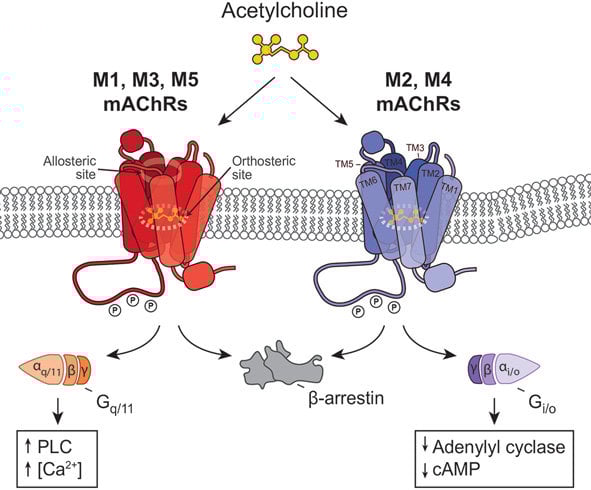
Muscarinic acetylcholine receptors (mAChRs) are a class of G protein-coupled receptors (GPCRs) found in the central and peripheral nervous systems, as well as in various other tissues and organs throughout the body. These receptors are named after muscarine, a natural alkaloid compound found in certain mushrooms, which was one of the first substances discovered to activate them.
There are five subtypes of muscarinic receptors, designated as M1 through M5, each with distinct tissue distribution and functions. Here's an overview of their roles:
- M1 Receptors: Predominantly found in the central nervous system, particularly in regions associated with cognitive functions. Activation of M1 receptors is linked to memory and learning.
- M2 Receptors: Found in the heart, where they play a crucial role in regulating heart rate and cardiac contractility. Activation of M2 receptors slows heart rate and reduces the force of cardiac contractions.
- M3 Receptors: Present in smooth muscle tissues, such as those in the gastrointestinal tract, urinary bladder, and bronchial airways. Activation of M3 receptors leads to smooth muscle contraction.
- M4 Receptors: Distributed mainly in the central nervous system and involved in modulating neurotransmitter release. Their role in cognition and neuropsychiatric disorders is of interest.
- M5 Receptors: Located in certain areas of the brain and implicated in the modulation of dopamine release. Research suggests they may be relevant to Parkinson's disease and addiction.
Muscarinic receptors are activated by the neurotransmitter acetylcholine and play a vital role in regulating a wide range of physiological processes, including heart rate, smooth muscle contraction, glandular secretion, and neurotransmitter release. They are targets for various drugs, including anticholinergic agents, which block their activity, and drugs used to treat conditions like bradycardia and neurodegenerative disorders.
Understanding the functions and regulation of muscarinic acetylcholine receptors is essential for developing therapies that modulate their activity and for advancing our knowledge of how they contribute to various physiological and pathological processes in the body.
