






Epigenetics
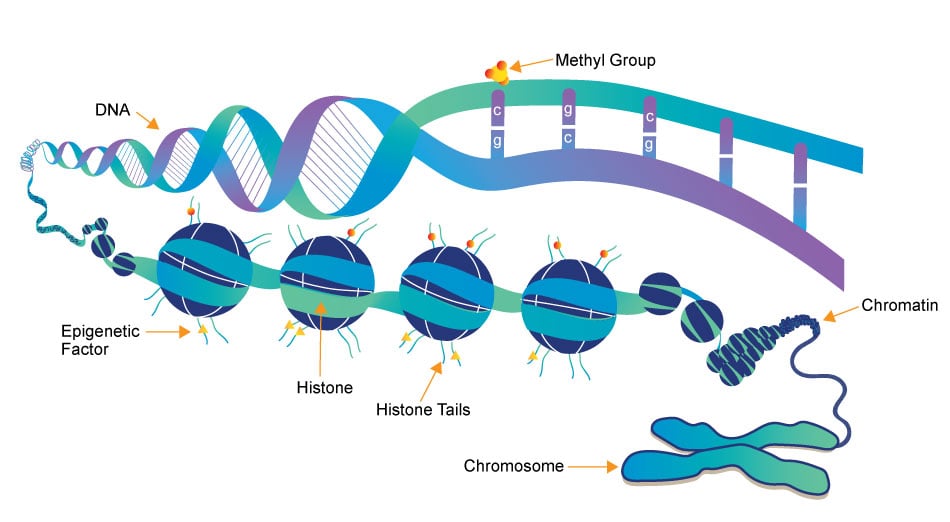
Epigenetics research delves into the molecular mechanisms that control gene expression and cellular traits without altering the underlying DNA sequence. One crucial aspect of this field is the role of small molecules, which act as powerful regulators of epigenetic modifications. These small compounds, typically comprising a few dozen to a few hundred atoms, have emerged as essential tools in understanding and manipulating the epigenome.
- DNA Methylation Inhibitors: Small molecules like 5-azacytidine and 5-aza-2'-deoxycytidine are DNA methyltransferase inhibitors. They block the addition of methyl groups to DNA, leading to DNA demethylation. This can reactivate silenced genes, potentially offering therapeutic avenues for conditions like cancer.
- HDAC inhibitors: HDACs remove acetyl groups from histone proteins, contributing to gene repression. Small molecule HDAC inhibitors, such as Vorinostat and Romidepsin, can reverse this process by increasing histone acetylation, allowing genes to be more accessible for transcription. These inhibitors are being explored for cancer therapy and other conditions.
- Histone Methyltransferase Inhibitors: Small molecules like GSK126 inhibit specific histone methyltransferases, affecting histone methylation patterns. This can alter gene expression, making them promising candidates for cancer and other diseases with epigenetic dysregulation.
- RNA Modulators: Small molecules can also target non-coding RNAs involved in epigenetic regulation. For instance, small molecules called small interfering RNAs (siRNAs) can be designed to target and degrade specific long non-coding RNAs, influencing gene expression.
- Epigenetic Reader Domain Inhibitors: These small molecules target proteins that recognize and bind to specific epigenetic marks. Examples include inhibitors of bromodomain-containing proteins (BET inhibitors), which can disrupt gene regulation by interfering with protein-DNA interactions.
Small molecules in epigenetics research not only provide insights into the fundamental biology of gene regulation but also hold immense promise for developing novel therapeutics. Their ability to selectively modulate specific epigenetic marks and pathways has led to ongoing clinical trials and drug development efforts for various diseases, including cancer, neurological disorders, and inflammatory conditions. Understanding and harnessing the power of these small molecules is at the forefront of modern epigenetics research, offering new hope for precision medicine and targeted therapies.
3 key components involved in the regulation of epigenetic modifications
Epigenetics Writer
Epigenetics writers are enzymes responsible for adding chemical marks or modifications to DNA or histone proteins. These marks include DNA methylation (addition of methyl groups to DNA) and histone modifications (such as acetylation, methylation, phosphorylation, etc.).
Epigenetics Reader
Function: Epigenetics readers are proteins that can recognize and bind to specific epigenetic marks on DNA or histones. These reader proteins interpret the epigenetic code and facilitate downstream cellular processes, such as gene activation or repression.
Epigenetics Eraser
Function: Epigenetics erasers are enzymes responsible for removing or reversing epigenetic marks on DNA or histones. This process allows for the dynamic regulation of gene expression and the resetting of epigenetic states during various stages of development and in response to environmental changes.
-
PRMT inhibitor
GSK3368715 (EPZ019997) is an orally active, reversible, and S-adenosyl-L-methionine (SAM) uncompetitive type I protein arginine methyltransferases (PRMTs) inhibitor (IC50=3.1 nM (PRMT1), 48 nM (PRMT3), 1148 nM (PRMT4), 5.7 nM (PRMT6), 1.7 nM (PRMT8)). -
BET bromodomain inhibitor
Bromodomain inhibitor-8 (Intermediate 21) is a BET bromodomain inhibitor for treating autoimmune and inflammatory diseases. -
JAK inhibitor
Delgocitinib is a novel and specific JAK inhibitor with IC50s of 2.8, 2.6, 13 and 58 nM for JAK1, JAK2, JAK3 and Tyk2, respectively. -
cyt-PTPε inhibitor
cyt-PTPε Inhibitor-1 is a potent cytosolic protein tyrosine phosphatase epsilon (cyt-PTPε) inhibitor, binds to the catalytic domain of cyt-PTPε, blocks c-Src activation (dephosphorylation of c-Src), and exhibits anti-osteoclastic activity. -
BET bromodomain inhibitor
(+)-JQ1 PA is a clickable JQ1 for building PROTACs, which acts as a BET bromodomain inhibitor. -
Sirt2 inhibitor
Sirt2-IN-1 (Compound 9) is a sirtuin 2 (Sirt2) inhibitor with an IC50 of 163 nM. -
Bromodomain inhibitor
BMS-986158 is an inhibitor of the bromodomain and extra-terminal (BET) proteins. -
Aurora A kinase inhibitor
Aurora Kinase Inhibitor 3 is a strong and selective Aurora A kinase inhibitor with an IC50 of 42 nM, and weakly inhibits EGFR with an IC50>10 μM. -
virion mRNA(guanine-7-)-methyltransferase inhibitor
Sinefungin is a potent inhibitor of virion mRNA(guanine-7-)-methyltransferase, mRNA(nucleoside-2'-)-methyltransferase, and viral multiplication. -
JAK inhibitor
S-Ruxolitinib is the chirality of INCB018424, is a potent and selective small-molecule Janus kinase 1 (JAK1) and JAK2 inhibitor. -
JAK inhibitor
Baricitinib phosphate is a selective JAK1 and JAK2 inhibitor with IC50 of 5.9 nM and 5.7 nM, ~70 and ~10-fold selective versus JAK3 and Tyk2, no inhibition to c-Met and Chk2. -
PARP Inhibitor
BMN-673 (8R,9S) is the (8R,9S) enantiomer of BMN-673. BMN 673 is a novel PARP inhibitor with IC50 of 0.58 nM. -
Pim Inhibitor
CX-6258 hydrochloride hydrate is a potent, orally efficacious Pim 1/2/3 kinase(IC50=5 nM/25 nM/16 nM) inhibitor with excellent biochemical potency and kinase selectivity. -
JAK inhibitor
CYT387 sulfate salt is an ATP-competitive inhibitor of JAK1/JAK2 with IC50 of 11 nM/18 nM, ~10-fold selectivity versus JAK3. -
HDAC inhibitor
Resminostat hydrochloride is a potent inhibitor of HDAC1/3/6(IC50=43-72 nM); less potent to HDAC8 with IC50 of 877 nM. -
HDAC Inhibitor
NCH 51 is a cell-permeable prodrug that is intracellularly converted to a potent HDAC inhibitor, with an IC50 of 48 nM. -
JAK2 inhibitor
1,2,3,4,5,6-Hexabromocyclohexane is a potent and specific inhibitor of JAK2 autophosphorylation. -
Mnk2/JAK3 inhibitor
Cercosporamide, an usnic amide, was originally identified in Cercosporidium henningsii as a host-selective phytotoxin and broad-spectrum antifungal agent and is a potent inhibitor of MAP-kinase interacting kinase-2 (Mnk2; IC50 = 11 nM), JAK3 (IC50 = 31), and Mnk1 (IC50 = 116 nM). -
JAK2/STAT3 inhibitor
Cucurbitacin I, Cucumis sativus L. has been found to suppress levels of phosphotyrosine Stat3 (signal transducer and activator of transcription 3) in v-Src-transformed NIH 3T3 cells. -
MBT Domain (L3MBTL1) Inhibitor
UNC 926 is a methyl lysine reader domain inhibitor. -
PIM-1 Inhibitor
PIM-1 inhibitor 2 is a potent Pim-1 kinase inhibitor (Ki = 91 nM). -
Pim-1 Kinase Inhibitor
TCS PIM-1 1 is a potent and selective ATP-competitive Pim-1 kianse inhibitor with IC50 of 50 nM, displays good selectivity over Pim-2 and MEK1/MEK2(IC50s >20,000 nM).
