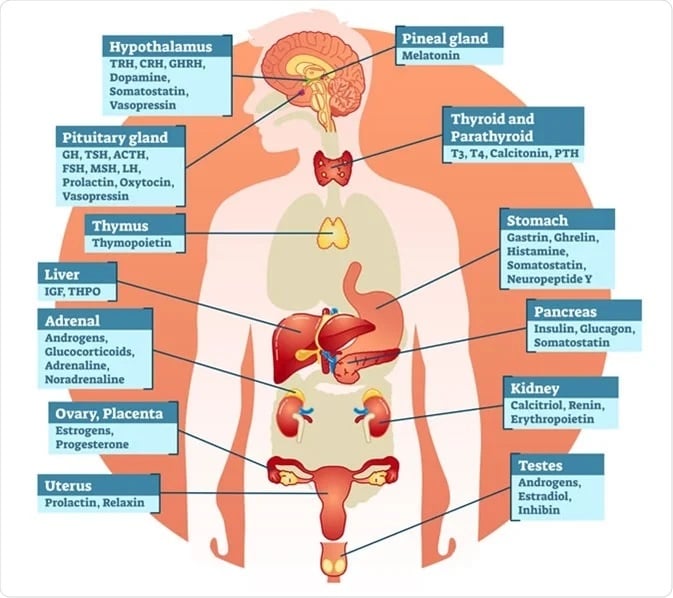
Endocrinology-Hormones

Small molecules play a pivotal role in Endocrinology Research. These are low molecular weight compounds that have a significant impact on the endocrine system, hormones, and their receptors. Here are some key aspects of how small molecules are involved in this field:

  • Hormone Mimetics and Inhibitors: Small molecules are used to develop synthetic compounds that mimic the actions of hormones or inhibit their effects. For example, drugs like metformin for diabetes management and selective estrogen receptor modulators (SERMs) for breast cancer treatment are used to either mimic or block hormonal activity.
  • Receptor Modulation: Small molecules can bind to hormone receptors and modulate their activity. This is crucial in developing drugs that target specific hormone receptors, like the use of small molecule agonists and antagonists to regulate thyroid hormone receptors.
  • Metabolism Regulation: Endocrinology research often focuses on metabolism and how hormones like insulin regulate it. Small molecules are employed to understand and develop drugs targeting enzymes involved in metabolism, such as glucagon-like peptide-1 (GLP-1) agonists for diabetes treatment.
  • Steroid Hormone Production: Small molecules may be utilized to influence the production of steroid hormones in the adrenal glands or gonads. This is essential for conditions like Cushing's syndrome or polycystic ovary syndrome (PCOS).
  • Hormone Assays: In laboratory research, small molecules are used as tracers or markers in hormone assays. For instance, small molecule fluorophores can be attached to antibodies to detect hormone levels in blood samples.

Drug Development: Endocrinology research relies on small molecules as potential drug candidates. Researchers design and test small molecules for their effectiveness in modulating hormonal pathways, with the goal of developing new therapies for endocrine disorders.
In summary, small molecules are indispensable tools in Endocrinology Research, enabling scientists to better understand the endocrine system's intricacies and develop novel treatments for a wide range of hormonal disorders and conditions. Their versatility and specificity make them valuable assets in advancing our knowledge of endocrinology and improving patient care.


Endocrinology Disease Products


Endocrinology Research Products

Kisspeptin Receptor

Leptin Receptors

Melanocortin (MC) Receptors

Mineralocorticoid Receptors

Ghrelin Receptors

Natriuretic Peptide Receptors

NPY Receptors

Motilin Receptor

PTH Receptor

Items 201-250 of 1456

Page
per page
Set Descending Direction
Catalog No.
Product Name
Application
Product Information
Citations
  1. Hydroxyprogesterone caproate is a synthetic, steroidal progestin; an ester derivative of 17?α-hydroxyprogesterone formed from caproic acid.
  2. Protirelin is a thyrotropin-releasing hormone receptor used to treat hypothyroidism.
  3. Desogestrel is a synthetic progestational hormone used often as the progestogenic component of combined oral contraceptive agents.
  4. GPR139 antagonist

    NCRW0005-F05, first antagonist selective for GPR139 (IC50 value 0.21 uM); a useful tool to study GPR139 pharmacology, especially in combination with the GPR139 agonist JNJ 63533054.
  5. RORγ modulator

    RORγ modulator 1 is a retinoid-related orphan receptor gamma (RORy) modulator, extracted from patent WO/2015061515 A1, example 124.
  6. Endoxifen (E-isomer hydrochloride) is a tamoxifen metabolite and potent Selective Estrogen Response Modifier (SERM).
  7. GPR39 agonist

    TC-G-1008 is a GPR39 (zinc receptor) agonist (EC50 values are 0.4 and 0.8 nM for rat and human receptors respectively).
  8. angiotensin II receptor type 1 antagonist

    Azilsartan medoxomil is an orally administered angiotensin II receptor type 1 antagonist with IC50 of 0.62 nM, which used in the treatment of adults with essential hypertension.
  9. Chlormadinone acetate is a steroidal progestin with additional antiandrogen and antigonadotropic effects, used often in combinations as an oral contraceptive.
  10. Chlorotrianisene is a synthetic, non-steroidal estrogen.
  11. Deoxycorticosterone acetate (DOCA) is a corticosteroid.
  12. glucocorticoid receptor agonist

    Dexamethasone acetate (Dexamethasone 21-acetate) is a glucocorticoid receptor agonist.
  13. GPR35/CXCR8 agonist

    Kynurenic acid, an endogenous tryptophan metabolite, is a broad-spectrum antagonist targeting NMDA, glutamate, α7 nicotinic acetylcholine receptor. Kynurenic acid is also an agonist of GPR35/CXCR8.
  14. MI-136 inhibits DHT-induced expression of androgen receptor (AR) target genes.
  15. selective estrogen receptor modulator (SERM)

    Tamoxifen (ICI 47699) is a selective estrogen receptor modulator (SERM) which blocks estrogen action in breast cells and can activate estrogen activity in other cells, such as bone, liver, and uterine cells.
  16. Vitamin D2 (Ergocalciferol) is a form of vitamin D, used as a vitamin D supplement.
  17. GPR55 antagonist

    CID16020046 is a selective GPR55 antagonist, inhibiting GPR55 constitutive activity with IC50 of 0.15 μM in yeast. It demonstrates weak activity against a broad spectrum of other GPCRs, ion channels, kinases, and nuclear receptor.
  18. RORγ agonist

    LYC-55716 is novel oral RAR-related orphan receptor γ (RORγ) agonist.
  19. androgen receptor modulator (SARM)

    LY2452473 is an orally bioavailable selective androgen receptor modulator (SARM), with potential tissue-selective androgenic/anti-androgenic activity.
  20. ACE2 inhibitor

    MLN-4760 is an angiotensin-converting (ACE2) inhibitor. In huMNCs, MLN-4760-B detected 63% ACE2 with 28-fold selectivity over ACE.
  21. Aldosterone Receptor Antagonist

    Esaxerenone, also known as CS-3150, XL-550, is a nonsteroidal antimineralocorticoid that acts as a highly selective silent antagonist of the mineralocorticoid receptor (MR), the receptor for aldosterone, with greater than 1,000-fold selectivity for this receptor over other steroid hormone receptors, and 4-fold and 76-fold higher affinity for the MR relative to the existing antimineralocorticoids spironolactone and eplerenone.
  22. RORγt inhibitor

    AGN-242428, also known as VTP-43742, is a potent, selective and orally active RORγt inhibitor for the treatment of autoimmune disorders, including multiple sclerosis and psoriasis.
  23. ERRβ & ERRγ Agonist

    GSK4716 is an Estrogen-related receptors ERRβ and ERRγ agonist with minimal activity for ERRα, ERα and ERβ
  24. synthetic glucocorticoid receptor agonist

    Methylprednisolone succinate is a synthetic glucocorticoid and widely used as an anti-inflammatory agent.
  25. Estrogen receptor agonist

    (R)-Equol is an agonist of both ERα and ERβ with Kis of 27.4 and 15.4 nM, respectively.
  26. ER antagonist

    Fulvestrant S enantiomer is the S enantiomer of Fulvestrant. Fulvestrant is a selective estrogen receptor (ER) antagonist which can be used to treat breast cancer.
  27. FAA1 agonist

    FAA1 agonist-1 is a potent free fatty acid receptor 1 (FFA1/ GPR40) agonist with a pEC50 of 7.54.
  28. ERβ receptor antagonist

    PHTPP is a pyrazolo[1,5-α]pyrimidine-based ligand that acts as a full antagonist of estrogen ERβ receptors with 36-fold selectivity over ERα.
  29. GPR39 agonist

    TM N1324 is an agonist of G-Protein-Coupled Receptor 39 (GPR39) with EC50s of 9 nM/5 nM in the presence of Zn2+, and 280 nM/180 nM in the absence of Zn2+ for human/murine GPR39.
  30. Androsterone is a steroid hormone produced in the body from 5α-reduced metabolites of dehydroepiandrosterone. It is the major androgen excreted in urine as a metabolite of testosterone and is used as the international reference standard for androgenic activity.
  31. glucocorticoid receptor agonist

    Dexamethasone Phosphate disodium is a is a water-soluble form of the synthetic glucocorticoid dexamethasone.
  32. Estrogen receptor ligand

    α-Estradiol is an endogenous estrogen receptor ligand (Ki values are 0.2 and 1.2 nM for ERα and ERβ receptors respectively).
  33. glucocorticoid agonist

    Beclometasone dipropionate is a potent glucocorticoid agonist; it is a prodrug of the free form, beclometasone.
  34. Medroxyprogesterone is used in the treatment of renal carcinoma. It is a synthetic progestational hormone used in veterinary practice as an estrus regulator.
  35. Quinestrol is a compound used in estrogen replacement therapy.
  36. Androgen receptor antagonist

    Spironolactone is a potent antagonist of the androgen receptor.
  37. non-peptide angiotensin II receptor antagonist

    Fimasartan is a non-peptide angiotensin II receptor antagonist (ARB) used for the treatment of hypertension and heart failure. Through oral administration, fimasartan blocks angiotensin II receptor type 1 (AT1 receptors), reducing pro-hypertensive actions of angiotensin II, such as systemic vasoconstriction and water retention by the kidneys.
  38. Angiotensin II receptor antagonist

    Losartan is an angiotensin II receptor antagonist, competing with the binding of angiotensin II to AT1 receptors with IC50 of 20 nM.
  39. Na/K ATPase partial agonist

    Canrenone is a metabolite of spironolactone, Na/K ATPase partial agonist and aldosterone and androgen receptor antagonist used as a diuretic.
  40. Estropipate is a form of estrogen, an estrogen receptor agonist. It has several uses such as: Alleviate symptoms of menopause as hormone replacement therapy, treatment some types of infertility, treatment of some conditions leading to underdevelopment of female sexual characteristics, and treatment of prostate cancer and prevention of osteoporosis.
  41. glucocorticoid

    Fluorometholone is a glucocorticoid employed, usually as eye drops, in the treatment of allergic and inflammatory conditions of the eye. It has also been used topically in the treatment of various skin disorders.
  42. GnRH antagonist

    Relugolix is a novel, non-peptide, orally active gonadotropin-releasing hormone (GnRH) antagonist with IC50 of 0.33 nM in the presence of 40% fetal bovine serum, TAK-385 possesses higher affinity and potent antagonistic activity compared with TAK-013.
  43. Cortisone is a naturally occurring glucocorticoid. It has been used in replacement therapy for adrenal insufficiency and as an anti-inflammatory agent. Cortisone itself is inactive. It is converted in the liver to the active metabolite HYDROCORTISONE.
  44. GnRH/LHRH receptor agonist

    Leuprorelin is a Gonadotropin-releasing hormone (GnRH, luteinizing hormone-releasing hormone, LHRH) receptor agonist. Suppresses estradiol, LH and FSH serum levels and represses the growth of experimental rat endometriosis.
  45. GnRH agonist

    Nafarelin is a gonadotropin-releasing hormone agonist (GnRH agonist) which acts as an analog of GnRH.
  46. Gestrinone (R2323) is a synthetic steroid hormone used to treat endometriosis. It inhibits leiomyoma cells with an IC50 of 43.67 μM.
  47. selective Estrogen receptor modulator

    Lasofoxifene tartrate is a third-generation selective estrogen receptor modulator.
  48. thromboxane A2 (TXA2) receptor (TP receptor) antagonist

    Seratrodast is a thromboxane A2 (TXA2) receptor (TP receptor) antagonist used primarily in the treatment of asthma.
  49. glucocorticoid receptor agonist

    Beclometasone, also known as Beclomethasone, is an anti-inflammatory, synthetic glucocorticoid. It is used topically as an anti-inflammatory agent and in aerosol form for the treatment of asthma.
  50. Norethindrone acetate is used in combination with estrogen as a contraceptive (oral). It is reasonably anticipated to be a human carcinogen.

Items 201-250 of 1456

Page
per page
Set Descending Direction