






Epigenetics
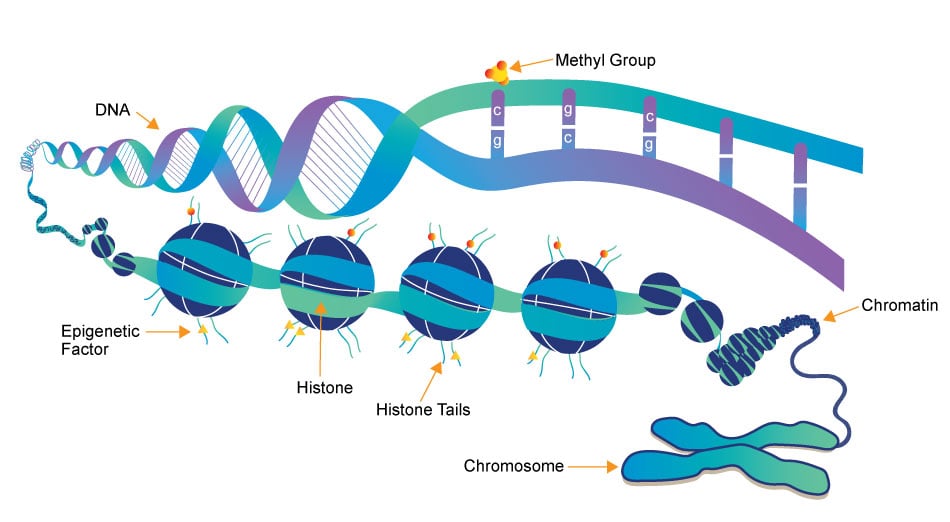
Epigenetics research delves into the molecular mechanisms that control gene expression and cellular traits without altering the underlying DNA sequence. One crucial aspect of this field is the role of small molecules, which act as powerful regulators of epigenetic modifications. These small compounds, typically comprising a few dozen to a few hundred atoms, have emerged as essential tools in understanding and manipulating the epigenome.
- DNA Methylation Inhibitors: Small molecules like 5-azacytidine and 5-aza-2'-deoxycytidine are DNA methyltransferase inhibitors. They block the addition of methyl groups to DNA, leading to DNA demethylation. This can reactivate silenced genes, potentially offering therapeutic avenues for conditions like cancer.
- HDAC inhibitors: HDACs remove acetyl groups from histone proteins, contributing to gene repression. Small molecule HDAC inhibitors, such as Vorinostat and Romidepsin, can reverse this process by increasing histone acetylation, allowing genes to be more accessible for transcription. These inhibitors are being explored for cancer therapy and other conditions.
- Histone Methyltransferase Inhibitors: Small molecules like GSK126 inhibit specific histone methyltransferases, affecting histone methylation patterns. This can alter gene expression, making them promising candidates for cancer and other diseases with epigenetic dysregulation.
- RNA Modulators: Small molecules can also target non-coding RNAs involved in epigenetic regulation. For instance, small molecules called small interfering RNAs (siRNAs) can be designed to target and degrade specific long non-coding RNAs, influencing gene expression.
- Epigenetic Reader Domain Inhibitors: These small molecules target proteins that recognize and bind to specific epigenetic marks. Examples include inhibitors of bromodomain-containing proteins (BET inhibitors), which can disrupt gene regulation by interfering with protein-DNA interactions.
Small molecules in epigenetics research not only provide insights into the fundamental biology of gene regulation but also hold immense promise for developing novel therapeutics. Their ability to selectively modulate specific epigenetic marks and pathways has led to ongoing clinical trials and drug development efforts for various diseases, including cancer, neurological disorders, and inflammatory conditions. Understanding and harnessing the power of these small molecules is at the forefront of modern epigenetics research, offering new hope for precision medicine and targeted therapies.
3 key components involved in the regulation of epigenetic modifications
Epigenetics Writer
Epigenetics writers are enzymes responsible for adding chemical marks or modifications to DNA or histone proteins. These marks include DNA methylation (addition of methyl groups to DNA) and histone modifications (such as acetylation, methylation, phosphorylation, etc.).
Epigenetics Reader
Function: Epigenetics readers are proteins that can recognize and bind to specific epigenetic marks on DNA or histones. These reader proteins interpret the epigenetic code and facilitate downstream cellular processes, such as gene activation or repression.
Epigenetics Eraser
Function: Epigenetics erasers are enzymes responsible for removing or reversing epigenetic marks on DNA or histones. This process allows for the dynamic regulation of gene expression and the resetting of epigenetic states during various stages of development and in response to environmental changes.
-
HDAC inhibitor
AR-42 is a novel HDAC inhibitor, exhibits biologic activity against malignant mast cell lines via down-regulation of constitutively activated Kit.- Yong-Hui Liao, .et al. , Mol Med Rep, 2018, Feb; 17(2): 2803-2810 PMID: 29257262
-
DOT1L Inhibitor
EPZ-5676 is a small molecule inhibitor of histone methyltransferase with potential antineoplastic activity.- Yoo H, .et al. , Cell Death Dis, 2020, Jan; 11(1): 14 PMID: 31908356
- Guang Bai, .et al. , Epigenetics of Chronic Pain, 2019, Pages 1-48
-
PARP inhibitor
Olaparib (AZD2281) is an inhibitor of poly ADP ribose polymerase (PARP), an enzyme involved in DNA repair.- Yuki Yoshino, .et al. , Biochem Biophys Res Commun, 2025, Jan:742:151153 PMID: 39672008
- Saptarshi Sinha, .et al. , Med Oncol, 2024, Jan 6;41(2):49 PMID: 38184505
- Erika Nakatsuka, .et al. , Transl Oncol, 2024, Sep 12:50:102119 PMID: 39270525
- Callum G Jones, .et al. , Cancers (Basel), 2024, Feb 21;16(5):863 PMID: 38473223
- Aurelie Vanderlinden, .et al. , Br J Cancer, 2023, Nov;129(11):1829-1840 PMID: 37777579
- Saptarshi Sinha, .et al. , Exp Cell Res, 2022, Nov 1;420(1):113338 PMID: 36075449
- Subhajit Chatterjee, .et al. , J Cancer Res Clin Oncol, 2022, Dec;148(12):3521-3535 PMID: 35962813
- Yuki Uchihara, .et al. , Mol Cell, 2022, Jul 21;82(14):2557-2570 PMID: 35594857
- Ji-Ye Kim, .et al. , Cell Death Dis, 2022, Mar 15;13(3):239 PMID: 35293383
- Emad Matanes, .et al. , Front Oncol, 2021, Oct 27;11:745981 PMID: 34778062
- Shino Endo, .et al. , Cancer Res Commun, 2021, 1(2): 90-105
- Yan Baglo, .et al. , Transl Oncol, 2021, Nov;14(11):101198 PMID: 34418731
- Joseph M Gozgit, .et al. , Cancer cell, 2021, Jul 22;S1535-6108(21)00340-8 PMID: 34375612
- Sefinew Molla, .et al. , DNA Repair (Amst), 2021, Jun 10;105:103157 PMID: 34144488
- Jianming Wang, .et al. , Cell Rep, 2021, Feb 16;34(7):108759 PMID: 33596418
- Ai Ito, .et al. , Biogerontology, 2021, Feb;22(1):119-131 PMID: 33216250
- Tim J Wigle, .et al. , Cell Chem Biol, 2020, Jul 16;27(7):877-887 PMID: 32679093
- Ali Divan, .et al. , Pharmacol Res Perspect, 2020, Apr; 8(2): e00586 PMID: 32342655
- Jianwei Dou, .et al. , J Sep Sci, 2020, Dec 4 PMID: 33275824
- Sai Dimple Manavitha Gullipalli, .et al. , Int. J. Adv. Pharm. Biotech, 2020, 6(2) 01-08
- Chao Zhang, .et al. , J Atheroscler Thromb, 2020, Sep 25 PMID: 32981917
- Wigle TJ, .et al. , SLAS Discov, 2019, Dec 19:2472555219883623 PMID: 31855104
- Wang Q, .et al. , Cancer Med, 2019, Dec 21 PMID: 31863638
- Molla S, .et al. , Pathol Oncol Res, 2019, Nov 25 PMID: 31768967
- Alvin Z.Lu, .et al. , Biochem Pharmacol, 2019, May 7. pii: S0006-2952(19)30171-6 PMID: 31075269
- Bian C, .et al. , Nat Commun, 2019, Feb 11;10(1):693 PMID: 30741937
- HC de Silva, .et al. , Cell Mol Life Sci, 2019, 1-16 PMID: 30725116
- Kamada Y, .et al. , Fitoterapia, 2018, Sep;129:94-101 PMID: 29928967
- 2018, .et al. , FEBS Open Bio, 2018, Jun; 8(6): 1001-1012 PMID: 29928579
- Hirosumi Tamura, .et al. , Oncol Rep, 2018, Aug; 40(2): 635-646 PMID: 29917168
- Hiro Sato, .et al. , Nat Commun, 2017, 8: 1751 PMID: 29170499
- Charles-André Philip, .et al. , BMC Cancer, 2017, 17: 638 PMID: 28886696
- Rulina AV, .et al. , Cell Death Dis, 2016, Dec 1;7(12):e2505 PMID: 27906189
-
CDK/Aurora A/B Inhibitor
JNJ-7706621 is pan-CDK inhibitor with the highest potency on CDK1/2 with IC50 of 9 nM/4 nM and showing >6-fold selectivity for CDK1/2 than CDK3/4/6 in cell-free assays. It also potently inhibits Aurora A/B and has no activity on Plk1 and Wee1.- Yuta Tanizaki, .et al. , Commun Biol, 2022, 5: 112 PMID: 35132135
-
BET inhibitor
GSK1324726A (I-BET726) is a novel, potent, and selective small molecule inhibitor of BET proteins with high affinity to BRD2 (IC50= 41 nM), BRD3 (IC50= 31 nM), and BRD4 (IC50= 22 nM).- Zhengjun Liu, .et al. , Cell Death Dis, 2020, May 5;11(5):318 PMID: 32371868
-
LSD1 inhibitor
SP2509 is a novel histone demethylase LSD1 (KDM1A) antagonist with IC50 of 13 nM; no inhibition on MAO-A and MAO-B.- Ziliang Yu, .et al. , Immunol Res, 2024, May 9 PMID: 38722530
-
Aurora Kinase B/C inhibitor
GSK1070916 is a potent Aurora B/C kinase inhibitor (with IC50 of 3.5 nM/6.5 nM) with broad antitumor activity in tissue culture cells and human tumor xenograft models.
-
Aurora A/B Kinase inhibitor
PF-03814735 is a novel, potent and reversible inhibitor of Aurora A/B with IC50of 0.8 nM/5 nM, is less potent to Flt3, FAK, TrkA, and minimally active to Met and FGFR1. Phase 1. -
JAK inhibitor
NVP-BSK805 is a potent and selective inhibition of polycythemia by the quinoxaline JAK2 inhibitor that potently suppressed recombinant human erythropoietin-induced polycythemia and extramedullary erythropoiesis in mice and rats.
-
JAK inhibitor
BMS-911543 is an orally available small molecule targeting a subset of Janus-associated kinase (JAK) with potential antineoplastic activity. -
multi-kinase inhibitor
Cenisertib (AS-703569) is a multi-kinase inhibitor that blocks the activity of Aurora-kinase-A/B, ABL1, AKT, STAT5 and FLT3. -
multi-kinase inhibitor
Lestaurtinib (CEP-701;KT-5555) is a multi-kinase inhibitor with potent activity against the Trk family of receptor tyrosine kinases. Lestaurtinib inhibits JAK2, FLT3 and TrkA with IC50s of 0.9, 3 and less than 25 nM, respectively. -
MGMT inhibitor
O6BTG-octylglucoside is a potent O6-methylguanine-DNAmethyl-transferase (MGMT) inhibitor, with IC50s of 32 nM in vitro (cell extracts) and 10 nM in HeLa S3 cells. -
BET inhibitor
GSK-525762A is a small molecule inhibitor of the BET (Bromodomain and Extra-Terminal) family -
JAK1/2 inhibitor
Ruxolitinib sulfate (INCB018424 sulfate) is the first potent, selective JAK1/2 inhibitor to enter the clinic with IC50s of 3.3 nM/2.8 nM, and has > 130-fold selectivity for JAK1/2 versus JAK3. -
LKB1/AAK1 dual inhibitor
Pim1/AKK1-IN-1 is a potent multi-kinase inhibitor with Kd values of 35 nM/53 nM/75 nM/380 nM for Pim1/AKK1/MST2/LKB1 respectively, and also inhibits MPSK1 and TNIK. -
JAK inhibitor
Ruxolitinib Phosphate is the phosphate salt form of ruxolitinib, an orally bioavailable Janus-associated kinase (JAK) inhibitor with potential antineoplastic and immunomodulating activities. -
HDAC6 inhibitor
ACY-1215 selectively targets and binds to HDAC6, thereby disrupting the Hsp90 protein chaperone system through hyperacetylation of Hsp90 and preventing the subsequent aggresomal protein degradation. -
FLT3 inhibitor
TG-02 is a novel small molecule potent CDK/JAK2/FLT3 inhibitor. -
HDAC Inhibitor
CI-994 is a histone deacetylase (HDAC) inhibitor and induces histone hyperacetylation in living cells. -
Pim inhibitor
TCS PIM-1 4a is a selective and ATP-competitive Pim kinase inhibitor (IC50 values = 24 and 100 nM for Pim-1 and Pim-2, respectively). -
HDAC inhibitor
Remetinostat (SHP-141) is a hydroxamic acid-based inhibitor of histone deacetylase enzymes (HDAC) which is under development for the treatment of cutaneous T-cell lymphoma. -
KDM4A inhibitor
Toxoflavin (Xanthothricin) is an antagonist of transcription factor 4 (TCF4)/β-catenin complex, also acts as an inhibitor of KDM4A, with antitumor activity. -
G9a inhibitor
CPUY074020 is a potent G9a inhibitor with an IC50 of 2.18 μM, and possesses anti-proliferative activity . -
HDAC inhibitor
CXD101 is a class I-selective HDAC inhibitor (HDAC1 (IC50, 63 nM), HDAC2 (IC50, 570 nM), HDAC3 (IC50, 550 nM). CXD101 has no activity against HDAC class II. -
PAD inhibitor
Cl-amidine is a peptidylarginine deminase (PAD) inhibitor, with an IC50 5.9 μM for PAD4. -
miR-544 inhibitor
SID 3712249 (MiR-544 Inhibitor 1) is an inhibitor of the biogenesis of microRNA-544 (miR-544). -
SIRT 6 inhibitor
OSS-128167, also known as SIRT6-IN-1, is a potent and selective SIRT 6 inhibitor with IC50 value of 89 μM. -
HDAC8 inhibitor
HDAC8-IN-1, is a HDAC8 inhibitor with an IC50 of 27.2 nM in cancer cell lines.
