






Epigenetics
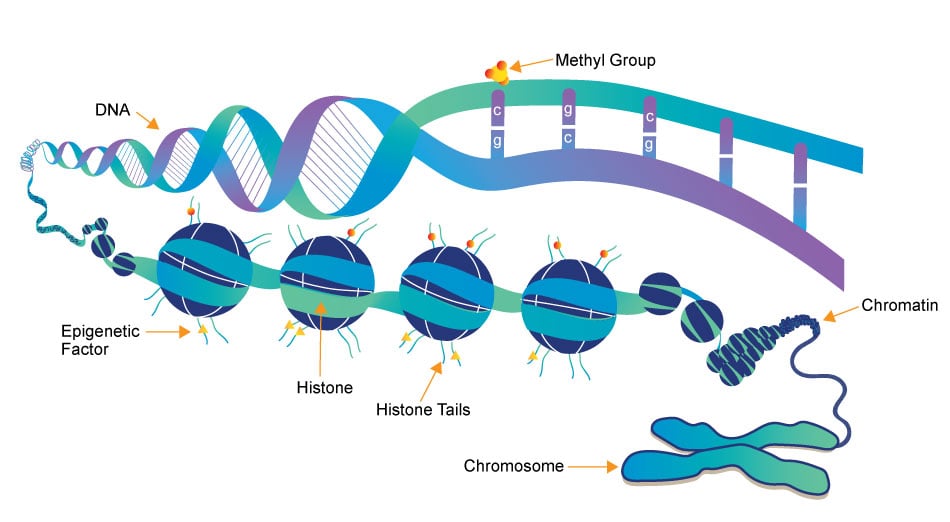
Epigenetics research delves into the molecular mechanisms that control gene expression and cellular traits without altering the underlying DNA sequence. One crucial aspect of this field is the role of small molecules, which act as powerful regulators of epigenetic modifications. These small compounds, typically comprising a few dozen to a few hundred atoms, have emerged as essential tools in understanding and manipulating the epigenome.
- DNA Methylation Inhibitors: Small molecules like 5-azacytidine and 5-aza-2'-deoxycytidine are DNA methyltransferase inhibitors. They block the addition of methyl groups to DNA, leading to DNA demethylation. This can reactivate silenced genes, potentially offering therapeutic avenues for conditions like cancer.
- HDAC inhibitors: HDACs remove acetyl groups from histone proteins, contributing to gene repression. Small molecule HDAC inhibitors, such as Vorinostat and Romidepsin, can reverse this process by increasing histone acetylation, allowing genes to be more accessible for transcription. These inhibitors are being explored for cancer therapy and other conditions.
- Histone Methyltransferase Inhibitors: Small molecules like GSK126 inhibit specific histone methyltransferases, affecting histone methylation patterns. This can alter gene expression, making them promising candidates for cancer and other diseases with epigenetic dysregulation.
- RNA Modulators: Small molecules can also target non-coding RNAs involved in epigenetic regulation. For instance, small molecules called small interfering RNAs (siRNAs) can be designed to target and degrade specific long non-coding RNAs, influencing gene expression.
- Epigenetic Reader Domain Inhibitors: These small molecules target proteins that recognize and bind to specific epigenetic marks. Examples include inhibitors of bromodomain-containing proteins (BET inhibitors), which can disrupt gene regulation by interfering with protein-DNA interactions.
Small molecules in epigenetics research not only provide insights into the fundamental biology of gene regulation but also hold immense promise for developing novel therapeutics. Their ability to selectively modulate specific epigenetic marks and pathways has led to ongoing clinical trials and drug development efforts for various diseases, including cancer, neurological disorders, and inflammatory conditions. Understanding and harnessing the power of these small molecules is at the forefront of modern epigenetics research, offering new hope for precision medicine and targeted therapies.
3 key components involved in the regulation of epigenetic modifications
Epigenetics Writer
Epigenetics writers are enzymes responsible for adding chemical marks or modifications to DNA or histone proteins. These marks include DNA methylation (addition of methyl groups to DNA) and histone modifications (such as acetylation, methylation, phosphorylation, etc.).
Epigenetics Reader
Function: Epigenetics readers are proteins that can recognize and bind to specific epigenetic marks on DNA or histones. These reader proteins interpret the epigenetic code and facilitate downstream cellular processes, such as gene activation or repression.
Epigenetics Eraser
Function: Epigenetics erasers are enzymes responsible for removing or reversing epigenetic marks on DNA or histones. This process allows for the dynamic regulation of gene expression and the resetting of epigenetic states during various stages of development and in response to environmental changes.
-
G9a/GLP inhibitor
UNC0642 is a potent and selective G9a and GLP histone lysine methyltransferase inhibitor (IC50 < 2.5 nM). It reduces H3K9 dimethylation levels in MDA-MB-231 cells (IC50 = 110 nM). Displays modest brain penetration in vivo.- Afifa Yaqub, .et al. , Pakistan Journal of Zoology, 2022, 54(6)
-
BRD4 Inhibitor
ARV-825 is a hetero-bifunctional molecule that is composed of a BRD4 binding moiety joined to an E3 ligase cereblon binding moiety using proteolysis targeting chimera (PROTAC) technology.- Aidan L Forberg, .et al. , Ann Hematol, 2024, Jan;103(1):199-209 PMID: 37792064
-
Aurora A Kinase inhibitor
MLN8237 (Alisertib) is a selective Aurora A inhibitor with IC50 of 1.2 nM in a cell-free assay. It has >200-fold higher selectivity for Aurora A than Aurora B. Phase 3..- Akitomo Inoue, .et al. , Cancer Sci, 2025, Apr;116(4):976-989 PMID: 39789853
- Shiang-Jie Yang, .et al. , Cell Death Dis, 2024, Jan 30;15(1):103 PMID: 38291041
- Vijaya Bharti, .et al. , Cell Rep, 2022, Dec 20;41(12):111826 PMID: 36543138
- Bucko PJ, .et al. , Elife, 2019, Dec 24;8. pii: e52220 PMID: 31872801
- Kimura M, .et al. , Exp Cell Res, 2018, Jun 1;367(1):73-80 PMID: 29571950
- Jing Wang, .et al. , J Cell Sci, 2017, Mar 15; 130(6): 1078-1093 PMID: 28167680
- Lessing D, .et al. , Proc Natl Acad Sci U S A, 2016, Dec 13;113(50):14366-14371 PMID: 28182563
- Jennifer M. Sahni, .et al. , J Biol Chem, 2016, Nov 4; 291(45): 23756-23768 PMID: 27650498
-
PARP inhibitor
AG-014699 (Rucaparib) is a PARP inhibitor that inhibits poly(ADP-ribose) polymerase (PARP) is a key enzyme in DNA repair.- Ali Divan, .et al. , Pharmacol Res Perspect, 2020, Apr; 8(2): e00586 PMID: 32342655
- Tahira Baloch, .et al. , BMC Cancer, 2019, Jan 10;19(1):44 PMID: 30630446
-
human A3 adenosine receptor antagonist /Aurora inhibitor
Reversine is a potent human A3 adenosine receptor antagonist with Ki of 0.66 μM, and a pan-aurora A/B/C kinase inhibitor with IC50 of 12 nM/13 nM/20 nM, respectively. Also used for stem cell dedifferentiation.- Amy H. Ide, .et al. , Mol Biol Cell, 2023, Jun 1;34(7):ar76 PMID: 37126397
- Hazheen K, .et al. , J Biol Chem, 2020, August 20
-
JAK2/FLT3 inhibitor
Pacritinib, also known as SB1518, is an orally bioavailable inhibitor of Janus kinase 2 (JAK2) and the JAK2 mutant JAK2V617F with potential antineoplastic activity. Pacritinib competes with JAK2 for ATP binding, which may result in inhibition of JAK2 activation, inhibition of the JAK-STAT signaling pathway, and so caspase-dependent apoptosis.- Angelina T Regua, .et al. , Cancer Lett, 2024, Jun 7:597:217023 PMID: 38852701
- Daniel Doheny, .et al. , Oncogene, 2020, Oct;39(42):6589-6605 PMID: 32929154
-
JAK3/2/1 inhibitor
Tofacitinib is an orally available JAK3/2/1 inhibitor with IC50s of 1, 20, and 112 nM, respectively.- Aya Hasan Alshammari, .et al. , Biochem Pharmacol, 2022, Mar;197:114914 PMID: 35041812
-
HDAC6 inhibitor
ACY-241 is a new, selective and orally available inhibitor of HDAC6.- Bae J, .et al. , Leukemia, 2018, Sep;32(9):1932-1947 PMID: 29487385
-
JAK inhibitor
CYT387 is an inhibitor of Janus kinases JAK1 and JAK2, acting as an ATP competitor with IC50 values of 11 and 18 nM, respectively.- Bopei Cui, .et al. , Signal Transduct Target Ther, 2023, Sep 25;8(1):366 PMID: 37743418
- Alex Bainbridge, .et al. , Nucleic Acids Research, 2020, April
-
PI3K/HDAC inhibitor
CUDC-907 (Fimepinostat) is a single small molecule inhibitor that targets both PI3K and HDAC. CUDC-907 is more efficacious than either a single PI3K or HDAC inhibitor reference compound or a combination of the two single agents at maximally tolerated doses.- Bopei Cui, .et al. , Signal Transduct Target Ther, 2023, Sep 25;8(1):366 PMID: 37743418
- Caner Gunaydın, .et al. , Immunopharmacol Immunotoxicol, 2022, Jun;44(3):447-455 PMID: 35291899
- Chie Ishikawa, .et al. , Eur J Haematol, 2020, Eur J Haematol PMID: 32780889
-
HDAC Inhibitor
MC1568 is a member of HDAC inhibitors that inhibits the histone deacetylase class II by modifying the genetic expression of various important genes of cell cycle mostly at G1 phase, resulting in the death of breast cancer cells by apoptosis.- Bopei Cui, .et al. , Signal Transduct Target Ther, 2023, Sep 25;8(1):366 PMID: 37743418
- Vivek Bora, .et al. , Can J Physiol Pharmacol, 2021, 6 October
- Minoru Ueda, .et al. , Plant Physiol, 2017, Dec; 175(4): 1760-1773 PMID: 29018096
- S Ishikawa, .et al. , Int J Cancer., 2014, 135(11): 2528-2536 PMID: 24346863
- Usui T, .et al. , Hypertension., 2014, Feb;63(2):397-403 PMID: 24166750
-
JAK inhibitor
Oclacitinib maleate (PF-03394197 maleate) is a novel JAK inhibitor. Oclacitinib maleate (PF-03394197 maleate) is most potent at inhibiting JAK1 (IC50=10 nM).- Carlos H de Mello Souza, .et al. , Vet Dermatol, 2021, Dec 9 PMID: 34882871
-
pan-Pim kinase inhibitor
AZD1208 is orally available, small molecule inhibitor of PIM kinases with potential antineoplastic activity.- Corbin C Jensen, .et al. , J Cell Biol, 2023, Jun 5;222(6):e202208136 PMID: 37042842
- Jeremiah J Bearss, .et al. , EMBO Rep, 2021, Apr 7;22(4):e50835 PMID: 33586867
- Remy J, .et al. , Biochim Biophys Acta Mol Cell Res, 2019, Feb;1866(2):175-189 PMID: 30389373
- Andrea L. Casillas, .et al. , Clin Cancer Res, 2018, Jan 1; 24(1): 169-180 PMID: 29084916
- Jin H. Song, .et al. , Mol Cancer Ther, 2018, Dec;17(12):2710-2721 PMID: 30190422
- Sathish K.R. Padi, .et al. , Oncotarget, 2017, May 2; 8(18): 30199-30216 PMID: 28415816
- Lim R, .et al. , Mol Hum Reprod, 2017, Jun 1;23(6):428-440 PMID: 28333279
-
JAK1 Inhibitor
INCB39110 is a potent JAK1 tyrosine kinase inhibitor, which is currently in Phase II trials for the treatment of rheumatoid arthritis, myelofibrosis, rheumatoid arthritis and plaque psoriasis.- Czech J, .et al. , Leukemia, 2018, Nov 23 PMID: 30470838
-
HDAC inhibitor
Romidepsin strongly inhibits HDAC1 and HDAC2 with IC5N/A of 1.6 nM and 3.9 nM, respectively, but is relatively weak in inhibiting HDAC4 and HDAC6 with IC5N/A 25 nM and 79N/A nM, respectively.- Dan Lu, .et al. , Sci Adv, 2024, Oct 25;10(43):eadp2229 PMID: 39454005
- Yu-Fang Liu, .et al. , J Biochem Mol Toxicol, 2022, Jun;36(6):e23044 PMID: 35499365
- David Diaz-Carballo, .et al. , Commun Biol, 2021, Mar 3;4(1):276 PMID: 33658617
- Eva Hesping, .et al. , Int J Parasitol Drugs Drug Resist, 2020, 14: 249-256
- Shariful Islam, .et al. , Blood Adv, 2020, 4(20): 5297-5310 PMID: 33108458
- Elena Netchiporouk, .et al. , Oncotarget, 2017, Nov 10; 8(56): 95981-95998 PMID: 29221181
- Ivan V. Litvinov, .et al. , Clin Cancer Res, 2014, 20(14): 3799-3808 PMID: 24850846
- Ivan V Litvinov, .et al. , Cell Cycle., 2014, 15; 13(18): 2975-2982 PMID: 25486484
-
HDAC inhibitor
Valproic acid is an HDAC inhibitor, with IC50 in the range of 0.5 and 2 mM, also inhibits HDAC1 (IC50, 400 μM), and induces proteasomal degradation of HDAC2; Valproic acid sodium salt is used in the treatment of epilepsy, bipolar disorder and prevention of migraine headaches.- Dan Zhao, .et al. , Poult Sci, 2022, Mar; 101(3): 101642 PMID: 35016046
-
HDAC6 inhibitor
ACY-738 is a potent and selective HDAC6 inhibitor with improved brain bioavailability. ACY-738 inhibits HDAC6 with low nanomolar potency and a selectivity of 60- to 1500-fold over class I HDACs.- Dao Xu, .et al. , Immunohorizons, 2024, Sep 1;8(9):668-678 PMID: 39259207
- Guang Bai, .et al. , Epigenetics of Chronic Pain, 2019, Pages 1-48
-
HDAC Inhibitor
LAQ824 (NVP-LAQ824) is a potent novel histone deacetylase inhibitor with significant activity against multiple myeloma.- De-Run Chen, .et al. , Appl Mater Today, 2022, 26: 101363
-
BET bromodomain Inhibitor
CPI203 is a novel potent, selective and cell permeable inhibitor of the bromodomain and extra terminal (BET) family protein BRD4 with an IC50 of ~37 nM (BRD4 α-screen assay).- Derenzini E, .et al. , Cell Rep, 2018, Aug 21;24(8):2155-2166 PMID: 30134175
-
TNKS inhibitor
G007-LK displays high selectivity toward tankyrases 1 and 2 with biochemical IC50 values of 46 nM and 25 nM, respectively, and a cellular IC50 value of 50 nM combined with an excellent pharmacokinetic profile in mice,- Dominic B. Bernkopf, .et al. , Nat Commun, 2019, 10:4251 PMID: 31534175
-
HDAC inhibitor
ITF2357 (Givinostat) is a HDACs inhibitor with potential anti-inflammatory, anti-angiogenic, and antineoplastic activities.- Flavien Bizot, .et al. , Mol Ther Nucleic Acids, 2022, Nov 21;30:606-620 PMID: 36514350
-
JAK3 inhibitor
CP-690550 (Tofacitinib citrate) is an orally available, highly selective inhibitor of the Janus kinase (JAK) family of enzymes.- Fujita KI, .et al. , J Pharm Sci, 2017, Sep;106(9):2632-2641 PMID: 28479358
-
EZH2 inhibitor
Lirametostat (CPI-1205) is a highly potent (biochemical IC50 = 0.002 μM, cellular EC50 = 0.032 μM) and selective inhibitor of EZH2.
- George L.Joun, .et al. , bioRxiv, 2025, Jan 8
-
JAK1/JAK2 inhibitor
Momelotinib Mesylate (CYT387 Mesylate) is an ATP-competitive inhibitor of JAK1/JAK2 with IC50 of 11 nM/18 nM, appr 10-fold selectivity versus JAK3.- Ghazal Nabil, .et al. , Cancers (Basel), 2021, Feb 20;13(4):898 PMID: 33672756
-
HDAC inhibitor
SB939 is an oral inhibitor of HDAC, selective for class I, II and IV HDACs and displays an IC50 value of 77 nM in an in vitro HDAC1 activity assay.- Giovanni Bocci, .et al. , ACS Pharmacol Transl Sci, 2020, Oct 14
-
Demethylase Inhibitor
GSK J4 is a cell permeable prodrug rapidly hydrolyzed by macrophage esterases to GSK-J1, a potent selective jumonji H3K27 demethylase inhibitor; attenuates lipopolysaccharide (LPS)-induced proinflammatory cytokine production in primary human macrophages (IC50 = 9 uM for the inhibition of TNF?? release).- Guang Bai, .et al. , Epigenetics of Chronic Pain, 2019, Pages 1-48
-
Aurora Kinase inhibitor
VX-680 is a potent and selective small-molecule inhibitor of the Aurora kinases.- Helen E. Grimsley, .et al. , bioRxiv, 2024, Jan 23
- Sakamoto K, .et al. , Leukemia, 2018, May 23 PMID: 29795241
- W. Joost Lesterhuis, .et al. , Sci Rep, 2015, 5: 12298 PMID: 26193793
-
MEK/Aurora Inhibitor
BI-847325 is an orally bioavailable, and selective dual MEK/Aurora kinase inhibitor with IC50 of 3 nM, 25 nM, 15 nM, 25 nM, and 4 nM for Xenopus laevis Aurora B, human Aurora A and Aurora C, as well as human MEK1 and MEK2, respectively. Phase 1.- Hilda Samimi, .et al. , Cancer Cell Int, 2022, Dec 8;22(1):388 PMID: 36482411
- Hilda Samimi, .et al. , Thyroid Res, 2021, Dec 3;14(1):27 PMID: 34861882
- Hilda Samimi, .et al. , DARU J Pharm Sci, 2019, 1-7 PMID: 31077090
-
PIM1 Inhibitor
SGI-1776 free base is a novel ATP competitive inhibitor of Pim1 with IC50 of 7 nM in a cell-free assay, 50- and 10-fold selective versus Pim2 and Pim3, also potent to Flt3 and haspin. Phase 1.- Ishikawa C, .et al. , Eur J Haematol, 2017, Dec;99(6):495-504 PMID: 28833639
-
HDAC6 inhibitor
CAY10603 is a potent and selective HDAC6 inhibitor with IC50 of 2 pM, >200-fold selectivity over other HDACs.- Isin Cakir, .et al. , Nat Metab, 2022, Jan;4(1):44-59 PMID: 35039672
-
HDAC6 inhibitor
Tubastatin A is a potent and selective HDAC6 inhibitor with IC50 of 15 nM in a cell-free assay. It is selective against all the other isozymes (1000-fold) except HDAC8 (57-fold).- Isin Cakir, .et al. , Nat Metab, 2022, Jan;4(1):44-59 PMID: 35039672
- Isin Cakir, .et al. , Elife, 2022, Mar 24 PMID: 35323110
-
HDAC Inhibitor
LBH589 is a hydroxamic acid and acts as a non-selective HDAC inhibitor with IC5o of HDAC1 to be 0.23 nM.- Jalila Chagraoui, .et al. , Cell Stem Cell, 2021, Jan 7;28(1):48-62.e6 PMID: 33417871
- Gils Jose, .et al. , Cancers (Basel), 2020, Oct 31;12(11):E3211 PMID: 33142721
- Shariful Islam, .et al. , Blood Adv, 2020, 4(20): 5297-5310 PMID: 33108458
- Giovanni Bocci, .et al. , ACS Pharmacol Transl Sci, 2020, Oct 14
- Justin Kale, .et al. , EMBO Rep, 2018, Sep; 19(9): e45235 PMID: 29987135
-
MATA2 inhibitors
AGI-25696 is a methionine adenosyltransferase 2A (MATA2 ) inhibitors useful for treatment of cancer. AGI-25696 blocks growth of MTAP-deleted tumors in vivo.- Jennifer Kim, .et al. , Front Bioeng Biotechnol, 2022, Mar 18;10:855755 PMID: 35372313
-
SUV39H2 inhibitor
OTS186935 is a protein methyltransferase SUV39H2 inhibitor with an IC50 of 6.49 nM.- Jennings Luu, .et al. , Hum Mol Genet, 2020, Jul 21;ddaa158 PMID: 32691052
-
BET Inhibitor
(+)-JQ1 is a potent, high affinity, selective BET bromodomain inhibitor.- Jiang Zhou, .et al. , Neoplasia, 2025, Oct:68:101223 PMID: 40850308
- Kei Taga, .et al. , Microbiol Immunol, 2024, Mar;68(3):90-99 PMID: 38244193
- Deeksha Sharma, .et al. , Breast Cancer Res, 2023, Nov 15;25(1):144 PMID: 37968653
- Adriana K Alexander, .et al. , Nat Commun, 2023, Mar 29;14(1):1753 PMID: 36990976
- Haruki Kitamura, .et al. , Biochem Biophys Res Commun, 2023, Jan 22;641:139-147 PMID: 36527748
- Gerald Thiel, .et al. , Pharmaceuticals (Basel), 2022, Jul 10;15(7):846 PMID: 35890145
- Selase D Deletsu, .et al. , Biochem Biophys Res Commun, 2021, Aug 27;567:106-111 PMID: 34146904
- Cole Schonhofer, .et al. , Biochem Pharmacol, 2021, Apr;186:114462 PMID: 33577894
- Nandini Verma, .et al. , Sci Adv, 2020, 6 : eaba8968
- Kuo MT, .et al. , Transl Oncol, 2020, 13(2):355-364 PMID: 31887630
- Rao Z, .et al. , J Immunol, 2019, Aug 15;203(4):1031-1043 PMID: 31300512
- A Carrer, .et al. , Cancer Discov, 2019, Jan 9. pii: CD-18-0567 PMID: 30626590
- Clocchiatti A, .et al. , J Clin Invest, 2018, Dec 3;128(12):5531-5548 PMID: 30395538
-
PARP-1 inhibitor
Rucaparib is a potent inhibitor of purified full-length human PARP-1 and shows higher inhibition of cellular PARP in LoVo and SW620 cells.- Jianwei Dou, .et al. , J Sep Sci, 2020, Dec 4 PMID: 33275824
-
PARP1 inhibitor
BSI-201 is a potent inhibitor of PARP-1 and has been shown to cross the blood-brain barrier.- Jianwei Dou, .et al. , J Sep Sci, 2020, Dec 4 PMID: 33275824
-
PARP inhibitor
MK-4827 is a novel potent, orally bioavailable PARP-1 and PARP-2 inhibitor.- Joseph M Gozgit, .et al. , Cancer cell, 2021, Jul 22;S1535-6108(21)00340-8 PMID: 34375612
- Ann-Katrin Hopp, .et al. , Molecular cell, 2021, Jan 21; 81(2): 340–354 PMID: 33450210
- Bian C, .et al. , Nat Commun, 2019, Feb 11;10(1):693 PMID: 30741937
- Tahira Baloch, .et al. , BMC Cancer, 2019, Jan 10;19(1):44 PMID: 30630446
- Khalid Hilmi, .et al. , Sci Adv, 2017, May; 3(5): e1601898 PMID: 28560323
-
PARP Inhibitor
3-Aminobenzamide is a novel PARP inhibitor, known to sensitize cells to radiation in vitro by inhibiting the repair of DNA damage.- Kamada Y, .et al. , Fitoterapia, 2018, Sep;129:94-101 PMID: 29928967
-
HDAC Inhibitor
PCI-24781 is a broad-spectrum phenyl hydroxamic acid HDAC inhibitor.- Kazuya Tsumagari, .et al. , Biochem Biophys Res Commun, 2021, Jul 23;563:60-65 PMID: 34062387
-
JAK1 inhibitor
GLPG0634 is an orally-available, selective inhibitor of JAK1 (Janus kinase 1) being developed by Galapagos for the treatment of rheumatoid arthritis and potentially other inflammatory diseases.- Keisuke Nishimura, .et al. , Arthritis Rheumatol., 2015, Apr;67(4):893-902 PMID: 25545152
-
Topoisomerase I inhibitor
Camptothecin is a cytotoxic quinoline alkaloid which inhibits the DNA enzyme topoisomerase I (topo I).- Kengo Takeda, .et al. , Int J Mol Sci, 2024, Mar 26;25(7):3693 PMID: 38612503
-
CBP/p300 bromodomain inhibitor
SGC-CBP30 is a potent and selective inhibitor of CREBBP (CBP) and EP300; which are general transcriptional co-activators.- Kevin Bohm, .et al. , Arch Pharm (Weinheim), 2023, Jul;356(7):e2200661 PMID: 37196427
-
PARP1/PARP2 inhibitor
Niraparib tosylate (MK-4827 tosylate) is a highly potent and orally bioavailable PARP1 and PARP2 inhibitor with an IC50 of 3.8 and 2.1 nM, respectively.- Laurie B Schenkel, .et al. , Cell Chem Biol, 2021, Mar 2;S2451-9456(21)00095-7 PMID: 33705687
-
SUV39H HMT Inhibitor
Chaetocin is a histone methyltransferase SUV39H1 inhibitor (IC50 = 0.8 μM). Induces apoptosis in myeloma cell lines in vitro; exhibits antiproliferative activity in a mouse myeloma model in vivo.- Linna Han, .et al. , Biochem J, 2023, Mar 31;480(6):421-432 PMID: 36896918
-
Pim Inhibitor
SIM-4a is a Pim kinase inhibitor that blocks mTORC1 activity via activation of AMPK. Mostly potent to Pim-2, does not significantly inhibit any other serine/threonine- or tyrosine-kinases.- Liong S, .et al. , Placenta, 2017, May;53:101-112 PMID: 28487013
-
BET inhibitor
PFI-1 is a BET bromodomain inhibitor that exhibits inhibitory activity at BRD2 and BRD4.- Lisa-Maria Winter, .et al. , Sci Rep, 2023, Jul 26;13(1):12061 PMID: 37495707
-
DNMT inhibitor
SGI-110 is a second generation DNA-hypomethyating agent.- Lise Brault, .et al. , EMBO Mol Med, 2025, Aug 29 PMID: 40883610
- Sho Sato, .et al. , Sci Rep, 2023, Jan 27;13(1):1537 PMID: 36707610
-
SIRT1 inhibitor
EX 527 is a potent and selective SIRT1 class III histone deacetylase enzyme inhibitor with IC50 of 38 nM in a cell-free assay.- Lisha Zhao, .et al. , Sci Rep, 2025, May 28;15(1):18761 PMID: 40437103
- Yue He, .et al. , FASEB J, 2024, Oct 15;38(19):e70095 PMID: 39373984
- Qiang Chen, .et al. , J Bioenerg Biomembr, 2022, Feb;55(1):33-42 PMID: 36525212
- Flavien Bizot, .et al. , Mol Ther Nucleic Acids, 2022, Nov 21;30:606-620 PMID: 36514350
- Takeshi Nakamura, .et al. , Shimane Journal of Medical Science, 2022, 38 (2), 59-66
- Bugga Paramesha, .et al. , Antioxidants (Basel), 2021, Feb 24;10(3):338 PMID: 33668369
- Wenhui Yao, .et al. , J Cell Physiol, 2020, 07 August
- Guang Bai, .et al. , Epigenetics of Chronic Pain, 2019, Pages 1-48
- Yoshikawa A, .et al. , J Neurochem, 2015, Feb;132(3):342-53 PMID: 25351847
