
- Cat. No.
- A18461
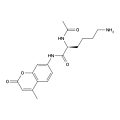
Ac-Lys-AMC
Synonyms: Hexanamide
Ac-Lys-AMC (Hexanamide), also termed MAL, is a fluorescent substrate for histone deacetylase HDACs.
In stock
View Details
Search by product name, CAS, target or catalog number. Press Down Arrow to reach product suggestions, Tab to move between links, and Escape to close suggestions.
Histone deacetylase (HDAC) inhibitors block enzymes that remove acetyl groups from histones and other proteins. Deacetylation compacts chromatin and generally represses transcription, so HDAC inhibitors are widely used to study gene regulation. Trichostatin A was characterized in 1990 as a specific inhibitor of mammalian histone deacetylase. The first mammalian HDAC was cloned in 1996 and found to be related to the yeast transcriptional regulator Rpd3p. Isoform-selective tools include entinostat for HDAC1 and HDAC3, and Tubastatin A HCl for HDAC6, a microtubule-associated deacetylase. Broad-spectrum hydroxamates such as vorinostat and panobinostat, together with the cyclic depsipeptide romidepsin, complete the range.
Synonyms: Hexanamide
Ac-Lys-AMC (Hexanamide), also termed MAL, is a fluorescent substrate for histone deacetylase HDACs.
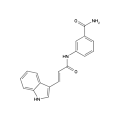
RSC133 is a dual epigenetic modulator that inhibits both histone deacetylases (HDACs) and DNA methyltransferases (DNMTs). It effectively enhances the reprogramming of human somatic cells into induced pluripotent stem cells (iPSCs) and supports the maintenance of pluripotency by promoting an undifferentiated state. RSC133 is a valuable tool for stem cell research and epigenetic reprogramming studies.
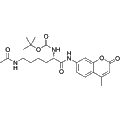
Synonyms: Boc-L-Lys(Ac)-AMC
Boc-Lys(Ac)-AMC is a cell-permeable fluorometric substrate for histone deacetylases (HDACs). When cleaved by HDAC enzymes, it releases a fluorescent signal with excitation and emission maxima at 355 nm and 460 nm, respectively. This compound is valuable for studying HDAC activity in various biological contexts and can be utilized in high-throughput screening assays to evaluate enzyme inhibitors.
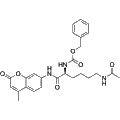
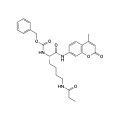
Z-MAL is a potent HDAC substrate that efficiently targets class I and II histone deacetylases, as well as class III SIRT1. This compound demonstrates significant conversion activity, making it suitable for studies focused on structure-activity relationships, subtype selectivity, and inhibitor screening of histone deacetylases. Z-MAL is an essential tool for advancing research in epigenetics and related biological pathways.
Out of stock
All 3 sizes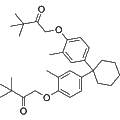
LG190119 is a selective modulator of HDAC8, primarily targeting Schistosoma mansoni with reduced affinity for human HDAC8. This compound has been shown to induce apoptosis in schistosome cells, making it a valuable tool for research in anti-parasitic agents. Its ability to selectively affect parasitic cells underscores its potential in developing effective treatments against schistosomiasis.