
- Cat. No.
- A16550
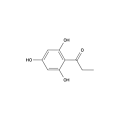
Flopropione
Flopropione is a 5-HT1A receptor antagonist and also a catechol-o-methyltransferase (COMT) inhibitor.
In stock
View Details
Search by product name, CAS, target or catalog number. Press Down Arrow to reach product suggestions, Tab to move between links, and Escape to close suggestions.
Catechol-O-methyltransferase (COMT) inhibitors block an enzyme that inactivates catecholamines such as dopamine. COMT transfers a methyl group from S-adenosylmethionine (SAM) to one hydroxyl group of the catechol ring. Enzymatic O-methylation of epinephrine and related catechols was first described in 1958. The enzyme converts dopamine into 3-methoxytyramine, a metabolite also listed here as 3-methoxyTyramine HCl. A common functional polymorphism, reported in 1996, lowers COMT activity and is studied in neuropsychiatric research. Entacapone, tolcapone, opicapone and nebicapone are nitrocatechol inhibitors used to study catecholamine and levodopa metabolism. The listing also includes related monoamine compounds such as serotonin maleate.
Flopropione is a 5-HT1A receptor antagonist and also a catechol-o-methyltransferase (COMT) inhibitor.
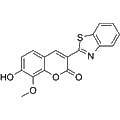
3-BTMD is a fluorescent compound generated through the action of the COMT enzyme on its substrate, 3-BTD, exhibiting an excitation wavelength of 390 nm and an emission wavelength of 510 nm. This reagent is primarily utilized in fluorescent labeling and imaging applications, facilitating the study of enzymatic activity and biomolecular interactions in various biological contexts. Its distinct fluorescence properties make it a valuable tool for researchers in the fields of biochemistry and molecular biology.
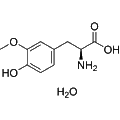
Synonyms: 3-Methoxy-L-tyrosine monohydrate; 3-O-Methyl-L-DOPA monohydrate
3-O-Methyldopa monohydrate is a notable metabolite of L-DOPA, primarily interacting with catechol O-methyltransferase (COMT). It does not function as a substrate or inhibitor of L-amino acid decarboxylase, distinguishing it from its precursor. The inhibition of COMT by this compound may enhance the therapeutic effects of L-DOPA in Parkinson's disease, making it a valuable tool in neurological research and studies on Parkinson's treatments.