Molecular Glues

Molecular glues are small molecules that bring two proteins into contact, often to trigger ubiquitination. Lenalidomide and pomalidomide bind cereblon, the substrate receptor of a cullin 4 ubiquitin ligase, and redirect it to new substrates. Cereblon was identified as a thalidomide-binding protein in 2010, and in 2014 lenalidomide was shown to drive degradation of the transcription factors Ikaros (IKZF1) and Aiolos (IKZF3). Mezigdomide is a further cereblon-binding degrader, while SJ3149 recruits casein kinase 1 alpha (CK1α) for degradation. Cyclosporin A follows a related principle, forming a complex with cyclophilin that was reported in 1991 to inhibit the phosphatase calcineurin. BI-3802 instead induces polymerization of its target protein, whereas bifunctional degraders sit in the sibling category PROTAC Degrader.

1 Item

  • Tz-Thalidomide
    Cat. No.
    A24497

    Tz-Thalidomide

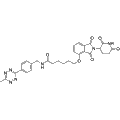
    Tz-Thalidomide is a tetrazine-tagged thalidomide derivative that functions as a ligand for E3 ligases. It exhibits binding affinity for BRD4, with IC₅₀ values of 46.25 μM for BRD4-1 and 62.55 μM for BRD4-2. As a click chemistry reagent, Tz-Thalidomide contains a tetrazine moiety capable of undergoing inverse electron demand Diels–Alder (iEDDA) reactions with trans-cyclooctene (TCO)-containing molecules, enabling bioorthogonal labeling and conjugation applications.

    5 mg
    $108.00
    10 mg
    $186.00
    All 4 sizes

1 Item

Added to your cart

View Cart Checkout

    Loading...