Opioid Receptors

Opioid receptor agonists and antagonists act on mu, delta and kappa receptors and the related nociceptin receptor. All four are G protein-coupled receptors that respond to endogenous peptides such as endorphins, enkephalins and dynorphins. Expression cloning of the delta opioid receptor in 1992 opened the family to molecular study. The nociceptin/orphanin FQ peptide (NOP) receptor, first called opioid receptor-like 1 (ORL1), was matched to its endogenous peptide agonist in 1995. Dynorphin A (1-13) Acetate is a peptide agonist at the kappa receptor, and JDTic is a kappa antagonist. SR-17018 acts as a mu agonist, while alvimopan is a peripherally acting opioid antagonist. MCOPPB trihydrochloride is a NOP agonist, and BAN ORL 24 blocks the same receptor.

1 Item

  • RSD-921
    Cat. No.
    A62520

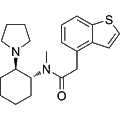
    RSD-921

    Synonyms: PD-123497

    RSD-921 is a potent sodium (Na+) channel blocker exhibiting significant anti-arrhythmic properties. It acts with state- and voltage-dependent inhibition on the open states of cardiac, skeletal muscle, and neuronal Na+ channels. Additionally, RSD-921 has a low affinity for κ-opioid receptors and shows weak κ-agonistic activity in vitro. This reagent is valuable for research focusing on cardiac arrhythmias and the modulation of Na+ channels in various biological models.

    5 mg
    $350.00
    10 mg
    $650.00
    All 3 sizes

1 Item

Added to your cart

View Cart Checkout

    Loading...