- Cat. No.
- A20462
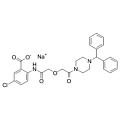
TM5275 sodium
Synonyms: TM 5275
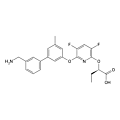
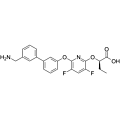
TM5275 sodium is a plasminogen activator inhibitor (PAI-1) with an IC50 of 6.95 μM.
Search by product name, CAS, target or catalog number. Press Down Arrow to reach product suggestions, Tab to move between links, and Escape to close suggestions.
PAI-1 inhibitors act on plasminogen activator inhibitor 1, the main brake on fibrinolysis. PAI-1, encoded by serpin family E member 1 (SERPINE1), is a serine protease inhibitor (serpin). It inactivates tissue-type and urokinase-type plasminogen activators (tPA, uPA), which convert plasminogen into the fibrin-degrading protease plasmin. Active PAI-1 converts spontaneously into an inactive latent form, so its activity in samples changes over time. Raised PAI-1 has been linked to thrombosis, obesity and tissue fibrosis, which are studied in animal models. Tiplaxtinin (PAI-039), TM5275 sodium and TM5441 are small-molecule PAI-1 inhibitors that restore plasminogen activator activity. UK-371804 and ZK824859 instead inhibit uPA, acting on the protease rather than its inhibitor.
Synonyms: TM 5275
TM5275 sodium is a plasminogen activator inhibitor (PAI-1) with an IC50 of 6.95 μM.
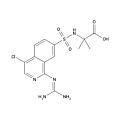
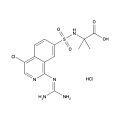
UK-371804 is a potent urokinase-type plasminogen activator (uPA) inhibitor.
ZK824859 is an oral available and selective urokinase plasminogen activator (uPA) inhibitor with IC50s of 79 nM, 1580 nM and 1330 nM for human uPA, tPA, and plasmin, respectively.
Synonyms: UK371804
UK-371804 is a potent and selective urokinase-type plasmogen activator (uPA) inhibitor with excellent enzyme potency (Ki=10 nM) and selectivity profile (4000-fold versus tPA and 2700-fold versus plasmin).
ZK824190 is an orally available and selective urokinase plasminogen activator (uPA) inhibitor as a potential treatment for multiple sclerosis. IC50s of 237, 1600 and 1850 nM for uPA, tPA, and Plasmin, respectively.
Synonyms: A6 Peptide
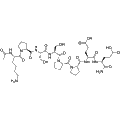
Angstrom6 (A6 Peptide) is an 8 amino-acid peptide derived from single-chain urokinase plasminogen activator (scuPA) and interferes with the uPA/uPAR cascade and abrogates downstream effects. Angstrom6 binds to CD44 resulting in the inhibition of migration, invasion, and metastasis of tumor cells, and the modulation of CD44-mediated cell signaling.
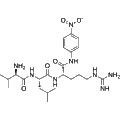
D-Val-Leu-Arg-pNA is a substrate for glandular kininoreleasing enzymes and tissue-type plasminogen activator (t-PA), exhibiting no significant affinity for fibrin. This compound is utilized to study enzyme kinetics and the activation mechanisms of proteolytic enzymes involved in various physiological processes. Its specificity for t-PA makes it a valuable tool in research focusing on thrombolytic therapy and related areas.
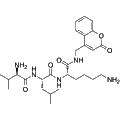
D-Val-Leu-Lys-AMC is a selective fluorogenic peptide substrate for plasmin, enabling the quantification of its enzymatic activity. This compound exhibits increased fluorescence upon cleavage, facilitating studies in fibrinolysis and related processes. It is suitable for applications in enzyme activity assays, offering high sensitivity with excitation at 360-380 nm and emission at 440-460 nm.
Out of stock
All 3 sizes
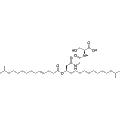
WB 3559 A is a fibrinolytic plasminogen activator that enhances the conversion of plasminogen to plasmin, thereby facilitating the direct degradation of fibrin in thrombus formations. This compound exhibits significant potential in the study of acute thrombotic diseases, such as myocardial infarction and pulmonary embolism, making it a valuable tool for researchers investigating therapeutic strategies in vascular events and clot management.