- Cat. No.
- A10657
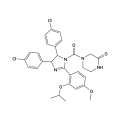
Nutlin-3
MDM2 antagonist nutlin-3 is a potent inducer of apoptosis.
Search by product name, CAS, target or catalog number. Press Down Arrow to reach product suggestions, Tab to move between links, and Escape to close suggestions.
MDM2 inhibitors disrupt the binding of mouse double minute 2 homolog (MDM2) to the tumor suppressor p53. In 1992 the MDM2 protein was shown to form a complex with p53 and inhibit p53-mediated transactivation. MDM2 is also an E3 ubiquitin ligase that promotes the rapid degradation of p53, as reported in 1997. Nutlins, reported in 2004, occupy the p53-binding pocket of MDM2 and activate the p53 pathway in cells and in vivo. Nutlin 3a is the active enantiomer of nutlin-3, and Nutlin 3b is a much weaker enantiomer used as a control. RG7112 and APG-115 are further MDM2 inhibitors, while MD-224 is a degrader that removes MDM2 protein. SJ 172550 targets the MDM2 relative MDM4 (also called MDMX).
MDM2 antagonist nutlin-3 is a potent inducer of apoptosis.
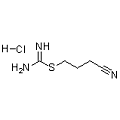
Synonyms: thioureidobutyronitrile
Kevetrin (thioureidobutyronitrile), is a water-soluble, small molecule and activator of the tumor suppressor protein p53, with potential antineoplastic activity.
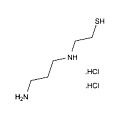
WR 1065, a dephosphorylated metabolite of amifostine (Ethyol), can protect against the immediate and delayed effects of radiation exposure.
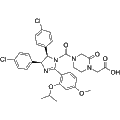
Nutlin carboxylic acid (MDM2 ligand 1) is the Nutlin 3-based MDM2 ligand. Nutlin carboxylic acid (MDM2 ligand 1) can be connected to the ligand for protein by a linker to form PROTACs.
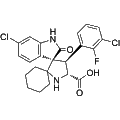
MDM2 Ligand 5 is a potent ligand targeting the MDM2 protein, known for its role in regulating p53 activity. This compound serves as a critical building block for the development of Proteolysis Targeting Chimeras (PROTACs), facilitating the selective degradation of MDM2 to enhance p53-mediated tumor suppression. MDM2 Ligand 5 is valuable for research applications focused on cancer therapeutics and the modulation of oncogenic pathways.
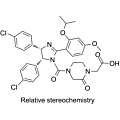
(rel)-Nutlin carboxylic acid is an MDM2 ligand derived from Nutlin 3, targeting the MDM2 protein to inhibit its interaction with p53. This compound plays a crucial role in cancer research, particularly in the study of p53 pathway modulation and potential therapeutic interventions. It can also be utilized in the development of PROTACs when linked to other proteins, facilitating targeted protein degradation.
Out of stock
All 3 sizes