- Cat. No.
- A11206
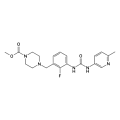
Omecamtiv mecarbil (CK-1827452)
Synonyms: CK1827452
CK-1827452 is a selective cardiac specific myosin activator.
In stock
- Isabella Leite Coscarella, .et al. , iScience, 2025, Oct 30;28(12):113901 PMID: 41321620
- Joohee Choi, .et al. , Am J Physiol Heart Circ Physiol, 2025, Jan 1;328(1):H161-H173 PMID: 39453428
- A. Balakin, .et al. , J Evol Biochem Physiol, 2023, 59: 1182-1194
- Oleg Lookin, .et al. , Clin Exp Pharmacol Physiol, 2021, Aug 29 PMID: 34459025
- Gabor A. Fulop, .et al. , Basic Res Cardiol, 2021, 116(1): 24 PMID: 33844095
- Wanjian Tang, .et al. , J Biol Chem, 2019, October 2 PMID: 31578282
- Thinh T. Kieu, .et al. , Biophysical Journal, 2019, 2019 PMID: 31103235
- Alexandre J. S. Ribeiro, .et al. , Circ Res, 2017, May 12; 120(10): 1572-1583 PMID: 28400398
- Anja M. Swenson, .et al. , J Biol Chem, 2017, Mar 3; 292(9): 3768-3778 PMID: 28082673
- Nánási P Jr, .et al. , Eur J Pharmacol, 2017, Aug 15;809:73-79 PMID: 28506910
- Horváth B, .et al. , Naunyn Schmiedebergs Arch Pharmacol, 2017, Dec;390(12):1239-1246 PMID: 28940010
- Szentandrassy N, .et al. , J Physiol Pharmacol, 2016, Aug;67(4):483-489 PMID: 27779469
- L Nagy, .et al. , Br J Pharmacol, 2015, Sep; 172(18): 4506-4518 PMID: 26140433
- Larissa Butler, .et al. , Toxicol Sci, 2015, Jun;145(2):396-406 PMID: 25820236
View Details