NF-κB

NF-κB inhibitors act on the transcription factor family that switches on many inflammatory and immune response genes. Nuclear factor kappa B (NF-κB) was identified in 1986 as a B cell nuclear factor binding the immunoglobulin kappa enhancer. It forms dimers from five Rel family proteins, including RelA, also called p65. In resting cells, inhibitor of κB (IκB) proteins hold these dimers in the cytoplasm. This category focuses on compounds that affect NF-κB dimers, their nuclear entry, DNA binding or target gene expression. Representative compounds include JSH 23, QNZ, SC75741 and the natural product withaferin A. Compounds acting on the upstream IκB kinase complex are listed in the neighboring IκK/IκB category.

16 Items

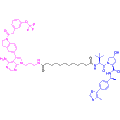
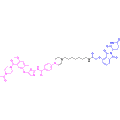
  • Zomiradomide
    Cat. No.
    A24835

    Zomiradomide

    Synonyms: KT-413

    Zomiradomide is an orally bioavailable PROTAC degrader targeting IRAK4, with a DC50 of 6 nM, which effectively inhibits the NF-κB signaling pathway. In addition to its suppression of IRAK4, Zomiradomide functions as a molecular glue, facilitating the degradation of Ikaros with a DC50 of 1 nM and consequently activating the type I IFN signaling pathway. This dual action positions Zomiradomide as a valuable tool in research focused on immune modulation and inflammatory responses.

    1 mg
    $125.00
    5 mg
    $230.00
    All 6 sizes
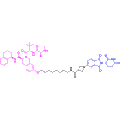
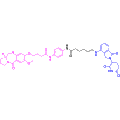
  • LD4172
    Cat. No.
    A25074

    LD4172

    LD4172 is a selective RIPK1 PROTAC degrader that exhibits a Ki of 4.8 nM. It facilitates RIPK1 protein degradation through the formation of a ternary complex with RIPK1 and VHL E3 ligase, leading to ubiquitination and proteasomal degradation. LD4172 effectively inhibits TNF-induced classical NF-κB signaling in TRAF2-deficient cells, significantly reducing IκBα phosphorylation and IL-8 production. Additionally, it promotes apoptosis and immunogenic cell death in tumor cells, enhances tumor-infiltrating lymphocyte responses, and sensitizes tumors to anti-PD1 therapy, making it a valuable chemical probe for studying RIPK1-related functions in melanoma and colon cancer research.

    1 mg
    $495.00
    5 mg
    $1,025.00
    All 3 sizes
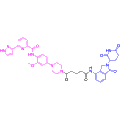
  • TD1092
    Cat. No.
    A25449

    TD1092

    TD1092 is a PROTAC that functions as a pan-IAP degrader, effectively targeting cIAP1, cIAP2, and XIAP. By promoting the degradation of IAPs, TD1092 activates Caspase 3/7, leading to apoptosis in cancer cells. Additionally, it inhibits the TNFα-mediated NF-κB signaling pathway, reducing the phosphorylation of IKK, IkBα, p65, and p38. This compound is primarily used in cancer research to explore mechanisms of apoptosis and therapeutic resistance.

    1 mg
    $270.00
    5 mg
    $690.00
    All 5 sizes
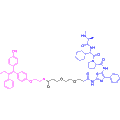
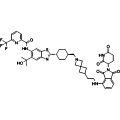
  • GNE-5472
    Cat. No.
    A26045

    GNE-5472

    GNE-5472 is a potent bifunctional degrader targeting estrogen receptor alpha (ERα) through the PRRTAC mechanism. By functioning as a pan-IAP antagonist, GNE-5472 inhibits cIAP1/2, thereby activating the non-classical NF-κB pathway, which leads to significant upregulation of TNFα expression. This compound effectively inhibits the proliferation of breast cancer cells and promotes apoptosis. GNE-5472 is valuable for research applications in the study of breast cancer and related signaling pathways.

    Out of stock

    All 3 sizes
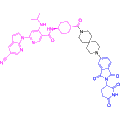
  • FIP22
    Cat. No.
    A26156

    FIP22

    FIP22 is a potent and selective degrader of IRAK4 utilizing the PROTAC technology. It functions by inducing degradation through the formation of a ternary complex consisting of IRAK4, FIP22, and CRBN, with an EC50 of 12.63 nM. This mechanism effectively inhibits IRAK4-mediated signaling pathways, including NF-κB and MAPK pathways, making FIP22 valuable for research into conditions such as atopic dermatitis, where IRAK4 plays a critical role.

    5 mg
    $1,265.00
    10 mg
    $1,805.00
    All 4 sizes
  • R1-ICR-5
    Cat. No.
    A26221

    R1-ICR-5

    R1-ICR-5 is a selective RIPK1 PROTAC degrader designed to mediate protein degradation via the VHL pathway. This compound promotes the degradation of RIPK1, subsequently dysregulating TNFR1 and TLR3/4 signaling pathways, enhancing the activity of NF-κB, MAPK, and IFN signaling. Additionally, R1-ICR-5 facilitates RIPK3 activation, leading to necroptosis. This reagent is applicable in research focused on triple-negative breast cancer and skin inflammation.

    5 mg
    $1,130.00
    10 mg
    $1,930.00
    All 5 sizes
  • HD-TAC7
    Cat. No.
    A26537

    HD-TAC7

    HD-TAC7 is a highly effective PROTAC HDAC degrader, specifically targeting histone deacetylases HDAC1, HDAC2, and HDAC3 with IC50 values of 3.6 μM, 4.2 μM, and 1.1 μM, respectively. This compound has demonstrated the ability to reduce NF-κB p65 levels in RAW 264.7 macrophages. HD-TAC7 is suitable for research applications focused on inflammatory diseases, including asthma and chronic obstructive pulmonary disease (COPD).

    1 mg
    $160.00
    5 mg
    $375.00
    All 6 sizes
  • PROTAC XPO1 degrader-1
    Cat. No.
    A30885

    PROTAC XPO1 degrader-1

    PROTAC XPO1 degrader-1 is a targeted protein degrader designed to selectively promote the degradation of XPO1. This compound demonstrates significant anti-proliferative effects, induces apoptosis, inhibits NF-κB signaling, and causes cell cycle arrest at the G1 phase. It is an important tool for researching hematological malignancies, offering insights into therapeutic strategies by modulating XPO1 levels.

    1 mg
    $385.00
    5 mg
    $945.00
    All 4 sizes
  • PROTAC BTK Degrader-6
    Cat. No.
    A34408

    PROTAC BTK Degrader-6

    PROTAC BTK Degrader-6 is a potent PROTAC degrader targeting Bruton's tyrosine kinase (BTK) with a DC50 of 3.18 nM. This compound exhibits anti-inflammatory activity by inhibiting NF-κB activation and reducing the expression of pro-inflammatory cytokines, including IL-1β and IL-6. It serves as a valuable tool for research into the modulation of immune responses and the development of therapies for inflammatory diseases.

    1 mg
    $430.00
    5 mg
    $1,105.00
    All 4 sizes
  • INNO-220
    Cat. No.
    A36893

    INNO-220

    INNO-220 is a CRBN-dependent molecular glue degrader that specifically targets CK1α. This orally active compound induces cell cycle arrest at the G0/G1 phase and promotes apoptosis through the degradation of CK1α. Additionally, INNO-220 disrupts the assembly and function of the CARD11/BCL10/MALT1 complex, effectively inhibiting NF-κB signaling in stimulated T cells and lymphoma cells with activating mutations in CARD11. This reagent serves as a valuable tool for advancing research in lymphoma.

    5 mg
    $140.00
    10 mg
    $230.00
    All 5 sizes
  • EN450
    Cat. No.
    A42445

    EN450

    EN450 is a cysteine-reactive covalent molecular glue degrader targeting NF-κB. By engaging with allosteric C111 in the E2 ubiquitin ligase UBE2D, EN450 facilitates the formation of a ternary complex involving UBE2D and NFKB1. This interaction leads to the degradation of NF-κB, resulting in notable anti-proliferative effects through a Cullin E3 ligase and proteasome-dependent mechanism. EN450 serves as a valuable tool for research involving NF-κB signaling and its implications in cancer biology.

    2 mg
    $30.00
    5 mg
    $50.00
    All 8 sizes
  • PROTAC STING degrader-3
    Cat. No.
    A65574

    PROTAC STING degrader-3

    PROTAC STING degrader-3 is a potent STING PROTAC degrader that operates through the ubiquitin-proteasome pathway, exhibiting a DC50 of 0.62 μM. This compound facilitates STING degradation, resulting in the inhibition of STING/TBK1/NF-κB signaling, thereby exerting notable anti-inflammatory effects. Additionally, PROTAC STING degrader-3 demonstrates renal protective properties and serves as a valuable tool for investigating acute kidney injury (AKI).

    1 mg
    $545.00
    5 mg
    $1,395.00
    All 3 sizes
  • (S,R,S)-AHPC-Boc derivative 1
    Cat. No.
    A76597

    (S,R,S)-AHPC-Boc derivative 1

    Synonyms: VH032-Boc derivative 1

    (S,R,S)-AHPC-Boc derivative 1 is a selective proteasomal degrader that targets MALT1. By recruiting the E3 ubiquitin ligase CRBN, it forms a ternary complex with MALT1, facilitating its ubiquitination and subsequent proteasomal degradation. This compound inhibits the NF-κB signaling pathway by disrupting the CBM complex, which may induce apoptosis in ABC-DLBCL cells. (S,R,S)-AHPC-Boc derivative 1 is valuable for the investigation of MALT1-dependent cancers, particularly diffuse large B-cell lymphoma (DLBCL).

    25 mg
    $65.00
    50 mg
    $100.00
    All 3 sizes
  • BSJ-05-037
    Cat. No.
    A79551

    BSJ-05-037

    BSJ-05-037 is an ITK PROTACs degrader that efficiently induces the degradation of ITK in T-cell lymphoma cell lines. This compound inhibits the NF-κB/GATA-3 signaling pathway and decreases PLCγ1 phosphorylation, thereby reducing the proliferation of T-cell lymphoma cells. Additionally, BSJ-05-037 enhances the sensitivity of these cancer cells to chemotherapy. In mouse models, it has shown the ability to diminish GATA-3 expression, lower tumor volume, and counteract chemotherapy resistance, making it a valuable tool for research on T-cell lymphoma.

    5 mg
    $1,265.00
    10 mg
    $1,940.00
    All 3 sizes
  • JP-163-16
    Cat. No.
    A79587

    JP-163-16

    JP-163-16 is a RelA/p65 PROTAC degrader that facilitates the selective degradation of RelA/p65 via the proteasome pathway. By inhibiting the NF-κB signaling pathway, JP-163-16 promotes apoptosis in cells, making it a valuable tool for investigating RelA/p65-dependent tumors, including chronic lymphocytic leukemia (CLL). This compound is instrumental for studies aimed at understanding the role of NF-κB in cancer progression and therapeutic resistance.

    1 mg
    $275.00
    5 mg
    $710.00
    All 4 sizes
  • PSP-0119
    Cat. No.
    B22084

    PSP-0119

    PSP-0119 is a highly selective PROTAC degrader targeting IRAK4, demonstrating an IC50 of 2.83 nM. This compound effectively inhibits IRAK4 kinase activity, NF-κB signaling, and IL-1β-induced IRAK4 phosphorylation. Notably, PSP-0119 induces degradation of IRAK4 specifically in FLT3-mutant acute myeloid leukemia (AML) cell lines while sparing FLT3-wild-type AML cells and normal bone marrow. It serves as a valuable tool for research into the mechanisms underlying AML, particularly in targeting aberrant IRAK4 activity.

    5 mg
    $1,230.00
    10 mg
    $1,890.00
    All 5 sizes

16 Items

Added to your cart

View Cart Checkout

    Loading...