Proteasome

Proteasome inhibitors block the 26S proteasome, the protease complex that degrades ubiquitin-tagged proteins. Its 20S core carries caspase-like, trypsin-like and chymotrypsin-like active sites on β subunits with an N-terminal threonine. In 1994, peptide aldehydes including MG-132 were shown to block degradation of most cell proteins. The same inhibitors prevented generation of peptides for major histocompatibility complex (MHC) class I molecules. Lactacystin, a Streptomyces metabolite, modifies the catalytic threonine of specific subunits. Later chemotypes include the boronates bortezomib and ixazomib and the epoxyketones carfilzomib and epoxomicin, which bind irreversibly. ONX-0914 prefers low molecular mass polypeptide 7 (LMP7), a subunit of the immunoproteasome.

10 Items

  • 20S Proteasome activator 1
    Cat. No.
    A77298

    20S Proteasome activator 1

    20S Proteasome Activator 1 is a potent activator of the 20S proteasome, demonstrating effective EC200 values of 0.3 μM, 0.7 μM, and 1.8 μM for trypsin-like, chymotrypsin-like, and caspase-like activities, respectively. This compound functions effectively within cellular environments, mitigating the accumulation of the pathogenic A53T mutant of α-synuclein. It is particularly useful for research in the context of neurodegenerative diseases, facilitating studies on proteostasis and related therapeutic approaches.

    5 mg
    $50.00
    10 mg
    $80.00
    All 5 sizes
  • Z-Ala-Arg-Arg-AMC
    Cat. No.
    A77300

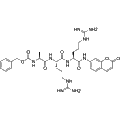
    Z-Ala-Arg-Arg-AMC

    Synonyms: Fluorogenic Proteasome Substrate; Z-ARR-AMC

    Z-Ala-Arg-Arg-AMC is a fluorogenic proteasome substrate designed to specifically assay the trypsin-like activity of the proteasome. Its unique structure allows for sensitive detection of proteolytic activity, making it a valuable tool for studying protein degradation and turnover in cellular processes. This substrate is widely utilized in research applications focused on proteasome function and its implications in various diseases.

    5 mg
    $105.00
    10 mg
    $170.00
    All 2 sizes
  • Ac-Nle-Pro-Nle-Asp-AMC
    Cat. No.
    A77307

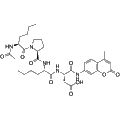
    Ac-Nle-Pro-Nle-Asp-AMC

    Ac-Nle-Pro-Nle-Asp-AMC is a specific substrate designed for the 26S proteasome, targeting its catalytic activities. This compound is utilized primarily for assessing the caspase-like activity of the 26S proteasome in various biological studies. Its application is crucial for understanding proteasomal regulation and function in cellular processes.

    1 mg
    $40.00
    5 mg
    $80.00
    All 4 sizes
  • Immunoproteasome activator 1
    Cat. No.
    A77318

    Immunoproteasome activator 1

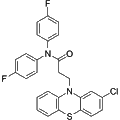
    Immunoproteasome Activator 1 is a selective activator of the immunoproteasome that enhances the presentation of MHC-I-bound peptides by over 100-fold. This compound functions by binding to the proteasome structural subunit PSMA1, facilitating the association of the proteasome activator PA28α/β (PSME1/PSME2) with immunoproteasomes. Its significant biological activity makes it valuable for research focused on immune response modulation and antigen processing.

    1 mg
    $265.00
    All 1 sizes
  • Biotin-epoxomicin
    Cat. No.
    A77319

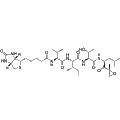
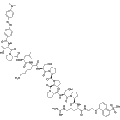
    Biotin-epoxomicin

    Biotin-epoxomicin is a proteasome subunit binder that serves as an affinity reagent for the identification and purification of proteasomal catalytic subunits. This compound enables the affinity purification of active subunits, facilitating their subsequent analysis via liquid chromatography-mass spectrometry (LC-MS). Biotin-epoxomicin is particularly useful in research applications focused on solid tumors, such as those derived from B16 melanoma, providing insights into proteasome function in cancer biology.

    1 mg
    $50.00
    5 mg
    $125.00
    All 3 sizes
  • Z-Leu-Leu-Leu-AMC
    Cat. No.
    A77322

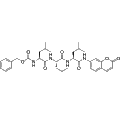
    Z-Leu-Leu-Leu-AMC

    Synonyms: Z-LLL-AMC

    Z-Leu-Leu-Leu-AMC is a fluorogenic substrate designed for the assessment of chymotrypsin-like protease activity in the 20S proteasome. It provides a sensitive and specific means to monitor proteasomal function and proteolytic activity. This reagent is valuable for research applications involving protein degradation, cellular homeostasis, and the study of proteasome-related diseases.

    1 mg
    $80.00
    5 mg
    $255.00
    All 2 sizes
  • Calpain substrate
    Cat. No.
    A77331

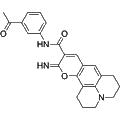
    Calpain substrate

    Calpain substrate is a fluorogenic substrate specifically designed for the assessment of calpain enzymatic activity. It is membrane non-permeable, ensuring precise measurement of calpain activity in biological samples. This reagent is suitable for applications in cellular signaling research and studies investigating calpain's role in various physiological and pathological processes.

    1 mg
    $105.00
    5 mg
    $260.00
    All 4 sizes
  • Suc-Ala-Ala-Pro-Phe-SBzl
    Cat. No.
    A77333

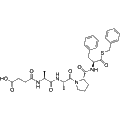
    Suc-Ala-Ala-Pro-Phe-SBzl

    Suc-Ala-Ala-Pro-Phe-SBzl is a synthetic peptide substrate targeting rat intestinal mast cell proteases RMCP I and RMCP II, as well as chymotrypsin. It serves as a useful tool for investigating proteolytic activity in biochemical assays. Additionally, Suc-Ala-Ala-Pro-Phe-SBzl can be hydrolyzed by glycine (R208G), facilitating studies on enzyme specificity and catalytic mechanisms. This substrate is valuable in researching mast cell biology and protease functions.

    Out of stock

    All 3 sizes
  • Bz-VGR-AMC
    Cat. No.
    A77358

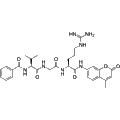
    Bz-VGR-AMC

    Bz-VGR-AMC is a synthetic substrate specifically designed for the trypsin-like activity of the 20S proteasome. This compound enables the quantification of β2 activity within the proteasome, serving as a valuable tool for researching proteasomal function and regulation. Its application is particularly relevant in studies investigating cellular protein degradation, signaling pathways, and disease mechanisms associated with proteasomal dysregulation.

    Out of stock

    All 3 sizes
  • MeOSuc-Gly-Leu-Phe-AMC
    Cat. No.
    A77367

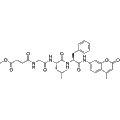
    MeOSuc-Gly-Leu-Phe-AMC

    MeOSuc-Gly-Leu-Phe-AMC is a peptide substrate specifically designed for proteasomal activity assays. This compound facilitates the study of proteasome function by serving as a sensitive probe for proteolytic activity. It is particularly useful in research areas focused on protein degradation pathways and cellular regulation mechanisms, providing insights into various biological processes and potential disease states.

    Out of stock

    All 3 sizes

10 Items

Added to your cart

View Cart Checkout

    Loading...