- Cat. No.
- A10657
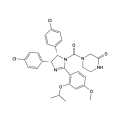
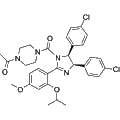
Nutlin-3
MDM2 antagonist nutlin-3 is a potent inducer of apoptosis.
Search by product name, CAS, target or catalog number. Press Down Arrow to reach product suggestions, Tab to move between links, and Escape to close suggestions.
MDM2 inhibitors disrupt the binding of mouse double minute 2 homolog (MDM2) to the tumor suppressor p53. In 1992 the MDM2 protein was shown to form a complex with p53 and inhibit p53-mediated transactivation. MDM2 is also an E3 ubiquitin ligase that promotes the rapid degradation of p53, as reported in 1997. Nutlins, reported in 2004, occupy the p53-binding pocket of MDM2 and activate the p53 pathway in cells and in vivo. Nutlin 3a is the active enantiomer of nutlin-3, and Nutlin 3b is a much weaker enantiomer used as a control. RG7112 and APG-115 are further MDM2 inhibitors, while MD-224 is a degrader that removes MDM2 protein. SJ 172550 targets the MDM2 relative MDM4 (also called MDMX).
MDM2 antagonist nutlin-3 is a potent inducer of apoptosis.
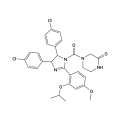
Synonyms: (+)-Nutlin-3
Nutlin 3b is a p53/MDM2 antagonist or inhibitor with IC50 value of 13.6 uM, 150-fold less potent (+)-enantiomer of Nutlin-3 as in comparison with opposite (-)-enantiomer Nutlin-3a.
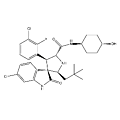
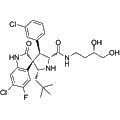
Synonyms: SAR405838
MI-773 is an orally available MDM2 antagonist with Ki of 0.88 nM.
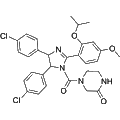
Synonyms: (Rac)-Rebemadlin
(Rac)-Nutlin-3 is a potent antagonist of the murine double minute protein 2 (MDM2), with an IC50 of 90 nM. This compound effectively disrupts the interaction between MDM2 and p53, leading to stabilization of the p53 protein. Additionally, (Rac)-Nutlin-3 promotes cell autophagy and apoptosis, making it a valuable tool for investigating the roles of MDM2 in TP53 wild-type ovarian carcinomas and other related cancer research applications.
MI-219 is an MDM2 antagonist with a Ki of 13.3 μM, specifically designed to disrupt the interaction between MDM2 and p53. This compound effectively inhibits the proliferation of FSCCL cells, demonstrated by an IC50 of 2.5 μM. MI-219 is suitable for research applications focused on cancer biology, particularly in studies exploring pathways related to tumor suppression and the p53 signaling axis.
Nutlin 1 is a potent MDM2 antagonist that reactivates the p53 pathway, playing a critical role in cell cycle regulation and apoptosis. With an IC50 of 0.26 μM, it effectively disrupts the MDM2-p53 interaction, promoting p53-mediated transcriptional activity. This compound is widely used in cancer research to explore the therapeutic potential of p53 reactivation in tumor cells.