- Cat. No.
- A10064
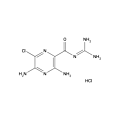
Amiloride HCl
Synonyms: MK 870; Midamor; Colectril; Amipramizide; Guanamprazine hydrochloride
Amiloride hydrochloride is a Na+ channel blocker, also inhibits TRPP3 channels and Na+/H+ exchanger (NHE).
Search by product name, CAS, target or catalog number. Press Down Arrow to reach product suggestions, Tab to move between links, and Escape to close suggestions.
Na+/H+ exchanger (NHE) inhibitors act on transporters that exchange sodium ions for protons. The exchangers form solute carrier family 9 (SLC9) and help control intracellular pH, cell volume and sodium handling. A human growth factor-activatable antiporter, now called NHE1, was cloned in 1989 and is present in most cell types. NHE3 sits in the apical membrane of intestinal and renal epithelia, where it mediates sodium absorption. In 2014, gut-restricted inhibition of NHE3 by tenapanor reduced intestinal sodium uptake in rats and humans. Cariporide, rimeporide and BI-9627 are NHE1 inhibitors used in studies of cardiac and muscle cell pH. Amiloride HCl, a sodium channel blocker, also inhibits Na+/H+ exchange.
Synonyms: MK 870; Midamor; Colectril; Amipramizide; Guanamprazine hydrochloride
Amiloride hydrochloride is a Na+ channel blocker, also inhibits TRPP3 channels and Na+/H+ exchanger (NHE).
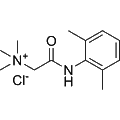
QX-222 chloride is a potent sodium (Na+) channel blocker, acting as a trimethyl analogue of Lignocaine. This compound exhibits significant inhibitory effects on neuronal excitability and plays a crucial role in studying ion channel functions and mechanisms of action. Research applications include elucidating pain pathways and investigating local anesthetic properties in cellular models.
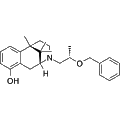
Synonyms: BIII-890; BIII-890 CL free acid
Crobenetine, a benzomorphan derivative and a potent Na+ channel blocker, selectively targets site 2 of the Na+ channel with an IC50 of 49 nM in rat brain synaptosomes. This compound demonstrates strong use-dependent inhibition while maintaining low binding affinity for other receptors and ion channels. Crobenetine has been shown to protect brain tissue from the harmful effects of focal cerebral ischemia in rodent models, making it a valuable tool for researching neuroprotection and ion channel physiology.