
- Cat. No.
- A19826
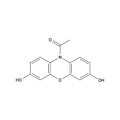
ADHP
ADHP is a fluorogenic peroxidase substrate (λex=530 nm, λem=590 nm).
In stock
View Details
Search by product name, CAS, target or catalog number. Press Down Arrow to reach product suggestions, Tab to move between links, and Escape to close suggestions.
Browse substrates and optical reporter reagents for enzyme-activity assays. Enzyme-activated fluorogenic probes can convert a chemical transformation into a fluorescence readout.[1] Choose the exact reagent for your enzyme, sample and detection method, and distinguish fluorescent from color-based readouts. This collection does not imply that every substrate is selective for one enzyme or suitable for use in living cells.
[1] Chyan W, Raines RT. Enzyme-Activated Fluorogenic Probes for Live-Cell and in Vivo Imaging. ACS Chemical Biology. 2018;13(7):1810–1823. DOI: 10.1021/acschembio.8b00371. PMID: 29924581; PMCID: PMC6056172.
ADHP is a fluorogenic peroxidase substrate (λex=530 nm, λem=590 nm).
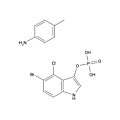
Synonyms: BCIP p-toluidine salt; X-phosphate p-toluidine salt
BCIP(BCIP p-toluidine salt; X-phosphate p-toluidine salt) is an artificial chromogenic substrate used for the sensitive colorimetric detection of alkaline phosphatase activity.
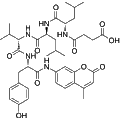
Suc-Leu-Leu-Val-Tyr-AMC is a fluorogenic substrate.
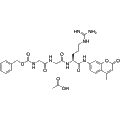
Z-Gly-Gly-Arg-AMC acetate is a thrombin-specific fluorogenic substrate for testing of thrombin generation in PRP and platelet-poor plasma (PPP).
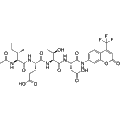
Ac-IETD-AFC is a fluorogenic substrate of caspase-8, caspase-3, caspase-10, and granzyme B.
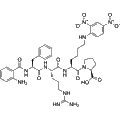
Abz-FR-K(Dnp)-P-OH is an angiotensin I-converting enzyme (ACE) substrate and an internally quenched fluorogenic substrate for real time fluorescent assay.
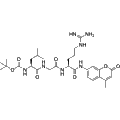
Boc-Leu-Gly-Arg-AMC is a fluorogenic AMC substrate for the convertases. Boc-Leu-Gly-Arg-AMC can be used in enzymatic assays.
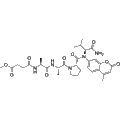
MeOSuc-AAPV-AMC is a fluorogenic substrate for human leukocyte and porcine pancreatic elastase (Km: 362 μM, Ex=380 nm, Em=460 nm).
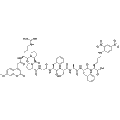
Mca-(ala7,lys(dnp)9)-bradykinin is a sensitive fluorogenic substrate for ECE-1 (endothelin-converting enzyme-1). The incorporation of a (7-methoxycoumarin-4-yl)acetyl (Mca) fluorescent group and a 2,4-dinitrophenyl (Dnp) quenching group has resulted in a large fluorescence increase upon substrate cleavage.
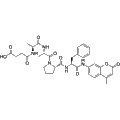
Synonyms: Suc-Ala-Ala-Pro-Phe-AMC
Suc-AAPF-AMC is an α-chymotrypsin fluorogenic substrate for the quantitative determination of chymotrypsin activity.
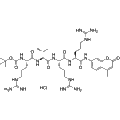
Synonyms: Boc-RVRR-AMC
Boc-Arg-Val-Arg-Arg-AMC hydrochloride (Boc-RVRR-AMC) is a synthetic fluorogenic substrate that is efficiently cleaved by furin.
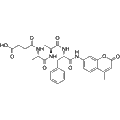
Suc-Ala-Ala-Phe-AMC is a fluorogenic chymotrypsin substrate, can be hydrolyzed by endopeptidase. Suc-Ala-Ala-Phe-AMC has been used in both in vivo assays of the acrosome reaction and in vitro enzyme assays.
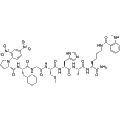
Synonyms: Dnp-P-Cha-G-Cys(Me)-HA-K(Nma)-NH2
MMP-1/MMP-9 Substrate, Fluorogenic is a highly sensitive substrate specifically designed for the detection of matrix metalloproteinases MMP-1 and MMP-9. Upon cleavage by these enzymes, it emits fluorescence with excitation and emission wavelengths at 340 nm and 440 nm, respectively. This substrate is ideal for research applications involving extracellular matrix remodeling, cancer metastasis studies, and the assessment of tissue remodeling processes.
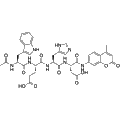
Synonyms: AC-WEHD-AMC
Ac-Trp-Glu-His-Asp-AMC is a specific fluorogenic substrate designed for caspase-1 detection and activity measurement. This compound exhibits high sensitivity and selectivity for caspase-1, enabling the quantitative assessment of apoptotic processes and inflammatory pathways. Its application in fluorescence assays facilitates the study of caspase-1's role in various biological contexts, including immune responses and cell death mechanisms.
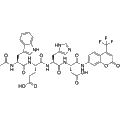
Ac-WEHD-AFC is a fluorogenic substrate specifically designed for the detection of caspase-1 activity. This compound enables the quantitative measurement of caspase-1 enzymatic function, making it a valuable tool in studies related to tumorigenesis and inflammatory processes. Its sensitive fluorescence readout facilitates the assessment of caspase-1 involvement in various biological systems.
Out of stock
All 3 sizes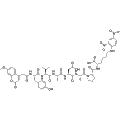
Mca-YVADAP-Lys(Dnp)-OH is a fluorogenic substrate designed for the characterization of caspase-1 and angiotensin-converting enzyme 2 (ACE2) activity. This compound enables the detection of enzymatic activity through fluorescence, making it valuable for studies focused on apoptosis and cardiovascular signaling pathways. It is suitable for use in various assays aimed at exploring the roles of these enzymes in cellular processes and disease states.
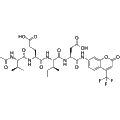
Ac-VEID-AFC is a fluorogenic substrate specifically designed for the detection of caspase-6 activity. Its cleavage by caspase-6 produces a fluorescent signal, making it a valuable tool for assessing apoptotic processes and related signaling pathways in various biological systems. This substrate is widely utilized in research applications focused on cell death, inflammation, and neurodegenerative diseases.
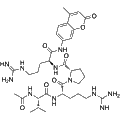
Ac-VRPR-AMC is a fluorogenic substrate specifically designed for the detection of metacaspase activity. This compound is utilized in biochemical assays to measure metacaspase activity, making it a valuable tool for research in apoptosis and programmed cell death. Its fluorescence properties enable sensitive detection, facilitating studies on metacaspase function in various biological systems.
Out of stock
All 3 sizes
Synonyms: Abltide
Abl Cytosolic Substrate serves as an active substrate for the Abelson tyrosine kinase (Abl). This substrate is vital for studying the enzymatic activity of Abl, a truncated form of the v-Abl protein associated with the Gag-Abl fusion protein in Abelson murine leukemia virus. It is primarily utilized in research applications focusing on signal transduction and oncogenic processes mediated by tyrosine phosphorylation.
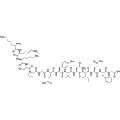
IGF1Rtide is a specific substrate for Ret proto-oncogene kinase (RET) that facilitates the assessment of RET kinase activity in various biochemical assays. This peptide is instrumental in evaluating RET signaling pathways and investigating the role of RET in cancer biology and cellular signaling processes. Its use in kinase assays aids in the development of RET-targeted therapies and drug discovery efforts.
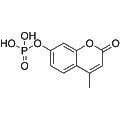
Synonyms: 4-MUP; MUP
4-Methylumbelliferyl phosphate is a fluorogenic substrate for acid and alkaline phosphatases. Upon dephosphorylation, it produces a fluorescent product, enabling sensitive detection in enzyme activity assays. This reagent is widely utilized in research applications involving phosphatase activity, enzymatic kinetics, and biological assays requiring fluorescent readout. Additionally, it serves as a nerve agent simulant in various experimental contexts.
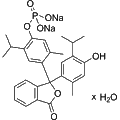
Thymolphthalein monophosphate disodium hydrate serves as a chromogenic substrate for the detection of acid and alkaline phosphatases. Upon enzymatic hydrolysis, it releases thymolphthalein, which increases the medium's pH, facilitating colorimetric detection and cessation of hydrolysis. This reagent is particularly valuable for the specific identification of prostatic phosphatase in serum samples, making it an essential tool in biochemical research and clinical diagnostics.
Out of stock
All 3 sizes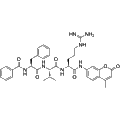
Bz-FVR-AMC is a fluorogenic substrate specifically designed for the assay of procathepsin activity. With a kcat/Km value of 1070 mM^-1s^-1, it provides a robust tool for measuring cathepsin enzyme activity in various biological samples. Bz-FVR-AMC is particularly useful for studying proteolytic processes and understanding cysteine protease functions in both physiological and pathological contexts. However, at high concentrations, this substrate may exhibit inhibitory effects.
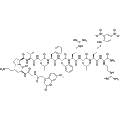
Cathepsin D and E FRET Substrate is a fluorogenic substrate specifically designed for the selective detection of cathepsins D and E, avoiding interaction with cathepsins B, H, and L. Cleavage occurs at the Phe-Phe amide bond, releasing a fluorescent signal that can be quantitatively measured. This substrate is ideal for routine assays and mechanistic studies, facilitating the investigation of cathepsin activity in various biological contexts.
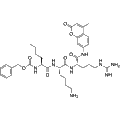
Z-Nle-Lys-Arg-AMC is a fluorogenic peptide substrate designed to specifically detect cathepsin B activity across a wide pH range. This substrate undergoes cleavage by cathepsin B, resulting in fluorescence which can be quantitatively measured. It is particularly valuable in studies related to protease activity, cell signaling, and understanding pathological processes where cathepsin B is involved.
Out of stock
All 3 sizes