- Cat. No.
- A19383
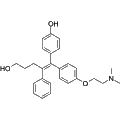
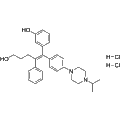
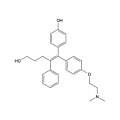
GSK5182
GSK5182 is a highly selective inverse agonist of estrogen-related receptor γ (ERRγ) with an IC50 of 79 nM and does not interact with other nuclear receptors, including ERRα or ERα.
Search by product name, CAS, target or catalog number. Press Down Arrow to reach product suggestions, Tab to move between links, and Escape to close suggestions.
Estrogen receptor (ER) antagonists and modulators act on ERα and ERβ, ligand-activated nuclear transcription factors. Cloning of human ERα complementary DNA in 1986 revealed homology with the v-erb-A oncogene product. A second receptor, ERβ, was cloned from rat prostate and ovary in 1996. Crystal structures from 1997 showed that agonists and the antagonist raloxifene place the ligand-binding domain in different conformations. Ligands here include Tamoxifen Citrate and its active metabolite (E/Z)-4-hydroxy Tamoxifen, both used in ER signaling studies. Fulvestrant is an ER antagonist that also promotes receptor degradation. GSK5182 instead targets estrogen-related receptor gamma (ERRγ), an orphan receptor that does not bind estrogens.
GSK5182 is a highly selective inverse agonist of estrogen-related receptor γ (ERRγ) with an IC50 of 79 nM and does not interact with other nuclear receptors, including ERRα or ERα.
XCT 790 is a potent and specific inverse agonist of ERRα.
PROTAC ERRα ligand 2 is an estrogen-related receptor α (ERRα) inverse agonist with an IC50 of 5.67 nM. PROTAC ERRα ligand 2 (IC50=5.67 nM) displays a ~11-fold improved potency than XCT790 (IC50=61.3 nM).
(E/Z)-GSK5182 is a racemic mixture of the (E)- and (Z)-isomers that acts as a selective inverse agonist of estrogen-related receptor γ (ERRγ), exhibiting an IC50 of 79 nM. This compound is notable for its ability to induce the generation of reactive oxygen species (ROS), particularly in hepatocellular carcinoma models. Due to its specificity and biological activity, (E/Z)-GSK5182 is a valuable tool for investigating ERRγ-related signaling pathways and potential therapeutic applications in cancer research.
GSK1362 is a selective inverse agonist of REV-ERB, targeting the disruption of its interaction with repressive co-modulators such as NCoR1, SMRT2, and RIP140. By promoting the transcriptional activity of BMAL1, GSK1362 alleviates the repression caused by endogenous REV-ERB ligands. This compound has been shown to reduce LPS-induced inflammatory cytokine expression and inhibit IL-1β-induced Cxcl5 transcription in various cell types, making it a valuable tool for research into inflammatory diseases.
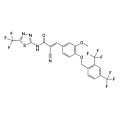
SLU-PP-1072 is a dual inverse agonist targeting ERRα and ERRγ. It demonstrates significant efficacy in prostate cancer research by disrupting cellular metabolism and inducing apoptosis through the dysregulation of the cell cycle. This compound serves as a valuable tool for studying the roles of nuclear receptors in cancer progression and metabolism.
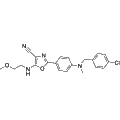
ERRα antagonist-2 is an inverse agonist of the estrogen-related receptor alpha (ERRα), exhibiting an IC50 of 0.80 μM. This compound effectively inhibits the migration and invasion of the ER-negative MDA-MB-231 breast cancer cell line. Furthermore, ERRα antagonist-2 demonstrates the ability to suppress breast cancer growth in vivo, making it a valuable tool for research into breast cancer therapies and the role of ERRα in cancer progression.
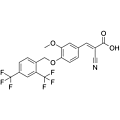
ERRγ inverse agonist 2 is a potent and selective inverse agonist targeting estrogen-related receptor gamma (ERRγ), demonstrating a Kd value of 6.5 μM. This compound effectively inhibits the expression of hepcidin, fibrinogen, and gluconeogenic genes. ERRγ inverse agonist 2 exhibits notable biological activities, including antimicrobial, anticoagulant, and antidiabetic effects, making it a valuable tool for research in metabolic disorders and inflammation.
Out of stock
All 3 sizes
ERRγ Inverse Agonist 1 is a selective inverse agonist of the estrogen-related receptor gamma (ERRγ) with an IC50 value of 40 nM. This compound exhibits potent antagonistic activity, making it useful for investigating the role of ERRγ in various biological processes. It is particularly relevant for research applications focused on metabolic regulation and cancer biology, where modulation of ERRγ signaling is of interest.