- Cat. No.
- A12592
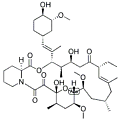
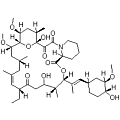
Ascomycin
Synonyms: FK 520; FR 900520
Ascomycin is a potent immunosuppressive agent that could be used as a potential therapeutic agent for autoimmune diseases.
Search by product name, CAS, target or catalog number. Press Down Arrow to reach product suggestions, Tab to move between links, and Escape to close suggestions.
Protein serine-threonine phosphatase inhibitors here mainly target calcineurin, a calcium-activated enzyme. Calcineurin, also called protein phosphatase 2B (PP2B), removes phosphate from serine and threonine residues when calcium and calmodulin bind to it. A 1991 study showed that cyclosporine bound to cyclophilin, and FK-506 bound to FK506-binding protein 12 (FKBP12), both inhibit calcineurin. In 1992, calcineurin was identified as a key signaling enzyme in T-lymphocyte activation. Its substrates include nuclear factor of activated T cells (NFAT) proteins, which enter the nucleus once dephosphorylated. Ascomycin acts through the same FKBP12 route, whereas INCA-6 blocks the calcineurin-NFAT interaction. Calcineurin Autoinhibitory Peptide mimics the enzyme's own inhibitory domain, and Protein Tyrosine Phosphatase covers the other major phosphatase class.
Synonyms: FK 520; FR 900520
Ascomycin is a potent immunosuppressive agent that could be used as a potential therapeutic agent for autoimmune diseases.
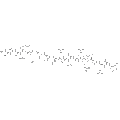
Calcineurin inhibitory peptide is a selective inhibitor of Ca2+-calmodulin-dependent protein phosphatase (calcineurin) (IC50 ~ 10 uM). Does not inhibit PP1, PP2A or CaM kinase II (IC50 > 100 mM).
Synonyms: NFAT Activation Inhibitor III
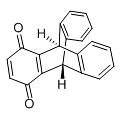
INCA-6 is a potent and selective inhibitor of calcineurin-NFAT (Nuclear Factor of Activated T cells) signaling.
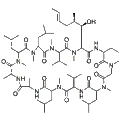
Cyclosporine is a calcineurin phosphatase pathway inhibitor, used as an immunosuppressant drug to prevent rejection in organ transplantation.
Synonyms: Immunomycin; FR-900520; FK520
Ascomycin is an ethyl analog of tacrolimus (FK506) with strong immunosuppressant properties. It has been researched for the treatment of autoimmune diseases and skin diseases, and to prevent rejection after an organ transplant.