- Cat. No.
- A10599
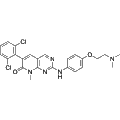
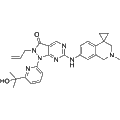
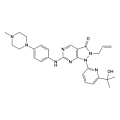
Adavosertib (MK-1775)
Synonyms: AZD1775; MK-1775
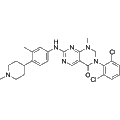
MK-1775 is a potent and selective Wee1 kinase inhibitor in vitro and in vivo.
Search by product name, CAS, target or catalog number. Press Down Arrow to reach product suggestions, Tab to move between links, and Escape to close suggestions.
Wee1 inhibitors act on a nuclear tyrosine kinase that delays entry into mitosis after DNA damage. Wee1 phosphorylates cyclin-dependent kinase 1 (CDK1) on tyrosine 15 and so keeps the CDK1-cyclin B complex inactive, as shown for the human enzyme in 1992. Protein kinase membrane-associated tyrosine/threonine 1 (PKMYT1) phosphorylates CDK1 on both threonine 14 and tyrosine 15. Blocking these kinases pushes cells with damaged DNA into premature mitosis. This effect is studied together with DNA-damaging agents, often in tumor cells that lack a functional G1 checkpoint. Adavosertib is a selective Wee1 inhibitor, whereas PD0166285 and PD 407824 also block checkpoint kinases listed under Chk. XH-30 inhibits PKMYT1, and HEMTAC WEE1 degrader-1 removes Wee1 by targeted degradation.
Synonyms: AZD1775; MK-1775
MK-1775 is a potent and selective Wee1 kinase inhibitor in vitro and in vivo.
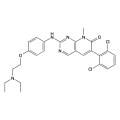
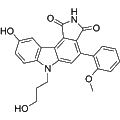
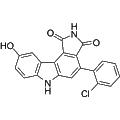
PD0166285 is a potent Wee1 and Chk1 inhibitor with activity at nanomolar concentrations.PD0166285 is a novel G2 checkpoint abrogator.
Pomalidomide-C3-adavosertib is a rapid and selective PROTAC degrader of Wee1, with an IC₅₀ of 3.58 nM. It exhibits anti-proliferative activity against cancer cells and induces apoptosis.
WEE1-IN-7 is a selective Wee1 inhibitor with an IC50 value of 2.1 nM. This compound induces apoptosis and facilitates cell cycle arrest during the S phase, making it valuable in the study of tumor biology. WEE1-IN-7 demonstrates significant antitumor activity, providing a useful tool for cancer research and therapeutic development.
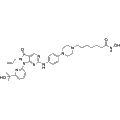
Wee1/HDAC-IN-1 is a dual inhibitor targeting Wee1 and histone deacetylases (HDACs). It demonstrates potent activity with an IC50 of 1.2 nM for Wee1 and varying IC50 values of 196 nM for HDAC1, 156 nM for HDAC3, and 55 nM for HDAC6. This compound displays significant antiproliferative effects in MV4-11 cells, with an IC50 of 0.076 μM, by disrupting DNA damage repair mechanisms and promoting apoptosis. Wee1/HDAC-IN-1 is suited for research on acute myeloid leukemia (AML).
Out of stock
All 3 sizes
PD-166285 is a potent inhibitor of PKMYT1, exhibiting an IC50 value of 17 nM. This compound demonstrates significant antiproliferative activity against CCNE1-amplified cancer cell lines, including OVCAR3 (IC50 = 0.14 μM) and HCC1569 (IC50 = 0.21 μM). In addition to its antiproliferative effects, PD-166285 induces apoptosis and effectively arrests CCNE1-amplified HCC1569 cells in the G1/S phase of the cell cycle. This reagent serves as a valuable tool for exploring PKMYT1-targeted therapies in the context of CCNE1-amplified malignancies.
XH-30 is a potent and selective inhibitor of PKMYT1, exhibiting an IC50 of 4.1 nM. This compound effectively suppresses the proliferation of P53-mutated triple-negative breast cancer (TNBC) cells by promoting G2/M phase release, inducing DNA damage, and triggering apoptosis. Additionally, XH-30 demonstrates significant antitumor effects in MDA-MB-231 mouse models, making it a valuable tool for research focused on P53-mutated TNBC.
Out of stock
All 3 sizes
HEMTAC WEE1 degrader-1 is a HSP90-mediated degrader specifically targeting the WEE1 kinase, with an IC50 of 16.76 nM for HSP90 inhibition. This compound facilitates the ubiquitination and subsequent degradation of WEE1, effectively disrupting the G2/M cell cycle checkpoint. It demonstrates significant anticancer activity in acute myeloid leukemia (AML) patient-derived xenograft models, making it a valuable reagent for research applications in AML therapeutics.
PD 407824 is a selective inhibitor of checkpoint kinase Chk1 and WEE1, exhibiting IC50 values of 47 nM and 97 nM, respectively. This compound enhances the sensitivity of cells to low concentrations of BMP4, positioning it as a valuable tool for studying BMP signaling pathways and cellular responses to DNA damage. PD 407824 is applicable in cancer research and therapeutic development targeting cell cycle regulation and stress response mechanisms.
DB07006 is a potent dual inhibitor targeting Wee1 and Chk1 kinases. It exhibits ATP-competitive inhibition, with IC50 values of 0.030 μM for Wee1 and 0.018 μM for Chk1. This compound effectively abrogates the G2/M checkpoint when used in conjunction with DNA-damaging agents in cellular models, making it a valuable tool for cancer research and therapeutic strategies aimed at enhancing the efficacy of DNA-damage response inhibitors.
Out of stock
All 3 sizes
Synonyms: Debio 0123; WEE1-IN-5
Zedoresertib, a potent WEE1 inhibitor, exhibits an IC50 value of 0.8 nM and effectively inhibits phospho-CDC2. By abrogating the G2 checkpoint, Zedoresertib enhances the sensitivity of cancer cells to DNA-damaging agents, making it a valuable tool for anticancer research. This compound is essential for studies investigating cell cycle regulation and therapeutic strategies in oncology.
PKMYT1-IN-12 is a selective inhibitor of the serine/threonine kinase PKMYT1, demonstrating an IC₅₀ of 2.6 nM. This compound effectively inhibits the phosphorylation of CDK1, with an IC₅₀ of 44 nM, making it a valuable tool for studying cell cycle regulation. Additionally, PKMYT1-IN-12 serves as a target protein ligand for the synthesis of PROTAC D16-M1P2, facilitating advancements in targeted protein degradation research.
Out of stock
All 3 sizes
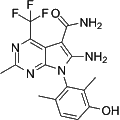
PKMYT1-IN-7 is a potent inhibitor of PKMYT1, demonstrating IC50 values of 1.6 nM against PKMYT1 and 0.06 μM against pCDK1. This compound effectively inhibits the phosphorylation of CDK1 at threonine 14 and tyrosine 15, making it valuable for research into cell cycle regulation. PKMYT1-IN-7 has shown significant anticancer activity, supporting its application in cancer biology studies.
Out of stock
All 3 sizes
Synonyms: RP-6306
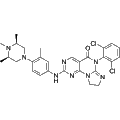
Lunresertib (RP-6306) is a potent and selective inhibitor of PKMYT1, demonstrating an IC50 of 14 nM. This compound exhibits high selectivity for PKMYT1 in cellular binding assays, making it an effective tool for studying the role of this kinase in cancer biology. Lunresertib's anticancer properties highlight its potential applications in cancer research and therapeutic development.
Synonyms: ZN-c3
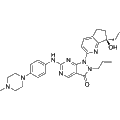
Azenosertib is a highly selective orally active Wee1 inhibitor, with an IC50 of 3.9 nM. It demonstrates significant antitumor activity, making it a valuable tool for cancer research. Azenosertib is utilized in studies investigating cell cycle regulation and DNA damage response pathways, contributing to the development of novel therapeutic strategies against various malignancies.
WEE1-IN-14 is a selective WEE1 inhibitor, exhibiting an IC50 of 0.5 nM in L-RB-FEP calculations and 1.0 nM in the ADP-Glo kinase assay. By inhibiting WEE1, this compound disrupts the G2-M checkpoint in cancer cells, effectively removing cell cycle regulatory controls. The resulting early onset of mitotic failure triggers apoptosis in tumor cells, making WEE1-IN-14 a valuable reagent for research in cancer biology and therapeutic development.
Out of stock
All 3 sizes
GSK-1520489A is a selective inhibitor of PKMYT1, an active protein kinase involved in cell cycle regulation. It exhibits an IC50 of 115 nM and a Ki value of 10.94 nM, demonstrating significant potency in inhibition. This compound is useful for exploring the role of PKMYT1 in tumorigenesis and cell proliferation, making it a valuable tool in cancer research and therapeutic discovery.
WEE1-IN-4 is a potent inhibitor of the Wee1 kinase, exhibiting an IC50 of 0.011 μM. By targeting and inhibiting Wee1, this compound effectively abrogates the G2/M checkpoint, thereby promoting cell cycle progression in cancer cells. WEE1-IN-4 serves as a valuable tool for research in cancer biology and therapeutics, particularly in studies focused on cell cycle regulation and the development of combination therapies.
Synonyms: (Rac)-RP-6306
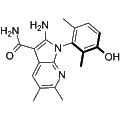
(Rac)-lunresertib is a potent inhibitor of the membrane-associated tyrosine and threonine-specific cdc2-inhibitory kinase (Myt1), with an IC50 of less than 10 nM. This compound demonstrates significant anticancer activity, making it a valuable reagent for research focused on targeting cell cycle regulation and kinase activity in cancer biology. Its precise inhibition of Myt1 positions it as a key tool for investigating therapeutic strategies in oncology.
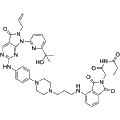
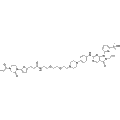
LEB-03-146 is a WEE1 deubiquitinase-targeting chimera (DUBTAC) that conjugates the potent inhibitor AZD1775 (Adavosertib) with the recruiter EN523 via a PEG2 linker. This compound effectively stabilizes WEE1 in HEP3B hepatoma cancer cells, making it a valuable tool for research into cell cycle regulation and cancer therapy. Its unique mechanism of action offers potential for novel therapeutic strategies in oncology.
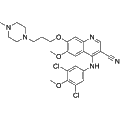
Bosutinib isomer is a potent inhibitor of the cell cycle regulators Wee1 and Wee2, exhibiting high binding affinities with Kd values of 43.7 ± 10.0 nM and 4.7 ± 2.3 nM, respectively. This compound is utilized in research applications aimed at understanding cell cycle modulation and exploring therapeutic strategies in cancer treatment, particularly in tumors with aberrant cell cycle regulation.
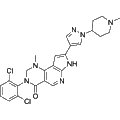
WEE1-IN-3 is a potent inhibitor of Wee1 kinase, demonstrating an IC50 of less than 10 nM. This compound exhibits significant anticancer activity, making it a valuable tool for research in cancer biology. Its ability to modulate cell cycle regulation positions WEE1-IN-3 as a useful reagent for exploring therapeutic strategies against various cancer types.
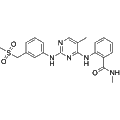
PKMYT1-IN-8 is a specific inhibitor of PKMYT1, demonstrating an IC50 of 9 nM. In addition to its primary target, it also inhibits several receptor tyrosine kinases, including EPHB3, EPHA1, KIT, EPHB1, EPHA2, EPHA3, and EPHB2, with varying IC50 values ranging from 1.79 to 10.9 μM. This compound effectively reduces the proliferation of the OVCAR3 cancer cell line, exhibiting a GI50 of 2.02 μM. PKMYT1-IN-8 is useful for research focused on cancer biology and targeted therapies.
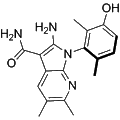
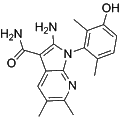
WEE1-IN-10 is a selective inhibitor of WEE1 kinase, a critical regulator of the cell cycle. It demonstrates potent inhibitory activity against LOVO cancer cell growth, with an IC50 of 0.524 μM. This compound is applicable in research focusing on diseases associated with aberrant WEE1 activity, providing insights into cell cycle regulation and potential therapeutic strategies.
Synonyms: (R)-RP-6306
(R)-lunresertib is a selective inhibitor of the myt1 kinase (PKMYT1), exhibiting an IC50 of 1360 nM. This compound is valuable for investigating Myt1-mediated signaling pathways and related oncogenic processes. Its application in cancer research highlights the potential for therapeutic interventions targeting Myt1 activity in tumor biology.