mAChR

Muscarinic acetylcholine receptors (mAChRs) are a class of G protein-coupled receptors (GPCRs) found in the central and peripheral nervous systems, as well as in various other tissues and organs throughout the body. These receptors are named after muscarine, a natural alkaloid compound found in certain mushrooms, which was one of the first substances discovered to activate them.

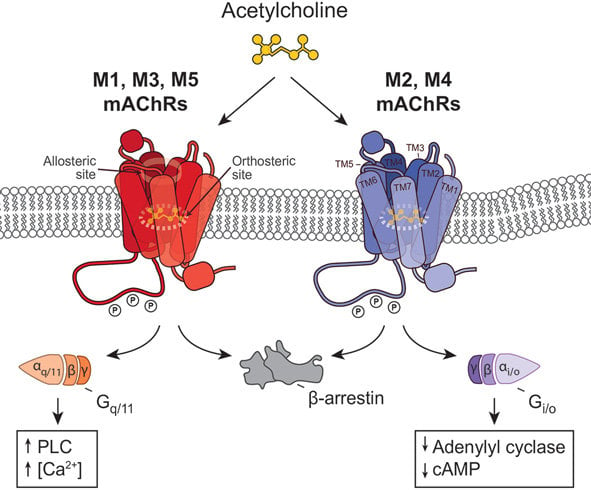
There are five subtypes of muscarinic receptors, designated as M1 through M5, each with distinct tissue distribution and functions. Here's an overview of their roles:

  • M1 Receptors: Predominantly found in the central nervous system, particularly in regions associated with cognitive functions. Activation of M1 receptors is linked to memory and learning.
  • M2 Receptors: Found in the heart, where they play a crucial role in regulating heart rate and cardiac contractility. Activation of M2 receptors slows heart rate and reduces the force of cardiac contractions.
  • M3 Receptors: Present in smooth muscle tissues, such as those in the gastrointestinal tract, urinary bladder, and bronchial airways. Activation of M3 receptors leads to smooth muscle contraction.
  • M4 Receptors: Distributed mainly in the central nervous system and involved in modulating neurotransmitter release. Their role in cognition and neuropsychiatric disorders is of interest.
  • M5 Receptors: Located in certain areas of the brain and implicated in the modulation of dopamine release. Research suggests they may be relevant to Parkinson's disease and addiction.

Muscarinic receptors are activated by the neurotransmitter acetylcholine and play a vital role in regulating a wide range of physiological processes, including heart rate, smooth muscle contraction, glandular secretion, and neurotransmitter release. They are targets for various drugs, including anticholinergic agents, which block their activity, and drugs used to treat conditions like bradycardia and neurodegenerative disorders.

Understanding the functions and regulation of muscarinic acetylcholine receptors is essential for developing therapies that modulate their activity and for advancing our knowledge of how they contribute to various physiological and pathological processes in the body.

4 Items

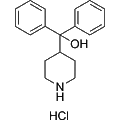
  • Azacyclonol hydrochloride
    Cat. No.
    A39183

    Azacyclonol hydrochloride

    Synonyms: γ-pipradol hydrochloride

    Azacyclonol hydrochloride is a selective ligand for the M3 muscarinic acetylcholine receptor, demonstrating significant inhibition of proliferation in androgen-refractory cancer cell lines, including DU145 and PC-3. This compound exhibits notable anticancer activity, particularly in A549 human lung cancer cells, by inhibiting NOX-derived reactive oxygen species. Additionally, Azacyclonol hydrochloride has shown antitumor effects in xenografted chorioallantoic membrane models. Beyond its anticancer applications, it is also explored for its potential in the treatment of chronic schizophrenia.

    25 mg
    $1,275.00
    50 mg
    $1,625.00
    All 3 sizes
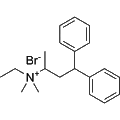
  • Emepronium bromide
    Cat. No.
    A61410

    Emepronium bromide

    Emepronium bromide is a muscarinic receptor ligand that acts as an antispasmodic agent for the bladder, exhibiting an IC50 of 236 nM. This compound is valuable for research focused on bladder diseases, allowing for the exploration of muscarinic receptor mechanisms and the development of therapeutic strategies targeting bladder dysfunction.

    25 mg
    $1,275.00
    50 mg
    $1,625.00
    All 3 sizes
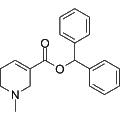
  • M1 ligand 1
    Cat. No.
    A61448

    M1 ligand 1

    M1 ligand 1 is a selective ligand for the muscarinic acetylcholine receptor M1. It is an N-desmethyl derivative of arecoline, designed for use in research applications focused on neurological studies. M1 ligand 1 serves as a potential PET (positron emission tomography) radiotracer, providing insights into receptor activity and distribution in brain imaging studies.

    25 mg
    $1,275.00
    50 mg
    $1,625.00
    All 3 sizes
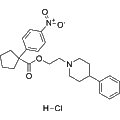
  • RLH-033
    Cat. No.
    A61513

    RLH-033

    RLH-033 is a potent and selective ligand for the sigma 1 recognition site. It exhibits high affinity for sigma 1 sites labeled by [3H](+)-pentazocine, demonstrating a Ki value of 50 pM. This compound is valuable for research applications targeting sigma 1 receptor functions, contributing to the understanding of its roles in neuroprotection and various pathophysiological conditions.

    25 mg
    $1,275.00
    50 mg
    $1,625.00
    All 3 sizes

4 Items

Added to your cart

View Cart Checkout

    Loading...