- Cat. No.
- A11360
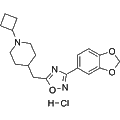
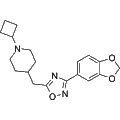
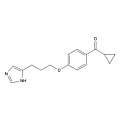
Ciproxifan
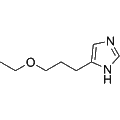
Ciproxifan is an extremely potent histamine H3 inverse agonist/antagonist.
Search by product name, CAS, target or catalog number. Press Down Arrow to reach product suggestions, Tab to move between links, and Escape to close suggestions.
Histamine receptor antagonists and related ligands target H1 to H4, the four G protein-coupled receptors for histamine. H1 receptors mediate allergic and smooth muscle responses, whereas H2 receptors control gastric acid secretion. Black and colleagues defined the H2 receptor in 1972 as a histamine receptor that classic H1 antagonists failed to block. The H3 receptor acts mainly as a presynaptic autoreceptor in the brain, and its human gene was cloned in 1999. H4, the most recently described subtype, is expressed largely on immune cells. Ligands here include the H1 antagonist chlorpheniramine maleate and the H2 antagonist cimetidine. Ciproxifan blocks H3, while JNJ7777120 is a widely used H4 antagonist.
Ciproxifan is an extremely potent histamine H3 inverse agonist/antagonist.
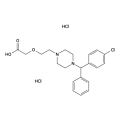
Cetirizine is a second-generation antihistamine, a major metabolite of hydroxyzine, and a racemic selective H1 receptor inverse agonist used in the treatment of allergies, hay fever, angioedema, and urticaria.
Synonyms: Tiprolisant
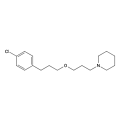
Pitolisant is a potent and selective nonimidazole inverse agonist at the recombinant human histamine H3 receptor (Ki=0.16 nM).
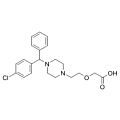
Cetirizine, a second-generation antihistamine, is a major metabolite of hydroxyzine, and a racemic selective H1 receptor inverse agonist used in the treatment of allergies, hay fever, angioedema, and urticaria.
Synonyms: Ciproxidine; BF 2649
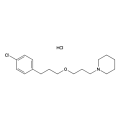
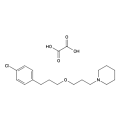
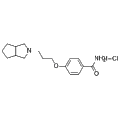
Pitolisant hydrochloride is a novel, potent, and selective nonimidazole inverse agonist at the recombinant human H3 receptor (Ki=0.16 nM).
Synonyms: Tiprolisant oxalate
Pitolisant oxalate is a novel, potent, and selective nonimidazole inverse agonist at the recombinant human H3 receptor (Ki=0.16 nM).
Synonyms: S 38093
S38093 is an inverse agonist at histamine H3 receptors. CAS: 862896-30-8 (Free base) 1222097-72-4 (HCl)
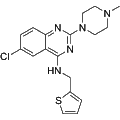
H4 Receptor antagonist 1 is a potent and selective histamine H4 receptor inverse agonist, with an IC50 of 19 nM.
Synonyms: SUVN-G3031
Samelisant (SUVN-G3031) is a potent and selective inverse agonist of the histamine H3 receptor (H3R), demonstrating significant brain penetration and oral bioavailability. It exhibits comparable binding affinities for human (Ki=8.7 nM) and rat H3Rs (Ki=9.8 nM), indicating a lack of inter-species variability. This compound is suitable for research into sleep-related disorders, providing insights into potential therapeutic applications.
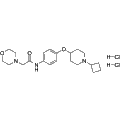
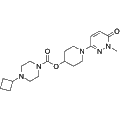
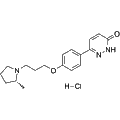
H3R Antagonist 1 Hydrochloride is an inverse agonist of the histamine receptor 3 (H3R). This compound has been shown to elevate the expression levels of myelin-associated glycoprotein (MAG) and myelin basic protein (MBP) in differentiating oligodendrocytes. It serves as a valuable reagent for research investigating myelination processes and potential therapeutic strategies for multiple sclerosis.
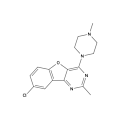
LML134 is a highly selective inverse agonist of the Histamine 3 receptor (H3R), demonstrating an impressive affinity with Ki values of 0.3 nM for hH3R cAMP and 12 nM for hH3R binding. This compound exhibits rapid brain penetration, resulting in significant H3R occupancy and a swift disengagement from its target. LML134 holds promise for investigating therapeutic strategies for sleep disorders by modulating histaminergic signaling pathways.
Synonyms: SUVN-G3031 free base
Samelisant free base is a selective inverse agonist of the histamine H3 receptor (H3R) that exhibits high binding affinity (Ki values of 8.7 nM for human H3R and 9.8 nM for rat H3R). It demonstrates effective brain penetration and oral bioavailability, making it a valuable tool in the study of sleep-related disorders. Research applications include exploring the mechanisms underlying sleep regulation and potential therapeutic interventions for insomnia and other sleep disturbances.
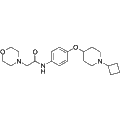
H3R antagonist 1 is an inverse agonist of the histamine receptor 3 (H3R). This compound promotes the upregulation of myelin-associated glycoprotein (MAG) and myelin basic protein (MBP) in differentiating oligodendrocytes, which is crucial for myelination processes. H3R antagonist 1 is applicable in research focused on multiple sclerosis and related demyelinating disorders, providing insight into oligodendrocyte differentiation and myelin repair mechanisms.
VUF10497 is a potent inverse agonist of the histamine H4 receptor (H4R). It demonstrates significant anti-inflammatory activity, making it a valuable tool for research focused on inflammation and immune response modulation. This compound can be utilized in studies examining the role of H4R in various inflammatory conditions and may aid in the development of new therapeutic strategies.
Synonyms: CEP-26401 hydrochloride
Irdabisant hydrochloride is a selective inverse agonist of the histamine H3 receptor (H3R), demonstrating high affinity with Ki values of 7.2 nM for rat H3R and 2.0 nM for human H3R. This compound exhibits cognition-enhancing and wake-promoting properties, as evidenced in the rat social recognition model. Due to its ability to penetrate the blood-brain barrier and its relatively low inhibitory activity on hERG current, Irdabisant hydrochloride is suitable for research applications focused on schizophrenia and cognitive impairment.
FUB 465 is an orally active inverse agonist targeting the histamine H3 receptor, exhibiting a pKi of 6.2. This compound is instrumental in investigating central nervous system disorders, offering insights into the modulation of histamine signaling pathways. Its activity may facilitate the development of novel therapeutic strategies for conditions associated with H3 receptor dysfunction.
Synonyms: (S)-Mequitazine
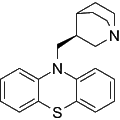
Levomequitazine, an inverse agonist of the human histamine H4 receptor, exhibits strong binding affinity with an IC50 of 94 nM for hM2 and 17 nM for hM3. This compound effectively antagonizes the actions of histamine at the H4 receptor, leading to significant anti-inflammatory effects. Levomequitazine is suitable for research applications focused on inflammatory diseases, providing a valuable tool for exploring therapeutic strategies targeting the H4 receptor in various pathological conditions.
MK-7288 is a histamine H3 receptor inverse agonist that modulates neurotransmitter release to enhance wakefulness. It has demonstrated the ability to prolong sleep latency in the Maintain Wake Test (MWT), making it a valuable tool in the investigation of obstructive sleep apnea (OSA) and excessive daytime sleepiness (EDS). This compound is essential for researchers exploring sleep regulation and associated disorders.