
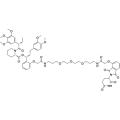
- Cat. No.
- A19081
FKBP12 PROTAC dTAG-7
Synonyms: dTAG-7
FKBP12 PROTAC dTAG-7 (dTAG-7) is a heterobifunctional degrader.
In stock
View Details
Search by product name, CAS, target or catalog number. Press Down Arrow to reach product suggestions, Tab to move between links, and Escape to close suggestions.
FKBP ligands bind FK506-binding proteins (FKBPs), a family of peptidyl-prolyl cis-trans isomerases. In 1989 the receptor for the immunosuppressant FK506 (tacrolimus) was shown to be such an isomerase, now known as FKBP12. Pimecrolimus is a related macrolactam that also binds FKBP12 and inhibits calcineurin. SAFit1 and SAFit2 selectively inhibit FKBP51 through an induced-fit binding mode reported in 2015. Shield-1 stabilizes fusions to a destabilized FKBP12 domain, a method described in 2006 for rapid, reversible control of protein levels. AP1867 binds the engineered mutant FKBP12(F36V), and FKBP12 PROTAC dTAG-7 uses this ligand to degrade tagged proteins in the degradation tag (dTAG) system. Rimiducid and zapalog are chemical inducers of dimerization for FKBP fusion proteins.
Synonyms: dTAG-7
FKBP12 PROTAC dTAG-7 (dTAG-7) is a heterobifunctional degrader.
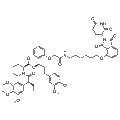
dTAG-13 is a PROTAC-based heterobifunctional degrader that selectively targets FKBP12^F36V fused in-frame to a protein of interest. By engaging both FKBP12^F36V and the cereblon (CRBN) E3 ligase, dTAG-13 induces efficient and selective degradation of FKBP12^F36V-tagged proteins, making it a valuable tool for conditional protein knockdown studies.
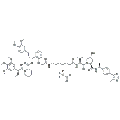
dTAGV-1 TFA is a potent and selective degrader of FKBP12^F36V-tagged fusion proteins. It enables efficient in vivo degradation of FKBP12^F36V-Nluc, making it a valuable tool for conditional protein degradation studies in live models.
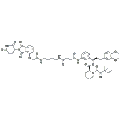
dFKBP-1 is a potent PROTAC-based degrader targeting FKBP12. It is composed of the FKBP12-binding ligand SLF, a thalidomide-derived cereblon ligand, and a linker. dFKBP-1 enables selective degradation of FKBP12 via the CRBN-mediated ubiquitin-proteasome pathway.
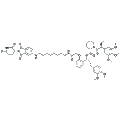
dTAG-47 is a heterobifunctional degrader that selectively targets FKBP12^F36V-tagged proteins for degradation. By binding FKBP12^F36V, which acts as a degradation tag (dTAG), dTAG-47 enables conditional and selective protein degradation. It is a valuable tool for studying protein function in models such as basal-like breast cancer (BBC).
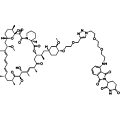
Synonyms: RC32
FKBP12 PROTAC RC32 is a targeted protein degrader utilizing PROTAC technology to selectively degrade FKBP12. This compound combines Rapamycin, a well-characterized immunosuppressant, with a Cereblon E3 ubiquitin ligase ligand derived from Pomalidomide, facilitating the ubiquitination and subsequent proteasomal degradation of FKBP12. It serves as an important tool in research applications aimed at investigating the modulation of protein levels and the functional consequences of targeted degradation in various biological contexts.
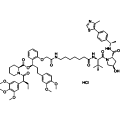
dTAGV-1 hydrochloride is a highly selective degrader targeting FKBP12F36V-tagged proteins through the PROTAC mechanism. This compound effectively induces the degradation of FKBP12F36V-Nluc in vivo, making it a valuable tool for studies involving targeted protein degradation. Its application in research facilitates the investigation of protein function, dynamics, and the development of therapies that exploit the proteolysis pathway.
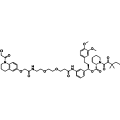
KB02-SLF is a PROTAC-based nuclear FKBP12 degrader designed to facilitate targeted protein degradation. It achieves this by covalently modifying DCAF16, an E3 ligase, thereby enhancing the stability of FKBP12 degradation within biological systems. The compound consists of a molecular glue linking the ubiquitin E3 ligase ligand KB02 with SLF, enabling efficient degradation of FKBP12 for various research applications in protein regulation and degradation pathways.
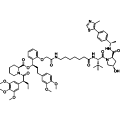
dTAGV-1-NEG is a diastereomer that acts as a heterobifunctional negative control for dTAGV-1, specifically targeted at FKBP12(F36V). This compound is utilized in research to study the selectivity and efficacy of FKBP12(F36V) degraders, helping to elucidate cellular mechanisms and pathways influenced by FKBP12 modulation. Its role as a control reagent makes it essential for validating experimental results in protein degradation studies.
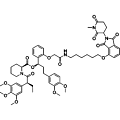
dTAG-13-NEG serves as a negative control for dTAG-13, a PROTAC-based bifunctional degrader that selectively targets FKBP12F36V in the presence of a protein of interest. While dTAG-13 promotes the degradation of FKBP12F36V, dTAG-13-NEG allows for the assessment of specificity and background in experimental setups involving this pathway. This compound is essential for validating experimental results when studying protein degradation mechanisms and their implications in cellular biology.
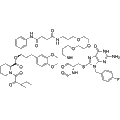
AUTAC2 is an FKBP12-targeting autophagy-mediated degrader designed to promote selective degradation of specific proteins. This compound incorporates a p-Fluorobenzyl Guanine (FBnG) moiety and an SLF ligand, which non-covalently binds to FKBP12. AUTAC2 facilitates the targeted removal of proteins through the autophagy pathway, making it a valuable tool for research applications focused on protein homeostasis and cellular regulation.
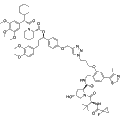
SelDeg51 is a selective PROTAC degrader targeting FKBP51 with a Kd value of 18 nM and a maximum degradation efficacy (Dmax) of 90%. It facilitates the proteasomal degradation of FKBP51 through the formation of a ternary complex with FKBP51 and VHL, effectively reactivating glucocorticoid receptor signaling. SelDeg51 is particularly relevant for research in stress-related mental disorders, chronic pain, and obesity.
Out of stock
All 3 sizes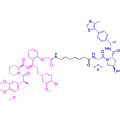
dTAGV-1 is a selective proteolysis-targeting chimera (PROTAC) degrader designed to target FKBP12F36V-tagged proteins. This compound effectively induces the degradation of FKBP12F36V-Nluc in vivo, making it a valuable tool for studying protein turnover and function. Its application is particularly relevant in cellular and molecular biology research, facilitating the investigation of protein interactions and therapeutic targets.
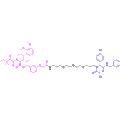
10-SLF is a PROTAC FKBP12 degrader that facilitates the formation of a ternary complex between FKBP12 and the mutant E3 ligase FBXW7-R465C. This compound promotes the FBXW7-R465C-mediated proteasomal degradation of FKBP12, selectively lowering FKBP12 levels in cells harboring the FBXW7-R465C mutation. 10-SLF is valuable for studying protein degradation pathways and the role of FKBP12 in various biological contexts.
Out of stock
All 3 sizes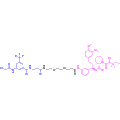
KB03-SLF is an electrophilic PROTAC degrader targeting DCAF16 to facilitate the degradation of the nuclear protein FKBP12. This compound serves as a valuable tool in cancer research, enabling the investigation of protein homeostasis and degradation pathways. KB03-SLF’s unique structure incorporates specific ligands that enhance its efficacy as a degradative agent, making it a significant asset for studies focused on targeted protein elimination.
Out of stock
All 3 sizes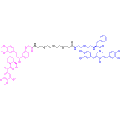
RAFKBP12 is a PROTAC degrader that specifically targets FKBP12, utilizing the CAP-TAC strategy to facilitate proteasome-dependent degradation. This compound operates independently of E3 ubiquitin ligases and protein ubiquitination, demonstrating its innovative mechanism of action. RAFKBP12 serves as a valuable tool for research in protein degradation pathways and therapeutic applications related to FKBP12 modulation.
Out of stock
All 3 sizes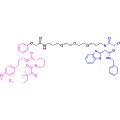
22-SLF is a PROTAC degrader specifically targeting FK506-binding protein 12 (FKBP12), exhibiting a DC50 of 0.5 µM. This compound forms a ternary complex with C227 and C228 in FBXO22, facilitating FKBP12 degradation in an FBXO22-dependent manner. 22-SLF is a valuable tool for cancer research, serving as a probe to investigate the FBXO22-mediated degradation pathways.
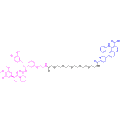
FKBP12 PROTAC FM4 is a potent PROTAC degrader targeting FKBP12 with demonstrated efficacy in inducing degradation of the MTH1 protein. Its DC50 value ranges from 0.09 to 0.22 nM, effectively inhibiting global protein synthesis and promoting apoptosis in cervical cancer cells that express MTH1-E6 and FKBP12F36V-tagged SARS1. This compound is particularly relevant for research focused on HPV-positive cervical cancer, providing valuable insights into therapeutic strategies against this malignancy.