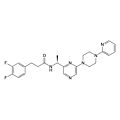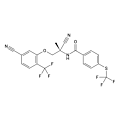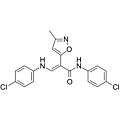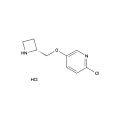
- Cat. No.
- A17079
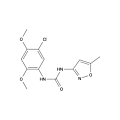
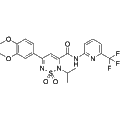
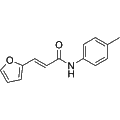
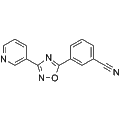
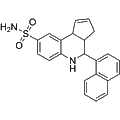
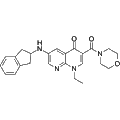
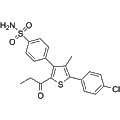
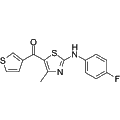
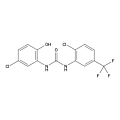
NS 1738
Synonyms: NSC-213859
NS 1738 is a α7 positive allosteric modulator.
Search by product name, CAS, target or catalog number. Press Down Arrow to reach product suggestions, Tab to move between links, and Escape to close suggestions.
Nicotinic acetylcholine receptor (nAChR) agonists, antagonists and modulators act on ligand-gated cation channels. Each receptor is a pentamer of subunits arranged around a central pore that opens when acetylcholine binds. A refined structure of the Torpedo receptor at 4 Å resolution, published in 2005, resolved its ligand-binding, membrane and cytoplasmic regions. Muscle-type receptors mediate neuromuscular transmission, while neuronal subtypes such as α7 and α4β2 are studied in attention, memory and nicotine dependence. Agonists include PNU 282987, which is selective for α7, and the partial agonist varenicline. PNU-120596, described in 2005, is a positive allosteric modulator of α7 that enhances acetylcholine-evoked currents. Vecuronium bromide, a neuromuscular blocking agent, acts on the muscle-type receptor.
Synonyms: NSC-213859
NS 1738 is a α7 positive allosteric modulator.
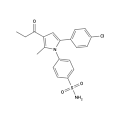
PNU-120596 is a positive allosteric modulator of α7 neuronal nicotinic acetylcholine receptors.
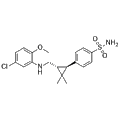
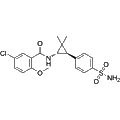
A-867744 is a novel positive allosteric modulator of the alpha7 nicotinic acetylcholine receptor.
Synonyms: dFBr hydrochloride
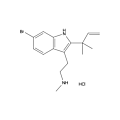
Desformylflustrabromine HCl is a positive allosteric modulator of α4β2 and also a muscle-type nAChR inhibitor.
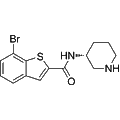
BNC375 is a Potent, Selective, and Orally Available Type I Positive Allosteric Modulator of α7 nAChRs.
Synonyms: B-973B
-)-(S)-B-973B is a potent allosteric agonist and positive allosteric modulator of α7 nAChR, with antinociceptive activity.
Synonyms: AAD1566
Monepantel is organic anthelmintic, and acts as a positive allosteric modulator of a nematode-specific clade of nicotinic acetylcholine receptor (nAChR) subunits.
Synonyms: IACS10759
CCMI is a potent and selective α7 nAChR-positive allosteric modulator, does not bind to or activate α7 nAChRs via the orthosteric site, and causes significant positive modulation of agonist-induced currents at α7 nAChRs.
Synonyms: Ebanicline hydrochloride; ABT-594 hydrochloride; ABT 594
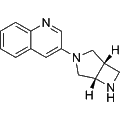
Tebanicline hydrochloride (ABT594 hydrochloride) is a nAChR modulator with potent, orally effective analgesic activity.
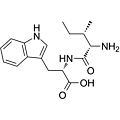
BNC210 (H-Ile-Trp-OH; IW-2143) is a α7 nAChR negative allosteric modulator. BNC210 has potent activity in animal models of anxiety and depression.
RGH-857 acts as a selective and potent positive allosteric modulator of nicotinic α7 receptors. It demonstrates effectiveness in ameliorating amnesia and is valuable in studies related to Alzheimer's disease. This compound can facilitate research into cognitive impairment and potential therapeutic interventions in neurodegenerative disorders.
Out of stock
All 3 sizes
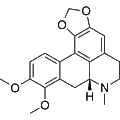
Crebanine is an isoquinoline-like alkaloid that acts as an apoptosis inducer through antagonism of the α7-nAChR, exhibiting an IC50 value of 19.1 μM. This compound suppresses cancer cell proliferation, migration, and invasion while triggering a reactive oxygen species (ROS) burst that promotes apoptosis. Additionally, Crebanine modulates critical signaling pathways including AKT/FoxO3a, NF-κB, and MAPK, and demonstrates antioxidant properties in microglia by reducing ROS and lipid peroxidation. With applications in studying hepatocellular carcinoma, cerebral ischemia, and Alzheimer's disease, Crebanine may also ameliorate cognitive deficits and ischemia-reperfusion brain damage in rodent models.
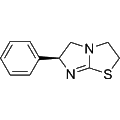
Synonyms: (-)-Tetramisole
Levamisole is an anthelmintic agent recognized for its immunoregulatory properties. This compound functions as a positive allosteric modulator of the α3β2 (EC50 = 300 μM) and α3β4 (EC50 = 100 μM) subtypes of nicotinic acetylcholine receptors (nAChRs), enhancing receptor activity. It is orally active and is commonly used in research applications related to parasitic infections and immune response modulation.
GSK575594A is an allosteric modulator of the nicotinic acetylcholine receptor (nAChR) in Ascaris suum. This compound enhances muscle contractions triggered by acetylcholine (ACh) by binding to the allosteric site within the transmembrane domain of the nAChR, leading to a significant increase in contraction amplitude (Emax from 1.19 g to 1.51 g) at a concentration of 3 μM. GSK575594A is applicable in antiparasitic research, providing insights into neuromuscular mechanisms in parasitic infections.
PAM-2 is a selective positive allosteric modulator of the α7 nicotinic acetylcholine receptor (nAChR). Exhibiting potent anti-nociceptive and anti-inflammatory properties, PAM-2 enhances receptor activity, demonstrating efficacy in animal models of neuropathic pain induced by Streptozotocin and Oxaliplatin. It shows selectivity for α7 nAChR over α9α10 nAChR and CaV2.2 channels, making it a valuable tool for research into pain mechanisms and potential therapeutic applications in neuropathic pain.
Out of stock
All 3 sizes
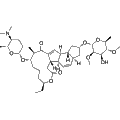
Spinosyn J functions as a non-competitive modulator of nicotinic acetylcholine receptors (nAChR) and γ-aminobutyric acid (GABA) receptors. It exhibits significant insecticidal activity, making it a valuable compound for the study of agricultural pests. This property positions Spinosyn J as a useful tool in entomological research and pest management strategies.
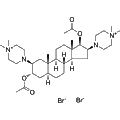
Pipecuronium bromide functions as a long-acting nondepolarizing steroidal neuromuscular blocker, acting primarily as a competitive antagonist of the nicotinic acetylcholine receptor (nAChR). With a dissociation constant (Kd) of 3.06 μM, it effectively inhibits neuromuscular transmission, making it valuable for facilitating intubation and maintaining muscle relaxation during surgical procedures. Its applications also extend to research examining neuromuscular function and pharmacological studies involving skeletal muscle.
NS 9283 is a positive allosteric modulator of the α4β2 nicotinic acetylcholine receptors (nAChR). It enhances receptor activity, making it useful for studying neurological conditions such as attention deficit hyperactivity disorder (ADHD), schizophrenia, Parkinson's disease, and Alzheimer's disease. This compound serves as a valuable tool for research into synaptic transmission and potential therapeutic interventions targeting nAChR-related pathways.
TQS is a positive allosteric modulator of the α7 nicotinic acetylcholine receptor (nAChR). This compound enhances the receptor's activity, making it a valuable tool for investigating mechanisms of neuroinflammatory pain. Researchers may utilize TQS to explore its potential therapeutic effects in neurodegenerative conditions and related pain pathways.
Synonyms: BNC210; IW-2143
Soclenicant (BNC210) is an orally active negative allosteric modulator (NAM) of the α7 nicotinic acetylcholine receptor (nAChR). It demonstrates acute anxiolytic effects in rodent models, making it relevant for research into anxiety, trauma, and stress-related disorders. Soclenicant effectively inhibits α7 nAChR currents induced by acetylcholine, nicotine, choline, and the α7-specific agonist PNU-282987, with IC50 values ranging from 1.2 to 3 μM. This compound presents a valuable tool for investigating the role of α7 nAChRs in neuropsychiatric conditions.
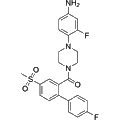
nAChR agonist 1 is a selective positive allosteric modulator of the α7 nicotinic acetylcholine receptor (α7 nAChR). It demonstrates potent activity with an EC50 of 0.32 μM in a calcium mobilization assay utilizing human IMR-32 neuroblastoma cells that express α7 nAChR endogenously. This compound shows promise for further development in therapeutic applications for Alzheimer's disease.
Br-PBTC is a selective positive allosteric modulator of nicotinic acetylcholine receptors (nAChRs), specifically targeting the α2β2, α2β4, α4β2, α4β4, (α4β2)2α4, and (α4β2)2β2 subtypes with effective concentration (EC50) values ranging from 0.1 to 0.6 μM. By acting on the c-terminal region of the α subunit, Br-PBTC enhances receptor activity, making it a valuable tool for studying nAChR-mediated signaling pathways and their implications in neuropharmacology and related fields.
LY-2087101 is an allosteric potentiator of the α7 nicotinic acetylcholine receptors (nAChRs). This compound enhances agonist-evoked responses by binding to the transmembrane region of the receptor, leading to increased receptor activation. LY-2087101 is useful for research focused on synaptic transmission, neuropharmacology, and the modulation of cognitive functions.
RO5126946 is a selective allosteric potentiator of the α7 nicotinic acetylcholine receptor (nAChR) with an EC50 of 0.06 μM for human α7 nAChR. This compound enhances synaptic transmission and positively modulates GABAergic responses by increasing peak current and elevating the frequency of spontaneous inhibitory postsynaptic currents while preserving receptor recovery from desensitization. RO5126946 is valuable for investigating cognitive deficits associated with neurodegenerative disorders such as Alzheimer's disease and psychiatric conditions including schizophrenia, as it augments the cognitive-enhancing effects of nicotine without detracting from its efficacy.
A-424274 is a positive allosteric modulator of the α4β2 neuronal nicotinic acetylcholine receptor. This compound enhances the potency and efficacy of various nicotinic acetylcholine receptor agonists, making it a valuable tool in pain management research. In preclinical studies, co-administration of A-424274 with an α4β2 positive allosteric modulator has been shown to significantly improve the analgesic effects of ABT-594, demonstrating its potential for enhancing therapeutic outcomes in pain relief.