
Navitoclax (ABT-263): Structure, Mechanism, In Vitro and In Vivo Methods, and What the Clinical Trials Showed
A working guide to navitoclax (ABT-263): what the molecule is, how BCL-2 and BCL-xL inhibition is measured, the concentrations and doses used in published experiments, and where the clinical programme stands.
Technical guide from Adooq Bioscience · Product: Navitoclax (ABT-263), Cat. No. A10022 · Last reviewed: 2026-11
Navitoclax at a glance
| Property | Value |
|---|---|
| Common name | Navitoclax; development code ABT-263 |
| CAS | 923564-51-6 |
| Molecular formula | C47H55ClF3N5O6S3 |
| Molecular weight | 974.6 g/mol |
| Class | BH3 mimetic, orally bioavailable |
| Targets | BCL-2, BCL-xL and BCL-w, Ki ≤ 1 nM each |
| Weakly bound | MCL-1 (Ki 550 nM) and A1/BFL-1 (Ki 354 nM), roughly 500-fold weaker |
| Cellular potency | EC50 4-6 nM in FL5.12 cells dependent on transfected BCL-xL or BCL-2; EC50 50-120 nM across small cell lung cancer lines in 10% human serum |
| On-target liability | Platelets depend on BCL-xL, so thrombocytopenia is mechanistic, not idiosyncratic |
| Solubility | DMSO 89 mg/mL (91.3 mM); insoluble in water and ethanol |
| Typical in vitro range | 100 nM to 10 µM, with 0.5-5 µM covering most published work |
| Typical in vivo use | 25-100 mg/kg/day by oral gavage in mice; 50 mg/kg for 5-7 days in senolytic studies |
| Originator | Abbott Laboratories, then AbbVie, in collaboration with Genentech |
| Highest clinical phase | Phase 3 (myelofibrosis, in combination with ruxolitinib) |
| Current status | No approval anywhere. Oncology indications discontinued; the EU orphan designation for myelofibrosis was withdrawn at the sponsor's request in June 2024 |
| Second life | Became the reference senolytic after 2016, and that is now the largest body of literature using the compound |
Navitoclax is the compound that proved BH3 mimetics work in people and then lost the race to its own successor. It is also the compound that opened senolytics as a field. Both facts matter when you pick a concentration, because the oncology literature and the ageing literature use it at different exposures for different reasons.
1. What ABT-263 (navitoclax) is
1.1 One molecule, two names
ABT-263 is the Abbott development code; navitoclax is the International Nonproprietary Name assigned later. The two refer to the same compound, and papers published between roughly 2008 and 2012 tend to use ABT-263 while anything after the phase 2 programme tends to use navitoclax. Searches for "ABT 263 navitoclax" are usually someone checking that these are not two different reagents. They are not. Adooq supplies it as Navitoclax (ABT-263), catalogue number A10022, under the synonym ABT263.
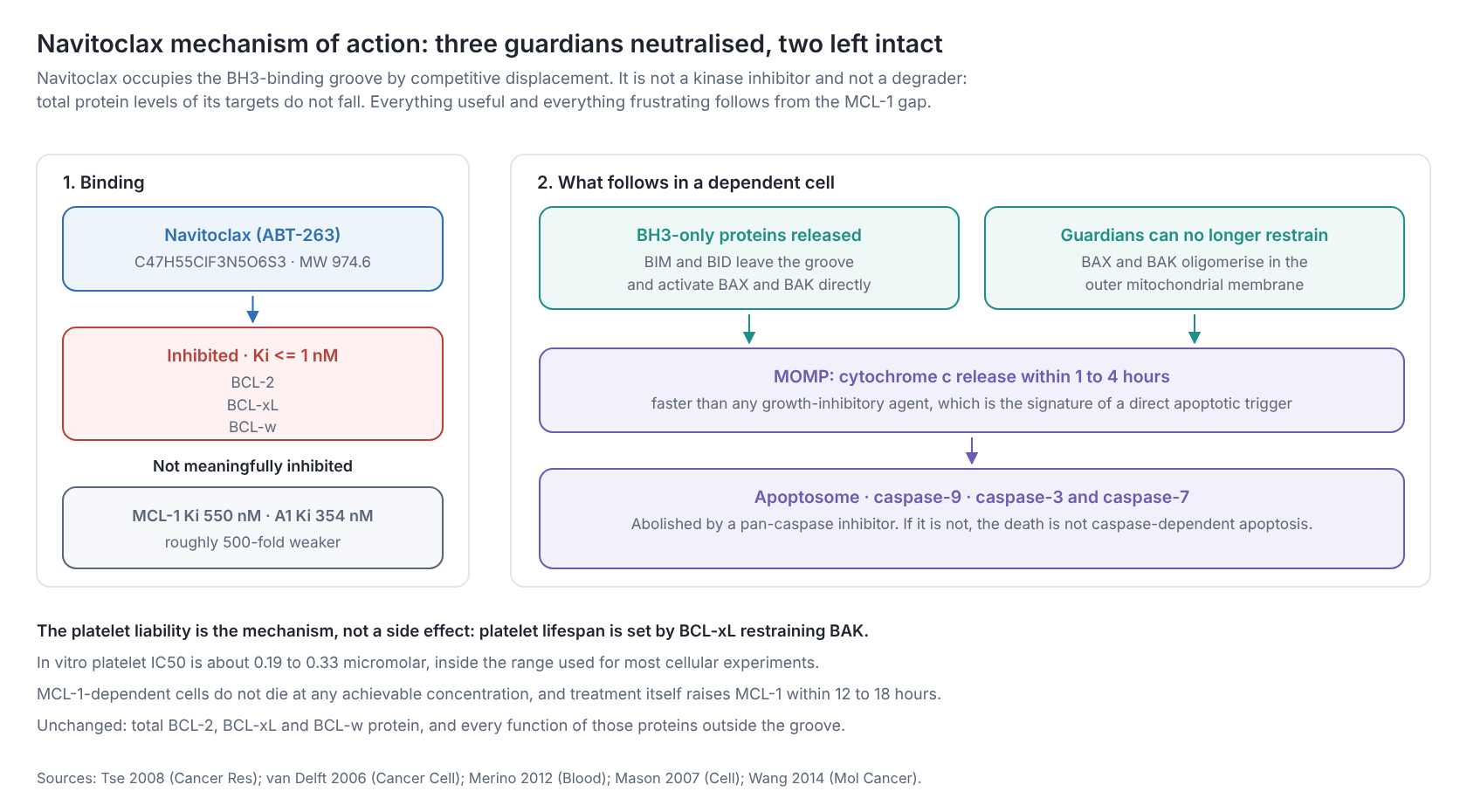
The compound is a BH3 mimetic: a small molecule that occupies the hydrophobic groove on an anti-apoptotic BCL-2 family protein, the groove that normally holds the BH3 helix of a pro-apoptotic partner. It is not a kinase inhibitor, not a caspase inhibitor and not a protein degrader. It works by competitive displacement of a protein-protein interaction, which is why its potency is quoted as a binding Ki rather than an enzymatic IC50.
1.2 Where it came from
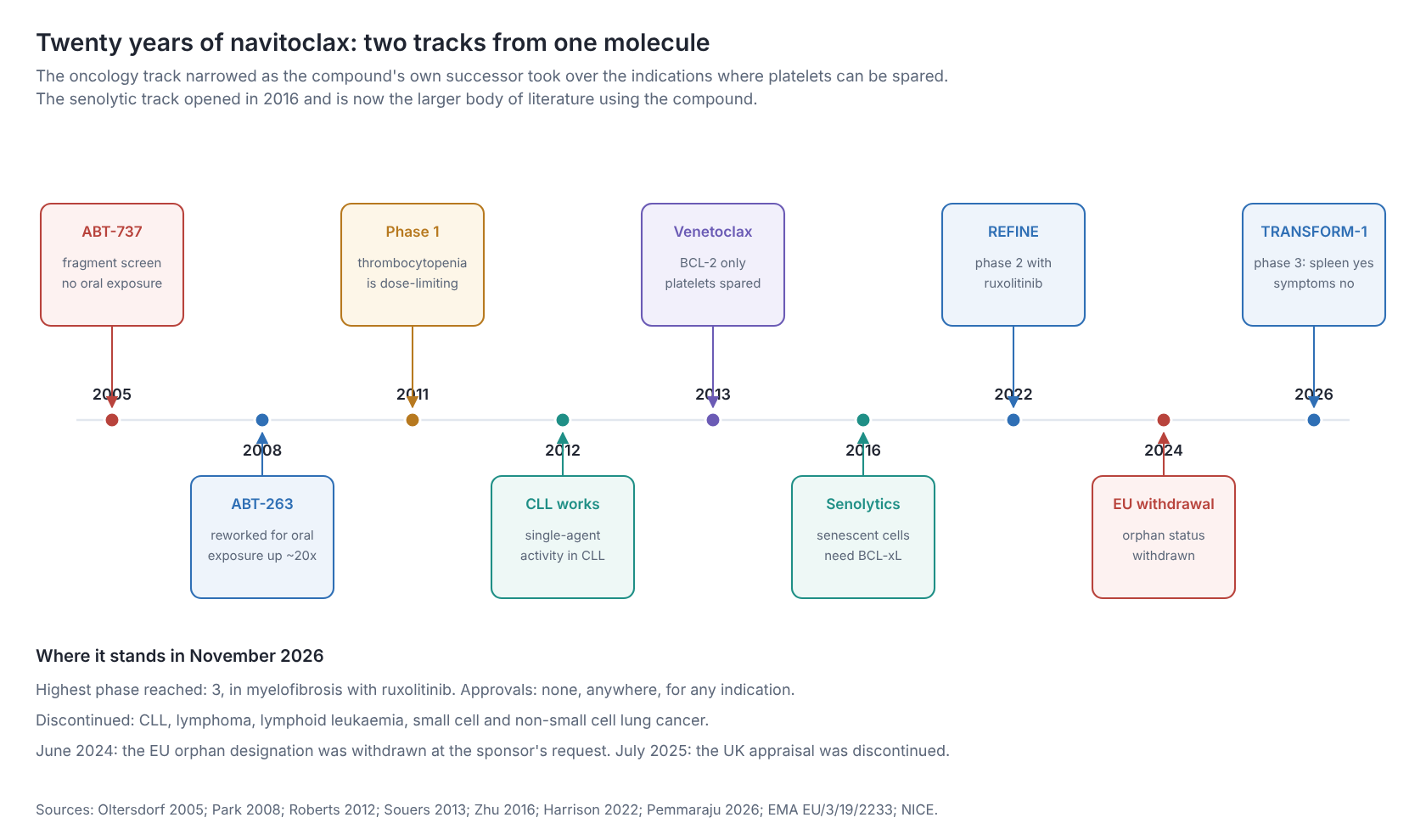
The lineage starts with a fragment-based screen at Abbott that produced ABT-737, described by Oltersdorf and colleagues in 2005 ([1]). ABT-737 bound BCL-2, BCL-xL and BCL-w with sub-nanomolar affinity, killed small cell lung cancer and lymphoma lines as a single agent, and caused regressions in xenografts. It also had no useful oral exposure, so it could only be given by injection in a formulation that was tolerable in mice and unattractive in people.
Park and colleagues then reworked the molecule specifically for oral absorption, changing it at three positions, and reported in 2008 that the modifications improved oral exposure by about 20-fold relative to in vitro potency ([2]). That compound was ABT-263. The three changes are set out in §2.1. Tse and colleagues published the biology in the same year: sub-nanomolar binding retained, apoptosis within hours, single-agent regressions in small cell lung cancer xenografts, and enhancement of several standard agents ([3]). ABT-263 entered the clinic in 2007.
1.3 Why the family matters before the molecule does
The intrinsic apoptotic pathway is a competition between three groups of BCL-2 family proteins: the anti-apoptotic guardians (BCL-2, BCL-xL, BCL-w, MCL-1, A1), the pro-apoptotic effectors (BAX, BAK), and the BH3-only activators and sensitisers (BIM, BID, PUMA, BAD, NOXA) ([4]). Guardians hold the effectors and the activators in check. When the balance tips, BAX and BAK oligomerise in the outer mitochondrial membrane, cytochrome c is released, and the apoptosome activates caspase-9 and then caspase-3 and caspase-7.
Navitoclax neutralises three of the five guardians and leaves two intact. Everything useful and everything frustrating about the compound follows from that single fact.
2. Navitoclax structure and physical properties
2.1 The navitoclax structure, region by region
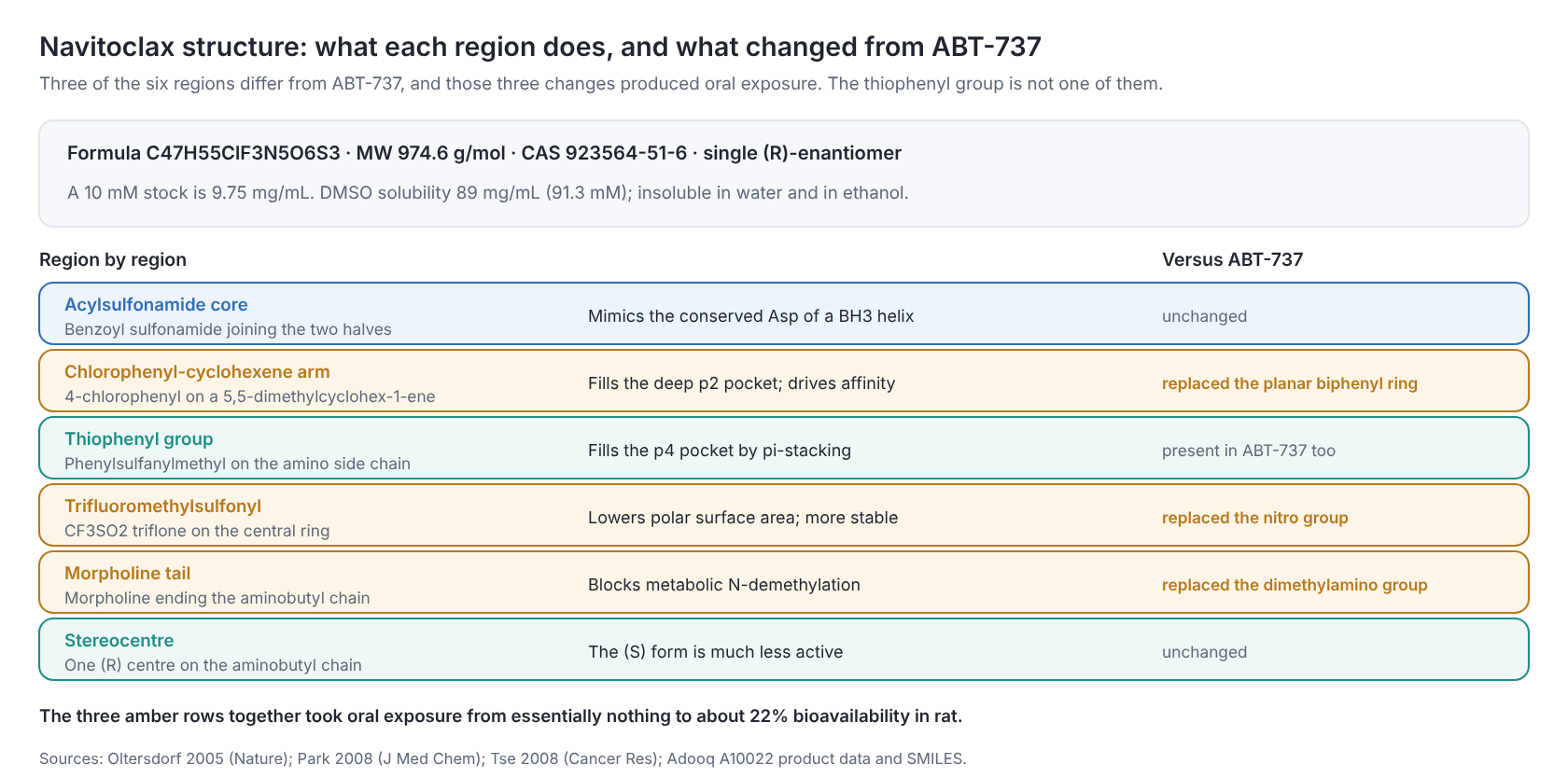
Navitoclax is a large, lipophilic acylsulfonamide. At 974.6 g/mol with a formula of C47H55ClF3N5O6S3 it sits well outside conventional small-molecule space, which is expected: it has to cover a protein-protein interaction surface rather than a nucleotide pocket.
Three of the six regions below differ from ABT-737, and those three changes are the ones that produced oral exposure. The thiophenyl group is not one of them: it is present in ABT-737 as well, and it is easy to misattribute.
| Region | What it is | What it does | Changed from ABT-737? |
|---|---|---|---|
| Acylsulfonamide core | Benzoyl sulfonamide linking the two halves | The anionic centre that mimics the conserved Asp of a BH3 helix and anchors the molecule in the groove | No |
| Chlorophenyl-cyclohexene arm | 4-chlorophenyl on a 5,5-dimethylcyclohex-1-ene ring, linked through a piperazine | Fills the deep p2 hydrophobic pocket; the main driver of affinity | Yes. The planar second ring of the ABT-737 biphenyl was saturated and gem-dimethylated, which improved oral pharmacokinetics |
| Thiophenyl group | Phenylsulfanylmethyl on the chiral amino side chain | Fills the p4 hydrophobic pocket by π-stacking | No. It is present in ABT-737 too |
| Trifluoromethylsulfonyl | CF3SO2, a triflone, on the central sulfonamide ring | Electron-withdrawing group that lowers polar surface area and raises metabolic stability | Yes. It replaced the nitro group of ABT-737 |
| Morpholine tail | Morpholine at the end of the aminobutyl side chain | Lowers the basicity of the terminal amine and blocks metabolic N-demethylation, which is what the dimethylamino group suffered from | Yes. It replaced the dimethylamino group of ABT-737 |
| Stereocentre | One (R) centre on the aminobutyl side chain | Supplied as the single (R)-enantiomer, so no correction for active-enantiomer concentration is needed. The (S)-enantiomer is much less active | No |
The SMILES string and a rendered structure are on the product page. Two practical consequences of the structure are worth stating plainly. Molecular weight 974.6 means a 10 mM stock is 9.75 mg/mL, so a 10 mg vial makes roughly 1 mL of 10 mM stock and no more. And the molecule's lipophilicity is why it is insoluble in water and in ethanol, and why serum protein binding changes its apparent potency by an order of magnitude.
2.2 Solubility and the serum effect
Reported solubility is 89 mg/mL in DMSO, which is 91.3 mM, and insoluble in water and in ethanol. For animal work the standard formulation on the datasheet is 6 mg/mL in 5% DMSO plus corn oil.
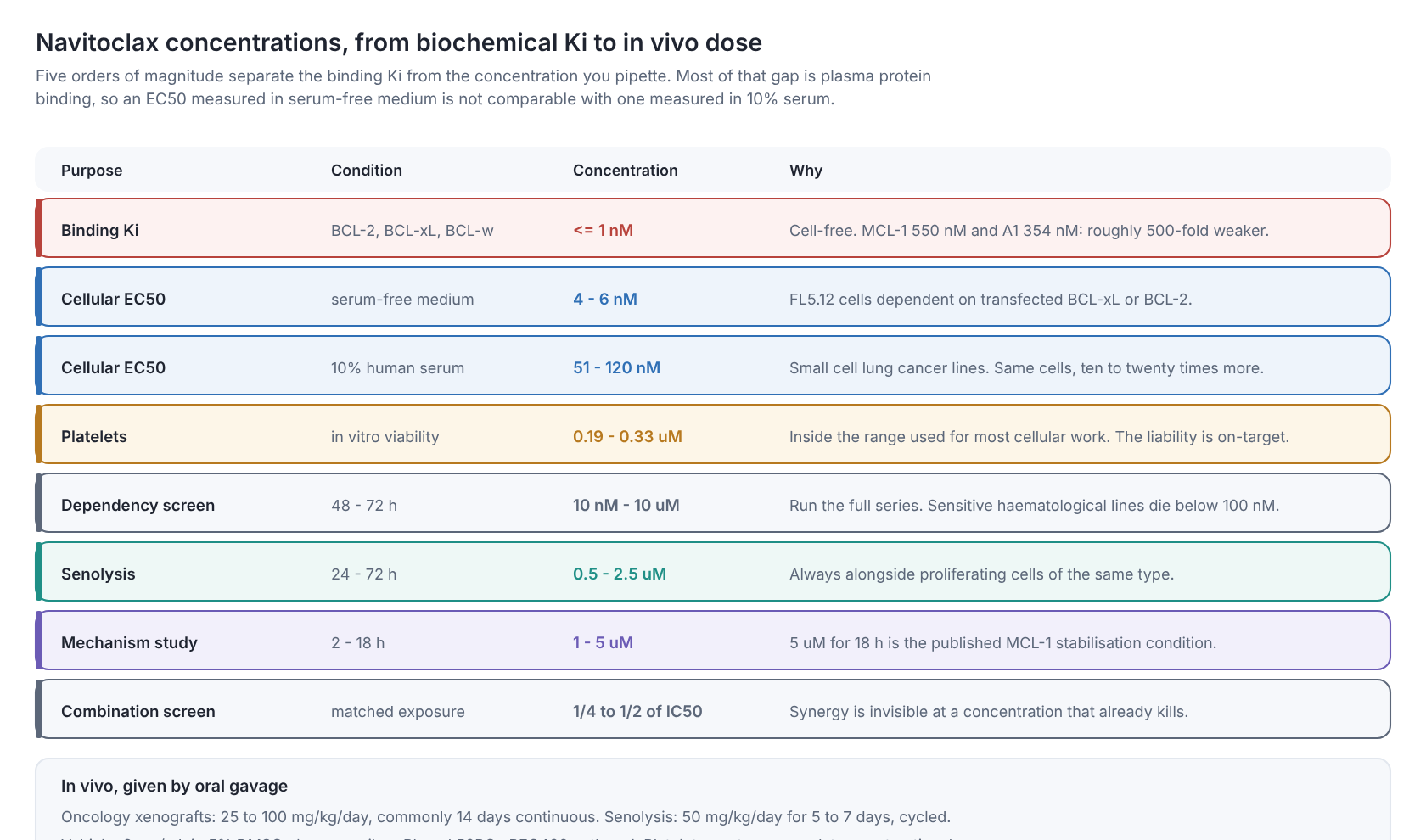
The number that catches people out is not the solubility but the plasma protein binding. Navitoclax is highly bound, so the same compound that kills a BCL-xL-dependent line at single-digit nanomolar in serum-free medium needs tens to hundreds of nanomolar in 10% human serum. Tse and colleagues measured both conditions deliberately for exactly this reason ([3]). If you compare your EC50 with a published one, check the serum concentration in the methods before you conclude that your cells are resistant.
3. Mechanism of action
3.1 Competitive displacement, then MOMP
Navitoclax binds the BH3-binding groove of BCL-2, BCL-xL and BCL-w with Ki ≤ 1 nM, and binds MCL-1 and A1 with Ki in the hundreds of nanomolar ([3], [2]). Occupying the groove does two things at once. Sequestered BH3-only activators such as BIM and BID are released and are free to activate BAX and BAK directly. And the guardians themselves can no longer restrain BAX and BAK.
If the cell was being held alive primarily by BCL-2, BCL-xL or BCL-w, the result is mitochondrial outer membrane permeabilisation within one to four hours, cytochrome c release, caspase-9 activation and apoptosis. Tse and colleagues documented the kinetics: caspase activation is detectable within hours rather than days, which is unusual for an anti-cancer agent and is the signature of a direct apoptotic trigger rather than a growth inhibitor ([3]).
3.2 What the MCL-1 gap means
The 500-fold selectivity gap against MCL-1 is the most important mechanistic fact about this compound. A cell that depends on MCL-1 for survival will not die to navitoclax at any achievable concentration. Van Delft and colleagues showed this directly for ABT-737: the BH3 mimetic kills efficiently through BAX and BAK only when MCL-1 is neutralised, and MCL-1 levels predict resistance ([5]). Mérino and colleagues extended the analysis to navitoclax and showed that BCL-2, BCL-xL and BCL-w are not interchangeable targets in lymphoid and leukaemic cells, so which of the three a cell actually uses determines the response ([6]).
There is also a feedback loop. Wang and colleagues reported that in four hepatocellular carcinoma lines, 5 µM ABT-263 for 18 h raised MCL-1 protein without changing BCL-2 or BCL-xL, and that MCL-1 half-life rose from about 30 minutes to more than 4 hours in a cycloheximide chase after 12 h of pretreatment. Knocking MCL-1 down restored sensitivity ([7]). Treatment with navitoclax can therefore generate its own resistance mechanism on the timescale of a single experiment, which is a strong argument for including an MCL-1 blot in any multi-day exposure.
3.3 Why platelets die
Platelets are anucleate and have no transcriptional response, and their lifespan is set by a BCL-xL timer. Mason and colleagues showed that BCL-xL restrains BAK in circulating platelets, that ABT-737 triggers platelet apoptosis within minutes, and that genetic loss of Bcl-x shortens platelet lifespan ([8]). Platelet destruction by navitoclax is therefore not toxicity in the usual sense; it is the drug doing exactly what it was designed to do, in a cell type that happens to need the target.
This single mechanism shaped the whole clinical programme, forced the design of the BCL-2-selective successor venetoclax, and is also the reason senolytic studies use short intermittent dosing.
4. Why researchers use navitoclax
Four distinct jobs, which call for different concentrations and different controls.
- As an apoptosis trigger with a known mechanism. When you need cells to die by the intrinsic pathway on a defined schedule, navitoclax does it without DNA damage, without metabolic stress and without a transcriptional programme in between. It is a cleaner stimulus than etoposide or staurosporine.
- As a dependency probe. Sensitivity to navitoclax, read against sensitivity to a BCL-2-selective and a BCL-xL-selective agent, tells you which guardian a cell uses. Leverson and colleagues formalised this approach with the selective tool compounds ([9]).
- As a senolytic. Senescent cells of many types upregulate BCL-xL and BCL-w, which makes them selectively vulnerable. This is now the single largest use of the compound in the literature ([10], [11]).
- As a resistance-reversal partner. Many targeted agents fail because they leave an anti-apoptotic buffer intact. Adding navitoclax converts cytostasis to cytotoxicity in several settings, most clearly with MEK inhibition in RAS-mutant models ([12]).
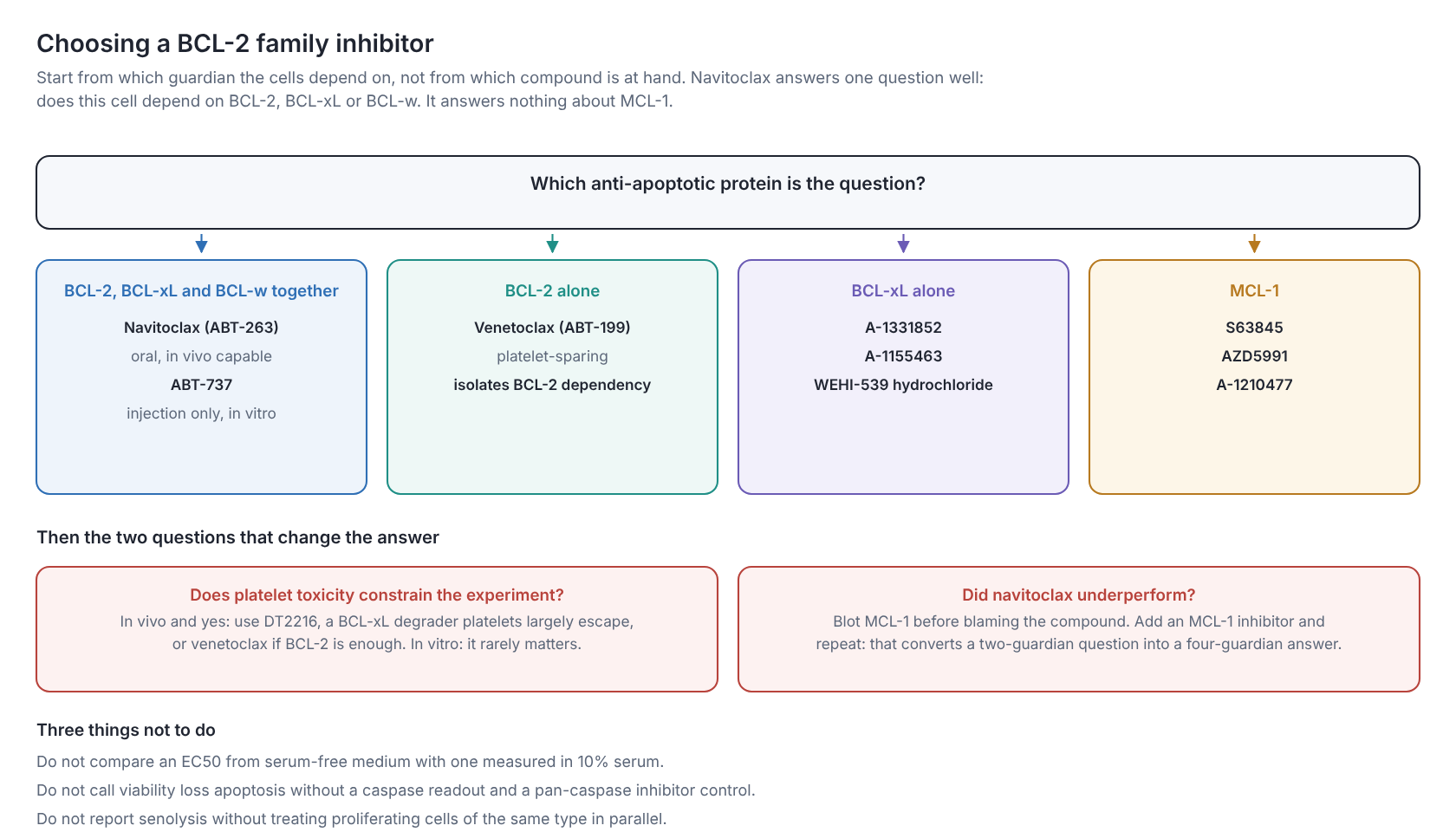
If you only remember one thing: navitoclax answers "does this cell depend on BCL-2, BCL-xL or BCL-w," and nothing else.
5. Research areas and experiment types
This section covers the methods, including what the published in vitro and in vivo designs actually look like. The compound's own catalogue entry lists 26 publications that used Adooq material, and the examples below are drawn from that list where possible.
5.1 In vitro: the core designs
Viability and potency. The standard is a 48 h exposure with an eight- to ten-point dilution series, read by a tetrazolium (MTS, MTT, WST) or ATP luminescence (CellTiter-Glo) assay. Published anchors from the Adooq activity table: EC50 4.2 nM and 5.9 nM in FL5.12 cells over-expressing BCL-xL or BCL-2 in serum-free medium; EC50 86.7 nM in NCI-H146 and 51 nM in NCI-H1963 small cell lung cancer lines in 10% human serum; IC50 42.6 nM in RS4;11; IC50 212 nM in MOLT-4. Note the two WI-38 and platelet numbers in the same table: IC50 8.06 µM for WI-38 fibroblasts against 0.189 µM for platelets, a 40-fold window that is the quantitative basis of the platelet problem.
Apoptosis confirmation. Viability loss is not apoptosis. Confirm with at least one direct readout: caspase-3/7 activity (an EC50 of 14 nM at 6 h has been reported in BCL-2-over-expressing RS4;11), annexin V/PI flow cytometry, cytochrome c release by fractionation, or PARP and caspase-3 cleavage blots. A pan-caspase inhibitor control such as Q-VD-OPh or Z-VAD-FMK should abolish the phenotype; if it does not, something other than caspase-dependent apoptosis is happening.
Dependency mapping. Run navitoclax alongside venetoclax (BCL-2 only) and A-1331852 or WEHI-539 hydrochloride (BCL-xL only) at matched exposures. A cell killed by navitoclax and venetoclax is BCL-2-dependent; killed by navitoclax and A-1331852 is BCL-xL-dependent; killed by navitoclax but neither selective agent usually means BCL-w or a shared dependency.
Immunoblot panel. BCL-2, BCL-xL, BCL-w, MCL-1, BIM, NOXA and PUMA at baseline, plus MCL-1 after treatment. Mérino and colleagues' expression-response analysis across 39 non-Hodgkin lymphoma lines found that higher BCL-2 and NOXA tracked with sensitivity and higher MCL-1 with resistance, while BCL-xL and BCL-w expression did not correlate in that panel ([6]). Expression is a weak predictor on its own; functional dependency is the real variable.
Protein-stability chase. The cycloheximide chase used by Wang and colleagues is worth copying when you care about MCL-1: 12 h pretreatment with 5 µM ABT-263, then 10 µM cycloheximide with sampling at 0, 15, 30, 60, 120 and 240 min ([7]).
5.2 In vitro: senescence and senolysis
The senolytic assay is a selectivity assay, so it needs two populations, not one.
- Induce senescence. Published inducers include ionising radiation, doxorubicin, replicative exhaustion, and oncogene expression. Suzuki and colleagues used ionising radiation and characterised the resulting micronucleated, prematurely senescent cells before testing ABT-263 ([13]).
- Let the phenotype mature. Senescence-associated BCL-xL and BCL-w upregulation takes days, not hours; most protocols wait 7 to 10 days after the insult.
- Confirm senescence before you treat: SA-β-galactosidase, p16INK4A and p21, loss of Ki67 or EdU incorporation, and a SASP cytokine or two.
- Treat both senescent and proliferating cells from the same donor in parallel, typically 0.5 to 2.5 µM for 24 to 72 h.
- Report the ratio, not the absolute kill. A senolytic result is a selectivity index; a compound that kills both populations is simply cytotoxic.
Zhu and colleagues identified navitoclax as a senolytic in exactly this framework and noted that its activity is cell-type dependent, being effective in senescent human umbilical vein endothelial cells and IMR-90 fibroblasts but not in senescent human preadipocytes ([11]). That cell-type dependence is a real result, not a protocol failure, and it is the reason a negative senolysis experiment needs a positive-control cell type.
5.3 In vivo: oncology designs
Navitoclax is given orally, which is the whole point of the molecule. Pharmacokinetics in Sprague-Dawley rats, from the Adooq datasheet summary of the original work: after a single 5 mg/kg oral dose, absolute oral bioavailability (F) 21.6 ± 2.0% and terminal half-life 6.5 ± 0.65 h, against an IV reference of 2 mg/kg with half-life 8.4 ± 1.4 h, clearance 0.15 ± 0.02 L/h/kg and Vss 0.6 ± 0.13 L/kg, with 10% DMSO in PEG-400 as vehicle ([3]).
The reference xenograft design comes from Ackler and colleagues: DoHH-2 diffuse large B-cell lymphoma flank xenografts in C.B.-17 scid mice, n = 10 per group, navitoclax 100 mg/kg/day by oral gavage for 14 days in a Phosal 50PG : PEG400 : ethanol vehicle. Monotherapy gave 44% tumour growth inhibition with no objective responses; with a single 25 mg/kg IV dose of bendamustine, growth inhibition reached 91%, overall response rate 90% and complete response rate 20% ([14]). That pattern, modest alone and strong in combination, recurs across models and is the honest summary of navitoclax as a single agent in solid tumours.
Koyama and colleagues used the same logic in colorectal cancer: low-dose trametinib (10 nM rather than the usual 100 nM) raised BCL-xL and so created its own resistance, and adding ABT263 synergistically increased apoptosis in vitro and suppressed xenograft growth in KRAS-mutant models ([15]). Xu and colleagues showed a different mechanism in prostate cancer, where ABT263 raised reactive oxygen species, suppressed USP26 and accelerated ARv7 degradation, increasing enzalutamide sensitivity in both enzalutamide-sensitive and resistant cells and in mice ([16]).
Monitoring. Platelet counts are mandatory, not optional, in any in vivo navitoclax experiment. Expect a nadir within 24 to 48 h of the first dose and partial recovery during continued dosing as the marrow compensates.
5.4 In vivo: senolytic designs
The senolytic dosing pattern is intermittent by design, to clear senescent cells while letting platelets recover.
- Dose. 50 mg/kg/day by oral gavage is the most common figure, usually for 5 to 7 consecutive days, sometimes repeated in cycles with a 2-week gap.
- Readouts. p16 and p21 transcripts in the target tissue, SA-β-gal histochemistry, SASP cytokines in plasma, and then the tissue-level endpoint the study is actually about.
Chang and colleagues gave ABT263 to sublethally irradiated and to normally aged mice and reported that it depleted senescent cells and rejuvenated aged haematopoietic stem cells, restoring their repopulating capacity ([10]). Mikawa and colleagues eliminated p19ARF-expressing cells in elastase-induced emphysema in 12-month-old mice and found that a senolytic drug attenuated the emphysema-associated pathology ([17]). Anderson and colleagues used senescent-cell clearance in aged mice to show that length-independent telomere damage drives post-mitotic cardiomyocyte senescence, with clearance reducing hypertrophy and fibrosis ([18]).
The same approach has been extended to organ fibrosis. Wen and colleagues dosed Sprague-Dawley rats with neurogenic bladder fibrosis at 25 or 50 mg/kg by oral gavage, with the higher dose giving the greater improvement in fibrosis markers, and found in primary bladder fibroblasts treated with TGF-β1 that apoptosis rose at 10 µmol/L as BCL-xL fell ([19]).
5.5 Other published uses worth knowing
The papers citing Adooq material cover a wider range than oncology and ageing alone: ruxolitinib-persistent JAK2-V617F leukaemic cells, where ABT-737, navitoclax or A-1331852 induced caspase-dependent apoptosis in combination with ruxolitinib ([20]) and where USP9X inhibition synergised with BH3 mimetics ([21]); and extracellular-ATP-driven survival signalling in Caco-2 colorectal cells, where ABT-263 markedly reduced ATP-induced survival ([22]). Metabolic work has also used the family: Wright and colleagues' analysis of MCL-1 and long-chain fatty acid oxidation sits in the same literature, and is a reminder that these proteins have day jobs beyond apoptosis ([23]).
6. Solubility, stock solution and working concentration
6.1 Stock solution
- Equilibrate the vial to room temperature before opening. Cold powder draws moisture.
- Dissolve in anhydrous DMSO. At 974.6 g/mol, a 10 mM stock is 9.75 mg/mL, and a 20 mM stock is 19.49 mg/mL, both comfortably below the 89 mg/mL reported maximum.
- Warm gently and vortex if dissolution is slow. Do not sonicate to dryness.
- Aliquot single-use volumes of 10 to 50 µL. Navitoclax tolerates freeze-thaw poorly and the datasheet gives one month at -20 °C in solution.
- Store powder at -20 °C, desiccated, where it is stable for about 36 months.
Common laboratory pack sizes, converted:
| Vial | 10 mM | 5 mM | 1 mM |
|---|---|---|---|
| 5 mg | 0.51 mL | 1.03 mL | 5.13 mL |
| 10 mg | 1.03 mL | 2.05 mL | 10.26 mL |
| 25 mg | 2.57 mL | 5.13 mL | 25.65 mL |
| 50 mg | 5.13 mL | 10.26 mL | 51.30 mL |
A ready-made 10 mM × 1 mL DMSO solution is also listed on the product page, alongside sizes up to 500 mg. It is worth considering if you need consistency across a long time course more than you need the dry powder.
6.2 Choosing a working concentration
| Application | Concentration | Notes |
|---|---|---|
| Dependency probe, haematological lines | 10 nM - 1 µM, 48 h | Sensitive lines die well below 100 nM; run the full series |
| Dependency probe, solid tumour lines | 100 nM - 10 µM, 48-72 h | Expect partial responses; pair with an MCL-1 inhibitor |
| Apoptosis trigger for mechanism work | 1-5 µM, 2-6 h | Short exposures give clean caspase kinetics |
| MCL-1 stabilisation studies | 5 µM, 12-18 h | The published condition ([7]) |
| Senolysis in vitro | 0.5-2.5 µM, 24-72 h | Always against proliferating control cells |
| Combination screening | One-quarter to one-half of the single-agent IC50 | Synergy is invisible at a concentration that already kills |
| In vivo oncology | 25-100 mg/kg/day, oral gavage | Monitor platelets |
| In vivo senolysis | 50 mg/kg/day, 5-7 days, cycled | Intermittent by design |
Keep final DMSO at or below 0.1% and match it exactly in the vehicle control. At 10 mM stock, a 10 µM final concentration is already a 1:1000 dilution, so this is easy to respect.
7. Molecules commonly used alongside navitoclax
| Molecule | Role in the experiment |
|---|---|
| Venetoclax (ABT-199) | BCL-2-selective comparator; splits BCL-2 from BCL-xL dependency |
| A-1331852 | BCL-xL-selective comparator; the other half of the same split |
| WEHI-539 hydrochloride | Earlier BCL-xL-selective tool compound |
| A-1155463 | BCL-xL-selective, used in senolytic and platelet work |
| S63845 | MCL-1 inhibitor; closes the gap navitoclax leaves |
| A-1210477 | Earlier MCL-1 inhibitor, useful as a second chemotype |
| AZD5991 | Macrocyclic MCL-1 inhibitor |
| ABT-737 | The parent compound; same target profile, injection only |
| Q-VD-OPh | Pan-caspase inhibitor; confirms the death is caspase-dependent |
| Z-VAD-FMK | The older pan-caspase control for the same purpose |
| DT2216 | BCL-xL PROTAC degrader; platelet-sparing comparator |
Pairing navitoclax with an MCL-1 inhibitor is the single most informative combination in the list, because it closes the main escape route and covers all four major guardians at once: BCL-2, BCL-xL, BCL-w and MCL-1. It is also the combination most likely to mislead you. Blocking BCL-xL and MCL-1 together kills normal cells as readily as tumour cells, through the same BAX/BAK-dependent route, so run it at reduced concentrations of both agents and at short timepoints, 2 to 6 h, with an untransformed control line. A combination that kills everything in the plate at 24 h has told you nothing about dependency.
Pairing navitoclax with a pan-caspase inhibitor is the cheapest control that protects you from over-interpreting a viability curve.
8. Limitations and off-target liabilities
8.1 Thrombocytopenia is mechanistic
BCL-xL sets platelet lifespan, so navitoclax reduces platelet counts in every species tested, including humans, at exposures close to the ones needed for anti-tumour activity ([8]). In vitro, platelets have an IC50 of about 0.19-0.33 µM, inside the concentration range used for most cellular experiments. You cannot dose around the mechanism, only around the kinetics, which is why clinical schedules used a lower lead-in dose and why senolytic schedules are intermittent.
8.2 MCL-1-dependent cells do not respond
Discussed in §3.2. If your cells do not die, measure MCL-1 before you question the compound.
8.3 Treatment raises MCL-1
The compound induces a resistance mechanism within 12 to 18 h in at least some models ([7]). Long exposures without an MCL-1 blot are hard to interpret.
8.4 Serum binding moves the dose-response by an order of magnitude
An EC50 measured in serum-free medium is not comparable with one measured in 10% serum. Always state the serum condition.
8.5 Senolytic activity is cell-type dependent
Navitoclax is not a universal senolytic. It does not clear senescent human preadipocytes, where the dasatinib-plus-quercetin combination does ([11]). A negative result in one cell type says nothing about another.
8.6 Formulation is genuinely awkward
Insoluble in water and ethanol, and highly protein-bound. Precipitation on dilution into aqueous medium is common at higher final concentrations, and precipitate reads as a plateau in a dose-response curve.
9. Navitoclax clinical trials: what was run and what it showed
Searches for "navitoclax clinical trials" usually want one of two things: the headline efficacy numbers, or whether the drug is available. The short answer to the second is no, and the long answer to the first is below.
9.1 Phase 1: the dose-limiting toxicity was decided early
| Study | Population | Key finding |
|---|---|---|
| Wilson 2010, Lancet Oncology ([24]) | Lymphoid malignancies, phase 1 dose escalation | Established thrombocytopenia as dose-limiting; durable single-agent responses in a minority of patients, mostly CLL |
| Gandhi 2011, J Clin Oncol ([25]) | Small cell lung cancer and other solid tumours, phase 1 | Tolerable with a lead-in dosing schedule; limited single-agent activity in solid tumours |
| Roberts 2012, J Clin Oncol ([26]) | Relapsed or refractory CLL, phase 1 | The standout result: substantial single-agent activity, establishing BCL2 as a genuine target in CLL |
The Roberts study is the one that changed the field. It demonstrated that inhibiting BCL-2 could produce meaningful responses in a human cancer, which justified the enormous subsequent investment in BH3 mimetics. It also made the platelet problem unavoidable, since the exposures needed for response overlapped the exposures that destroyed platelets.
9.2 Phase 2: the ceiling in solid tumours
Rudin and colleagues ran single-agent navitoclax in relapsed small cell lung cancer, the indication the preclinical data pointed at most strongly. The response rate was low, and the biomarker analysis did not identify a selectable population ([27]). Kipps and colleagues tested navitoclax with or without rituximab in previously untreated CLL ([28]). Neither study produced a registrational path.
9.3 The pivot to combinations
Once single-agent activity proved insufficient outside CLL, and once venetoclax had taken over the BCL-2-dependent indications, the programme moved to combinations where BCL-xL inhibition supplies something venetoclax cannot.
RAS-mutant solid tumours. Corcoran and colleagues had shown in 2013 that combined BCL-xL and MEK inhibition is synthetically lethal in KRAS-mutant models ([12]). The clinical test followed: a phase 1/2 study of navitoclax with trametinib in KRAS- or NRAS-mutant advanced solid tumours, reported in 2024 ([29]).
Acute lymphoblastic leukaemia. Pullarkat and colleagues combined venetoclax and navitoclax with chemotherapy in relapsed or refractory ALL and lymphoblastic lymphoma, using both BH3 mimetics together to cover BCL-2 and BCL-xL dependency simultaneously ([30]).
Myelofibrosis. This became the lead indication, on the rationale that BCL-xL supports the malignant clone and that anti-fibrotic activity might follow. Harrison and colleagues reported the phase 2 REFINE study, adding navitoclax to ongoing ruxolitinib in patients with progression or suboptimal response ([31]). The results were encouraging enough to support two phase 3 trials.
9.4 TRANSFORM-1: the phase 3 result
TRANSFORM-1 randomised 252 JAK-inhibitor-naive patients with intermediate-2 or high-risk myelofibrosis to navitoclax plus ruxolitinib or placebo plus ruxolitinib. Pemmaraju and colleagues published the full results in Blood ([32]).
| Endpoint | Navitoclax + ruxolitinib (n=125) | Placebo + ruxolitinib (n=127) |
|---|---|---|
| SVR35 at week 24 (primary) | 63.2% | 31.5% (P < 0.0001) |
| SVR35 at any time | 76.8% | 44.1% (nominal P < 0.0001) |
| Change in Total Symptom Score at week 24 | -10.2 | -11.6 (P = 0.2852) |
| ≥20% variant allele frequency reduction | 58.5% | 45.5% |
| Grade 3/4 thrombocytopenia | 54.0% | 19.2% |
| Grade 3/4 neutropenia | 40.3% | 8.8% |
| Any-grade diarrhoea | 41.9% | 16.8% |
The two randomised group sizes in the header are the intention-to-treat numbers. The three adverse-event rows are reported for the safety population, that is the patients who received at least one dose, whose denominators differ slightly from the randomised numbers; the variant allele frequency row is an exploratory analysis in the biomarker-evaluable subset.
Read that table as a whole and the outcome of the programme becomes self-explanatory. The primary endpoint doubled. The first-ranked secondary endpoint, symptom score, did not improve at all and numerically favoured placebo. And grade 3/4 thrombocytopenia nearly tripled. A drug that shrinks spleens twice as well while making patients no better symptomatically, at the cost of a large increase in severe cytopenias, is a difficult regulatory proposition. The authors describe the cytopenias as generally manageable and reversible with dose adjustment.
10. Navitoclax and AbbVie: who developed it and where it stands
10.1 The ownership chain
Navitoclax was discovered at Abbott Laboratories, in a BCL-2 programme run in collaboration with Genentech. When Abbott split its research-based pharmaceutical business into AbbVie on 1 January 2013, the compound went with it, which is why pre-2013 papers credit Abbott and later ones credit AbbVie. AbbVie remains the originator of record and ran the phase 3 programme.
10.2 What AbbVie did with it
The strategic decision that defines the compound's history is that AbbVie built its successor and then prioritised it. Souers and colleagues reported ABT-199, now venetoclax, in 2013: a reengineered BH3 mimetic that retains sub-nanomolar BCL-2 binding but loses BCL-xL affinity, and therefore achieves antitumour activity while sparing platelets ([33]). Venetoclax went on to approval in CLL and AML. Navitoclax's own BCL-2-dependent indications were handed to the better molecule, and navitoclax was left with the indications where BCL-xL inhibition is the point.
10.3 Current status
- Highest phase reached: phase 3, in myelofibrosis with ruxolitinib (TRANSFORM-1 and TRANSFORM-2).
- Approvals: none, in any jurisdiction, for any indication.
- Discontinued indications: chronic lymphocytic leukaemia, lymphoma, lymphoid leukaemia, non-small cell and small cell lung cancer.
- Europe: the orphan designation for myelofibrosis, EU/3/19/2233, granted on 16 December 2019 to AbbVie Deutschland, was withdrawn from the Union Register in June 2024 at the sponsor's request.
- United Kingdom: the NICE technology appraisal was suspended after the company stated in June 2024 that it was no longer pursuing an MHRA marketing authorisation application for the indication, and was formally discontinued on 24 July 2025.
Those two 2024 withdrawals are the clearest available public signal: AbbVie is not pursuing registration of navitoclax in myelofibrosis in Europe or the UK. The compound's future is as a research tool and as the chemical starting point for platelet-sparing BCL-xL approaches, not as a medicine.
For a research guide this is good news rather than bad. A tool compound with a fully published clinical dataset, including the exact exposures at which it damages a defined human cell type, is more interpretable than one with a confidential development history.
11. Navitoclax manufacturer and research supply
"Navitoclax manufacturer" is an ambiguous query with two correct answers, and which one you need depends on who is asking.
The clinical sponsor and originator is AbbVie, following Abbott Laboratories, with Genentech as a collaborator. That entity holds the development history, made the clinical material, and ran the trials described in §9. It does not supply the compound to laboratories, and since navitoclax is not approved anywhere there is no commercial pharmaceutical product to source.
For laboratory work the compound is supplied as a research chemical. Adooq Bioscience manufactures and supplies Navitoclax (ABT-263) as catalogue number A10022, at greater than 98% purity, in sizes from 5 mg to 500 mg plus a pre-made 10 mM × 1 mL DMSO solution. The listing is in the Bcl-2 family category, and 26 published papers citing that material are listed on the product page. Material is for laboratory research use only and is not sold to patients.
What to check on any certificate of analysis before you commit a long experiment to a lot:
- Purity by HPLC, with the actual chromatogram rather than a summary figure. At 974.6 g/mol, a 2% impurity by mass is a meaningful amount of material.
- Identity by NMR and mass spectrometry. The molecule has one stereocentre; the certificate should confirm the single enantiomer.
- Water content. Navitoclax is supplied as the free compound rather than a salt or defined hydrate, so residual solvent and water affect the effective molarity of your stock.
- Lot number recorded in your notebook. Lot-to-lot variation in a lipophilic compound of this size is the commonest unexamined source of drift in a long study.
12. Similar products: ABT-737, venetoclax and the selective agents
12.1 ABT-737 and navitoclax: what actually differs
Anyone comparing "ABT-737 navitoclax" is choosing between a parent and its orally available successor. The target profiles are close enough to be interchangeable in a dish and different enough to matter in an animal.
| ABT-737 | Navitoclax (ABT-263) | |
|---|---|---|
| Targets | BCL-2, BCL-xL, BCL-w | BCL-2, BCL-xL, BCL-w |
| Affinity | Sub-nanomolar | Ki ≤ 1 nM |
| MCL-1 | Not inhibited | Not meaningfully inhibited |
| Oral bioavailability | Essentially none | About 22% in rat |
| Route in animals | Intraperitoneal or intravenous | Oral gavage |
| Reported | 2005 ([1]) | 2008 ([2], [3]) |
| Molecular weight | 813.4 | 974.6 |
| Structural difference | Planar biphenyl p2 arm, central nitro group, terminal dimethylamino group | Gem-dimethylcyclohexene p2 arm, central triflone, terminal morpholine. The p4 thiophenyl group is shared |
| Still used for | In vitro work and historical comparison | In vitro and in vivo, especially senolytics |
| Platelet effect | Yes, same mechanism | Yes, same mechanism |
The practical rule. For cell culture the two are near-equivalent, and ABT-737 is still the right choice when you are comparing against the large body of pre-2008 literature. For anything in an animal, navitoclax is the one that can be dosed by mouth, and most in vivo senolytic protocols are written for it. Adooq supplies both: ABT-737 and Navitoclax (ABT-263).
12.2 The wider comparison
| Compound | Selectivity | Why you would choose it instead |
|---|---|---|
| Venetoclax (ABT-199) | BCL-2 only | Platelet-sparing; isolates BCL-2 dependency; an approved drug, so clinically relevant |
| A-1331852 | BCL-xL only | Isolates BCL-xL dependency; the cleanest single-target BCL-xL probe |
| A-1155463 | BCL-xL only | Second BCL-xL chemotype; widely used in senolytic work |
| WEHI-539 hydrochloride | BCL-xL only | The original BCL-xL-selective tool compound |
| S63845 | MCL-1 | Covers the guardian navitoclax misses |
| AZD5991 | MCL-1 | Different chemotype for the same target |
| DT2216 | BCL-xL, by degradation | Platelet-sparing BCL-xL removal; platelets lack the E3 ligase it recruits ([34]) |
| Obatoclax mesylate | Pan-BCL-2 family, claimed | Historic comparator; off-target activity is substantial |
| Sabutoclax | Pan-BCL-2 family | Gossypol-derived pan-inhibitor, including MCL-1 |
DT2216 deserves a note because it answers the exact problem navitoclax created. Khan and colleagues built a PROTAC that recruits VHL to degrade BCL-xL; platelets express little VHL, so the degrader removes BCL-xL from tumour cells while largely sparing platelets ([34]). If your reason for using navitoclax is BCL-xL and your obstacle is platelet toxicity in vivo, that is the comparison to run.
12.3 The short version
Use navitoclax when you want BCL-2, BCL-xL and BCL-w blocked at once, orally if needed. Use venetoclax to isolate BCL-2 and spare platelets. Use A-1331852 or A-1155463 to isolate BCL-xL. Add an MCL-1 inhibitor whenever navitoclax underperforms. Use DT2216 when BCL-xL is the target and platelets are the obstacle.
13. Troubleshooting
| Observation | Likely cause | What to do |
|---|---|---|
| No killing at 10 µM | MCL-1 or A1 dependency | Blot MCL-1; add S63845 or AZD5991 and repeat |
| Potency 10-50× worse than published | Serum protein binding | Check the serum percentage in both methods sections; repeat at matched serum |
| Dose-response plateaus rather than reaching zero | Precipitation on dilution, or a mixed population | Inspect wells under the microscope; pre-dilute in medium stepwise; keep DMSO at 0.1% |
| Viability falls but no caspase signal | Not apoptosis, or the timepoint is wrong | Sample at 2, 4 and 8 h for caspase-3/7; confirm Q-VD-OPh rescues viability |
| Killing works on day 1, fails on day 3 | MCL-1 upregulation during treatment | Blot MCL-1 at 0, 12, 24 and 48 h ([7]) |
| Senescent and proliferating cells die equally | Senescence not established, or the wrong cell type | Confirm SA-β-gal and p16 before treating; include a cell type with published senolysis |
| Activity drops across a long study | Freeze-thaw or lot change | Single-use aliquots; record the lot; one month maximum for DMSO stocks at -20 °C |
| Mice lose weight or bleed | Thrombocytopenia | Check platelets; move to intermittent dosing; reduce to 25-50 mg/kg |
| Compound will not dissolve for gavage | Wrong vehicle | Use the published formulation, 6 mg/mL in 5% DMSO plus corn oil, or the Phosal 50PG : PEG400 : ethanol vehicle used in the xenograft literature |
14. Frequently asked questions
What is navitoclax (ABT-263)?
Navitoclax, development code ABT-263, is an orally bioavailable BH3 mimetic that binds BCL-2, BCL-xL and BCL-w with Ki values at or below 1 nM and triggers apoptosis in cells that depend on those proteins for survival.
What is the navitoclax structure?
It is a large acylsulfonamide of formula C47H55ClF3N5O6S3 and molecular weight 974.6, built around a benzoyl sulfonamide core that mimics a BH3 helix. Compared with its parent ABT-737 it carries three changes that together produced oral bioavailability: a 4-chlorophenyl-dimethylcyclohexene arm in the p2 pocket in place of the planar biphenyl, a trifluoromethylsulfonyl group in place of the central nitro group, and a morpholine in place of the terminal dimethylamino group on the (R)-aminobutyl side chain. The thiophenyl group that fills the p4 pocket is present in both molecules.
How is navitoclax different from ABT-737?
Same three targets and comparable affinity. The difference is pharmacokinetic: ABT-737 has essentially no oral bioavailability, while navitoclax was engineered from it at three positions to reach about 22% oral bioavailability in rat, which is what makes oral dosing in animals possible.
What is the working concentration of navitoclax in vitro?
Sensitive haematological lines respond below 100 nM. Most published work falls between 100 nM and 10 µM, senolytic protocols cluster at 0.5-2.5 µM, and mechanism studies commonly use 1-5 µM for a few hours.
What dose is used in mice?
Oncology studies generally use 25-100 mg/kg/day by oral gavage; senolytic studies most often use 50 mg/kg/day for 5-7 days, sometimes in repeated cycles. Platelet counts should be monitored in either case.
Is navitoclax soluble in water?
No. It is insoluble in water and in ethanol, and dissolves in DMSO to about 89 mg/mL. For animal dosing the standard formulation is 6 mg/mL in 5% DMSO plus corn oil.
Why does navitoclax cause thrombocytopenia?
Platelet lifespan is set by BCL-xL restraining BAK. Inhibiting BCL-xL triggers platelet apoptosis directly, so the effect is on-target and unavoidable rather than an idiosyncratic toxicity.
Why do some cells not respond to navitoclax at all?
Because they depend on MCL-1 or A1, which navitoclax binds roughly 500-fold more weakly. MCL-1 level is the single best predictor of resistance, and adding an MCL-1 inhibitor usually restores sensitivity.
Is navitoclax a senolytic?
Yes, in many but not all cell types. Senescent cells upregulate BCL-xL and BCL-w, which makes them selectively vulnerable. It does not clear senescent human preadipocytes, so a negative result in one cell type does not generalise.
What did the navitoclax clinical trials show?
Dose-limiting thrombocytopenia in phase 1, real single-agent activity in chronic lymphocytic leukaemia, limited activity in solid tumours, and in phase 3 myelofibrosis a doubling of spleen volume response when added to ruxolitinib without any symptom benefit, at the cost of substantially more grade 3/4 cytopenias.
Is navitoclax approved as a drug?
No. It has never been approved in any jurisdiction. The EU orphan designation for myelofibrosis was withdrawn at the sponsor's request in June 2024 and the corresponding UK appraisal was discontinued in July 2025.
Who is the navitoclax manufacturer?
For clinical development, AbbVie, following Abbott Laboratories and in collaboration with Genentech. For laboratory use the compound is supplied as a research chemical; Adooq supplies it as catalogue number A10022 at greater than 98% purity.
What is the relationship between navitoclax and venetoclax?
Venetoclax (ABT-199) was engineered from navitoclax to keep BCL-2 affinity and lose BCL-xL affinity, which removed the platelet liability. It was approved; navitoclax was not. Venetoclax is the better choice for isolating BCL-2 dependency, and navitoclax remains the choice when BCL-xL is the point.
How should navitoclax be stored?
Powder at -20 °C, desiccated, where it is stable for about 36 months. DMSO stocks at -20 °C for no more than a month, in single-use aliquots to avoid freeze-thaw cycles.
References
- Oltersdorf T, Elmore SW, Shoemaker AR, et al. An inhibitor of Bcl-2 family proteins induces regression of solid tumours. Nature 2005. PMID 15902208
- Park CM, Bruncko M, Adickes J, et al. Discovery of an orally bioavailable small molecule inhibitor of prosurvival B-cell lymphoma 2 proteins. Journal of Medicinal Chemistry 2008. PMID 18841882
- Tse C, Shoemaker AR, Adickes J, et al. ABT-263: a potent and orally bioavailable Bcl-2 family inhibitor. Cancer Research 2008. PMID 18451170
- Czabotar PE, Lessene G, Strasser A, Adams JM Control of apoptosis by the BCL-2 protein family: implications for physiology and therapy. Nature Reviews Molecular Cell Biology 2014. PMID 24355989
- van Delft MF, Wei AH, Mason KD, et al. The BH3 mimetic ABT-737 targets selective Bcl-2 proteins and efficiently induces apoptosis via Bak/Bax if Mcl-1 is neutralized. Cancer Cell 2006. PMID 17097561
- Merino D, Khaw SL, Glaser SP, et al. Bcl-2, Bcl-x(L), and Bcl-w are not equivalent targets of ABT-737 and navitoclax (ABT-263) in lymphoid and leukemic cells. Blood 2012. PMID 22538851
- Wang B, Ni Z, Dai X, et al. The Bcl-2/xL inhibitor ABT-263 increases the stability of Mcl-1 mRNA and protein in hepatocellular carcinoma cells. Molecular Cancer 2014. PMID 24779770
- Mason KD, Carpinelli MR, Fletcher JI, et al. Programmed anuclear cell death delimits platelet life span. Cell 2007. PMID 17382885
- Leverson JD, Phillips DC, Mitten MJ, et al. Exploiting selective BCL-2 family inhibitors to dissect cell survival dependencies and define improved strategies for cancer therapy. Science Translational Medicine 2015. PMID 25787766
- Chang J, Wang Y, Shao L, et al. Clearance of senescent cells by ABT263 rejuvenates aged hematopoietic stem cells in mice. Nature Medicine 2016. PMID 26657143
- Zhu Y, Tchkonia T, Fuhrmann-Stroissnigg H, et al. Identification of a novel senolytic agent, navitoclax, targeting the Bcl-2 family of anti-apoptotic factors. Aging Cell 2016. PMID 26711051
- Corcoran RB, Cheng KA, Hata AN, et al. Synthetic lethal interaction of combined BCL-XL and MEK inhibition promotes tumor regressions in KRAS mutant cancer models. Cancer Cell 2013. PMID 23245996
- Suzuki K, et al. Characterization of radiation-induced micronuclei associated with premature senescence, and their selective removal by senolytic drug, ABT-263. Mutation Research. Genetic Toxicology and Environmental Mutagenesis 2022. PMID 35483779
- Ackler S, Mitten MJ, Chen J, et al. Navitoclax (ABT-263) and bendamustine with or without rituximab induce enhanced killing of non-Hodgkin's lymphoma tumours in vivo. British Journal of Pharmacology 2012. PMID 22624727
- Koyama M, et al. Low-dose trametinib and Bcl-xL antagonist have a specific antitumor effect in KRAS-mutated colorectal cancer cells. International Journal of Oncology 2020. PMID 32901840
- Xu H, et al. Preclinical study using ABT263 to increase enzalutamide sensitivity to suppress prostate cancer progression via targeting BCL2/ROS/USP26 axis through altering ARv7 protein degradation. Cancers 2020. PMID 32235588
- Mikawa R, et al. Elimination of p19ARF-expressing cells protects against pulmonary emphysema in mice. Aging Cell 2018. PMID 30058137
- Anderson R, Lagnado A, Maggiorani D, et al. Length-independent telomere damage drives post-mitotic cardiomyocyte senescence. The EMBO Journal 2019. PMID 30737259
- Wen Y, Wu J, Pu Q, et al. ABT-263 exerts a protective effect on upper urinary tract damage by alleviating neurogenic bladder fibrosis. Renal Failure 2023. PMID 37154092
- Ishida S, et al. Mechanisms for mTORC1 activation and synergistic induction of apoptosis by ruxolitinib and BH3 mimetics or autophagy inhibitors in JAK2-V617F-expressing leukemic cells including newly established PVTL-2. Oncotarget 2018. PMID 29928488
- Akiyama H, et al. Inhibition of USP9X downregulates JAK2-V617F and induces apoptosis synergistically with BH3 mimetics preferentially in ruxolitinib-persistent JAK2-V617F-positive leukemic cells. Cancers 2020. PMID 32050632
- Shatat AS, Mahgoup EM, Rashed MH, et al. Molecular mechanisms of extracellular-ATP-mediated colorectal cancer progression: implication of purinergic receptors-mediated nucleocytoplasmic shuttling of HuR. Purinergic Signalling 2024. PMID 38801618
- Wright T, Turnis ME, Grace CR, et al. Anti-apoptotic MCL-1 promotes long-chain fatty acid oxidation through interaction with ACSL1. Molecular Cell 2024. PMID 38503284
- Wilson WH, O'Connor OA, Czuczman MS, et al. Navitoclax, a targeted high-affinity inhibitor of BCL-2, in lymphoid malignancies: a phase 1 dose-escalation study of safety, pharmacokinetics, pharmacodynamics, and antitumour activity. The Lancet Oncology 2010. PMID 21094089
- Gandhi L, Camidge DR, Ribeiro de Oliveira M, et al. Phase I study of Navitoclax (ABT-263), a novel Bcl-2 family inhibitor, in patients with small-cell lung cancer and other solid tumors. Journal of Clinical Oncology 2011. PMID 21282543
- Roberts AW, Seymour JF, Brown JR, et al. Substantial susceptibility of chronic lymphocytic leukemia to BCL2 inhibition: results of a phase I study of navitoclax in patients with relapsed or refractory disease. Journal of Clinical Oncology 2012. PMID 22184378
- Rudin CM, Hann CL, Garon EB, et al. Phase II study of single-agent navitoclax (ABT-263) and biomarker correlates in patients with relapsed small cell lung cancer. Clinical Cancer Research 2012. PMID 22496272
- Kipps TJ, Eradat H, Grosicki S, et al. A phase 2 study of the BH3 mimetic BCL2 inhibitor navitoclax (ABT-263) with or without rituximab, in previously untreated B-cell chronic lymphocytic leukemia. Leukemia & Lymphoma 2015. PMID 25797560
- Corcoran RB, Do KT, Kim JE, et al. Phase I/II study of combined BCL-xL and MEK inhibition with navitoclax and trametinib in KRAS or NRAS mutant advanced solid tumors. Clinical Cancer Research 2024. PMID 38456660
- Pullarkat VA, Lacayo NJ, Jabbour E, et al. Venetoclax and navitoclax in combination with chemotherapy in patients with relapsed or refractory acute lymphoblastic leukemia and lymphoblastic lymphoma. Cancer Discovery 2021. PMID 33593877
- Harrison CN, Garcia JS, Somervaille TCP, et al. Addition of navitoclax to ongoing ruxolitinib therapy for patients with myelofibrosis with progression or suboptimal response: phase II safety and efficacy. Journal of Clinical Oncology 2022. PMID 35180010
- Pemmaraju N, Mead AJ, Somervaille TCP, et al. TRANSFORM-1 phase 3 study: efficacy and safety of navitoclax plus ruxolitinib in patients with untreated myelofibrosis. Blood 2026. PMID 42378247
- Souers AJ, Leverson JD, Boghaert ER, et al. ABT-199, a potent and selective BCL-2 inhibitor, achieves antitumor activity while sparing platelets. Nature Medicine 2013. PMID 23291630
- Khan S, Zhang X, Lv D, et al. A selective BCL-XL PROTAC degrader achieves safe and potent antitumor activity. Nature Medicine 2019. PMID 31792461