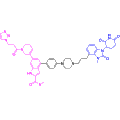
PROTAC Degrader

PROTAC degraders recruit an E3 ubiquitin ligase to a target protein so that the proteasome degrades it. Each proteolysis-targeting chimera (PROTAC) links a target-binding ligand to an E3 ligase ligand through a chemical linker. The approach was first described in 2001, and later work showed that small-molecule PROTACs can act catalytically, removing several target copies per molecule. Examples include the bromodomain and extra-terminal (BET) degraders dBET1, MZ1 and ARV-771, and the estrogen receptor degrader ERD-308. Degraders of anti-apoptotic proteins, such as PROTAC Mcl1 degrader-1, are also listed.

Items 376-400 of 786

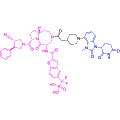
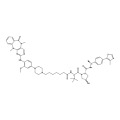
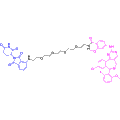
  • PROTAC STAT6 degrader-1
    Cat. No.
    A36475

    PROTAC STAT6 degrader-1

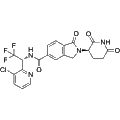
    PROTAC STAT6 degrader-1 is a targeted protein degradative compound designed to modulate STAT6 activity through the recruitment of E3 ligase CRBN. With a DC50 of less than 1 nM, this PROTAC showcases potent efficacy in STAT6 degradation. It is particularly relevant for research on inflammation and various cancer types, providing a valuable tool for exploring STAT6's role in pathophysiology and therapeutic responses.

    1 mg
    $465.00
    5 mg
    $1,190.00
    All 4 sizes
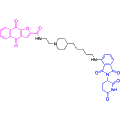
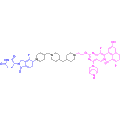
  • SD-436
    Cat. No.
    A36514

    SD-436

    SD-436 is a selective and potent degrader of STAT3, functioning through the PROTAC mechanism with a DC50 of 0.5 μM and an IC50 of 19 nM for STAT3. It promotes the ubiquitination and subsequent degradation of STAT3, leading to significant tumor regression. This reagent is applicable in cancer research, including studies focused on leukemia and lymphoma.

    1 mg
    $210.00
    5 mg
    $645.00
    All 6 sizes
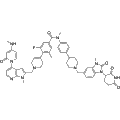
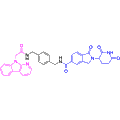
  • DU-14 (PTP1B/TC-PTP PROTAC)
    Cat. No.
    A36544

    DU-14 (PTP1B/TC-PTP PROTAC)

    DU-14 is a potent dual degrader targeting PTP1B and TC-PTP via the PROTAC mechanism. It demonstrates remarkable selectivity with IC50 values of 24.2 nM and 30.1 nM for PTP1B and TC-PTP phosphatase activity, respectively. DU-14 enhances interferon-gamma signaling, promotes T cell activation, and exhibits anti-tumor properties, making it a valuable tool for cancer immunology research and the study of immune modulation.

    1 mg
    $840.00
    5 mg
    $3,025.00
    All 3 sizes
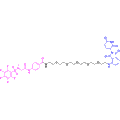
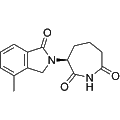
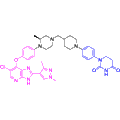
  • PROTAC STAT6 degrader-3
    Cat. No.
    A36554

    PROTAC STAT6 degrader-3

    PROTAC STAT6 degrader-3 is a highly potent degrader targeting STAT6, exhibiting a DC50 of less than 1 nM. This compound facilitates the targeted degradation of STAT6, making it a valuable tool for investigating allergic and inflammatory diseases as well as various cancers. Its application in research can provide insights into the role of STAT6 in disease pathways and therapeutic interventions.

    5 mg
    $465.00
    10 mg
    $760.00
    All 5 sizes
  • SD-2301
    Cat. No.
    A36580

    SD-2301

    SD-2301 is a selective STAT3 PROTAC degrader that targets and induces the degradation of STAT3 while preserving the expression of other STAT family members such as STAT1, STAT2, STAT4, STAT5, and STAT6. It has demonstrated anti-tumor efficacy in B16F10-bearing mouse models, making it a valuable tool for cancer research. This compound can be utilized in studies focused on the modulation of STAT3 pathways and the development of targeted therapies.

    1 mg
    $560.00
    5 mg
    $1,435.00
    All 4 sizes
  • PROTAC STAT6 degrader-2
    Cat. No.
    A36586

    PROTAC STAT6 degrader-2

    PROTAC STAT6 Degrader-2 is a potent bifunctional degrader that specifically targets signal transducer and activator of transcription 6 (STAT6). It demonstrates high efficiency with a DC50 of 1-10 nM in human peripheral blood mononuclear cells (PBMC) and less than 100 nM in HEK293-HIBiT-STAT6 cells. This compound is ideal for research applications related to STAT6-mediated diseases, facilitating the study of its role in various biological processes.

    Out of stock

    All 3 sizes
  • XD2-149
    Cat. No.
    A36589

    XD2-149

    XD2-149 is a PROTAC designed to selectively target STAT3, employing a unique mechanism of action that promotes targeted protein degradation. This compound combines the STAT3 ligand Napabucasin with the E3 ligase Thalidomide via a specialized linker (NH2-C5-Azacyclohexane-N-Boc). XD2-149 offers significant potential for research applications involving cancer biology and the modulation of inflammatory responses, making it a valuable tool for the investigation of therapeutic strategies that manipulate protein levels within cells.

    Out of stock

    All 3 sizes
  • PROTAC STAT6 degrader-4
    Cat. No.
    A36598

    PROTAC STAT6 degrader-4

    PROTAC STAT6 degrader-4 is a potent STAT6 PROTAC degrader with a DC50 of 0.04 nM. It functions by inducing the ubiquitination and subsequent degradation of STAT6, making it an important tool for investigating immune-related diseases. This compound is valuable for researchers studying the role of STAT6 in immune signaling pathways and therapeutic interventions.

    Out of stock

    All 3 sizes
  • S3D5
    Cat. No.
    A36601

    S3D5

    S3D5 is a selective PROTAC degrader specifically targeting STAT3, with a dissociation constant (KD) of 4.35 μM. It effectively induces degradation of the STAT3 protein in HepG2 cells, demonstrating minimal impact on other STAT proteins. This degradation is mediated via the ubiquitin-proteasome system, contributing to its potent anti-proliferative effects in hepatocellular carcinoma by activating the p53 pathway. S3D5 serves as a valuable tool for research focused on the mechanisms underlying hepatocellular carcinoma.

    Out of stock

    All 3 sizes
  • PPM-3
    Cat. No.
    A36667

    PPM-3

    PPM-3 is a potent and selective PROTAC degrader of ERK5, exhibiting an IC50 of 62.4 nM. While PPM-3 does not directly affect tumor cell proliferation, it modulates tumor development by impacting macrophage differentiation. This compound may serve as a valuable tool for investigating the role of ERK5 degradation in cancer biology and immune modulation.

    1 mg
    $220.00
    5 mg
    $685.00
    All 2 sizes
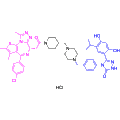
  • PROTAC K-Ras Degrader-5
    Cat. No.
    A36686

    PROTAC K-Ras Degrader-5

    PROTAC K-Ras Degrader-5 is a cereblon-based PROTAC specifically designed to target KRASG12D, achieving a DC50 of less than 100 nM. This reagent facilitates the recruitment of KRASG12D to the cereblon E3 ubiquitin ligase complex, leading to its ubiquitination and proteasomal degradation. As a result, it effectively reduces pERK levels and inhibits the proliferation of cancer cells. PROTAC K-Ras Degrader-5 also enhances caspase 3/7 activity and cleaved PARP levels, indicative of apoptosis, in pancreatic cancer models. This compound is a valuable tool for researching both pancreatic and colorectal cancer.

    1 mg
    $1,005.00
    5 mg
    $3,095.00
    All 3 sizes
  • GT19630
    Cat. No.
    A36868

    GT19630

    GT19630 is a multiple target PROTAC designed to degrade c-MYC, CK1α, GSPT1, and IKZF1/2/3 proteins. This compound effectively targets and reduces the levels of these proteins in various tumor cell lines, making it a valuable tool for studying diseases characterized by high c-MYC expression, including cancer, cardiovascular disorders, cerebrovascular diseases, and viral infections. Researchers can utilize GT19630 to further investigate the therapeutic potential of protein degradation in relevant biological contexts.

    5 mg
    $355.00
    10 mg
    $575.00
    All 5 sizes
  • BTX161
    Cat. No.
    A36879

    BTX161

    BTX161 is a thalidomide analog that functions as an effective degrader of CKIα. This compound promotes the degradation of CKIα in human acute myeloid leukemia (AML) cells, leading to enhanced activation of the DNA damage response (DDR) and p53 while simultaneously stabilizing the p53 antagonist MDM2. BTX161 serves as a valuable tool for studying the role of CKIα in cancer biology and potential therapeutic strategies targeting the DDR pathway.

    5 mg
    $310.00
    10 mg
    $505.00
    All 5 sizes
  • (R,R)-BMS-986397
    Cat. No.
    A36904

    (R,R)-BMS-986397

    (R,R)-BMS-986397 is a potent CK1α degrader, exhibiting a degradation concentration (DC50) range of 0.1-0.5 pM. This compound is instrumental in studying the role of CK1α in cellular processes and has applications in anti-leukemia research, enabling insights into targeted therapeutic strategies. Its ability to specifically degrade CK1α makes it a valuable tool for investigating CK1α-related signaling pathways in cancer biology.

    5 mg
    $160.00
    10 mg
    $255.00
    All 5 sizes
  • TGFβRII-IN-3
    Cat. No.
    A37034

    TGFβRII-IN-3

    TGFβRII-IN-3 is a selective degrader of the TGFβ type II receptor (TGFβ RII), exhibiting an IC50 of 4.1 μM. This compound disrupts TGFβ signaling pathways by promoting the proteolytic degradation of TGFβ RII, leading to the inhibition of endothelial-to-mesenchymal transition and cell migration. TGFβRII-IN-3 is a valuable tool in cancer research, offering insights into the modulation of TGFβ-mediated biological processes.

    5 mg
    $275.00
    10 mg
    $455.00
    All 5 sizes
  • NF764
    Cat. No.
    A37048

    NF764

    NF764 is a selective degrader of β-catenin (CTNNB1) that induces its degradation through a proteasome-dependent mechanism. By effectively lowering CTNNB1 protein levels, NF764 serves as a valuable tool for investigating the role of β-catenin in various cancer signaling pathways. This compound is essential for research aimed at understanding tumorigenesis and developing targeted cancer therapies.

    1 mg
    $280.00
    5 mg
    $695.00
    All 4 sizes
  • SK2187
    Cat. No.
    A37402

    SK2187

    Synonyms: JB301

    SK2187 is a selective degrader of Aurora kinase A (AURKA) utilizing the PROTAC technology, exhibiting a DC50 of approximately 10 nM. This compound demonstrates significant growth inhibition of NGP neuroblastoma cells, with an IC50 value of 101.5 nM. SK2187 is particularly relevant for research on MYCN-amplified neuroblastoma, enabling exploration of targeted degradation pathways in cancer therapy.

    5 mg
    $1,050.00
    10 mg
    $1,790.00
    All 4 sizes
  • dAurAB2
    Cat. No.
    A37408

    dAurAB2

    dAurAB2 is a dual-targeting PROTAC designed to degrade Aurora-A and Aurora-B, demonstrating potent efficacy with DC50 values of 59 nM and 39 nM, respectively. This compound effectively reduces N-Myc protein levels in MYCN-amplified IMR32 neuroblastoma cells, making it a valuable tool for neuroblastoma research. The unique design incorporates a specific Aurora ligand and an E3 ligase ligand connected by a tailored linker, facilitating targeted degradation and advancing studies in cancer biology.

    5 mg
    $985.00
    10 mg
    $1,650.00
    All 4 sizes
  • AurAP14
    Cat. No.
    A37414

    AurAP14

    AurAP14 is a PROTAC degrader specifically targeting Aurora A, with a DC50 of 120 nM. This compound exhibits potent inhibitory effects on various tumor cell lines, showing IC50 values of 0.294 μM in A549 cells and 0.534 μM in MCF-7 cells. AurAP14 induces apoptosis while effectively arresting A549 cells in the S and G2/M phases of the cell cycle. Additionally, AurAP14 demonstrates significant anti-tumor efficacy in nude mouse xenograft models of A549 and A549/PTR, making it a valuable tool for research focused on treating Aurora A-overexpressing non-small cell lung cancer (NSCLC).

    1 mg
    $1,825.00
    5 mg
    $2,995.00
    All 4 sizes
  • dAURK-4
    Cat. No.
    A37416

    dAURK-4

    dAURK-4 is a potent and selective degrader of Aurora A kinase (AURKA) utilizing the PROTAC (proteolysis-targeting chimera) approach. This compound induces the degradation of AURKA, leading to significant antitumor activity. dAURK-4 is ideal for research applications focused on cancer biology, particularly in studies exploring the role of AURKA in tumorigenesis and therapeutic resistance.

    Out of stock

    All 3 sizes
  • JB300
    Cat. No.
    A37417

    JB300

    JB300 is a highly selective degrader of Aurora A, utilizing PROTAC technology with a DC50 of 30 nM. This compound demonstrates significant potential for tumor research by promoting targeted degradation of the Aurora A protein through the recruitment of E3 ligase. JB300 comprises the PROTAC target protein ligand MK-5108, an E3 ligase ligand Thalidomide-O-COOH, and a linker, enabling the efficient conjugation necessary for effective protein degradation. It is a valuable tool for investigating the role of Aurora A in cancer biology and for the development of targeted therapeutics.

    1 mg
    $225.00
    5 mg
    $695.00
    All 2 sizes
  • PROTAC AURKA degrader 2
    Cat. No.
    A37428

    PROTAC AURKA degrader 2

    PROTAC AURKA Degrader 2 is a selective degrader targeting Aurora Kinase A (AURKA), with an IC50 of 3.58 nM. It demonstrates significant selectivity for AURKA over Aurora Kinase B (AURKB), showing an IC50 of 77.2 nM. This compound effectively depletes AURKA from the mitotic spindle, making it a valuable tool for investigating the role of AURKA in cell division and for potential therapeutic applications in cancer research.

    Out of stock

    All 3 sizes
  • PROTAC Aurora A Degrader-1
    Cat. No.
    A37441

    PROTAC Aurora A Degrader-1

    PROTAC Aurora A Degrader-1 is a selective degrader that targets Aurora A, effectively forming a ternary complex with AURKA and CRBN. This compound demonstrates potent biological activity, inducing degradation of AURKA, lowering MYCN levels, and promoting DNA damage and apoptosis in cancer cells. With DC50 values of 1 nM and 2 nM in LAN5 and SMS-SAN cells, respectively, it exhibits significant antiproliferative effects and is valuable for research on neuroblastoma and small cell lung cancer.

    Out of stock

    All 3 sizes
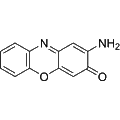
  • Questiomycin A
    Cat. No.
    A37479

    Questiomycin A

    Synonyms: Phx-3

    Questiomycin A is a potent GRP78 degrader, targeting the cytoprotective endoplasmic reticulum chaperone to promote enhanced anticancer activity, particularly in conjunction with Sorafenib. Additionally, Questiomycin A exhibits antimicrobial properties and is derived from the metabolite of Pseudomonas chlororaphis HT66. This compound is valuable for research in the biological control of both cancer and plant diseases, providing insights into therapeutic strategies and molecular mechanisms.

    5 mg
    $20.00
    10 mg
    $40.00
    All 6 sizes
  • PROTAC BRD4 Degrader-21
    Cat. No.
    A37537

    PROTAC BRD4 Degrader-21

    PROTAC BRD4 Degrader-21 is a targeted PROTAC that degrades the BRD4 protein through the induction of ubiquitination, achieving an IC50 of 59 nM. This compound effectively leads to BRD4 degradation via the proteasome pathway, and demonstrates moderate affinity for recombinant HSP90α with an IC50 range of 100-1000 nM. In preclinical studies, PROTAC BRD4 Degrader-21 has been shown to induce apoptosis in cancer cells and inhibit tumor growth in xenograft mouse models, making it a valuable tool for research into acute myeloid leukemia and diffuse large B-cell lymphoma.

    Out of stock

    All 3 sizes

Items 376-400 of 786

Added to your cart

View Cart Checkout

    Loading...