- Cat. No.
- A12373
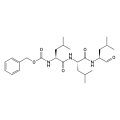
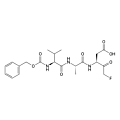
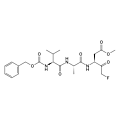
Z-VAD-FMK
Synonyms: Z-VAD(OMe)-FMK
Z-VAD-FMK is a cell-permeable, irreversible pan-caspase inhibitor. Inhibits caspase processing and apoptosis induction in tumor cells in vitro (IC50 = 0.0015 - 5.8 mM). Active in vivo.
In stock
- Perla Nafeh, .et al. , BMC Complement Med Ther, 2025, Aug 13;25(1):304 PMID: 40804627
- Cheng Chen, .et al. , Neurochem Res, 2025, Mar 18;50(2):122 PMID: 40100474
- Lara Ebbert, .et al. , Antioxidants (Basel), 2024, Jul; 13(7): 864 PMID: 39061932
- Rushikesh Deshpande, .et al. , Int J Mol Sci, 2024, Jan 18;25(2):1157 PMID: 38256231
- Sarah Metcalfe, .et al. , J Leukoc Biol, 2023, Jul 27;qiad089 PMID: 37497744
- Kazutoshi Toriyama, .et al. , Oncol Lett, 2023, Nov 10;27(1):12 PMID: 38028184
- Bopei Cui, .et al. , Signal Transduct Target Ther, 2023, Sep 25;8(1):366 PMID: 37743418
- Akira Endo, .et al. , Dev Cell, 2023, Oct 9;58(19):1819-1829 PMID: 37716356
- Rui Zhou, .et al. , Nagoya J Med Sci, 2023, Aug;85(3):579-591 PMID: 37829490
- Chantal-Kristin Wenzel, .et al. , Toxicol In Vitro, 2023, Sep;91:105625 PMID: 37268255
- Joshua H Choe, .et al. , Cancer Discov, 2023, May 4;13(5):1250-1273 PMID: 37067901
- Yu-Chih Hsu, .et al. , Int J Med Sci, 2023, 20(4): 444-454 PMID: 37057216
- Debin Qi, .et al. , Cell Cycle, 2023, Apr;22(7):818-828 PMID: 36482709
- Ming-Chun Hung, .et al. , Cell Biosci, 2022, 12: 122 PMID: 35918763
- Kaori Kanemaru, .et al. , Nat Commun, 2022, May 9;13(1):2347 PMID: 35534464
- Chie Ishikawa, .et al. , Invest New Drugs, 2022, Aug;40(4):718-727 PMID: 35477814
- Aida Falgas, .et al. , Biomed Pharmacother, 2022, Jun;150:112940 PMID: 35421785
- Sumire Suzuki, .et al. , Oncol Rep, 2022, Feb;47(2):40 PMID: 34958115
- Lina Y Abou Zeid, .et al. , Cell Stress Chaperones, 2022, Jan;27(1):11-25 PMID: 34719748
- Simon Boudreault, .et al. , Viruses, 2022, Dec 3;14(12):2710 PMID: 36560714
- Kosar Jabbari, .et al. , Cancers (Basel), 2021, Sep 8;13(18):4521 PMID: 34572749
- Xiaoyue Deng, .et al. , Invest Ophthalmol Vis Sci, 2021, May 3;62(6):1 PMID: 33938913
- Liqun Zhao, .et al. , Apoptosis, 2021, Apr 27 PMID: 33905036
- Sofia Giacosa, .et al. , Cancers (Basel), 2021, Feb 2;13(3):576 PMID: 33540838
- Hideyuki Kinoshita, .et al. , Anticancer Res, 2021, Dec;41(12):6013-6021 PMID: 34848455
- Hannes Schmid, .et al. , Haematologica, 2021, Jan 14 PMID: 33440919
- Hideyuki Kinoshita, .et al. , Anticancer Res, 2021, Oct;41(10):4947-4955 PMID: 34593442
- Hua Xu, .et al. , Cancers (Basel), 2020, Apr; 12(4): 831 PMID: 32235588
- El-Ashmawy NE, .et al. , Pathol Oncol Res, 2020, Jan 4 PMID: 31902118
- Schneider D, .et al. , Clin Epigenetics, 2019, Jul 2;11(1):98 PMID: 31266541
- Fujiki K, .et al. , Cell Death Differ, 2019, Feb 25 PMID: 30804470
- T Yamamoto, .et al. , Cell Microbiol, 2019, 2019 PMID: 30702185
- Maeda N, .et al. , J Biol Chem, 2019, Nov 13. pii: jbc.RA119.010379 PMID: 31723031
- Miyazawa S, .et al. , Breast Cancer, 2019, Oct 17 PMID: 31625014
- Yeh HT, .et al. , Eur J Pharmacol, 2019, Sep 10;863:172658 PMID: 31518562
- D. Bosc, .et al. , Sci Rep, 2018, 8: 11653 PMID: 30076329
- Tsukamoto H, .et al. , J Biol Chem, 2018, Jun 29;293(26):10186-10201 PMID: 29760187
- Hiroshi Kuribayashi, .et al. , Cell Death Dis, 2018, Sep; 9(9): 891 PMID: 30166529
- Matsuo J, .et al. , Can J Microbiol, 2018, Oct 18:1-9 PMID: 30336068
- Orly Ravid, .et al. , Front Cell Neurosci, 2018, 12: 359 PMID: 30459557
- Im E, .et al. , Life Sci, 2018, Sep 15;209:259-266 PMID: 30107166
- Szalai P, .et al. , Cell Calcium, 2018, Dec;76:48-61 PMID: 30261424
- Im E, .et al. , Life Sci, 2018, Jan 1;192:286-292 PMID: 29128513
- Iriyama N, .et al. , Leuk Lymphoma, 2018, Jun;59(6):1439-1450 PMID: 28918692
- Birte Plitzko, .et al. , J Biol Chem, 2017, Dec 22; 292(51): 21102-21116 PMID: 29074620
- Akashi E, .et al. , Oncol Rep, 2017, Jul;38(1):506-514 PMID: 28586026
View Details