
KRAS Inhibitors: A Review of G12C, G12D and Pan-RAS Small Molecules, from Mechanism to Clinical Data and Lab Use
A 2026 review of small-molecule KRAS inhibitors: how G12C, G12D, pan-KRAS and RAS(ON) compounds work, what the trials showed, which molecules are approved, and the concentrations and stock solutions used at the bench.
Technical guide from Adooq Bioscience · Product: Sotorasib (AMG-510), Cat. No. A19021 · Last reviewed: 2026-11
KRAS inhibitors at a glance
| Molecule | Allele | State it binds | Binding | Highest status (Nov 2026) | Cat. No. |
|---|---|---|---|---|---|
| Sotorasib (AMG 510) | G12C | GDP (OFF) | Covalent | Approved 2021 for lung cancer, 2025 with panitumumab for colorectal cancer | A19021 |
| Adagrasib (MRTX849) | G12C | GDP (OFF) | Covalent | Approved 2022 for lung cancer, 2024 with cetuximab for colorectal cancer | A16482 |
| Divarasib (GDC-6036) | G12C | GDP (OFF) | Covalent | Phase 3 positive against the first-generation drugs | A24528 |
| Fulzerasib and glecirasib | G12C | GDP (OFF) | Covalent | Approved in China, 2024 and 2025 | A24228, A24226 |
| Garsorasib (D-1553) | G12C | GDP (OFF) | Covalent | Approved in China, 2024 | Not catalogued |
| Olomorasib | G12C | GDP (OFF) | Covalent | Phase 3 | A24221 |
| Elironrasib (RMC-6291) | G12C | GTP (ON), tri-complex | Covalent | Phase 1/2 | A24117 |
| MRTX1133 | G12D | GDP and GTP | Non-covalent | Preclinical reference compound; trial ended 2025 | A24519 |
| Zoldonrasib (RMC-9805) | G12D | GTP (ON), tri-complex | Covalent | Phase 3 | A24224 |
| HRS-4642 | G12D | GDP and GTP | Non-covalent | Phase 3 in China | A24532 |
| Setidegrasib (ASP3082) | G12D | Degrader | PROTAC | Phase 3 | A24693 |
| BI-2865 | Most KRAS mutants, not HRAS or NRAS | GDP (OFF) | Non-covalent | Preclinical tool | A24530 |
| Daraxonrasib (RMC-6236) | All RAS, mutant and wild type | GTP (ON), tri-complex | Non-covalent | Approved August 2026 for pancreatic cancer | A24531 |
| RMC-7977 | All RAS | GTP (ON), tri-complex | Non-covalent | Preclinical tool | A24118 |
Three results define where this field stands at the end of 2026. Daraxonrasib nearly doubled overall survival against chemotherapy in previously treated metastatic pancreatic cancer and became the first RAS(ON) and first pan-RAS drug to reach the market [1]. Divarasib beat both first-generation KRAS G12C inhibitors in a head-to-head phase 3 trial in lung cancer [2]. And at least five KRAS G12D programmes, built on three different mechanisms, reached phase 3. This review covers how each class works, what the trials showed, and how the research compounds behave at the bench.
1. Why KRAS was called undruggable, and what changed
1.1 The KRAS GTPase cycle
KRAS is a small GTPase that works as a switch. Bound to GDP it is inactive, the OFF state. Guanine nucleotide exchange factors, mainly SOS1, swap GDP for GTP, which is about ten times more abundant in the cytosol. GTP-bound KRAS, the ON state, rearranges two flexible loops called switch I and switch II, and in that shape it binds RAF, PI3K and RALGDS and drives MAPK and PI3K signalling. GTPase-activating proteins such as NF1 then accelerate hydrolysis of GTP back to GDP and turn the switch off [3].
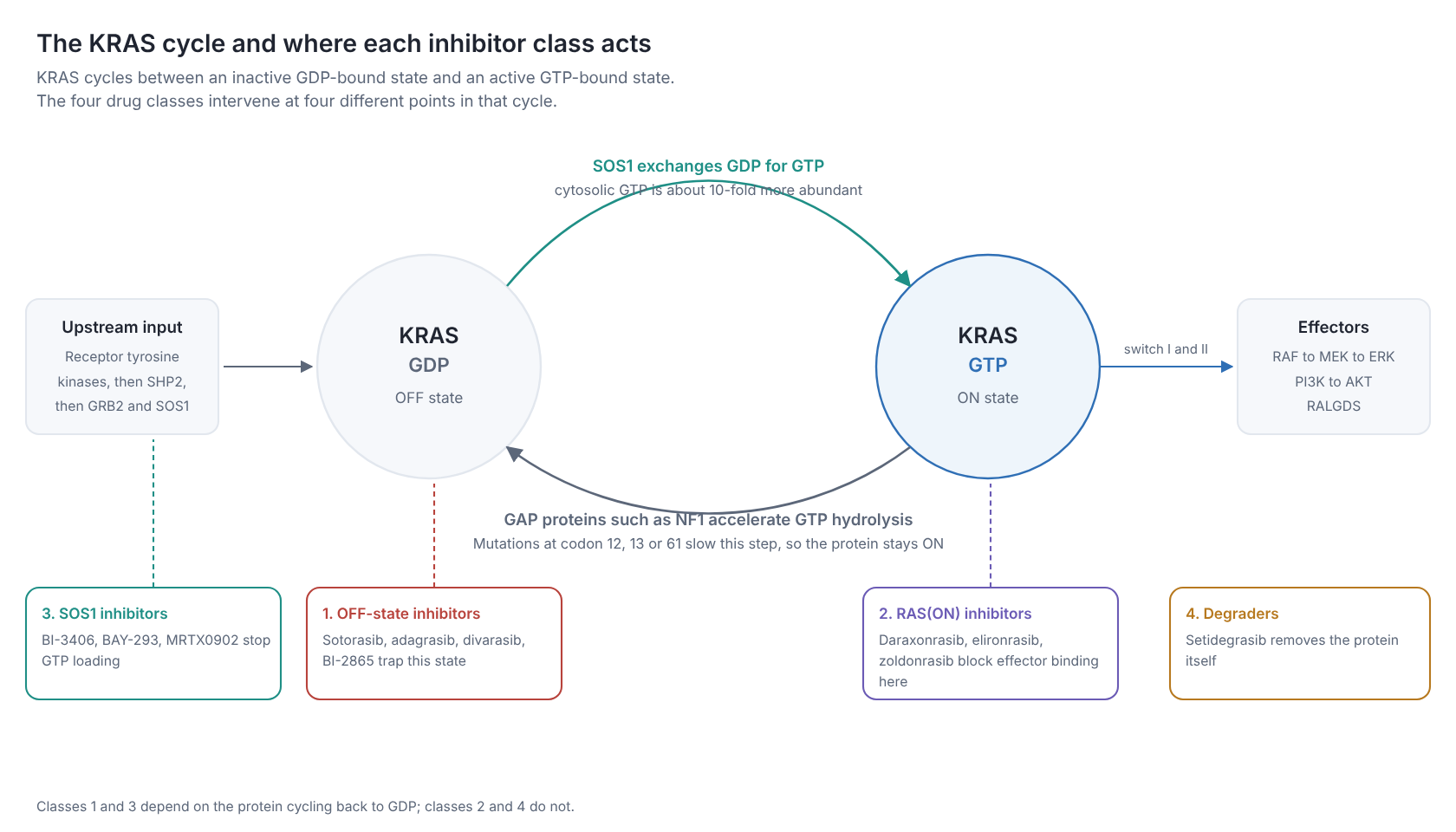
Mutations at codons 12, 13 and 61 impair GAP-stimulated hydrolysis, so the protein spends more of its time in the ON state. For four decades that made KRAS look undruggable. GTP binds with picomolar affinity, so a nucleotide-competitive inhibitor was never realistic, and the protein surface offered no obvious pocket for a small molecule [3].
1.2 Mutation spectrum by tumour type
KRAS is the most frequently mutated oncogene in human cancer: mutated in roughly 88% of pancreatic ductal adenocarcinomas, about half of colorectal cancers and about a third of lung adenocarcinomas [4]. Which allele is present decides which drug can be used, and the alleles are not spread evenly.
| Allele | Lung adenocarcinoma | Colorectal | Pancreatic | Compounds that target it |
|---|---|---|---|---|
| G12C | The most common KRAS allele here, about 13% of all cases | About 3 to 4% of all cases | About 1 to 2% | Sotorasib, adagrasib, divarasib and the newer G12C agents |
| G12D | Less common, roughly 4% | The most common KRAS allele here | The most common KRAS allele here, around 40% of KRAS-mutant cases | MRTX1133, zoldonrasib, HRS-4642, setidegrasib, pan-RAS agents |
| G12V | Second most common | Common | Second most common | Pan-KRAS and pan-RAS agents only |
| G12R, G13D, Q61 | Minor | G13D notable | G12R in roughly 15% of cases | Pan-RAS agents; Q61 and G12R respond poorly to OFF-state compounds |
Figures are approximate and vary between cohorts; the table follows the pooled analysis by Prior and colleagues [4].
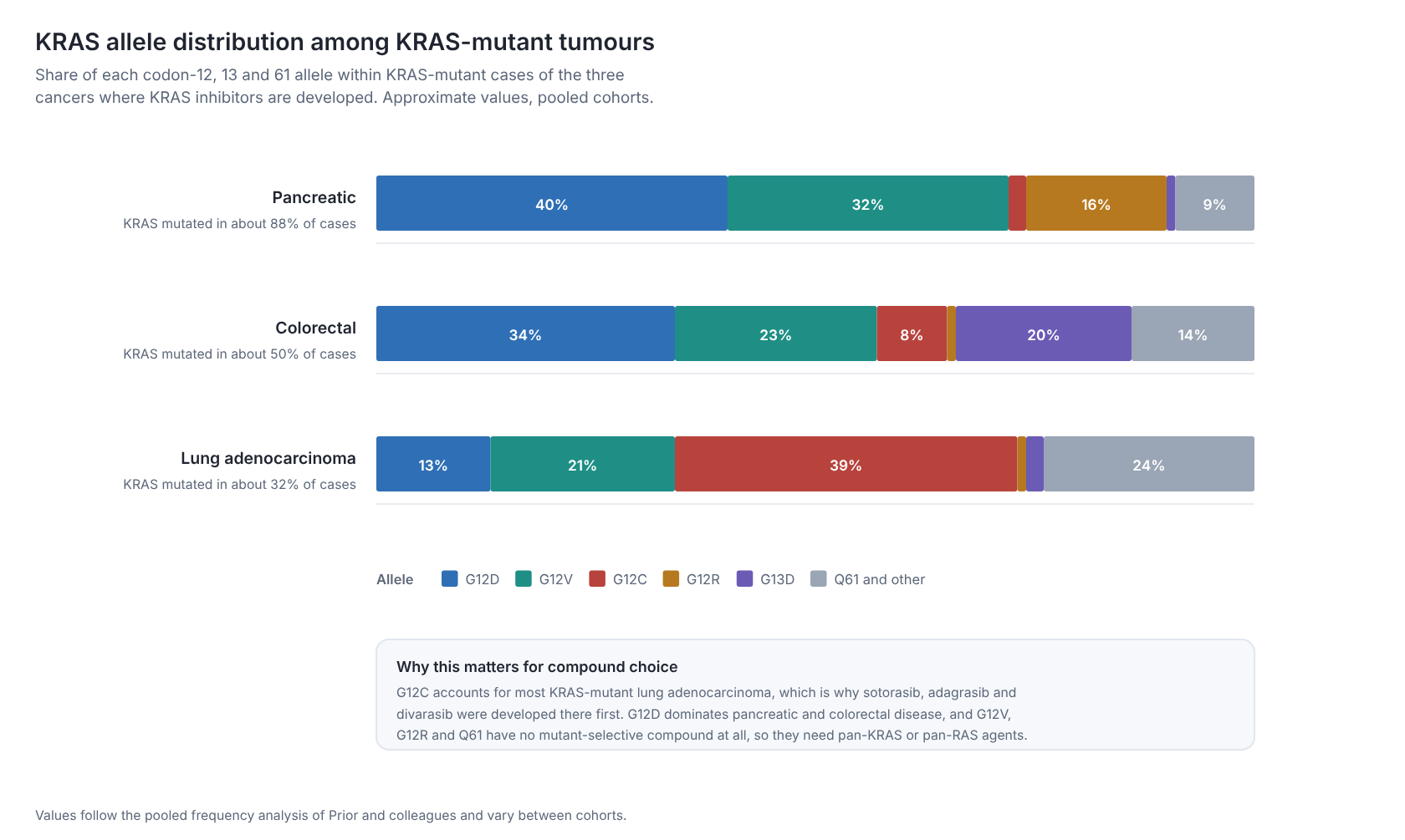
The consequence is that G12C compounds serve lung cancer well and pancreatic cancer hardly at all, which is why the G12D and pan-RAS programmes matter so much for pancreatic work.
1.3 From 2013 to 2026
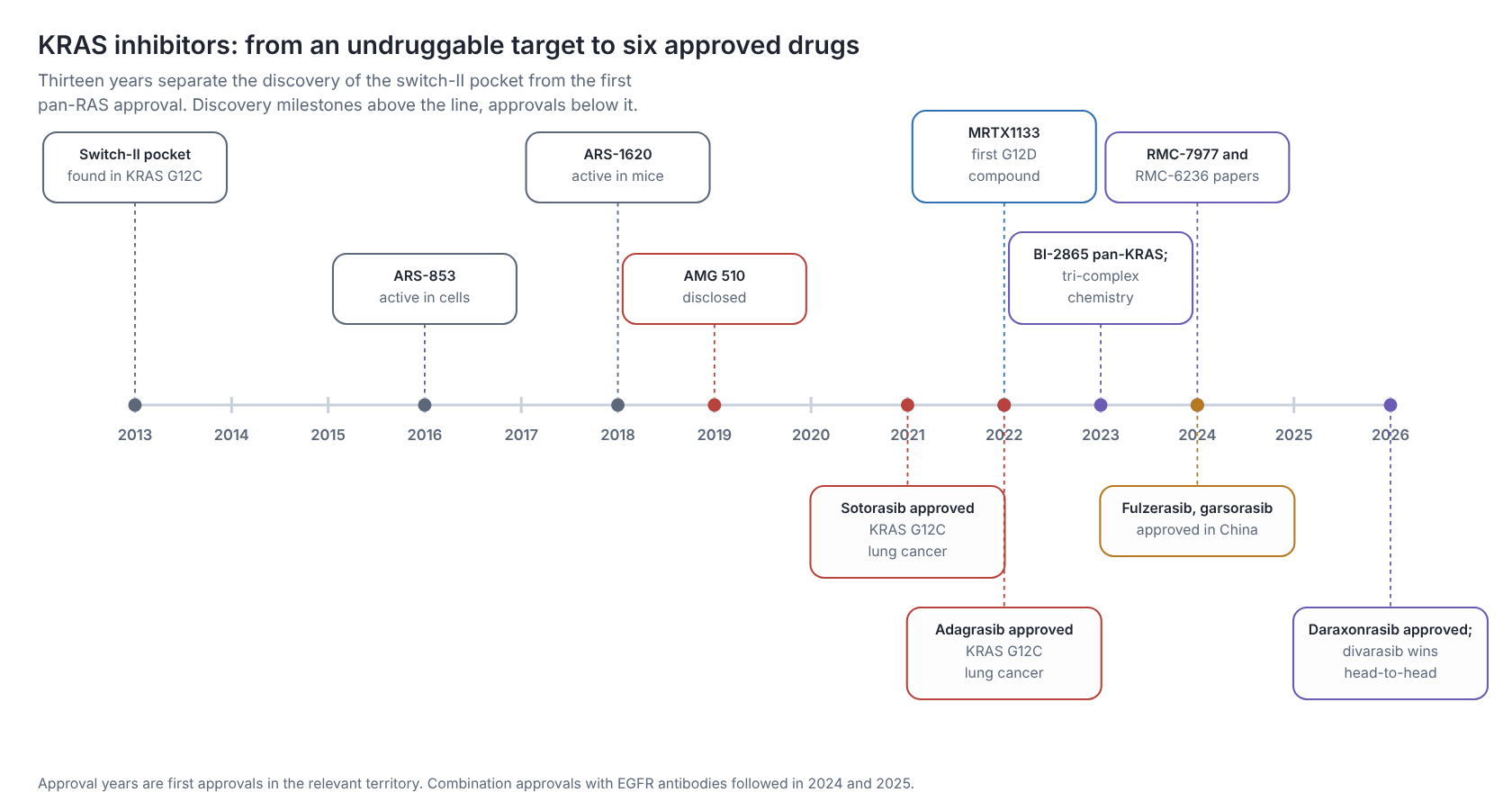
The turning point was a 2013 paper from Ostrem, Shokat and colleagues. They screened tethered fragments against KRAS G12C and found a previously unseen pocket under switch II, present only in the GDP-bound state, next to the mutant cysteine [5]. Because cysteine 12 does not exist in wild-type KRAS, a covalent compound that reaches it from this pocket is mutant-selective by construction. ARS-853 showed the idea worked in cells [6][7], ARS-1620 showed it worked in mice [8], and AMG 510 took it into patients [9].
| Year | Event |
|---|---|
| 2013 | The switch-II pocket of KRAS G12C is described [5] |
| 2016 | ARS-853 inhibits KRAS G12C in cells [6][7] |
| 2018 | ARS-1620 is active in vivo [8] |
| 2019 | AMG 510 (sotorasib) is disclosed [9] |
| 2021 | Sotorasib receives accelerated approval for KRAS G12C lung cancer |
| 2022 | Adagrasib is approved for KRAS G12C lung cancer; MRTX1133 is disclosed for G12D [10] |
| 2023 | Pan-KRAS compound BI-2865 [11]; tri-complex RAS(ON) chemistry [12] |
| 2024 | RMC-7977 and RMC-6236 preclinical papers [13][14]; fulzerasib and garsorasib approved in China |
| 2025 | Sotorasib with panitumumab approved in colorectal cancer; glecirasib approved in China |
| 2026 | Daraxonrasib phase 3 reported and approved in August [1]; divarasib wins its head-to-head trial [2] |
2. Mechanism of action: four ways small molecules hit KRAS
2.1 The switch-II pocket and the OFF state
Sotorasib, adagrasib, divarasib and the other approved G12C agents all bind the switch-II pocket of GDP-bound KRAS G12C and form a covalent bond with cysteine 12 through an acrylamide group. The bound protein is held in the OFF state: SOS1 cannot load GTP onto it, and RAF cannot bind it [9][15].
This mechanism carries a built-in dependency. The compound can only capture KRAS G12C while it is GDP-bound, so it works only because G12C still hydrolyses GTP at a useful rate and returns to the OFF state [7][16]. Anything that pushes the protein towards the ON state, such as growth-factor signalling through receptor tyrosine kinases, high SOS1 activity or loss of NF1, lowers target capture. That one fact explains most of the resistance biology in Section 7 and the logic behind the EGFR antibody combinations in colorectal cancer.
Put briefly, the sotorasib mechanism of action is to bind the switch-II pocket of GDP-bound KRAS G12C, react covalently with cysteine 12 and hold the protein inactive. Sotorasib also occupies a cryptic groove formed by His95, Tyr96 and Gln99 that earlier compounds did not use, and that extra contact gave it the potency to work in patients [9][17].
2.2 Tri-complex RAS(ON) inhibitors
Revolution Medicines took a different route. Their compounds are macrocycles inspired by natural products that first bind cyclophilin A, an abundant intracellular chaperone. Compound and chaperone together create a new composite surface with affinity for GTP-bound RAS. The resulting three-part complex physically blocks RAF and other effectors from docking [12][13].
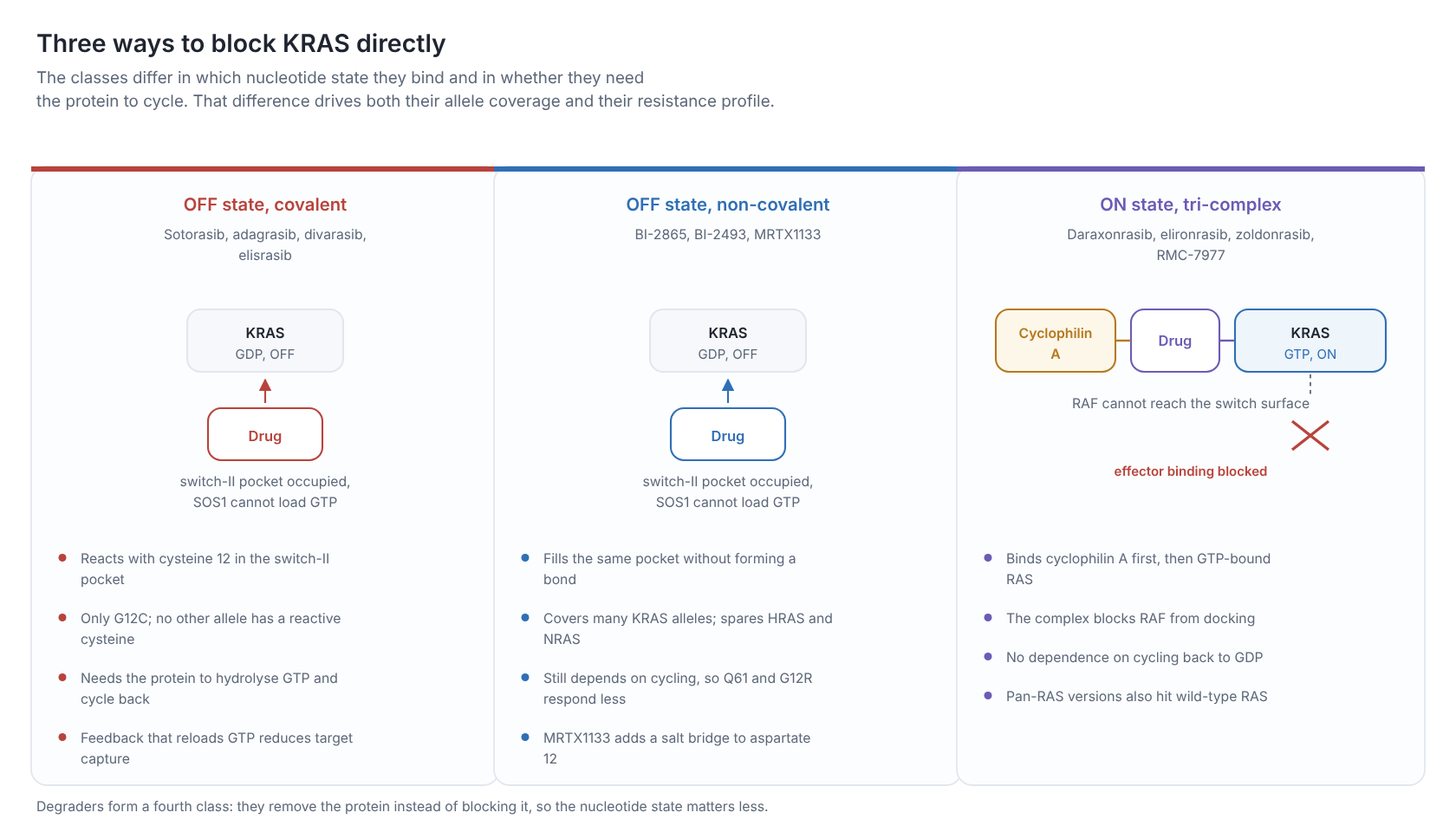
The design comes in two versions. Elironrasib for G12C and zoldonrasib for G12D carry a reactive group that bonds to the mutant residue once the complex has formed [12]. RMC-7977 and daraxonrasib are non-covalent and bind the active state of KRAS, NRAS and HRAS, mutant or wild type [13][14].
Because these compounds act on the ON state they do not need the protein to cycle back to GDP. That is the main reason elironrasib still works in tumours that have stopped responding to sotorasib or adagrasib, and the reason daraxonrasib covers G12V, G12R and Q61 alleles that OFF-state compounds handle poorly.
2.3 Non-covalent compounds: MRTX1133, BI-2865 and the dual-state G12D agents
The carboxylate of aspartate 12 is a far weaker nucleophile than the thiol of cysteine 12, so the acrylamide warheads used for G12C do not react with it, and the covalent G12C strategy does not transfer directly to G12D. (Asp12 can be modified covalently, but only by a more reactive warhead held against it, which is what the tri-complex compound zoldonrasib does; see Section 4.2.) For a conventional switch-II binder, G12D therefore demanded non-covalent affinity instead. MRTX1133 solved this with a molecule that fills the switch-II pocket and makes a salt bridge to Asp12. Its dissociation constant for KRAS G12D is about 0.2 pM and it binds both GDP- and GTP-loaded protein [10][18]. HRS-4642 works in a similar way, with a reported Kd of 0.083 nM [19].
BI-2865 goes broader. It binds GDP-bound KRAS whether residue 12 is glycine, cysteine, aspartate or valine, with dissociation constants from single-digit to low double-digit nanomolar, and blocks nucleotide exchange [11]. It spares HRAS and NRAS because of a small number of residue differences around the pocket, His95 in KRAS being the main one [11]. That selectivity matters for tolerability, since wild-type HRAS and NRAS can keep normal tissue signalling while mutant KRAS is shut down.
2.4 Degraders and indirect routes
Setidegrasib is a proteolysis-targeting chimera: a G12D-selective binder joined to an E3 ligase ligand, which tags KRAS G12D for destruction by the proteasome. Indirect compounds act upstream instead. SOS1 inhibitors such as BI-3406 and BAY-293 block GTP loading [20][21], and allosteric SHP2 inhibitors such as SHP099 and RMC-4550 cut the receptor-tyrosine-kinase input that feeds SOS1 [22][23]. On their own these are weak. Combined with an OFF-state KRAS compound they raise the share of KRAS sitting in the GDP state where it can be captured.
Older tools that predate the switch-II work are still useful as historical controls. Kobe0065 came from an in-silico screen for RAS-effector blockers [24], and Deltarasin HCl blocks the PDE-delta prenyl-binding pocket that traffics KRAS to the membrane [25]. Both act at micromolar concentrations and have off-target activity, so neither belongs in an experiment that needs a selective KRAS probe.
3. KRAS G12C inhibitors
3.1 Sotorasib
Sotorasib came out of a structure-based programme at Amgen that exploited the His95 groove to reach low-nanomolar potency [17]. It inhibits proliferation of KRAS G12C MIA PaCa-2 cells with a 72-hour IC50 of about 5 nM while sparing KRAS G12S A549 cells above 10 micromolar [17]. In immunocompetent mouse models it also made tumours more inflamed and combined well with anti-PD-1 treatment [9].
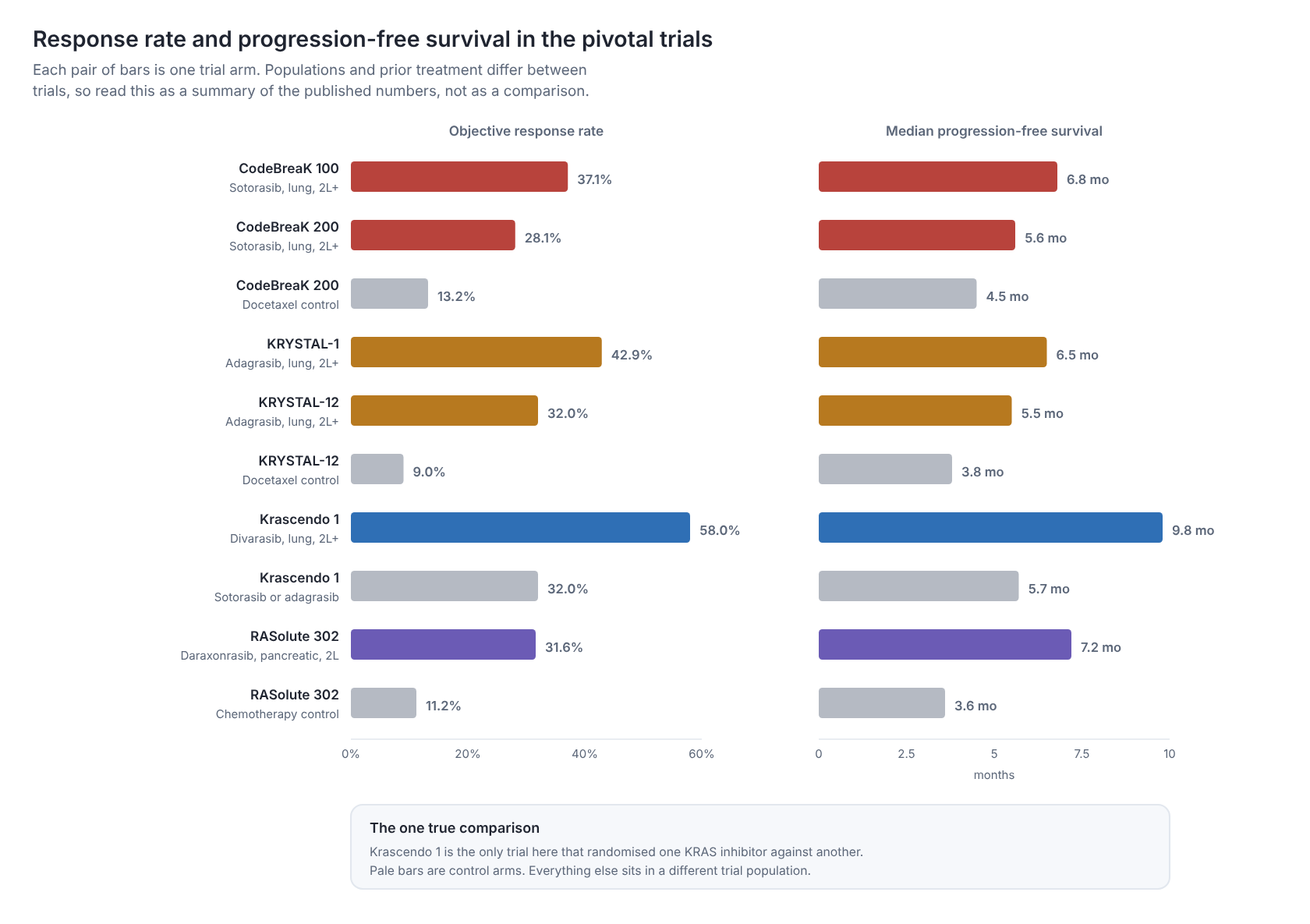
The phase 1 trial reported responses in 32.2% of lung cancer patients and 7.1% of colorectal cancer patients [26]. The phase 2 CodeBreaK 100 lung cohort of 126 patients gave a response rate of 37.1%, median progression-free survival of 6.8 months and median overall survival of 12.5 months [27]. Accelerated approval followed in May 2021. The confirmatory phase 3 CodeBreaK 200 trial in 345 patients improved progression-free survival over docetaxel, 5.6 against 4.5 months with a hazard ratio of 0.66, and raised the response rate from 13.2% to 28.1%, but overall survival did not differ [28].
In pancreatic cancer, where G12C is rare, CodeBreaK 100 recorded a response rate of 21% in 38 patients [29]. In colorectal cancer sotorasib works poorly alone because EGFR feedback reactivates the pathway; in CodeBreaK 300, which randomised 160 patients across three arms, the 53 patients given panitumumab with sotorasib at 960 mg had a median progression-free survival of 5.6 months against 2.2 months for investigator's choice, a hazard ratio of 0.49, and a response rate of 26.4% against 0% [30], and that combination was approved in January 2025.
3.2 Adagrasib
Adagrasib was optimised for a long half-life and tissue penetration [31]. It inhibits ERK phosphorylation with IC50 values of 5 nM in MIA PaCa-2 cells and 14 nM in NCI-H358 cells [31] and caused regression in most KRAS G12C xenograft models tested [15].
In KRYSTAL-1, with 112 evaluable patients, adagrasib gave a response rate of 42.9%, median progression-free survival of 6.5 months and median overall survival of 12.6 months in previously treated lung cancer, and responses were also seen in treated, stable brain metastases [32]. Approval followed in December 2022. The phase 3 KRYSTAL-12 trial in 453 patients improved progression-free survival over docetaxel, 5.5 against 3.8 months with a hazard ratio of 0.58, and raised the response rate from 9% to 32% [33]. In colorectal cancer, adagrasib alone gave 19% and adagrasib with cetuximab 46% [34]; that combination was approved in June 2024.
3.3 Adagrasib vs sotorasib
No randomised trial has compared the two first-generation compounds directly. Both now serve as the comparator arm for divarasib. Across separate trials they behave more alike than different.
| Feature | Sotorasib | Adagrasib |
|---|---|---|
| Cat. No. | A19021 | A16482 |
| Molecular weight | 560.59 | 604.12 |
| Half-life | About 5 hours | About 23 hours |
| Lung cancer phase 2 response rate and progression-free survival | 37.1%, 6.8 months [27] | 42.9%, 6.5 months [32] |
| Phase 3 progression-free survival hazard ratio against docetaxel | 0.66 [28] | 0.58 [33] |
| Colorectal partner antibody | Panitumumab [30] | Cetuximab [34] |
| Brain metastases | Limited prospective data | Intracranial responses reported [32] |
| Cellular ERK IC50 | Low nanomolar [9] | 5 to 14 nM [31] |
For lab work the two are interchangeable as OFF-state G12C probes. Many groups run both, so that an observed effect can be attributed to the class rather than to one compound.
3.4 Next-generation G12C compounds
Divarasib is 5 to 20 times more potent and up to 50 times more selective than sotorasib and adagrasib in vitro [35]. Its phase 1 study reported a response rate of 53.4% and median progression-free survival of 13.1 months in lung cancer, and 29.1% and 5.6 months in colorectal cancer [35]. The phase 3 Krascendo 1 trial randomised 338 previously treated lung cancer patients to divarasib or to sotorasib or adagrasib. Median progression-free survival was 9.8 against 5.7 months with a hazard ratio of 0.58, median overall survival 17.7 against 12.0 months with a hazard ratio of 0.56, and confirmed response rate 58% against 32% [2]. This is the first evidence that one KRAS G12C compound outperforms another.
Olomorasib is in the phase 3 SUNRAY-01 trial with pembrolizumab in the first-line setting (NCT06119581), and has breakthrough designation in previously treated KRAS G12C pancreatic cancer.
China has approved three domestic G12C compounds. Fulzerasib came first, in August 2024, after a registrational phase 2 study in 116 patients reported a response rate of 49.1% and median progression-free survival of 9.7 months. The compound is in the GFH925 solid-tumour programme (NCT05005234). Garsorasib followed later in 2024 and glecirasib in May 2025.
Elisrasib (D3S-001) is a brain-penetrant OFF-state compound that inhibits proliferation of NCI-H358 and MIA PaCa-2 cells with IC50 values of 0.6 nM and 0.44 nM. At AACR 2026 it was reported to give a response rate of 58.8% and median progression-free survival of 12.2 months in patients who had not had a G12C compound before, and 32.3% in those who had. These are conference data and await full publication.
Opnurasib (JDQ443) and AZD4625 are further OFF-state compounds, useful as structurally distinct research tools. Their clinical development has slowed.
3.5 Targeting G12C in the ON state
Elironrasib forms a covalent tri-complex with GTP-bound KRAS G12C and cyclophilin A, and inhibits proliferation across G12C-mutant lines with a median IC50 of 0.11 nM [12]. In 24 patients with lung cancer who had progressed on a first-generation compound it produced a confirmed response rate of 42% and median progression-free survival of 6.2 months, reported at the AACR-NCI-EORTC meeting in October 2025, and it holds breakthrough designation in that setting. BBO-8520 binds both the GDP and GTP states of KRAS G12C and is in phase 1.
4. KRAS G12D inhibitors
4.1 MRTX1133, the reference KRAS G12D compound
MRTX1133 was the first potent, selective, non-covalent KRAS G12D inhibitor [10]. It binds KRAS G12D with an estimated Kd near 0.2 pM, blocks both SOS1-mediated exchange and RAF1 binding, inhibits ERK phosphorylation at low-nanomolar concentrations in almost every G12D line tested, and is roughly 700-fold selective over wild-type KRAS [18]. At 30 mg/kg intraperitoneally it shrank tumours by more than 30% in 11 of 25 xenograft models, with pancreatic models responding more often than colorectal ones [18]. In immunocompetent pancreatic models the regressions depended partly on CD8-positive T cells [36].
MRTX1133 has poor oral bioavailability, which is why the in vivo papers inject it. Its phase 1/2 trial (NCT05737706) was terminated in early 2025 when the sponsor left the programme. It nevertheless remains the most cited KRAS G12D compound in preclinical work and the usual positive control in G12D experiments.
4.2 Zoldonrasib
Zoldonrasib is the G12D member of the tri-complex family and reacts covalently with aspartate 12 of GTP-bound KRAS G12D once the cyclophilin A complex has formed. In its phase 1 trial (NCT06040541) single-agent dosing produced a 30% response rate in previously treated pancreatic cancer in 40 patients, and combinations with first-line chemotherapy or with daraxonrasib gave higher rates in small cohorts [37]. In 27 previously treated lung cancer patients the confirmed response rate was 52% and median progression-free survival 11.1 months, reported at AACR 2026. Zoldonrasib has breakthrough designation and is in phase 3.
4.3 HRS-4642, AZD0022 and the other G12D programmes
HRS-4642 is a high-affinity non-covalent G12D compound. Its clinical formulation is an intravenous liposome, while the catalogue reagent is the free small molecule, so animal work with the research material needs its own vehicle rather than the clinical route. Its preclinical paper also showed that proteasome inhibition with carfilzomib increased its activity and that it remodelled the tumour microenvironment towards an immune-activating state [19]. In first-line pancreatic cancer with chemotherapy it gave a response rate of 63% in 30 patients [37]. AZD0022 is an oral G12D compound in phase 1 that suppressed growth in the GP2D xenograft model. VS-7375 and INCB161734 are dual-state G12D compounds with response rates of 29 to 41% in early pancreatic cohorts, and both have moved into phase 3 [37]. Neither is currently catalogued as a research reagent.
Two tool compounds fill out the G12D bench options: KRAS G12D inhibitor 14 and KRAS inhibitor-9. Both are patent-derived compounds without peer-reviewed characterisation, so treat them as chemical starting points rather than validated probes.
4.4 Setidegrasib and the degrader approach
Setidegrasib degrades KRAS G12D rather than inhibiting it, with a reported DC50 of 37 nM and loss of phospho-ERK, phospho-AKT and phospho-S6 in AsPC-1 cells. In a phase 1 study in previously treated pancreatic cancer it gave a response rate of 24% in 21 patients, and a 614-patient phase 3 trial with first-line chemotherapy is recruiting [37]. Degradation removes the scaffold function of the protein as well as its catalytic activity, and a degrader can act catalytically rather than stoichiometrically. The trade-off is a molecule of 1,117 g/mol, which needs care in cell assays and in stock preparation. Like other bivalent degraders it can also show a hook effect: at high concentrations, binary complexes with KRAS G12D or with the ligase outcompete the ternary complex that ubiquitination needs, and degradation falls off again, so a degrader curve is not read like an inhibitor curve.
5. Pan-KRAS and pan-RAS inhibitors
5.1 BI-2865 and BI-2493, pan-KRAS but not pan-RAS
BI-2865 binds GDP-bound KRAS with dissociation constants of 6.9 nM for wild type, 4.5 nM for G12C, 32 nM for G12D, 26 nM for G12V and 4.3 nM for G13D, and it blocks proliferation of Ba/F3 cells driven by G12C, G12D or G12V with a mean IC50 of about 140 nM [11]. Because it binds the OFF state it needs the mutant protein to cycle back to GDP, which leaves two allele classes relatively insensitive [11]. Glutamine 61 positions the water molecule used in hydrolysis, so Q61 mutants lose almost all intrinsic GTPase activity and sit in the ON state. In G12R the bulky arginine side chain both slows hydrolysis and blocks SOS1 binding. BI-2493 is the close analogue optimised for oral exposure in mice, and is the one to use in vivo, and pan-KRAS-IN-18 belongs to the same chemical series.
For experiments, BI-2865 is the cleanest way to ask whether a phenotype depends on KRAS specifically rather than on RAS in general, because HRAS and NRAS stay active. AMG410 is a different kind of pan-KRAS compound: it binds both nucleotide states, with a Kd of 1 nM for the GDP form and 22 nM for the GTP form, inhibits G12D, G12V and G13D with IC50 values of 1 to 4 nM, and shows more than 100-fold selectivity over HRAS and NRAS. Because it does not depend on cycling, it also works in cells driven by amplified wild-type KRAS.
5.2 Daraxonrasib and RMC-7977, blocking all RAS(ON)
RMC-7977 is the research compound of the tri-complex pan-RAS series. It binds cyclophilin A with a Kd of 195 nM and, through the complex, inhibits GTP-bound KRAS, NRAS and HRAS, mutant and wild type. Two companion 2024 Nature papers showed it causes regression across RAS-mutant models with a therapeutic window that comes from cancer cells depending on RAS signalling more heavily than normal tissues do [13][38].
Daraxonrasib is the clinical compound in that series. It disrupts RAS-RAF binding with EC50 values of 28 to 220 nM across wild-type and mutant RAS variants and drives deep regressions in KRAS G12X xenografts [14].
Clinically it has moved faster than any other RAS-directed agent:
- Phase 1/2 in pancreatic cancer. Among 168 previously treated patients, the second-line RAS G12 cohort at the selected dose, 26 patients, had a response rate of 35%, median progression-free survival of 8.5 months and median overall survival of 13.1 months [39].
- Phase 3 RASolute 302 (NCT06625320). Against chemotherapy in previously treated metastatic pancreatic cancer, median overall survival was 13.2 against 6.7 months with a hazard ratio of 0.40, median progression-free survival 7.2 against 3.6 months, and response rate 31.6% against 11.2% [1]. Approval followed in August 2026.
- Lung cancer. Among 136 previously treated patients with RAS-mutant disease the response rate reached 37% at the highest dose studied, and in a post hoc group of 38 patients who had not had docetaxel it was 42%, with median progression-free survival of 8.3 months and median overall survival of 16 months [40]. The phase 3 RASolve 301 trial (NCT06881784) compares daraxonrasib with docetaxel.
Rash, stomatitis and diarrhoea are the common adverse events, consistent with inhibition of wild-type RAS in skin and mucosa [40]. Resistance can appear quickly, and about one in five patients with pancreatic cancer progressed within two months [37].
RMC-9945 is a related covalent RAS(ON) G12D compound used in colorectal liver-metastasis models. It is catalogued but currently out of stock, so check availability before planning around it.
6. The clinical landscape in 2026
6.1 Approved KRAS inhibitors
| Drug | Target | Approval | Setting |
|---|---|---|---|
| Sotorasib | KRAS G12C, OFF state | US 2021, accelerated; with panitumumab 2025 | Previously treated KRAS G12C lung cancer; KRAS G12C colorectal cancer with panitumumab |
| Adagrasib | KRAS G12C, OFF state | US 2022, accelerated; with cetuximab 2024 | Previously treated KRAS G12C lung cancer; KRAS G12C colorectal cancer with cetuximab |
| Fulzerasib | KRAS G12C, OFF state | China, August 2024 | Previously treated KRAS G12C lung cancer |
| Garsorasib | KRAS G12C, OFF state | China, 2024 | Previously treated KRAS G12C lung cancer |
| Glecirasib | KRAS G12C, OFF state | China, May 2025 | Previously treated KRAS G12C lung cancer |
| Daraxonrasib | RAS(ON), all variants | US, August 2026 | Metastatic pancreatic adenocarcinoma after at least one prior therapy, or where multiagent chemotherapy is unsuitable |
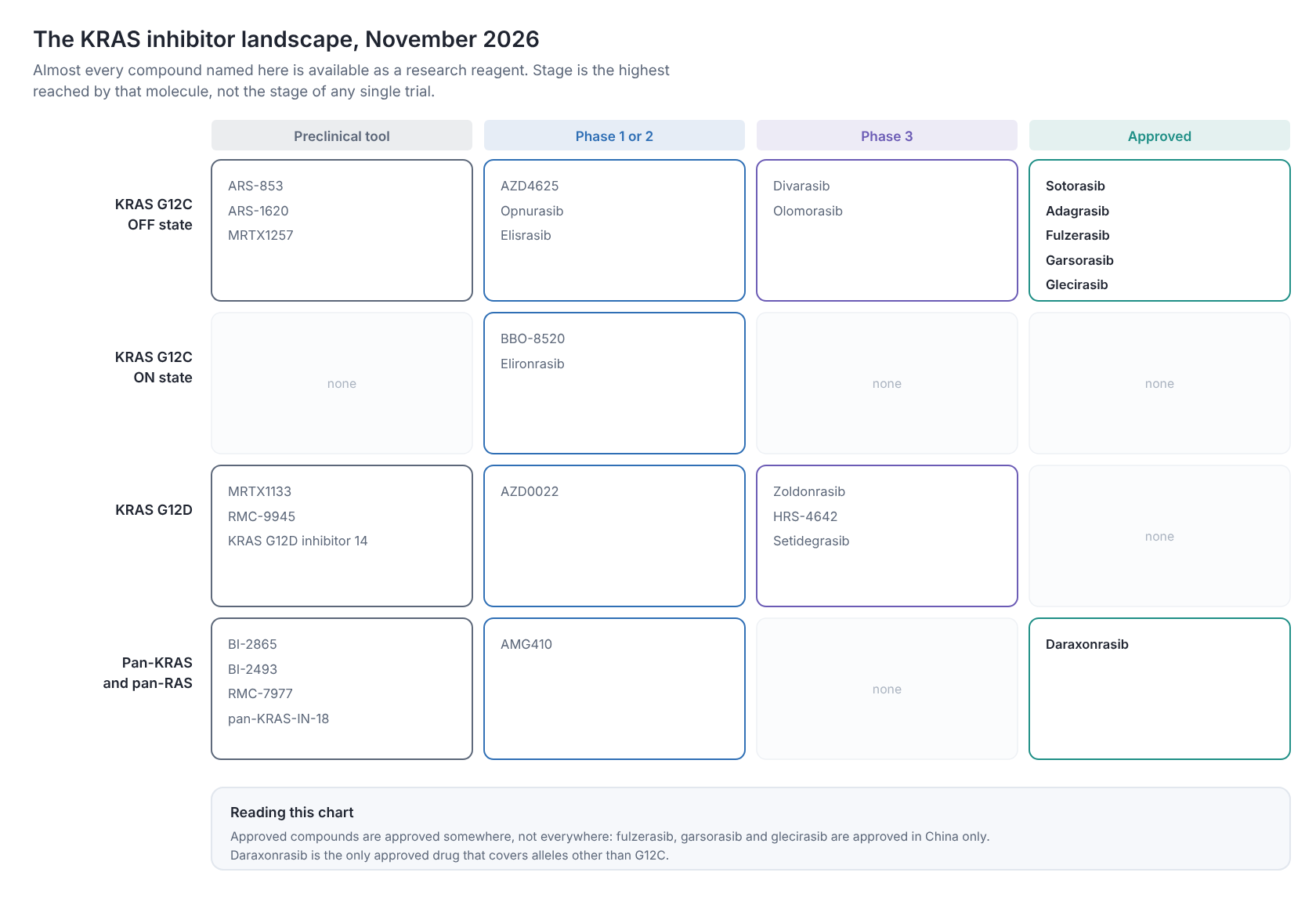
6.2 Pivotal trial results
| Trial | Drug | Setting | n | Response rate | Median progression-free survival | Overall survival |
|---|---|---|---|---|---|---|
| CodeBreaK 100 [27] | Sotorasib | Lung, previously treated | 126 | 37.1% | 6.8 mo | 12.5 mo |
| CodeBreaK 200 [28] | Sotorasib vs docetaxel | Lung, previously treated | 345 | 28.1% vs 13.2% | 5.6 vs 4.5 mo, HR 0.66 | No difference |
| KRYSTAL-1 [32] | Adagrasib | Lung, previously treated | 112 | 42.9% | 6.5 mo | 12.6 mo |
| KRYSTAL-12 [33] | Adagrasib vs docetaxel | Lung, previously treated | 453 | 32% vs 9% | 5.5 vs 3.8 mo, HR 0.58 | Immature |
| Krascendo 1 [2] | Divarasib vs sotorasib or adagrasib | Lung, previously treated | 338 | 58% vs 32% | 9.8 vs 5.7 mo, HR 0.58 | 17.7 vs 12.0 mo, HR 0.56 |
| CodeBreaK 300 [30] | Sotorasib 960 mg with panitumumab | Colorectal, refractory | 160 in three arms, 53 at 960 mg | 26.4% vs 0% | 5.6 vs 2.2 mo, HR 0.49 | Immature |
| KRYSTAL-1 colorectal [34] | Adagrasib with or without cetuximab | Colorectal, refractory | 94 | 46% with cetuximab | 6.9 mo with cetuximab | Not mature |
| RASolute 302 [1] | Daraxonrasib vs chemotherapy | Pancreatic, second line | 500 | 31.6% vs 11.2% | 7.2 vs 3.6 mo | 13.2 vs 6.7 mo, HR 0.40 |
6.3 Combination strategies
Three patterns have emerged, each with a mechanistic rationale.
EGFR antibodies in colorectal cancer. Colonic epithelium signals heavily through EGFR, which reactivates RAS after KRAS G12C inhibition. Panitumumab or cetuximab blocks that loop and roughly doubles the response rate [30][34].
Chemotherapy in pancreatic cancer. First-line studies of daraxonrasib, zoldonrasib and HRS-4642 with gemcitabine and nab-paclitaxel or with FOLFIRINOX have reported response rates of 58 to 82% in small cohorts [37], and phase 3 trials are running.
Immunotherapy in lung cancer. KRAS G12C inhibition makes tumours more immunogenic in mice [9][36], which led to the olomorasib and pembrolizumab phase 3 trial. Liver toxicity limited some earlier combinations of first-generation G12C compounds with checkpoint inhibitors.
7. Resistance to KRAS inhibitors
Responses are real but often short-lived. Four mechanisms are now well documented.
Adaptive feedback. Within hours to days of KRAS G12C inhibition, the loss of ERK-dependent negative feedback reactivates receptor tyrosine kinases, which load GTP onto newly synthesised KRAS G12C and onto wild-type RAS. Cells escape drug capture unevenly, and newly made KRAS G12C is held in the active state through EGFR and Aurora kinase signalling [41][42].
Secondary KRAS mutations. In patients progressing on adagrasib, Awad and colleagues found new mutations at the drug-binding site (Y96C, R68S, H95D, H95Q, H95R), new activating mutations (G12D, G12R, G12V, G12W, G13D, Q61H) and amplification of KRAS G12C itself [43]. Tanaka and colleagues described Y96D, which blocks both sotorasib and adagrasib [44].
Bypass alterations. Amplification of MET, activating mutations in NRAS, BRAF, MAP2K1 and RET, oncogenic fusions, and loss of NF1 or PTEN all reactivate the pathway in parallel or downstream [43][44].
Histological change. Transformation from adenocarcinoma to squamous cell carcinoma has been seen in a minority of patients [43].
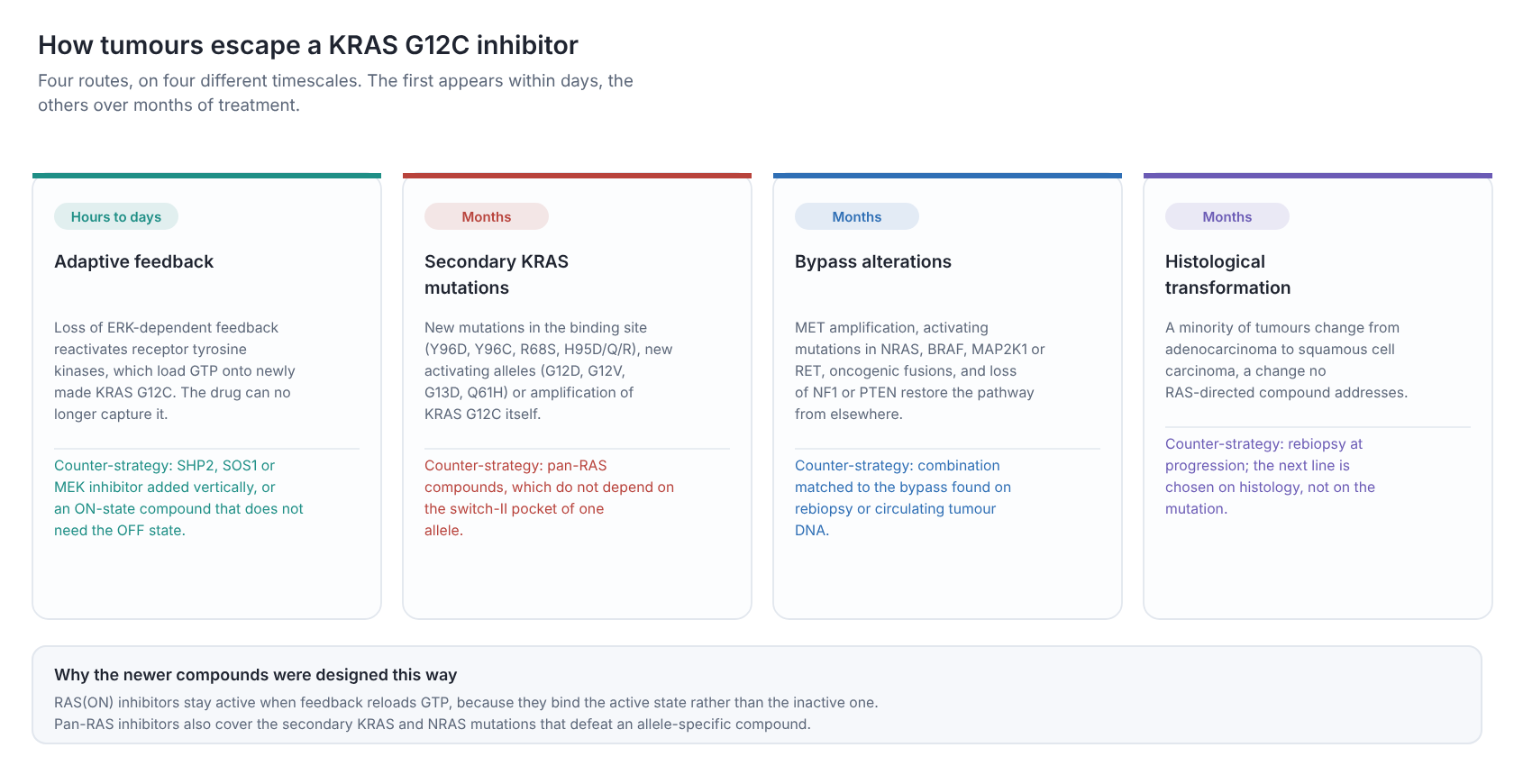
These findings explain the design of the newer compounds. RAS(ON) inhibitors do not need the protein to cycle, so feedback-driven reloading does not disarm them. Pan-RAS compounds also cover secondary KRAS and NRAS mutations. Vertical combinations with SOS1, SHP2 or MEK inhibitors block the reactivation loop directly [42][20].
8. Working with KRAS inhibitors at the bench
8.1 Physical data and potency for the key compounds
Molecular weights and solubility figures below are the values on the product pages; potency figures come from the papers cited. Where no solubility has been measured for a compound, the table says so, and Section 8.2 gives the volume needed for a 10 mM stock calculated from molecular weight.
| Compound | Cat. No. | MW | Reported solubility | Cellular potency |
|---|---|---|---|---|
| Sotorasib | A19021 | 560.59 | DMSO 90 mg/mL (160 mM), ethanol 90 mg/mL, insoluble in water | MIA PaCa-2 viability IC50 about 5 nM [17] |
| Adagrasib | A16482 | 604.12 | DMSO 87 mg/mL (144 mM), ethanol 44 mg/mL, insoluble in water | phospho-ERK IC50 5 nM in MIA PaCa-2, 14 nM in NCI-H358 [31] |
| Divarasib | A24528 | 622.06 | Not reported | 5 to 20 times more potent than sotorasib [35] |
| MRTX1257 | A17223 | 565.72 | DMSO 89 mg/mL (157 mM), ethanol 27 mg/mL | Adagrasib analogue used for mouse work |
| ARS-1620 | A16809 | 430.84 | DMSO 82 mg/mL (190 mM), ethanol 57 mg/mL | The first G12C compound active in vivo [8] |
| ARS-853 | A12542 | 432.94 | DMSO 80 mg/mL with warming, ethanol 1 mg/mL | Cell-active G12C probe [6] |
| MRTX1133 | A24519 | 600.63 | Not reported | Kd about 0.2 pM, low-nanomolar phospho-ERK inhibition [18] |
| HRS-4642 | A24532 | 632.68 | Not reported | Kd 0.083 nM [19] |
| BI-2865 | A24530 | 465.57 | Not reported | Ba/F3 mean IC50 about 140 nM [11] |
| Daraxonrasib | A24531 | 811.05 | Not reported | RAS-RAF EC50 28 to 220 nM [14] |
| RMC-7977 | A24118 | 865.11 | Not reported | Cyclophilin A Kd 195 nM, pan-RAS(ON) [13] |
| Elironrasib | A24117 | 1012.26 | Not reported | Median IC50 0.11 nM across G12C lines [12] |
| Zoldonrasib | A24224 | 1168.44 | Not reported | Covalent G12D RAS(ON) tri-complex compound |
| Setidegrasib | A24693 | 1117.30 | Not reported | KRAS G12D degrader, DC50 37 nM in AsPC-1 cells |
| BI-3406 | A18507 | 462.46 | DMSO 85 mg/mL (184 mM), ethanol 85 mg/mL | SOS1-KRAS IC50 6 nM [20] |
| BAY-293 | A18319 | 448.59 | DMSO 88 mg/mL (196 mM), ethanol 88 mg/mL | KRAS-SOS1 IC50 21 nM [21] |
| MRTX0902 | A24525 | 388.47 | Not reported | SOS1 IC50 46 nM [45] |
| RMC-4550 | A18893 | 437.36 | DMSO 91 mg/mL (208 mM) | SHP2 IC50 0.58 nM [23] |
| SHP099 | A20594 | 352.26 | Not reported | SHP2 IC50 70 nM [22] |
8.2 Stock solutions
Every compound here is lipophilic and insoluble in water. The standard approach is a 10 mM stock in anhydrous DMSO, split into single-use aliquots and stored at -80 °C, or at -20 °C for up to a month. Two practical points. Covalent acrylamides such as sotorasib and adagrasib react slowly with thiols, so avoid stocks or dilution buffers containing DTT or beta-mercaptoethanol and keep the DMSO dry. And the tri-complex compounds and the degrader are large molecules, above 800 g/mol, so weighing small amounts accurately is harder; dissolving the whole vial is usually better than weighing out a portion.
Volume of DMSO for a 10 mM stock, calculated from molecular weight:
| Compound | mg/mL at 10 mM | For 1 mg | For 5 mg |
|---|---|---|---|
| Sotorasib | 5.61 | 178 µL | 892 µL |
| Adagrasib | 6.04 | 166 µL | 828 µL |
| Divarasib | 6.22 | 161 µL | 804 µL |
| MRTX1133 | 6.01 | 166 µL | 832 µL |
| HRS-4642 | 6.33 | 158 µL | 790 µL |
| BI-2865 | 4.66 | 215 µL | 1,074 µL |
| BI-3406 | 4.62 | 216 µL | 1,081 µL |
| Daraxonrasib | 8.11 | 123 µL | 616 µL |
| RMC-7977 | 8.65 | 116 µL | 578 µL |
| Elironrasib | 10.12 | 99 µL | 494 µL |
| Zoldonrasib | 11.68 | 86 µL | 428 µL |
| Setidegrasib | 11.17 | 90 µL | 448 µL |
For a compound with no measured solubility, make the 10 mM solution first, confirm it is clear, and only then try something more concentrated. A 1 mg vial of most of these compounds gives only 100 to 220 µL at 10 mM, which is less than the hold-up volume of many syringe filters, so dissolve in the supplied vial rather than filtering.
8.3 Choosing a concentration
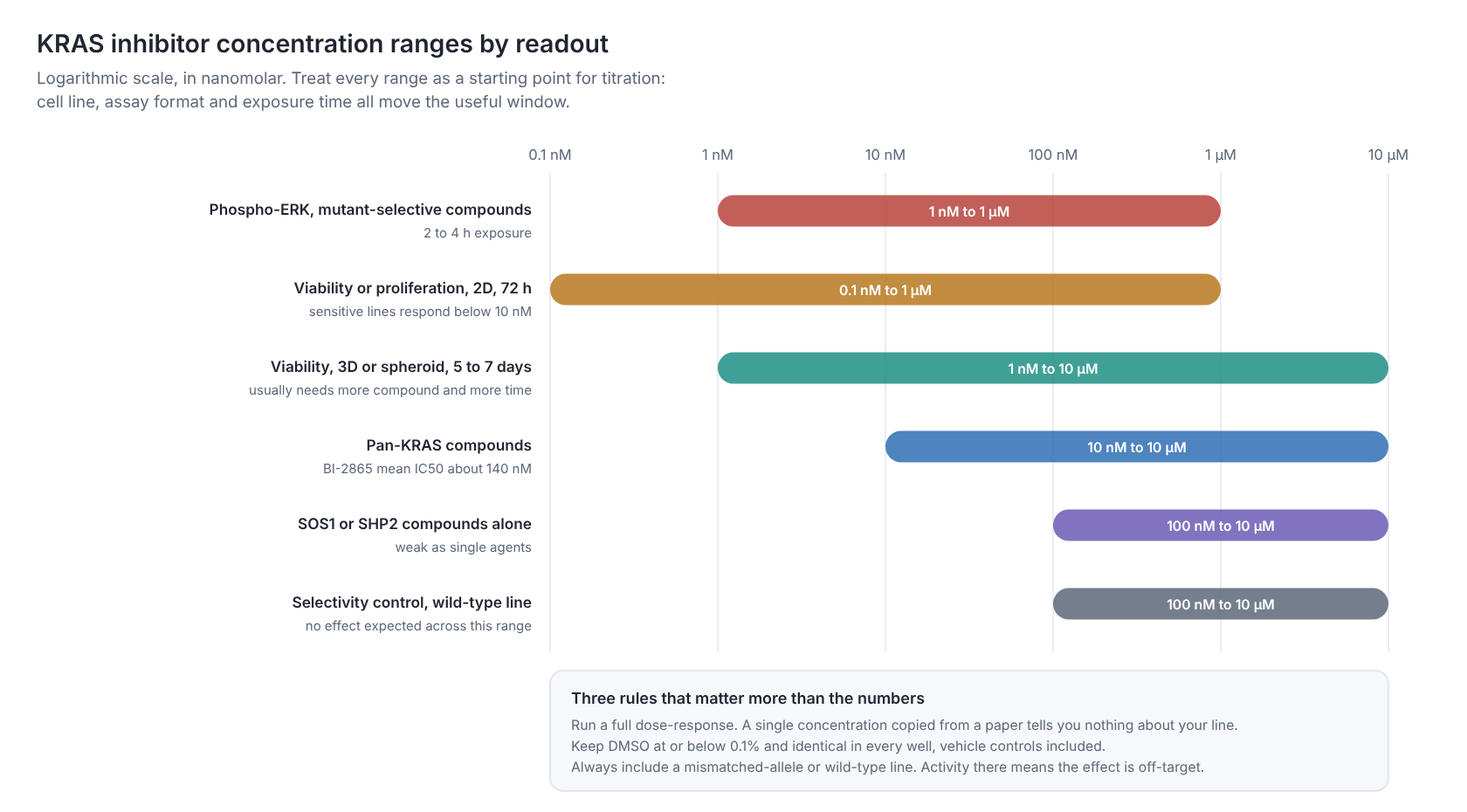
Run a dose-response curve rather than copying a single concentration from a paper. The potency gap between these classes is wide, and so is the gap between a signalling readout and a viability readout. Useful starting ranges for cell work, based on the cited literature:
| Readout | Range to test | Notes |
|---|---|---|
| Phospho-ERK suppression, mutant-selective compounds | 1 nM to 1 µM, 2 to 4 h | Most compounds give full suppression well below 100 nM in a sensitive line [31][18] |
| Proliferation or viability, 2D, 72 h | 0.1 nM to 1 µM | MIA PaCa-2 and NCI-H358 respond at single-digit nanomolar to G12C compounds [17][31] |
| Proliferation, 3D or spheroid, 5 to 7 days | 1 nM to 10 µM | 3D assays usually need higher concentrations and longer exposure than 2D [20] |
| Pan-KRAS compounds | 10 nM to 10 µM | Mean IC50 near 140 nM for BI-2865, so a 10 µM top dose is generally enough [11] |
| SOS1 or SHP2 compounds alone | 100 nM to 10 µM | Weak as single agents; most informative in combination [20][23] |
| Selectivity control | Same range in a KRAS wild-type or non-G12C line | A compound that kills A549 (G12S) at 1 µM is not acting through KRAS G12C [17] |
Keep the final DMSO concentration at or below 0.1% and match it across every well, vehicle controls included.
8.4 Picking cell lines
Allele-matched and allele-mismatched lines in the same experiment are what make a KRAS result interpretable.
| Line | KRAS allele | Tumour type | Typical use |
|---|---|---|---|
| MIA PaCa-2 | G12C | Pancreatic | The standard sensitive line for G12C compounds [17] |
| NCI-H358 | G12C | Lung | Second standard G12C line, used for phospho-ERK work [31] |
| NCI-H23, NCI-H2122, NCI-H1373 | G12C | Lung | Less sensitive G12C lines, useful for studying partial response |
| AsPC-1, HPAC, Panc 04.03 | G12D | Pancreatic | G12D compounds and degraders [18] |
| GP2D, LS180 | G12D | Colorectal | G12D compounds in colorectal context |
| SW620, LoVo | G12V, G13D | Colorectal | Pan-KRAS and pan-RAS compounds; insensitive to G12C compounds |
| A549 | G12S | Lung | Negative control for G12C compounds [17] |
| BxPC-3 | Wild type | Pancreatic | KRAS wild-type control |
| Ba/F3 engineered lines | Single defined allele | Murine pro-B | Clean allele-by-allele potency comparison [11] |
8.5 Readouts and controls
Phospho-ERK by western blot or in-cell western is the primary pharmacodynamic readout, usually at 2 to 4 hours; DUSP6 or SPRY2 messenger RNA gives the same information with a larger dynamic range. A RAS-GTP pulldown with the RAF1 RAS-binding domain distinguishes OFF-state from ON-state compounds directly: OFF-state compounds lower RAS-GTP, whereas tri-complex compounds leave RAS-GTP in place and block effector binding instead. To show target engagement directly rather than through downstream signalling, covalent compounds give a simple electrophoretic readout. Reaction with sotorasib, adagrasib, elironrasib or zoldonrasib adds 560 to 1,170 Da to a 21 kDa protein, which shifts the KRAS band upwards on a high-resolution immunoblot and can be quantified exactly by intact-protein mass spectrometry [6][9]. For non-covalent compounds such as MRTX1133 and BI-2865 the equivalent is a cellular thermal shift assay or a NanoBRET displacement assay [18][11].
One trap is specific to the tri-complex compounds. In cells, cyclophilin A is abundant and the binary complex forms on its own, so daraxonrasib, RMC-7977, elironrasib and zoldonrasib work as soon as they are added. In a cell-free biochemical assay with purified protein, such as TR-FRET, AlphaLISA or surface plasmon resonance against the RAS-RAF interaction, the same compounds look completely inactive unless recombinant cyclophilin A is added to the buffer and RAS is loaded with GTP or a non-hydrolysable analogue such as GppNHp [12][13]. Use the cyclophilin A concentration given in the paper whose assay you are reproducing.
Three controls are worth running every time: a KRAS wild-type or mismatched-allele line, a structurally unrelated compound of the same class, and a late time point, because adaptive feedback restores phospho-ERK within 24 to 48 hours in many lines [41][42].
8.6 Moving to animal work
Several of these compounds behave very differently in vivo from in culture, either because they are not orally bioavailable or because the clinical formulation is not what arrives in the vial.
| Compound | Route in the published studies | What to watch |
|---|---|---|
| Sotorasib, adagrasib, divarasib | Oral gavage, once daily [9][15] | MRTX1257 (A17223) is the adagrasib analogue used for mouse work |
| MRTX1133 | Intraperitoneal injection, 30 mg/kg twice daily, in 10% Captisol in 50 mM citrate buffer at pH 5.0 [18] | Oral bioavailability is too low to dose by mouth |
| HRS-4642 | Intravenous in the clinic, as a liposome [19] | The research reagent is the free compound, so the vehicle is yours to build |
| BI-2865 | Cell work only [11] | Use BI-2493 (A24522) for mouse studies |
| Daraxonrasib, RMC-7977 | Oral dosing [13][14] | Large molecules, so check the suspension is uniform before dosing |
Take the vehicle from the paper you are reproducing rather than from a generic formulation table, because exposure for these compounds depends heavily on it.
9. Compounds used alongside KRAS inhibitors
| Partner | Reason to combine | Compounds |
|---|---|---|
| SOS1 inhibitor | Blocks GTP loading, so more KRAS sits in the OFF state where a covalent compound can capture it; also prevents feedback reactivation [20] | BI-3406 (A18507), BAY-293 (A18319), MRTX0902 (A24525) |
| SHP2 inhibitor | Cuts receptor-tyrosine-kinase input upstream of SOS1 and reduces adaptive reactivation [23][42] | SHP099 (A20594), RMC-4550 (A18893), SHP394 (A18613) |
| MEK inhibitor | Vertical block downstream of RAF; the combination most often used to show pathway dependence | Trametinib (A11029), Selumetinib (A10257), Cobimetinib (A11441) |
| EGFR antibody or inhibitor | Blocks the dominant feedback receptor in colorectal models [30][34] | Panitumumab or cetuximab in vivo; Erlotinib (A11416) for cell work |
| Proteasome inhibitor | Reported to increase the activity of HRS-4642 in G12D models [19]; also the control that shows a degrader works through the proteasome | Carfilzomib (A11278), MG-132 (A11043) |
| Trafficking and interaction tools | Historical controls for membrane localisation and RAS-effector binding [25][24] | Deltarasin HCl (A13722), Kobe0065 (A13135) |
10. Choosing a KRAS inhibitor for an experiment
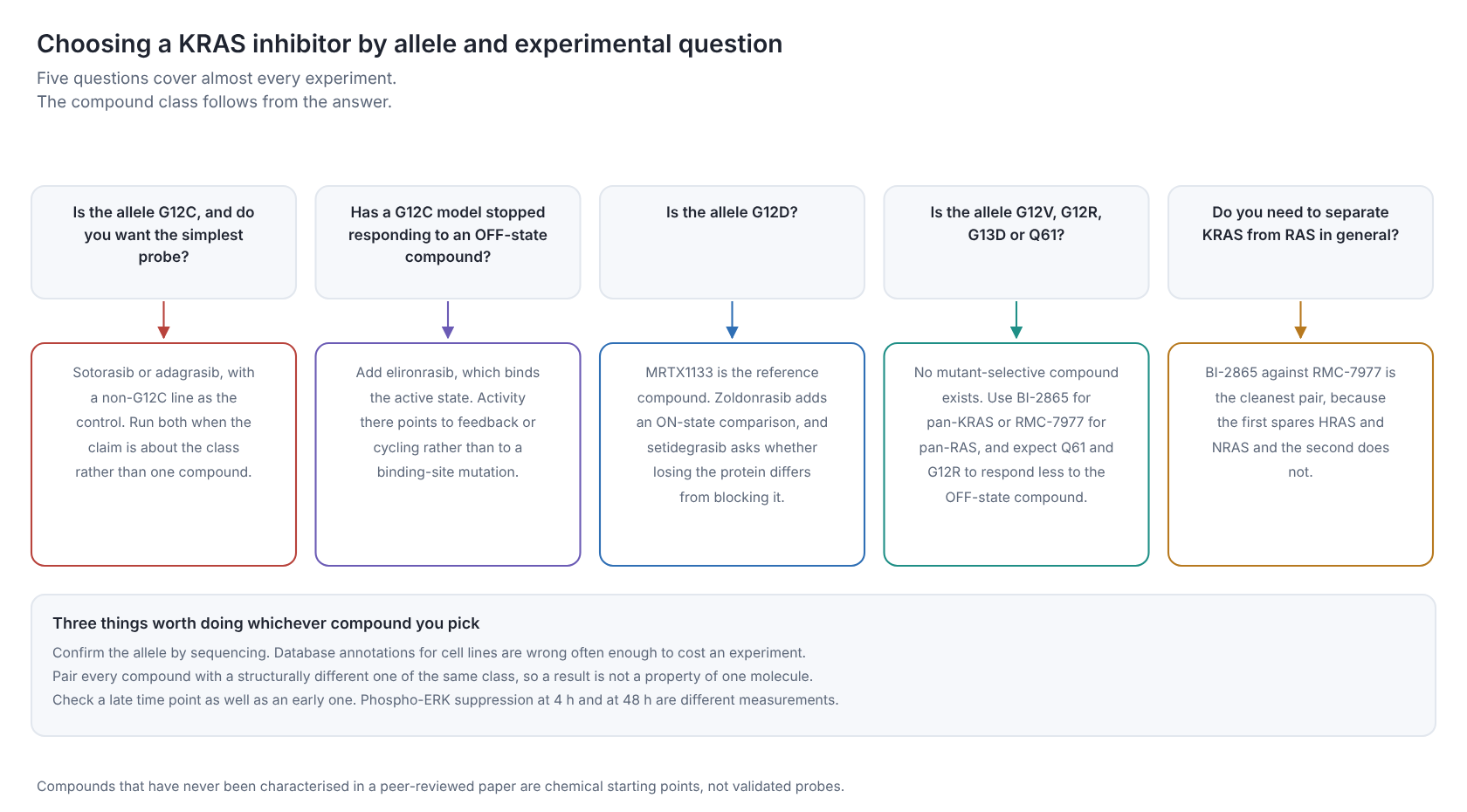
If the cells carry G12C and the question is whether the phenotype depends on mutant KRAS, use sotorasib or adagrasib with a non-G12C line as the control. If a G12C model has stopped responding to an OFF-state compound and the question is why, add elironrasib: activity there points to feedback or cycling rather than to a binding-site mutation.
If the cells carry G12D, MRTX1133 is the reference compound, and zoldonrasib adds an ON-state comparison. For degradation rather than inhibition, setidegrasib answers whether the scaffold function of the protein matters as well as its signalling.
If the allele is G12V, G12R, G13D or Q61, no mutant-selective compound exists, so the options are pan-KRAS (BI-2865) or pan-RAS (RMC-7977). Remember that BI-2865 binds the OFF state, so slow-hydrolysing alleles such as Q61 and G12R are relatively resistant [11].
If the question is whether KRAS specifically, rather than RAS generally, drives the phenotype, BI-2865 versus RMC-7977 is the cleanest pair, because the first spares HRAS and NRAS and the second does not.
11. Troubleshooting
No response in a G12C-mutant line. Confirm the allele by sequencing rather than relying on a database entry. Check the time point: adaptive feedback restores phospho-ERK within 24 to 48 hours in many lines [41]. Some G12C lines, including NCI-H23 and NCI-H1792, are intrinsically much less sensitive than MIA PaCa-2 even though the allele matches.
Phospho-ERK falls but the cells keep growing. Pathway inhibition and growth inhibition are separate questions. Co-occurring alterations, particularly loss of STK11 or KEAP1, or PI3K pathway activation, let cells survive MAPK suppression. A viability assay over 5 to 7 days, or a 3D assay, usually resolves it.
No activity from a RAS(ON) compound in a biochemical assay. Tri-complex compounds do not bind RAS on their own. In a cell-free system, add recombinant cyclophilin A to the buffer and load RAS with GTP or GppNHp, as in Section 8.5. In cells the same compounds need nothing extra.
KRAS comes back at the top doses of a degrader. That is the hook effect, not a failed experiment. Drop the top concentration, titrate through the nanomolar range, and confirm the mechanism by co-treating with a proteasome inhibitor such as carfilzomib or MG-132, which should block the degradation.
Activity in a KRAS wild-type line. Almost always an off-target effect from too high a concentration. Compounds in this class should be inactive below 10 µM in wild-type lines; if they are not, lower the top dose.
Compound will not dissolve. For compounds with no published solubility, stay at 10 mM in DMSO. Gentle warming to 37 °C and brief sonication help. Visible precipitate on dilution into medium means the nominal concentration is wrong, so dilute stepwise and keep DMSO at or below 0.1%.
Results drift between experiments. Repeated freeze-thaw of DMSO stocks is the usual cause, and water absorbed by DMSO is the second. Use single-use aliquots. For covalent compounds, check that no thiol reducing agent has been introduced anywhere in the dilution chain.
Poor in vivo exposure. Several compounds in this review are not orally bioavailable. MRTX1133 is dosed by injection in the published studies [18], BI-2865 is a cell-only compound whose oral analogue is BI-2493 [11], and HRS-4642 is given intravenously as a liposome in the clinic while the catalogue material is the free compound [19]. Section 8.6 lists the routes; take the vehicle from the original paper rather than assuming oral dosing.
12. Frequently asked questions
What is a KRAS inhibitor?
A KRAS inhibitor is a small molecule that blocks the KRAS protein, the most frequently mutated oncogene in human cancer. Four mechanisms are in use. Covalent OFF-state compounds trap GDP-bound KRAS G12C. Non-covalent compounds such as MRTX1133 and BI-2865 bind the same switch-II pocket without forming a bond. Tri-complex RAS(ON) compounds recruit cyclophilin A to block GTP-bound RAS from reaching its effectors. And degraders remove the protein altogether.
Which KRAS inhibitors are approved?
Six as of November 2026. Sotorasib and adagrasib for KRAS G12C lung cancer, each also approved with an EGFR antibody for KRAS G12C colorectal cancer; fulzerasib, garsorasib and glecirasib for KRAS G12C lung cancer in China; and daraxonrasib, approved in August 2026 for previously treated metastatic pancreatic adenocarcinoma. Daraxonrasib is the first pan-RAS and first RAS(ON) drug to be approved.
What is the difference between a KRAS G12C and a KRAS G12D inhibitor?
Cysteine 12 is nucleophilic, so a covalent compound can bond to it, which makes G12C compounds inherently mutant-selective. The carboxylate of aspartate 12 is a much weaker nucleophile and does not react with those warheads, so G12D compounds reach selectivity either through non-covalent affinity, as MRTX1133 does with a salt bridge to Asp12, or through the tri-complex route, where cyclophilin A holds a more reactive warhead against Asp12 long enough to react, as zoldonrasib does.
How does sotorasib work?
Sotorasib binds the switch-II pocket of GDP-bound KRAS G12C and forms a covalent bond with cysteine 12, locking the protein in its inactive state so that SOS1 cannot load GTP and RAF cannot bind. Its potency comes partly from a cryptic groove formed by His95, Tyr96 and Gln99 [9][17].
Is divarasib better than sotorasib or adagrasib?
In the phase 3 Krascendo 1 trial divarasib gave longer progression-free survival (9.8 against 5.7 months), longer overall survival (17.7 against 12.0 months) and a higher response rate (58% against 32%) than sotorasib or adagrasib in previously treated KRAS G12C lung cancer [2].
What is a RAS(ON) inhibitor?
A compound that binds the active, GTP-loaded form of RAS. The current RAS(ON) compounds work by first binding cyclophilin A and then using the combined surface to block RAS from its effectors [12]. Because they do not require the protein to cycle back to GDP, they stay active where OFF-state compounds lose target engagement.
Why is MRTX1133 still used if its trial stopped?
Its phase 1/2 study was terminated in early 2025, but it remains the best-characterised KRAS G12D compound in the literature, with a Kd near 0.2 pM and about 700-fold selectivity over wild-type KRAS [18]. For preclinical G12D work it is still the standard reference.
What is the working concentration of a KRAS inhibitor in cell culture?
It depends on the compound and the readout. Mutant-selective G12C compounds suppress phospho-ERK at low nanomolar concentrations in sensitive lines and inhibit viability at single-digit nanomolar in MIA PaCa-2 [17][31]. Pan-KRAS compounds such as BI-2865 need about 140 nM for half-maximal effect [11]. Test a range rather than a single concentration, and keep DMSO at or below 0.1%.
How do I make a KRAS inhibitor stock solution?
Dissolve in anhydrous DMSO at 10 mM, aliquot for single use and store at -80 °C. For sotorasib that is 5.61 mg/mL, so a 1 mg vial takes 178 µL; for MRTX1133 it is 6.01 mg/mL and 166 µL. Avoid thiol reducing agents with covalent compounds, and do not filter small volumes, because the filter hold-up volume can exceed the volume being prepared.
Which cell lines should I use?
MIA PaCa-2 and NCI-H358 for KRAS G12C, AsPC-1 or HPAC for G12D, SW620 or LoVo for G12V and G13D, and A549 (G12S) or BxPC-3 (wild type) as negative controls. Engineered Ba/F3 lines give the cleanest allele-by-allele comparison [11].
Why do tumours stop responding to KRAS inhibitors?
Four reasons. Adaptive feedback reactivates receptor tyrosine kinases and reloads KRAS with GTP within days [41][42]. Secondary mutations appear at the drug-binding site, such as Y96D, or create new activating alleles [43][44]. Bypass alterations such as MET amplification or NRAS and BRAF mutations restore signalling [43]. And a minority of tumours change histology [43].
Can a pan-KRAS inhibitor be used instead of an allele-specific one?
For research, yes, and it is the only direct option for G12V, G12R, G13D and Q61. BI-2865 binds most KRAS mutants while sparing HRAS and NRAS [11]. It is less potent than the allele-specific compounds, and because it binds the OFF state, slow-hydrolysing alleles respond less well.
What is the difference between BI-2865 and daraxonrasib?
BI-2865 is a non-covalent pan-KRAS compound that binds the GDP-bound state and spares HRAS and NRAS [11]. Daraxonrasib is a tri-complex pan-RAS compound that binds the GTP-bound state of KRAS, NRAS and HRAS, mutant and wild type [14]. Use the first to ask whether KRAS specifically matters, the second to shut down RAS signalling as completely as possible.
Do KRAS inhibitors cross the blood-brain barrier?
Adagrasib was designed for tissue penetration and intracranial responses were reported in KRYSTAL-1 [32]. Elisrasib is described as brain-penetrant, and MRTX0902 was optimised for brain penetration among the SOS1 compounds [45]. Sotorasib has less prospective evidence in this setting.
Why combine a KRAS inhibitor with an EGFR antibody in colorectal cancer?
Because colonic epithelium signals strongly through EGFR, which reloads RAS with GTP as soon as the MAPK pathway is inhibited. Blocking EGFR removes that loop, and in both CodeBreaK 300 and KRYSTAL-1 the combination roughly doubled the response rate over the KRAS compound alone [30][34].
References
- O'Reilly EM, Wolpin BM, et al. Daraxonrasib or Chemotherapy in Previously Treated Metastatic Pancreatic Cancer. New England Journal of Medicine 2026. doi
- Skoulidis F, et al. Divarasib as Compared with Sotorasib or Adagrasib in KRAS G12C-Mutated NSCLC. New England Journal of Medicine 2026. doi
- Simanshu DK, Nissley DV, McCormick F RAS Proteins and Their Regulators in Human Disease. Cell 2017. doi
- Prior IA, Hood FE, Hartley JL The Frequency of Ras Mutations in Cancer. Cancer Research 2020. doi
- Ostrem JM, Peters U, Sos ML, Wells JA, Shokat KM K-Ras(G12C) inhibitors allosterically control GTP affinity and effector interactions. Nature 2013. doi
- Patricelli MP, Janes MR, Li LS, et al. Selective Inhibition of Oncogenic KRAS Output with Small Molecules Targeting the Inactive State. Cancer Discovery 2016. doi
- Lito P, Solomon M, Li LS, Hansen R, Rosen N Allele-specific inhibitors inactivate mutant KRAS G12C by a trapping mechanism. Science 2016. doi
- Janes MR, Zhang J, Li LS, et al. Targeting KRAS Mutant Cancers with a Covalent G12C-Specific Inhibitor. Cell 2018. doi
- Canon J, Rex K, Saiki AY, et al. The clinical KRAS(G12C) inhibitor AMG 510 drives anti-tumour immunity. Nature 2019. doi
- Wang X, Allen S, Blake JF, et al. Identification of MRTX1133, a Noncovalent, Potent, and Selective KRAS G12D Inhibitor. Journal of Medicinal Chemistry 2022. doi
- Kim D, Herdeis L, Rudolph D, et al. Pan-KRAS inhibitor disables oncogenic signalling and tumour growth. Nature 2023. doi
- Schulze CJ, Seamon KJ, Zhao Y, et al. Chemical remodeling of a cellular chaperone to target the active state of mutant KRAS. Science 2023. doi
- Holderfield M, Lee BJ, Jiang J, et al. Concurrent inhibition of oncogenic and wild-type RAS-GTP for cancer therapy. Nature 2024. doi
- Jiang J, Jiang L, Maldonato BJ, et al. Translational and Therapeutic Evaluation of RAS-GTP Inhibition by RMC-6236 in RAS-Driven Cancers. Cancer Discovery 2024. doi
- Hallin J, Engstrom LD, Hargis L, et al. The KRAS(G12C) Inhibitor MRTX849 Provides Insight toward Therapeutic Susceptibility of KRAS-Mutant Cancers in Mouse Models and Patients. Cancer Discovery 2020. doi
- Hunter JC, Manandhar A, Carrasco MA, et al. Biochemical and Structural Analysis of Common Cancer-Associated KRAS Mutations. Molecular Cancer Research 2015. doi
- Lanman BA, Allen JR, Allen JG, et al. Discovery of a Covalent Inhibitor of KRAS G12C (AMG 510) for the Treatment of Solid Tumors. Journal of Medicinal Chemistry 2020. doi
- Hallin J, Bowcut V, Calinisan A, et al. Anti-tumor efficacy of a potent and selective non-covalent KRAS(G12D) inhibitor. Nature Medicine 2022. doi
- Zhou C, Li C, Luo L, et al. Anti-tumor efficacy of HRS-4642 and its potential combination with proteasome inhibition in KRAS G12D-mutant cancer. Cancer Cell 2024. doi
- Hofmann MH, Gmachl M, Ramharter J, et al. BI-3406, a Potent and Selective SOS1-KRAS Interaction Inhibitor, Is Effective in KRAS-Driven Cancers through Combined MEK Inhibition. Cancer Discovery 2021. doi
- Hillig RC, Sautier B, Schroeder J, et al. Discovery of potent SOS1 inhibitors that block RAS activation via disruption of the RAS-SOS1 interaction. Proceedings of the National Academy of Sciences 2019. doi
- Chen YN, LaMarche MJ, Chan HM, et al. Allosteric inhibition of SHP2 phosphatase inhibits cancers driven by receptor tyrosine kinases. Nature 2016. doi
- Nichols RJ, Haderk F, Stahlhut C, et al. RAS nucleotide cycling underlies the SHP2 phosphatase dependence of mutant BRAF-, NF1- and RAS-driven cancers. Nature Cell Biology 2018. doi
- Shima F, Yoshikawa Y, Ye M, et al. In silico discovery of small-molecule Ras inhibitors that display antitumor activity by blocking the Ras-effector interaction. Proceedings of the National Academy of Sciences 2013. doi
- Zimmermann G, Papke B, Ismail S, et al. Small molecule inhibition of the KRAS-PDEdelta interaction impairs oncogenic KRAS signalling. Nature 2013. doi
- Hong DS, Fakih MG, Strickler JH, et al. KRAS G12C Inhibition with Sotorasib in Advanced Solid Tumors. New England Journal of Medicine 2020. doi
- Skoulidis F, Li BT, Dy GK, et al. Sotorasib for Lung Cancers with KRAS p.G12C Mutation. New England Journal of Medicine 2021. doi
- de Langen AJ, Johnson ML, Mazieres J, et al. Sotorasib versus docetaxel for previously treated non-small-cell lung cancer with KRAS G12C mutation: a randomised, open-label, phase 3 trial. The Lancet 2023. doi
- Strickler JH, Satake H, George TJ, et al. Sotorasib in KRAS p.G12C-Mutated Advanced Pancreatic Cancer. New England Journal of Medicine 2023. doi
- Fakih MG, Salvatore L, Esaki T, et al. Sotorasib plus Panitumumab in Refractory Colorectal Cancer with Mutated KRAS G12C. New England Journal of Medicine 2023. doi
- Fell JB, Fischer JP, Baer BR, et al. Identification of the Clinical Development Candidate MRTX849, a Covalent KRAS(G12C) Inhibitor for the Treatment of Cancer. Journal of Medicinal Chemistry 2020. doi
- Janne PA, Riely GJ, Gadgeel SM, et al. Adagrasib in Non-Small-Cell Lung Cancer Harboring a KRAS G12C Mutation. New England Journal of Medicine 2022. doi
- Barlesi F, Mok TSK, et al. Adagrasib versus docetaxel in KRAS G12C-mutated non-small-cell lung cancer (KRYSTAL-12): a randomised, open-label, phase 3 trial. The Lancet 2025. doi
- Yaeger R, Weiss J, Pelster MS, et al. Adagrasib with or without Cetuximab in Colorectal Cancer with Mutated KRAS G12C. New England Journal of Medicine 2023. doi
- Sacher A, LoRusso P, Patel MR, et al. Single-Agent Divarasib (GDC-6036) in Solid Tumors with a KRAS G12C Mutation. New England Journal of Medicine 2023. doi
- Kemp SB, Cheng N, Markosyan N, et al. Efficacy of a Small-Molecule Inhibitor of KrasG12D in Immunocompetent Models of Pancreatic Cancer. Cancer Discovery 2023. doi
- Yu S, Oberstein PE, Maitra A, Hidalgo M Pancreatic Cancer KRAS Breakthrough: Drug Graveyard No More. Clinical Cancer Research 2026. doi
- Wasko UN, Jiang J, Dalton TC, et al. Tumour-selective activity of RAS-GTP inhibition in pancreatic cancer. Nature 2024. doi
- Wolpin BM, et al. Daraxonrasib in Previously Treated Advanced RAS-Mutated Pancreatic Cancer. New England Journal of Medicine 2026. doi
- Arbour KC, et al. Daraxonrasib for Previously Treated RAS-Mutant Non-Small-Cell Lung Cancer. New England Journal of Medicine 2026. doi
- Xue JY, Zhao Y, Aronowitz J, et al. Rapid non-uniform adaptation to conformation-specific KRAS(G12C) inhibition. Nature 2020. doi
- Ryan MB, Fece de la Cruz F, Phat S, et al. Vertical Pathway Inhibition Overcomes Adaptive Feedback Resistance to KRAS(G12C) Inhibition. Clinical Cancer Research 2020. doi
- Awad MM, Liu S, Rybkin II, et al. Acquired Resistance to KRAS G12C Inhibition in Cancer. New England Journal of Medicine 2021. doi
- Tanaka N, Lin JJ, Li C, et al. Clinical Acquired Resistance to KRAS(G12C) Inhibition through a Novel KRAS Switch-II Pocket Mutation and Polyclonal Alterations Converging on RAS-MAPK Reactivation. Cancer Discovery 2021. doi
- Ketcham JM, Haling J, Khare S, et al. Design and Discovery of MRTX0902, a Potent, Selective, Brain-Penetrant, and Orally Bioavailable Inhibitor of the SOS1:KRAS Protein-Protein Interaction. Journal of Medicinal Chemistry 2022. doi