Search by product name, CAS, target or catalog number. Press Down Arrow to reach product suggestions, Tab to move between links, and Escape to close suggestions.
USD – US Dollar✓Current currency
Account
Fluorescent Labeling Dyes
Begin with the molecule you want to label and the functional group available for reaction. The examples below compare the free-acid and succinimidyl-ester forms of 5(6)-TAMRA using documented coupling examples. [1][2] Check whether activation is required and whether the reaction partner matches the method. Treat general coupling chemistry as a planning principle, not a promise of performance, and assess the resulting conjugate separately from the starting dye. [2][3]
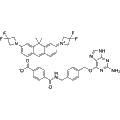
BG-JF585 is a Benzylguanine-conjugated JF585 fluorophore, which serves as a substrate for SNAP tags. With an absorption maximum at 593 nm and an emission maximum at 611 nm, this compound provides strong fluorescence suitable for various imaging applications. BG-JF585 is invaluable for monitoring protein localization and dynamics in live-cell imaging experiments, facilitating advanced studies in cellular biology and protein function.
The free acid and succinimidyl ester are different reagents. A study coupled 5(6)-TAMRA-COOH to a cyclic beta-tripeptide using PyBOP-mediated activation. A separate study used 5(6)-succinimidyl TAMRA with cystamine. These examples establish specific reactions, not universal labeling conditions. [1][2]
Identify the reaction partner.
For amine coupling, distinguish activation of a carboxylic acid from reaction of an already activated ester. For azide chemistry more generally, copper-catalyzed and strain-promoted azide–alkyne routes have different partner and catalyst requirements. These are general principles, separate from the specific examples in the table. [3]
Evaluate the product of labeling.
TAMRA derivative formation changed optical behavior in the cited dimer study. Do not assign a conjugate’s reported fluorescence to the starting reagent or transfer performance between different isomer forms. [2]
Representative Reagent Comparison
Selected examples for this topic; independent of the current product page or filters.
Representative reagents and selection considerations
Attachment to an amine-bearing cyclic beta-tripeptide scaffold.
The reported synthesis used PyBOP and DIEA for coupling. This is an activation-dependent example, not a ready-made NHS ester or a universal biomolecule-labeling recipe. [1]
Reaction with cystamine hydrochloride to prepare a TAMRA disulfide dimer.
Already supplied as an activated ester. The paper supports this specific derivatization; the dimer’s optical properties should not be assigned to the starting ester. [2]
Attachment to an amine-bearing cyclic beta-tripeptide scaffold.
Activation / selection boundary
The reported synthesis used PyBOP and DIEA for coupling. This is an activation-dependent example, not a ready-made NHS ester or a universal biomolecule-labeling recipe. [1]
Reaction with cystamine hydrochloride to prepare a TAMRA disulfide dimer.
Activation / selection boundary
Already supplied as an activated ester. The paper supports this specific derivatization; the dimer’s optical properties should not be assigned to the starting ester. [2]
Check the reagent form, reaction partner and method requirements before labeling. These examples do not promise labeling efficiency or compatibility with every sample.