
- Cat. No.
- A19716
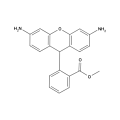
Dihydrorhodamine 123
Synonyms: DHR 123
Dihydrorhodamine 123 is a fluorescent probe (λex=488 nm, λem=525 nm).
In stock
View Details
Search by product name, CAS, target or catalog number. Press Down Arrow to reach product suggestions, Tab to move between links, and Escape to close suggestions.
Explore rhodamine dyes and derivatives with product-specific family evidence. Compare individual reagent forms, specifications and package options.
Derivatives can have different properties and uses. Family membership alone does not establish membrane staining, calcium indication or biomolecule-labeling suitability.
Synonyms: DHR 123
Dihydrorhodamine 123 is a fluorescent probe (λex=488 nm, λem=525 nm).
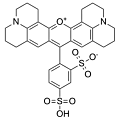
Synonyms: SR101; Sulforhodamine 101
Sulforhodamine 101 is a red fluorescent dye.
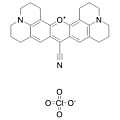
Rhodamine 800 is a near-infrared fluorescent dye.
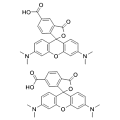
Synonyms: 5(6)-Carboxytetramethylrhodamine
5(6)-TAMRA contains a carboxylic acid that can be used to react with primary amines via carbodiimide activation of the carboxylic acid; bright, orange-fluorescent dye produces conjugates with absorption/emission maxima of ~555/580 nm.
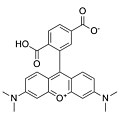
Synonyms: 6-Carboxytetramethylrhodamine
6-TAMRA has been a widely used fluorophore for preparing bioconjugates, especially fluorescent antibody and avidin derivatives used in immunochemistry.
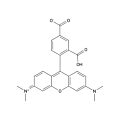
Synonyms: 5-Carboxytetramethylrhodamine
5-TAMRA (5-Carboxytetramethylrhodamine), SE and its conjugates yield bright, pH-insensitive orange-red fluorescence (approximate excitation/emission maxima ~546/579) with good photostability.
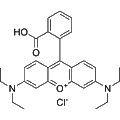
Synonyms: Basic Violet 10; Brilliant Pink B; Rhodamine O; Tetraethylrhodamine
Rhodamine B is a fluorescent dye widely used for staining applications. It is commonly employed in the dyeing of textiles, paper, soap, leather, and various industrial agents.
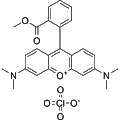
Synonyms: T668
Rhodamine dyes are membrane-permeable, cationic fluorescent probes that selectively accumulate in mitochondria by recognizing mitochondrial membrane potential, producing bright fluorescence. At appropriate concentrations, they exhibit low cytotoxicity and are widely used for mitochondrial staining in animal cells, plant cells, and microorganisms.
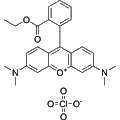
Synonyms: Tetramethylrhodamine ethyl ester perchlorate
Rhodamine dyes are membrane-permeable, cationic fluorescent probes that selectively accumulate in mitochondria by sensing mitochondrial membrane potential, resulting in bright fluorescence. Due to their low cytotoxicity at appropriate concentrations, they are widely used for mitochondrial labeling in animal cells, plant cells, and microorganisms.
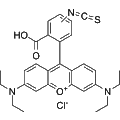
Rhodamine B isothiocyanate (RBITC) is a reactive fluorescent dye widely used for covalent labeling of biomolecules in imaging and analytical applications. The isothiocyanate functional group readily reacts with primary amines on proteins, peptides, and other biomolecules to form stable thiourea linkages, enabling durable fluorescent tagging. RBITC emits bright orange-red fluorescence upon green light excitation, providing strong signal intensity and excellent photostability for visualization in complex biological systems. Owing to its high sensitivity, chemical stability, and compatibility with diverse assay conditions, RBITC is extensively utilized in cell biology, immunology, neurobiology, and fluorescence microscopy studies for tracking molecular localization and dynamics.
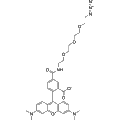
TAMRA-PEG3-Azide is a fluorescent dye derivative of TAMRA featuring three polyethylene glycol (PEG) units. This compound contains an azide functional group, enabling it to participate in copper-catalyzed azide-alkyne cycloaddition (CuAAc) reactions with alkyne-containing molecules. Additionally, it can engage in strain-promoted alkyne-azide cycloaddition (SPAAC) reactions with DBCO or BCN functionalities. TAMRA-PEG3-Azide is valuable for applications in fluorescent labeling and bioconjugation in chemical biology research.
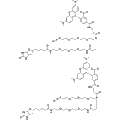
TAMRA-Azide-PEG-biotin is a dye derivative that incorporates an azide functional group, enabling copper-catalyzed azide-alkyne cycloaddition (CuAAc) with alkyne-containing molecules. Additionally, it facilitates strain-promoted alkyne-azide cycloaddition (SPAAC) reactions with DBCO or BCN modified compounds. This reagent is valuable for labeling and tracking biomolecules in various biological assays, enhancing visualization and detection in chemical biology research.
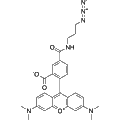
TAMRA azide, 5-isomer is an azide-containing dye that serves as a versatile linker for the orange fluorophore TAMRA. This compound facilitates copper-catalyzed azide-alkyne cycloaddition (CuAAc) with alkyne-bearing molecules and can also participate in strain-promoted alkyne-azide cycloaddition (SPAAC) with DBCO or BCN-reactive partners. Its ability to efficiently form stable conjugates makes it an important tool for a wide range of applications, including bioconjugation, imaging, and cellular labeling in chemical biology research.
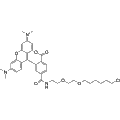
HaloTag TMR is a red fluorescent dye designed for the specific labeling of HaloTag proteins. This compound consists of HaloTag ligand molecules conjugated with TMR (TAMRA), allowing for rapid and stable covalent binding with high specificity and affinity. With excitation and emission wavelengths of 550 nm and 576 nm, respectively, it is ideal for a range of biological applications, including live-cell imaging and protein localization studies.
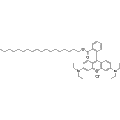
Octadecyl Rhodamine B chloride is a versatile amphiphilic fluorescent probe targeting cell membranes. This compound effectively stains cell membranes and is instrumental in membrane biology research. It exhibits fluorescence properties, with a maximum absorption and emission wavelength of 565 nm and 585 nm, respectively, when in Triton X-100. In aqueous solutions, the compound forms aggregates that shift absorption peaks to 524 nm and 574 nm, resulting in notable fluorescence quenching.
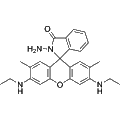
Synonyms: R6GH
Rhodamine 6G hydrazide is a fluorescent dye known for its strong absorbance and emission characteristics. It exhibits robust colorimetric and fluorescent properties, making it suitable for a variety of sensing applications. This reagent is commonly utilized in biochemical assays and imaging studies, facilitating the detection of specific biomolecules.
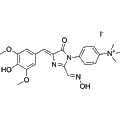
DMHBO+ is a cationic chromophore known for its high-affinity binding to the Chili aptamer, exhibiting a dissociation constant (Kd) of 12 nM. The Chili-DMHBO+ complex serves as an effective fluorescence donor for FRET applications with the rhodamine dye Atto 590, facilitating RNA imaging within cellular environments. With excitation and emission wavelengths of 456 nm and 592 nm respectively, DMHBO+ is a valuable tool for researchers studying RNA dynamics and interactions.
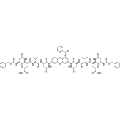
Synonyms: (Z-Asp-Glu-Val-Asp)₂-Rhodamine 110
Z-DEVD-R110 is a fluorogenic substrate specifically designed for the detection of caspase-3 and caspase-7 activity. Composed of two DEVD peptide sequences linked to the rhodamine 110 fluorophore, this reagent is valuable for studying apoptotic processes in various biological systems. Its ability to provide quantitative measurements of caspase activity makes it an essential tool in apoptosis research and related studies.
Out of stock
All 3 sizes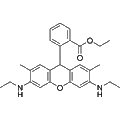
Synonyms: DHR 6G
Dihydrorhodamine 6G (DHR 6G) serves as a fluorescent probe targeting mitochondrial membranes. This nonfluorescent compound easily penetrates cells and is oxidized by reactive oxidative species or cellular redox systems, converting into the fluorescent rhodamine 6G. DHR 6G is valuable for the detection of reactive oxygen species (ROS), including superoxide, making it a crucial tool for research involving oxidative stress and mitochondrial function.
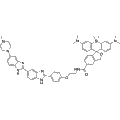
5-HMSiR-Hoechst is a fluorescent dye designed for DNA probing, combining the characteristics of Hoechst 33258 with spontaneously blinking far-red hydroxymethyl silicon-rhodamine (HMSiR). This reagent effectively stains living cells, allowing for comprehensive visual analysis of cellular structures. With an excitation/emission wavelength of 640 nm/675 nm, it is suitable for advanced fluorescence imaging applications in various biological research studies.
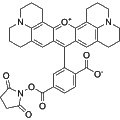
Synonyms: 6-ROX; SE
6-Carboxy-X-rhodamine, succinimidyl ester is a fluorescent dye specifically designed for oligonucleotide labeling. This compound exhibits high stability and fluorescence intensity, making it suitable for applications in automated DNA sequencing and molecular biology research. It enables effective visualization of nucleic acids in various assays, improving the accuracy and efficiency of genetic analyses.
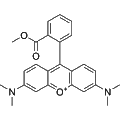
TMRM (Tetramethylrhodamine Methyl Ester) is a membrane-permeable cationic fluorescent dye that selectively targets mitochondrial membrane potential. Its ability to accumulate in mitochondria results in strong fluorescence, enabling the visualization of mitochondrial dynamics. TMRM is widely utilized in cellular research, including studies of mitochondrial function, cell viability, and apoptosis in various biological systems, including animal, plant, and microbial cells.
Out of stock
All 3 sizes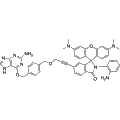
TMR-NO-BG is a specialized nitric oxide (NO) detection probe that incorporates a tetramethylrhodamine (TMR) lactone sensing unit linked to a SNAP-tag reactive benzyl guanine (BG). This hybrid structure enables precise subcellular localization of NO, facilitating sensitive detection in living cells. TMR-NO-BG is ideal for research applications focused on studying nitric oxide signaling and its biological implications in various cellular processes.
Out of stock
All 3 sizes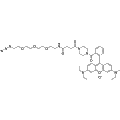
Rhodamine-N3 chloride is a fluorescent dye with a primary mechanism based on its azide functionalities. This reagent is designed for the labeling of biomolecules containing alkyne groups through copper-catalyzed azide-alkyne cycloaddition (CuAAc) reactions as well as strain-promoted alkyne-azide cycloaddition (SPAAC) with DBCO or BCN groups. With an excitation/emission wavelength of 544/576 nm, Rhodamine-N3 chloride is ideal for various applications in bioimaging and chemical biology studies.
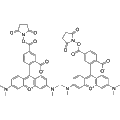
Synonyms: 5(6)-Carboxytetramethylrhodamine N-succinimidyl ester
5(6)-TAMRA SE is a fluorescent dye that emits red fluorescence, primarily targeting oligonucleotides. Its ability to bind specifically to these molecules makes it ideal for applications in DNA sequencing, facilitating the analysis of genetic material. Additionally, 5(6)-TAMRA SE is employed in cancer research, with optimal excitation and emission wavelengths at 565 nm and 580 nm, respectively.