
- Cat. No.
- A11619
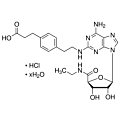
CGS 21680 HCl Hydrate
Synonyms: CGS-21680
CGS 21680 is a specific adenosine A2A subtype receptor agonist.
Search by product name, CAS, target or catalog number. Press Down Arrow to reach product suggestions, Tab to move between links, and Escape to close suggestions.
Adenosine receptor agonists and antagonists target A1, A2A, A2B and A3, the four G protein-coupled adenosine receptors. The International Union of Pharmacology (IUPHAR) set out this nomenclature in 2001. A1 and A3 receptors usually inhibit adenylyl cyclase, while A2A and A2B receptors stimulate it. In 2008 the human A2A receptor was crystallized bound to an antagonist at 2.6 Å resolution. Ligands in this category include the A2A agonist CGS 21680 HCl Hydrate, the A2A antagonist istradefylline and the A3 agonist IB-MECA. Xanthines such as theophylline block several subtypes, and 5-Iodotubercidin inhibits adenosine kinase, which phosphorylates adenosine.
Synonyms: CGS-21680
CGS 21680 is a specific adenosine A2A subtype receptor agonist.
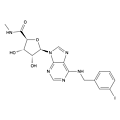
Synonyms: CF 101
IB-MECA has been shown to act as a potent and selective Adenosine A3-R agonist with Ki values of 1.1, 54 and 56 nM for Adenosine A3-R, Adenosine A1-R and Adenosine A2A-R, respectively.
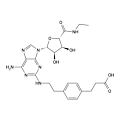
CGS 21680 is a selective adenosine A2A receptor agonist, with a Ki of 27 nM.
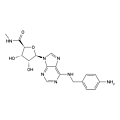
AB-MECA is a high affinity A3 adenosine receptor agonist, has high affinity for recombinant A1 and A3 receptors.
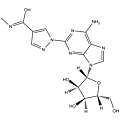
Regadenoson was selective agonist for the A2A adenosine receptor versus the A1, A2B, and A3 receptors in binding and functional studies. Regadenoson was also found to be a full and potent agonist to cause coronary vasodilation, a response that has a very large A2A receptor reserve?
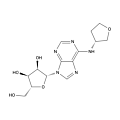
Synonyms: CVT-510
Tecadenoson (CVT-510) is a selective A1 adenosine receptor agonist.
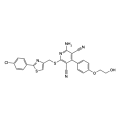
Capadenoson is a selective agonist of adenosine-A1 receptor.
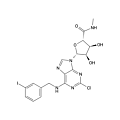
Synonyms: CF102; Cl-IB-MECA
CF-102 is an orally bioavailable, synthetic, highly selective adenosine A3 receptor (A3AR) agonist with potential antineoplastic activity.
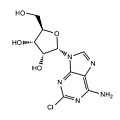
Synonyms: CADO
2-Chloroadenosine is a metabolically stable analog of adenosine that behaves as an Adenosine A Receptor agonist (Ki values are 300, 80 and 1900 nM for Adenosine A1-R, Adenosine A2A-R and Adenosine A3-R, respectively).
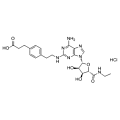
Synonyms: CGS-21680 Hydrochloride
CGS 21680 HCl is an adenosine A2 receptor agonist with IC50 of 22 nM, exhibits 140-fold over A1 receptor.
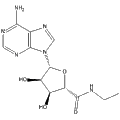
Synonyms: 5'-N-Ethylcarboxamidoadenosine
NECA is a high-affinity adenosine receptor agonist (Ki values are 6.2, 14, and 20 nM for human A3, A1 and A2A receptors respectively; EC50 = 2.4 μM for human A2B).
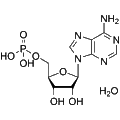
Synonyms: 5'-AMP monohydrate
Adenosine 5'-monophosphate monohydrate is an adenosine A1 receptor agonist that plays a crucial role in cellular signaling pathways. This compound exhibits significant antiviral activity against Herpes Simplex Virus types 1 and 2 (HSV-1 and HSV-2), making it valuable for studies related to viral infections. Its modulation of adenosine receptors also provides insights into various physiological and pathological processes, offering applications in pharmacological research.
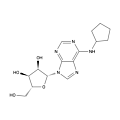
Synonyms: CPA; UK-80882
N6-Cyclopentyladenosine (CPA) is a selective Adenosine A1 receptor agonist, with Ki values of 2.3 nM, 790 nM and 43 nM for human A1, A2A and A3 receptors, respectively.
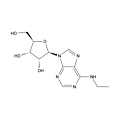
Synonyms: NSC 516603
N6-Ethyladenosine is an adenosine derivative, acts as a Adenosine receptor agonist, with Kis of 4.9 and 4.7 nM for hA1AR and hA3AR, respectively.

Synonyms: N6-Phenethyladenosine; N6-Phenylethyladenosine
N6-(2-Phenylethyl)adenosine is a selective A1 adenosine receptor agonist.
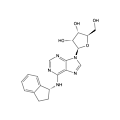
Synonyms: CI947
PD 117519 (CI947) is an A2A adenosine agonist which has shown oral antihypertensive activity in pharmacological animal models.
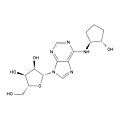
GR79236 is a highly potent and selective adenosine A1 receptor agonist (Ki = 3.1 nM) that has analgesic and anti-inflammatory actions in humans and animals.
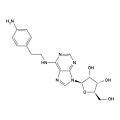
Synonyms: N6-[2-(4-Aminophenyl)ethyl]adenosine
APNEA (N6-[2-(4-Aminophenyl)ethyl]adenosine) is a potent, non-selective A3 adenosine receptor agonist.
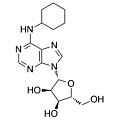
N6-Cyclohexyladenosine is a selective A1 receptor agonist (EC50 = 8.2 nM).
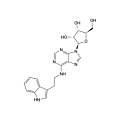
A2AR-agonist-1 is a potent A2AR and ENT1 agonist with Ki of 4.39 and 3.47 for A2AR and ENT1.
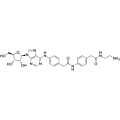
Synonyms: ADAC
Adenosine amine congener (ADAC) is a selective A1 adenosine receptor agonist, can ameliorate noise- and Cisplatin-induced cochlear injury.

Synonyms: Dermaseptin b2
Adenoregulin, also known as Dermaseptin b2, is an antimicrobial peptide antibiotic that targets a broad spectrum of microorganisms. It exhibits activity against both Gram-negative and Gram-positive bacteria, as well as yeast and fungi. Additionally, Adenoregulin enhances the binding of agonists to the A1 adenosine receptor, making it valuable for research applications in microbiology and pharmacology.
Out of stock
All 3 sizes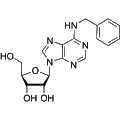
Synonyms: Benzyladenosine
N6-Benzyladenosine is an adenosine receptor agonist that demonstrates significant cytotoxic activity. It effectively induces apoptosis in cells and arrests the cell cycle at the G0/G1 phase, making it a valuable tool for studying cell proliferation and death. Additionally, N6-Benzyladenosine inhibits Toxoplasma gondii adenosine kinase, providing insights into its potential applications in antiparasitic research and glioma studies.
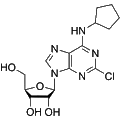
Synonyms: 2-Chloro-N6-cyclopentyladenosine
CCPA (2-Chloro-N6-cyclopentyladenosine) is a highly selective agonist for A1 adenosine receptors, demonstrating a Ki value of 0.4 nM. This compound effectively inhibits adenylate cyclase, with an IC50 of 33 nM. CCPA is relevant in studies investigating anti-seizure and cardioprotective effects, making it a valuable tool for research related to seizures and myocardial infarction.
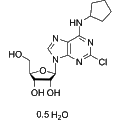
Synonyms: 2-Chloro-N6-cyclopentyladenosine hemihydrate
CCPA hemihydrate is a highly selective agonist of the A1 adenosine receptors, exhibiting a Ki value of 0.4 nM. It demonstrates preferential binding to the A1 receptor over the A2 receptor, with a Ki of 3900 nM. As a purine nucleoside analog, CCPA hemihydrate has demonstrated broad antitumor activity, particularly in the context of indolent lymphoid malignancies. Its anticancer effects are mediated through mechanisms such as inhibition of DNA synthesis and induction of apoptosis, making it valuable for research applications in cancer therapy.
Out of stock
All 3 sizes