
Alpelisib (BYL719): PI3Kα Mechanism of Action, PIK3CA Mutations, Solubility and Working Concentration
A working guide to alpelisib (BYL719): how this PI3Kα-selective inhibitor blocks p110α, why PIK3CA mutation status decides whether it works, how to dissolve it and what concentrations published work uses.
Technical guide from Adooq Bioscience · Product: Alpelisib (BYL719), Cat. No. A11328 · Last reviewed: 2026-11
Alpelisib at a glance
| Property | Value |
|---|---|
| Common name | Alpelisib; development codes BYL719, NVP-BYL719 and BYL-719 |
| CAS | 1217486-61-7 (free base) |
| Molecular formula | C19H22F3N5O2S |
| Molecular weight | 441.5 g/mol |
| Class | ATP-competitive, isoform-selective class IA PI3Kα (p110α) inhibitor |
| Cell-free potency | p110α IC50 5 nM; p110γ 250 nM; p110δ 290 nM; p110β 1,200 nM |
| Cellular potency | 74 nM against myristoylated p110α signaling to phospho-AKT Ser473; 0.1-0.5 µM antiproliferative IC50 in PIK3CA-mutant lines |
| Mutant selectivity | None. Alpelisib inhibits mutant and wild-type p110α alike, which is the source of its on-target hyperglycemia |
| Solubility | DMSO 77 mg/mL (174.41 mM); ethanol 2 mg/mL (4.53 mM); insoluble in water |
| Typical in vitro range | 0.1-5 µM for cell work; 1 µM for a 1 h pathway readout |
| Typical in vivo use | 25 mg/kg daily by oral gavage in mouse xenograft work |
| Storage | Powder at -20 °C, desiccated, stable for about 36 months; DMSO stocks at -20 °C for no more than one month |
| Other catalog forms | Alpelisib hydrochloride (A21794, 477.93 g/mol); alpelisib carboxylic acid metabolite (A70765, 442.46 g/mol) |
| Originator | Novartis |
| Clinical status | Approved as Piqray for PIK3CA-mutated HR-positive, HER2-negative advanced breast cancer, and as Vijoice for severe PIK3CA-related overgrowth spectrum |
Alpelisib is the compound that turned PI3Kα from a pathway target into a genotype-matched one. Earlier pan-PI3K inhibitors hit all four class I catalytic isoforms and were limited by the sum of their toxicities; alpelisib leaves p110β largely alone at working concentrations, which is what made it usable. For bench work the practical consequences are a wide margin between its biochemical IC50 and the concentration needed in cells, a hard dependence on PIK3CA genotype, and a feedback loop through insulin that shows up in any whole-animal experiment.
1. What alpelisib (BYL719) is
1.1 One molecule, several names
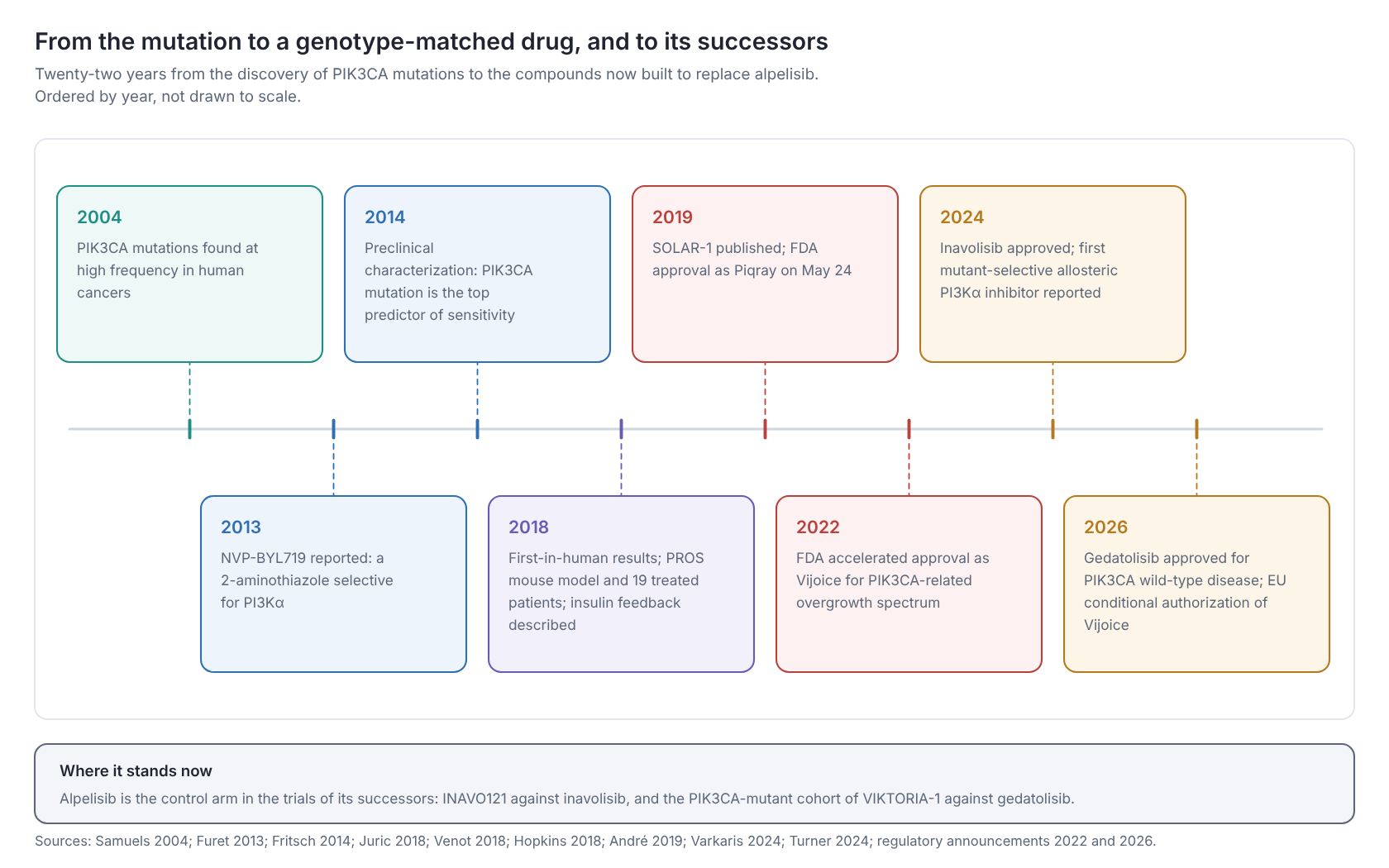
Alpelisib was discovered at Novartis as NVP-BYL719 and is still cited as BYL719 or BYL-719 in most of the preclinical literature [1]. The international nonproprietary name is alpelisib. It carries two brand names, because it is approved in two unrelated settings: Piqray in PIK3CA-mutated advanced breast cancer, and Vijoice in PIK3CA-related overgrowth spectrum. People searching for the alpelisib brand name usually mean one of those two. All of these names refer to the same molecule.
Adooq supplies it as Alpelisib (BYL719), catalog number A11328, as the free base.
Searches for "alpelisib PI3K inhibitor" are usually someone checking the class before ordering, so to be explicit: alpelisib is an ATP-competitive inhibitor of the p110α catalytic subunit of class IA PI3K. It is not a pan-PI3K inhibitor, not a dual PI3K/mTOR inhibitor, not an AKT inhibitor, and not mutant-selective. Each of those four categories exists as a separate class of compound, and §14 places alpelisib among them.
1.2 Structure and physical properties
| Property | Value |
|---|---|
| CAS | 1217486-61-7 |
| Formula | C19H22F3N5O2S |
| Molecular weight | 441.5 |
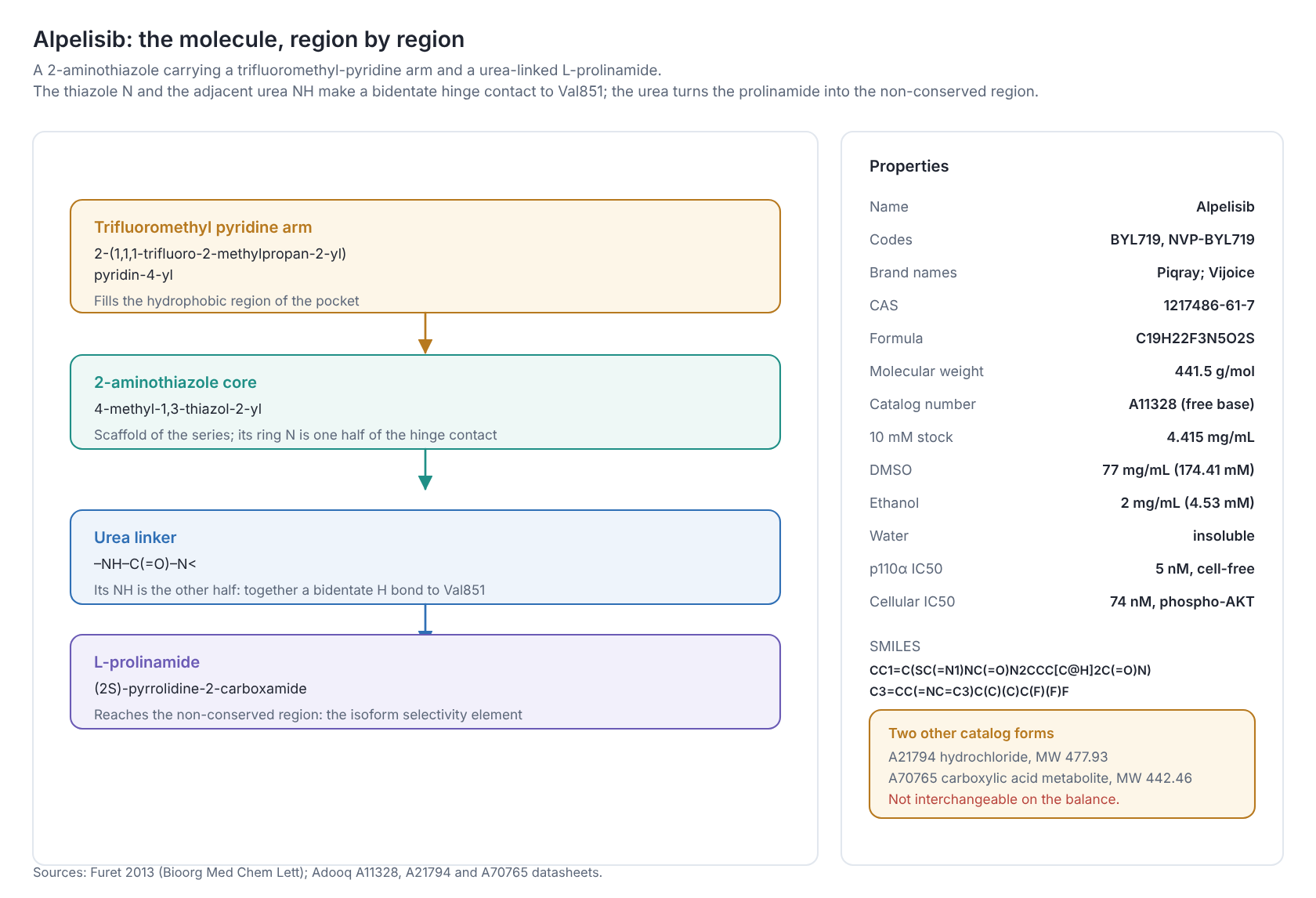
| SMILES | CC1=C(SC(=N1)NC(=O)N2CCC[C@H]2C(=O)N)C3=CC(=NC=C3)C(C)(C)C(F)(F)F |
| 10 mM stock | 4.415 mg/mL |
The molecule is a 2-aminothiazole: a thiazole core carrying a 4-methyl group, a pyridine ring bearing a trifluoromethyl-dimethyl-methyl group, and a urea link to an L-prolinamide. It came out of a medicinal chemistry program built on a binding model that explained why this particular 2-aminothiazole series is both potent and selective for PI3Kα [1]. The prolinamide is the selectivity element: it reaches a non-conserved region of the p110α ATP pocket and makes contacts that the other three class I isoforms cannot reproduce.
1.3 The three catalog forms
| Form | Catalog number | CAS | Formula | MW | What it is |
|---|---|---|---|---|---|
| Alpelisib | A11328 | 1217486-61-7 | C19H22F3N5O2S | 441.5 | The free base, and the form essentially all published work uses |
| Alpelisib hydrochloride | A21794 | 1584128-91-5 | C19H23ClF3N5O2S | 477.93 | The hydrochloride salt, for work that wants improved aqueous handling |
| Alpelisib carboxylic acid | A70765 | 2715981-74-9 | C19H21F3N4O3S | 442.46 | The carboxylic acid metabolite, in which the prolinamide is hydrolyzed to the acid; a reference standard for metabolism work, not a PI3Kα inhibitor to use in cells |
Two practical points follow. The salt and the free base differ by 8% in molecular weight, so weighing the hydrochloride and calculating with 441.5 overstates your concentration; use 477.93 for A21794. And the carboxylic acid is a metabolite standard, not an active tool compound: the prolinamide it has lost is the selectivity element described above.
2. Alpelisib mechanism of action
2.1 What PI3Kα does, and where alpelisib stops it
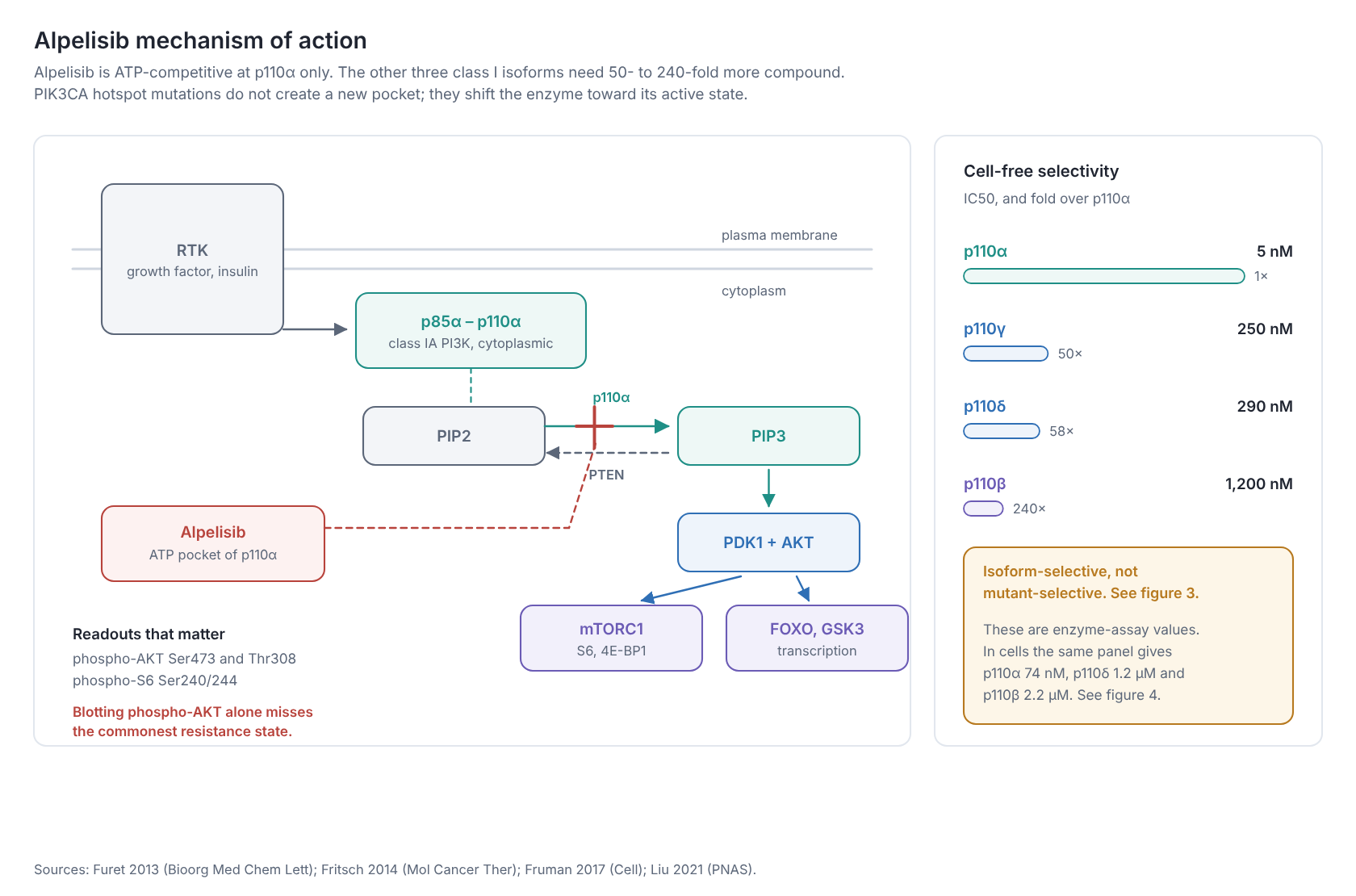
Class IA PI3K is a heterodimer of a p110 catalytic subunit and a p85 regulatory subunit. When a receptor tyrosine kinase is activated, p85 docks on phosphotyrosines, which relieves its inhibition of p110, and p110 phosphorylates PIP2 to PIP3 at the inner face of the plasma membrane. PIP3 recruits AKT and PDK1 through their PH domains, AKT is phosphorylated on Thr308 and Ser473, and the signal continues through TSC2 to mTORC1, through FOXO transcription factors, and through GSK3 [2]. PTEN runs the reaction backwards, converting PIP3 to PIP2, which is why PTEN loss and PI3K activation are partly interchangeable.
There are four class I catalytic isoforms. p110α and p110β are expressed everywhere; p110δ and p110γ are largely restricted to leukocytes. They do different jobs: p110α carries insulin and most growth factor signaling, p110β couples to G protein-coupled receptors and to some integrin signaling, and the two leukocyte isoforms run immune receptor signaling [3]. That division of labor is the whole argument for isoform-selective inhibition, and it is also why the three approved PI3K-directed drug classes target different isoforms for different diseases.
Alpelisib binds the ATP pocket of p110α. Inhibition is therefore ATP-competitive, and the measured selectivity across the four isoforms is wide [1], [4]:
| Isoform | Cell-free IC50 | Fold over p110α |
|---|---|---|
| p110α (PIK3CA) | 5 nM | 1 |
| p110γ (PIK3CG) | 250 nM | 50 |
| p110δ (PIK3CD) | 290 nM | 58 |
| p110β (PIK3CB) | 1,200 nM | 240 |
The practical reading of that table is a working window rather than a single number. Below about 1 µM in cells you can argue that what you see is p110α inhibition. Above a few micromolar you are inhibiting p110δ and p110γ as well, and the compound is no longer the selective tool it is advertised as. §7 turns this into concentrations.
2.2 Cellular potency is not biochemical potency
The gap between 5 nM in a cell-free assay and the concentration that does something to a cell is large, and it trips people up. In Rat1 cells expressing a myristoylated, constitutively membrane-bound p110α, alpelisib inhibited AKT Ser473 phosphorylation with an IC50 of 74 nM; in the same system the values for myristoylated p110δ and p110β were 1.2 µM and 2.2 µM, preserving the isoform ranking [1]. Antiproliferative IC50 values sit higher again, in the 0.1-0.5 µM range in sensitive lines.
Three things cause that 15-fold step from 5 nM to 74 nM, and the further step to antiproliferative potency: ATP competition means cellular ATP concentrations push the apparent IC50 up; pathway output is buffered, so partial PI3K inhibition produces very little change in phospho-AKT; and proliferation depends on how much of the cell's growth signal actually runs through p110α. Only the third is biology you want to measure. The first two mean you should always set your concentration from a cellular readout in your own cells, not from the 5 nM figure.
2.3 What the structures show
Cryo-electron microscopy of the full-length p110α/p85α complex with BYL719 bound resolved the inhibitor in the p110α active site at 2.93 Å global resolution, retaining an interaction with Gln859 seen in the earlier crystal structure while the trifluoromethyl group adopted a different orientation [5]. The same work described conformational changes between inhibited and activated states of the enzyme, which matters for the next section: the oncogenic mutations do not create a new pocket, they shift the enzyme's conformational equilibrium toward the active state.
Note what that structural evidence is and is not. It establishes where the compound binds. It does not measure an IC50 and does not by itself demonstrate isoform selectivity; those come from the enzymatic and cellular assays above.
3. PIK3CA mutations: why genotype decides the result
3.1 The mutation landscape
PIK3CA, the gene encoding p110α, is among the most frequently mutated oncogenes in human cancer. The original survey found mutations at high frequency in colorectal cancer and across other solid tumors, clustered in the helical and kinase domains [6]. In hormone receptor-positive, HER2-negative breast cancer the reported frequency is roughly 28-46% of advanced cases [7].
The mutations are not scattered. Three hotspots account for most of them:
| Hotspot | Domain | Effect |
|---|---|---|
| H1047R (and H1047L) | Kinase | Increases membrane association of p110α |
| E545K | Helical | Disrupts the inhibitory contact with p85α |
| E542K | Helical | Disrupts the inhibitory contact with p85α |
Both routes produce the same outcome, a p110α that signals without upstream input, by different physical means. That distinction matters now in a way it did not a few years ago, because the mutant-selective compounds described in §14 have different potency against kinase-domain and helical-domain mutants, while alpelisib does not discriminate between them at all.
3.2 Alpelisib is not mutant-selective, and that is the central fact about it
It is worth stating plainly, because the marketing language around "PI3Kα-selective" invites the opposite conclusion. Alpelisib is selective for the p110α isoform over the other three isoforms. It is not selective for mutant p110α over wild-type p110α. Every cell in the body carrying wild-type PI3Kα is inhibited at the same concentration as the tumor.
Everything downstream follows from that single fact: the dose-limiting on-target toxicity in the first-in-human study was hyperglycemia [8]; the mechanism of that hyperglycemia is §4; and the existence of the mutant-selective allosteric compounds is a direct response to it [9] [10].
3.3 Predictors of sensitivity, and what does not predict it
Screening across the Cancer Cell Line Encyclopedia identified PIK3CA mutation as the foremost positive predictor of sensitivity to alpelisib, with PIK3CA amplification as an additional positive association and PTEN mutation as a negative one [4]. Two refinements have been added since.
Double mutations in cis. Multiple PIK3CA mutations occur in 12-15% of breast cancers and other tumor types, and 95% of those are double mutations. They sit on the same allele, increase PI3K activity and downstream signaling, and predict increased sensitivity to PI3Kα inhibitors compared with single hotspot mutations [11]. If you are choosing cell lines for a sensitivity panel, genotype them properly rather than scoring mutation as a yes-or-no variable.
***PTEN* status.** Loss of PTEN uncouples pathway output from p110α, because PIP3 accumulates whether or not p110α is inhibited. It is both a baseline resistance marker and an acquired one [12].
4. Why alpelisib raises blood glucose: the insulin feedback loop
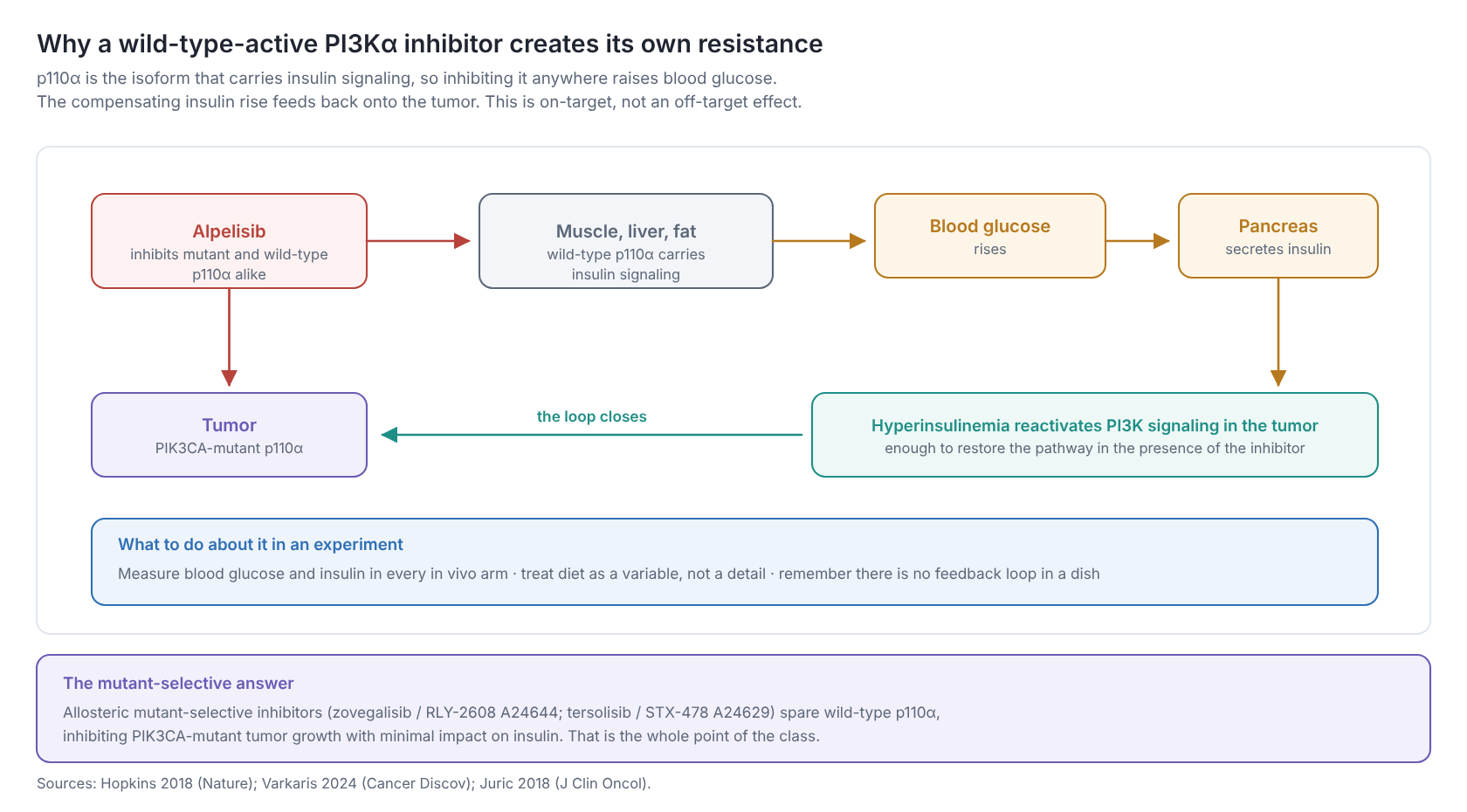
This is the most-asked mechanistic question about the compound, and the answer is not a side effect in the usual sense. It is the pathway working as designed.
Insulin signals through the insulin receptor to class IA PI3K, and the isoform that carries that signal is p110α. Inhibit p110α anywhere in the body and you blunt insulin signaling in muscle, liver and adipose tissue; glucose uptake falls, hepatic glucose output rises, and blood glucose goes up. The pancreas responds with insulin, and the resulting hyperinsulinemia pushes back on the tumor: Hopkins and colleagues showed in mouse models that systemic glucose-insulin feedback is sufficient to reactivate PI3K signaling in tumors even in the continued presence of a PI3K inhibitor, and that preventing the feedback, dietarily or pharmacologically, improves the efficacy-to-toxicity ratio of the inhibitor [13].
Three consequences for experimental design.
- In any whole-animal experiment, measure glucose and insulin. A xenograft study with a PI3Kα inhibitor and no metabolic readout is missing the variable most likely to explain a disappointing result.
- Diet is a covariate, not a detail. The feedback runs through nutrient intake, which is why dietary manipulation changes the answer. Standard chow, a high-fat diet and a ketogenic diet are three different experiments.
- In cell culture there is no feedback loop. The medium's glucose and insulin are fixed by you, so an in vitro potency measurement will always flatter the compound relative to an in vivo one. That is a large part of why cellular IC50 values and in vivo efficacy correlate so loosely for this class. It also means the medium itself can move your IC50: many defined and serum-free formulations, and most adipocyte, hepatocyte and stem-cell media, contain insulin or ITS supplement at concentrations far above physiological, which drives PI3K signaling continuously and shifts the apparent potency of a PI3Kα inhibitor. Check the formulation and state the insulin content whenever you report a value.
This is also the cleanest way to see what the mutant-selective compounds are for. RLY-2608, an allosteric mutant-selective PI3Kα inhibitor, inhibited tumor growth in PIK3CA-mutant xenografts with minimal impact on insulin, explicitly decoupling antitumor activity from hyperinsulinemia [9]. The compound is available as zovegalisib and is the natural comparator in any experiment where the insulin arm is the thing you are studying. Agents used to counter the feedback in published designs include metformin and the SGLT2 inhibitor dapagliflozin.
5. Why researchers choose alpelisib
Four reasons, each with a practical consequence.
- It is the reference PI3Kα-selective tool compound. More than a decade of preclinical literature and two approved indications were generated with this molecule, so a result obtained with it is directly comparable with a large body of published work. For a pathway control where comparability matters more than potency, that is worth more than a newer compound.
- The isoform selectivity is real and quantified. A 240-fold window over p110β means that at 1 µM you can defend the claim that you inhibited p110α and not the others. Few kinase inhibitors come with a selectivity argument this clean.
- It is orally active in mice at a well-characterized dose. 25 mg/kg daily by gavage is the dose most published xenograft work uses, which is a starting point rather than a guess.
- Genotype-matched sensitivity is reproducible. PIK3CA-mutant lines are consistently more sensitive than wild-type lines, which makes the compound useful as a probe of pathway dependence, not only as an inhibitor.
If what you need is simply "a PI3K inhibitor" to shut the pathway down in a non-cancer model, and genotype matching and isoform selectivity are not part of the question, the older pan-PI3K tool compounds LY294002 and wortmannin are cheaper and more widely characterized, with the important caveat that both have substantial off-target activity. The whole PI3K inhibitor range lists over 400 compounds across the isoforms and generations.
6. Research applications and published experimental designs
6.1 Pathway suppression as the primary readout
The core in vitro experiment is a phospho-AKT and phospho-S6 time course, not a viability curve.
Design. Treat for 1-2 h across 0.01-10 µM, then blot for phospho-AKT Ser473 and Thr308 against total AKT, with phospho-S6 Ser240/244 and phospho-4E-BP1 as mTORC1 readouts.
Why both arms. Residual mTORC1 activity in the face of inhibited AKT phosphorylation is the signature of intrinsic resistance to PI3Kα inhibition, and phospho-S6 at Ser240/244 was the marker that tracked tumor response [14]. A blot showing only phospho-AKT will miss the most informative result in the experiment.
Expect rebound. In HER2-amplified BT474 and SKBR3 cells, 1 µM alpelisib suppressed the PIP3 to PI(4,5)P2 ratio at 1 h, and the ratio partially recovered by 24 h, with p110β implicated in the early adaptive response [15]. Sustained pathway suppression should not be assumed from an early time point. If your experiment runs for days, measure at 24 h as well as at 1 h.
6.2 Viability and proliferation
Antiproliferative potency varies over two to three orders of magnitude across cell lines, and genotype explains much but not all of it. Values compiled on the A11328 product page activity table from the cited literature. Each row comes from a different primary publication, and the PubMed ID for each is given alongside the value on that product page; they are not interconvertible, because the assay and the duration differ from row to row:
| Cell line | Relevant genotype | Readout | Value | Assay |
|---|---|---|---|---|
| T47D | PIK3CA H1047R | IC50 | 0.1 µM | 72 h, MTT |
| T47D | PIK3CA H1047R | IC50 | 0.42 µM | 7 d, ATP luminescence |
| MCF7 | PIK3CA E545K | IC50 | 0.43 µM | 72 h, CCK8 |
| MCF7 | PIK3CA E545K | IC50 | 0.53 µM | 7 d, ATP luminescence |
| MGC-803 | gastric | IC50 | 0.43 µM | 72 h, CCK8 |
| Kasumi-1 | AML | IC50 | 0.44 µM | 72 h, MTT |
| SJRH30 (Rh30) | rhabdomyosarcoma | IC50 | 7.6 µM | 72 h, sulforhodamine B |
| MDA-MB-231 | PIK3CA wild type | IC50 | 62.9 µM | 24 h |
Read that table as a method lesson rather than a ranking. The 600-fold spread between T47D and MDA-MB-231 is partly genotype and partly assay: the MDA-MB-231 figure comes from a 24 h readout, and PI3Kα inhibition is largely cytostatic, so a short assay measures how quickly cells stop dividing rather than how many die. Run 72 h or longer with a time-zero plate if you want a number comparable with published values, and state the duration whenever you report an IC50.
6.3 In vivo designs
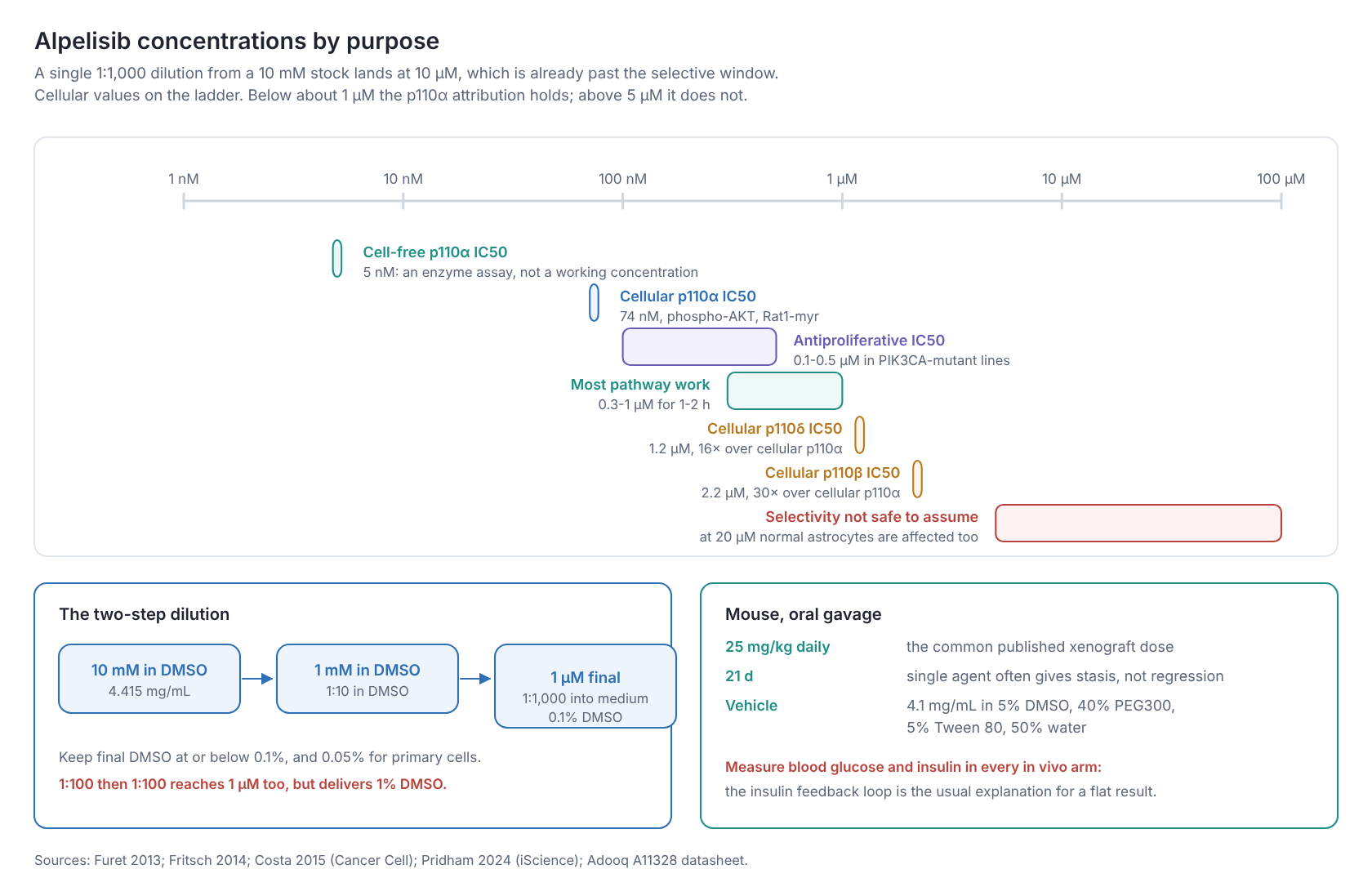
The standard xenograft design uses 25 mg/kg daily by oral gavage. In BT474 xenografts in estrogen-supplemented female athymic nude mice, that schedule for 21 d gave variable responses around tumor stasis as a single agent, while adding the p110β-selective inhibitor KIN-193 produced more consistent regression than either agent alone [15]. Two design points come out of that study. Single-agent alpelisib at a tolerated dose often produces stasis rather than regression, so power your study for that rather than for a dramatic effect. And the vehicle in that work was 0.5% carboxymethyl cellulose; the Adooq datasheet gives an alternative in vivo preparation at 4.1 mg/mL in 5% DMSO, 40% PEG300, 5% Tween 80 and 50% water, which is the more practical choice when the dose volume is small.
As noted in §4, add glucose and insulin measurements to any in vivo arm.
6.4 PIK3CA-driven overgrowth and vascular malformation models
This is the second, less obvious research literature on the compound, and it is covered in §13. The relevant point for experimental design is that a genetic mouse model of PIK3CA-related lymphatic malformation recapitulates the human disease and responds to alpelisib, with prevention of malformation occurrence, improvement of established anomalies and extended survival [16]. If your interest is vascular or lymphatic biology rather than cancer, that model is the published entry point.
6.5 Selectivity controls, and a caution about high concentrations
Two controls make a PI3Kα result defensible.
- An isoform control. Run a p110β-selective compound such as TGX-221, AZD8186 or GSK2636771 alongside alpelisib. If the phenotype appears with both, isoform attribution is not established.
- A genotype control. A PIK3CA wild-type line treated in parallel is the cleanest evidence that the effect is pathway-dependent.
The caution concerns concentration. In glioblastoma work, 20 µM alpelisib for 4 d reduced viability in SF295 and LN229 cells and also in normal astrocytes, and combinations with temozolomide scored as antagonistic by excess-over-Bliss in all three models [17]. At 20 µM a compound with a 5 nM target IC50 is 4,000-fold above its target potency; the loss of selectivity between tumor cells and astrocytes is the expected result. If a phenotype only appears above about 5 µM, treat it as off-target until a second, structurally unrelated PI3Kα inhibitor reproduces it.
7. Alpelisib solubility, DMSO stocks and working concentration
7.1 Solubility
| Solvent | Reported solubility |
|---|---|
| DMSO | 77 mg/mL (174.41 mM) |
| Ethanol | 2 mg/mL (4.53 mM) |
| Water | Insoluble |
DMSO is the practical solvent, and the 77 mg/mL figure is generous: a 10 mM stock needs only 4.415 mg/mL, well under 6% of the maximum, so there is no reason to push the concentration. Ethanol at 2 mg/mL is too low to be useful for a stock. The compound is insoluble in water, so a stock must be made in DMSO and diluted into medium, never the other way round.
7.2 Making a stock solution
- Equilibrate the vial to room temperature before opening, so that cold powder does not draw moisture.
- Add anhydrous DMSO to the weighed mass, aiming for 10 mM, which is 4.415 mg/mL for A11328.
- Vortex until completely clear. A faintly hazy stock will precipitate on dilution into medium.
- Aliquot into single-use volumes of 10-50 µL. A month at -20 °C is the stated limit for the solution, and freeze-thaw cycles are the main cause of lost potency.
- Record the catalog number against the aliquot box, because the free base and the hydrochloride have different molecular weights.
Volumes for 10 mM, 5 mM and 1 mM stocks of alpelisib (BYL719) (A11328):
| Vial | 10 mM | 5 mM | 1 mM |
|---|---|---|---|
| 1 mg | 0.2265 mL | 0.4530 mL | 2.265 mL |
| 5 mg | 1.1325 mL | 2.2650 mL | 11.33 mL |
| 10 mg | 2.2650 mL | 4.5300 mL | 22.65 mL |
| 25 mg | 5.6625 mL | 11.325 mL | 56.63 mL |
Those volumes are for the free base at 441.5 g/mol. For alpelisib hydrochloride (A21794, 477.93 g/mol), a 10 mM stock is 4.779 mg/mL.
7.3 Choosing a working concentration
Unlike the single-digit-nanomolar MEK and BRAF inhibitors, alpelisib works in cells at high nanomolar to low micromolar concentrations, so a single 1:1,000 dilution from a 10 mM stock lands you at 10 µM, which is already past the selective window. Use a 1:10,000 overall dilution in two steps, and put the large step in the medium rather than in the DMSO: dilute the 10 mM stock 1:10 in DMSO to give 1 mM, then add that 1:1,000 into medium for a 1 µM final concentration at 0.1% DMSO. Splitting it the other way round (1:100 in DMSO, then 1:100 into medium) reaches the same 1 µM but delivers 1% DMSO, ten times the limit below.
| Application | Concentration | Notes |
|---|---|---|
| Phospho-AKT suppression, PIK3CA-mutant lines | 0.3-1 µM, 1-2 h | 1 µM is the concentration most published pathway work uses |
| Phospho-AKT dose-response | 0.01-10 µM, 1 h | Eight to ten points; include phospho-S6 on the same lysates |
| Proliferation and viability curves | 0.01-10 µM, 72 h or longer | Include a time-zero plate; expect cytostasis, not killing |
| Combination screening | One-quarter to one-half of the single-agent IC50 of each agent | Synergy is invisible when either agent already kills |
| Lipid measurements (PIP3/PIP2) | 1 µM, 1 h and 24 h | The 24 h point captures the rebound described in §6.1 |
| Pathway control in a non-cancer model | 0.5-1 µM | Confirm suppression in your own cells before interpreting a phenotype |
| In vivo, mouse, oral | 25 mg/kg/day | The common published xenograft dose; measure glucose and insulin |
Keep final DMSO at or below 0.1%, and at or below 0.05% for primary cells, neurons and stem cells. Above about 5 µM, isoform selectivity is no longer a safe assumption; above 20 µM the compound is cytotoxic to normal cells as well as tumor cells [17].
8. Storage and handling
| Form | Condition | Keep for |
|---|---|---|
| Powder | -20 °C, desiccated | About 36 months |
| DMSO stock | -20 °C, single-use aliquots | No more than one month |
Handling notes that matter in practice:
- Equilibrate to room temperature before opening the vial; the powder is hygroscopic enough that condensation inside a cold vial is a real source of weighing error.
- Aliquot the stock on the day you make it. Repeated freeze-thaw is the commonest cause of a stock that no longer gives the expected IC50.
- The datasheet, safety data sheet and handling instructions are all on the product page. A safety data sheet is specific to the supplier and the material, so use the one for the catalog number you hold; the free base and the hydrochloride have separate documents.
- For laboratory research use only.
9. Molecules commonly used alongside alpelisib
| Purpose | Compound | Why |
|---|---|---|
| Pathway partner, endocrine arm | Fulvestrant | PI3K inhibition induces ER-dependent transcription, and fulvestrant markedly sensitizes ER-positive tumors to PI3Kα inhibition [18] |
| Pathway partner, mTOR arm | Everolimus (RAD001), sirolimus | Adding an mTORC1 inhibitor reverses resistance driven by residual mTORC1 activity [14] |
| Pathway partner, CDK4/6 arm | Palbociclib, ribociclib | The combination logic behind the current triplet regimens |
| Downstream node, AKT | Capivasertib (AZD5363), ipatasertib, MK-2206 | Place the phenotype above or below AKT; see the AKT inhibitor range |
| Isoform control | TGX-221, AZD8186, GSK2636771 | p110β-selective; the control that makes isoform attribution defensible |
| Genotype-matched comparator | Inavolisib (GDC-0077), taselisib (GDC-0032) | Both degrade mutant p110α as well as inhibiting it [19] |
| Mutant-selective comparator | Zovegalisib (RLY-2608), tersolisib (STX-478) | Allosteric and mutant-selective; the insulin arm is the difference [9] [10] |
| Metabolic arm | Metformin, dapagliflozin | Used to test whether blunting the insulin feedback improves the response [13] |
| Upstream and parallel pathways | The PI3K/AKT/mTOR range and the mTOR inhibitors; for the parallel MAPK arm, the KRAS inhibitor guide | RAS drives both the MAPK and PI3K arms, so dual blockade is a standard design |
| Apoptosis arm | Navitoclax and the BCL-2 family | Cytostatic pathway inhibition plus a BH3 mimetic is a common way to convert stasis into cell death |
10. Resistance: five mechanisms and what each implies
Resistance to PI3Kα inhibition is unusually well mapped, and all five main routes below were worked out with this compound. Each one suggests a specific experiment.
| Mechanism | Evidence | What it implies |
|---|---|---|
| ***PTEN* loss** | In a patient with a lasting response to BYL719 followed by progression, all metastatic lesions had copy loss of PTEN and the refractory lesions had additional PTEN alterations abolishing expression; acquired bi-allelic PTEN loss recurred in another patient of seven examined [12] | Genotype PTEN at baseline and at progression; PIP3 accumulates regardless of p110α inhibition |
| Residual mTORC1 activity | Sensitivity tracked complete TORC1 pathway inhibition; resistant lines retained mTORC1 signaling while AKT phosphorylation was inhibited, and adding an allosteric mTORC1 inhibitor reversed resistance in vitro and in vivo [14] | Always blot phospho-S6 Ser240/244, not only phospho-AKT |
| PDK1-SGK1 signaling | SGK1, activated by PDK1, maintains residual mTORC1 activity by phosphorylating and inhibiting TSC2; targeting PDK1 or SGK1 restored the antitumor effect of PI3Kα inhibition [20] | An AKT inhibitor is not a complete substitute for a PI3K inhibitor, because this arm is AKT-independent |
| ER-dependent transcription | Suppressing PI3K signaling induced ER-dependent transcriptional activity and raised ESR1 and ER protein, in cell lines, xenografts and tumors from patients receiving BYL719; fulvestrant and tamoxifen suppressed the effect [18] | In ER-positive models, a PI3Kα inhibitor without an endocrine arm is testing the wrong hypothesis |
| p110β-mediated early rebound | The PIP3/PIP2 ratio partially recovered by 24 h in HER2-amplified cells, and combined p110α plus p110β inhibition gave more consistent regression in vivo [15] | Isoform redundancy is a within-hours phenomenon; sample early and late |
The common thread is that PI3Kα inhibition does not simply reduce pathway output; it reorganizes the network. Any design that measures a single node at a single time point will miss the mechanism.
11. Limitations and things that catch people out
- The 5 nM number is not a working concentration. It is a cell-free enzymatic IC50. Cells need roughly 15-fold more for a phospho-AKT readout and more again for an antiproliferative effect.
- "PI3Kα-selective" means isoform-selective, not mutant-selective. Wild-type p110α in every cell is inhibited at the same concentration.
- Compare cellular potency with cellular potency, not with cell-free IC50 values. The cell-free IC50 values for p110δ and p110γ (250-290 nM) look alarmingly close to a 1 µM working concentration, but they are the wrong comparator: in the same Rat1-myr cellular panel the values are p110α 74 nM, p110δ 1.2 µM and p110β 2.2 µM [1]. On cellular numbers, below about 1 µM the selectivity argument holds; between 1 and 5 µM the other isoforms begin to contribute; above 5 µM it does not hold at all.
- Effects are mostly cytostatic. Short viability assays understate potency, and apoptosis experiments usually need a second agent.
- Rebound within 24 h is normal. A 1 h phospho-AKT blot overstates the durability of suppression.
- In vivo results depend on a metabolic variable you may not be measuring. Without glucose and insulin data, an in vivo result is hard to interpret.
- **The PIK3CA genotype is not binary.** Hotspot identity, double mutations in cis, amplification and PTEN status all shift sensitivity.
- The carboxylic acid metabolite is not a tool compound. It is a reference standard for metabolism work.
12. Alpelisib in PIK3CA-mutated breast cancer: the clinical record
This section summarizes trial designs and reported outcomes. It is not clinical guidance, and doses and administration are deliberately left out.
First-in-human (NCT01219699). 134 patients with PIK3CA-altered advanced solid tumors. Dose-limiting toxicities were hyperglycemia, nausea, and hyperglycemia with hypophosphatemia; the overall response rate was 6.0%, with one complete response in endometrial cancer and seven partial responses across cervical, breast, endometrial, colon and rectal cancers, and stable disease in 52.2% [8]. That modest single-agent response rate is the reason every later trial used a combination.
SOLAR-1 (NCT02437318). Randomized phase 3 of alpelisib plus fulvestrant against placebo plus fulvestrant in HR-positive, HER2-negative advanced breast cancer after endocrine therapy, with two cohorts enrolled by tumor PIK3CA status. Of 572 patients randomized, 341 had confirmed PIK3CA mutations. In the mutated cohort, median progression-free survival was 11.0 months (95% CI 7.5-14.5) with alpelisib against 5.7 months (95% CI 3.7-7.4) with placebo, hazard ratio 0.65 (95% CI 0.50-0.85). In the cohort without PIK3CA mutations the hazard ratio was 0.85 [21]. That contrast between cohorts is the clearest existing demonstration that the compound's benefit is genotype-dependent.
SOLAR-1 overall survival. Median overall survival in the mutated cohort was 39.3 months (95% CI 34.1-44.9) against 31.4 months (95% CI 26.8-41.3), hazard ratio 0.86 (95% CI 0.64-1.15, P = 0.15), which did not cross the prespecified efficacy boundary. In patients with lung or liver metastases the medians were 37.2 and 22.8 months, hazard ratio 0.68 (0.46-1.00), and median time to chemotherapy was 23.3 against 14.8 months, hazard ratio 0.72 (0.54-0.95) [7]. The honest summary is a clear progression-free survival benefit and an overall survival signal that did not reach statistical significance.
FDA approval. Regular approval was granted on May 24, 2019 for alpelisib with fulvestrant in HR-positive, HER2-negative, PIK3CA-mutated advanced or metastatic breast cancer detected by an approved test, after progression on an endocrine-based regimen, on the basis of SOLAR-1 [22]. The brand name in this indication is Piqray.
BYLieve (NCT03056755). Phase 2, open-label, non-comparative, in patients who had progressed on a CDK4/6 inhibitor. In cohort A, 61 of 121 patients with centrally confirmed PIK3CA mutation (50.4%, 95% CI 41.2-59.6) were alive without disease progression at 6 months; grade 3 or worse hyperglycemia occurred in 28% [23]. BYLieve is the study that extended the evidence into the post-CDK4/6 setting, where most patients now are.
Where the field has moved since. Three events changed the competitive position of alpelisib after SOLAR-1, and all three postdate most of the review literature:
| When | What | Relevance to alpelisib |
|---|---|---|
| October 2024 | Inavolisib approved in the US with palbociclib and fulvestrant for PIK3CA-mutated, endocrine-resistant HR-positive, HER2-negative advanced breast cancer, on INAVO120: median progression-free survival 15.0 against 7.3 months, hazard ratio 0.43 [24]; final median overall survival 34.0 against 27.0 months, hazard ratio 0.67 [25] | The first PI3Kα-directed agent in this setting with a significant overall survival benefit |
| July 2025 | The same regimen approved in the EU | — |
| July 14, 2026 | Gedatolisib (a pan-PI3K/mTOR inhibitor) approved in the US with fulvestrant, with or without palbociclib, for PIK3CA wild-type HR-positive, HER2-negative advanced breast cancer, on VIKTORIA-1 | Occupies the wild-type population that alpelisib was never indicated for |
Two further developments are worth tracking because they bear directly on whether alpelisib remains the comparator of record. INAVO121 is a randomized phase 3 of inavolisib plus fulvestrant against alpelisib plus fulvestrant, the only head-to-head trial of its kind; recruitment completed in late 2024 and results had not been reported as of November 2026. And in the PIK3CA-mutated cohort of VIKTORIA-1, gedatolisib with fulvestrant and palbociclib reported median progression-free survival of 11.1 months against 5.6 months for alpelisib with fulvestrant, adjusted hazard ratio 0.50; that application is under review with a target action date in June 2027. Both are generated against alpelisib as the control arm, which is itself a statement about its position in the field.
13. Alpelisib and Vijoice in PIK3CA-related overgrowth spectrum
The second indication has little to do with cancer, and it is the part of the alpelisib story most reviews skip.
PIK3CA-related overgrowth spectrum (PROS) is a group of rare disorders caused by somatic, mosaic gain-of-function PIK3CA mutations arising during development. The mutation is present in some tissues and not others, and the affected tissues overgrow. CLOVES syndrome (congenital lipomatous overgrowth, vascular malformations, epidermal nevi, scoliosis and skeletal and spinal anomalies) sits in this spectrum, as do isolated lymphatic malformations, megalencephaly-capillary malformation and several other named conditions. The underlying genetics are the same as in PIK3CA-mutant cancer; the biology differs because the mutation is developmental and mosaic rather than clonal and acquired.
Mosaicism is the practical problem in modeling the disease. The variant allele fraction in affected tissue is often low and varies between biopsies from the same patient, so a bulk-sequenced sample can read as near wild type while the overgrown tissue is driven by a minority mutant population. For experimental work that means droplet digital PCR or deep targeted sequencing rather than standard panel depth, affected tissue rather than blood, and in mouse work an inducible mosaic model rather than a germline one, because a uniformly mutant animal is not the disease.
The research path from gene to drug is unusually short and well documented:
- A mouse model and a drug repurposing. A postnatal mouse model of PROS/CLOVES partly recapitulated the human disease, and BYL719 prevented and improved organ dysfunction; on that basis 19 patients with PROS were treated, with reduction of previously intractable vascular tumors, improvement of congestive heart failure, reduced hemihypertrophy and attenuated scoliosis [26].
- A lymphatic malformation model. A genetic mouse model of PIK3CA-related lymphatic malformation responded to alpelisib with prevention, improvement and extended survival; six patients with severe malformations, previously unsuccessfully treated by other means, showed improvement, with a 48% decrease in the median volume of lymphatic malformations by MRI over 6 months [16].
- Infants. Two infants with life-threatening PROS manifestations were treated with low-dose alpelisib under pharmacokinetic monitoring, with improvement in signs, symptoms and morphological lesions over 12 months of follow-up [27].
- EPIK-P1 (NCT04285723). A non-interventional, retrospective chart review of 57 patients aged 2 years and older treated through compassionate use. At week 24, 12 of 32 patients with complete case records (37.5%) met the response definition [28].
Regulatory status. In April 2022 the FDA granted accelerated approval to alpelisib, as Vijoice, for adult and pediatric patients 2 years and older with severe manifestations of PROS who require systemic therapy. In the EU, the CHMP adopted a positive opinion on May 21, 2026 and a conditional marketing authorization was issued on July 15, 2026 for the same population, with the company required to submit final results of an ongoing study; the efficacy basis cited in the European assessment is the retrospective review of 57 compassionate-use patients, with the 37.5% response figure at 24 weeks.
For a research audience the interesting feature of this indication is the evidence standard. It rests on a mouse model plus retrospective and small prospective human series, not on a randomized trial, which is a realistic picture of how rare-disease drug repurposing actually works, and a reason the European authorization is conditional rather than full.
14. Similar products: the PI3K inhibitor landscape
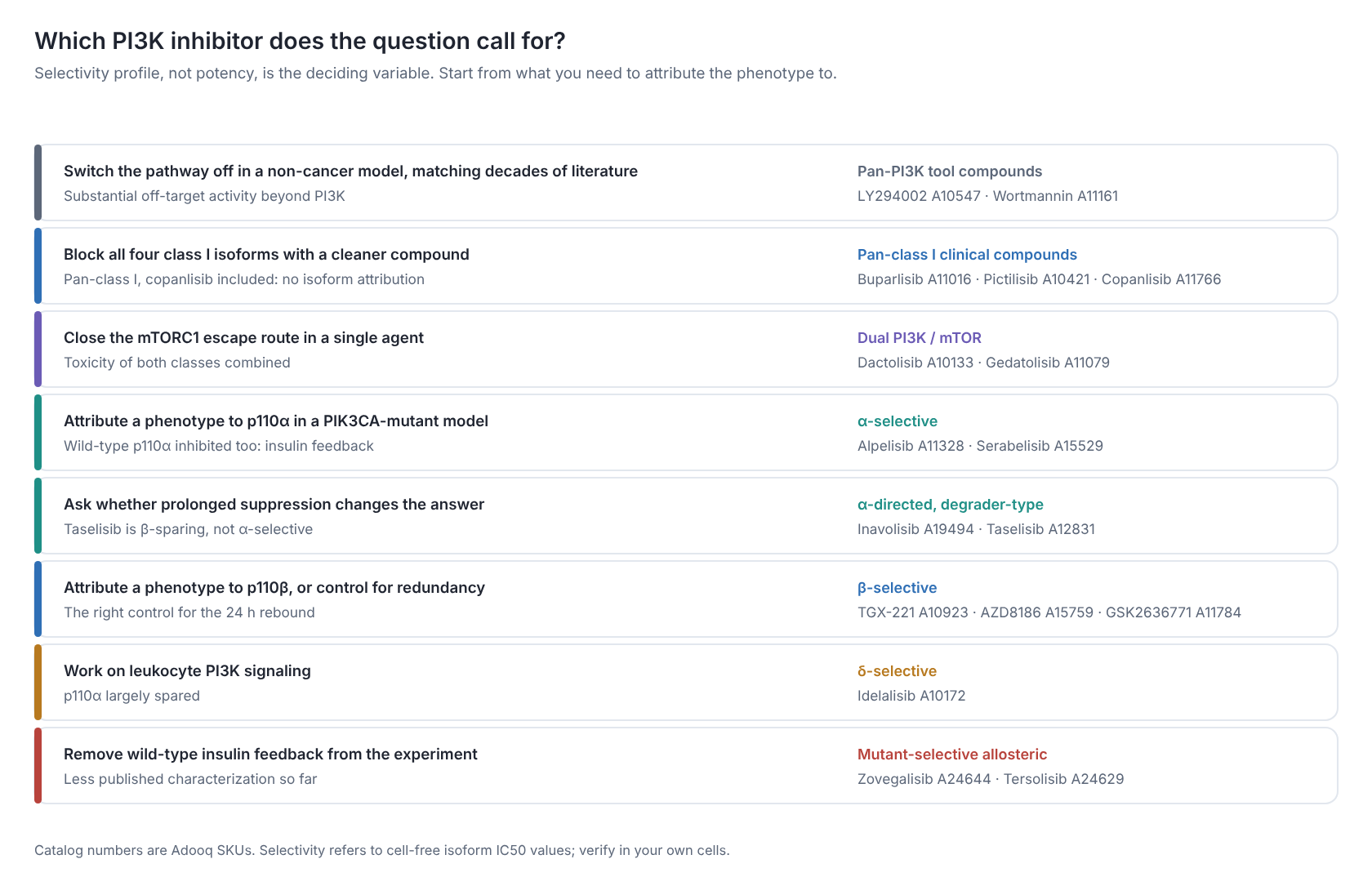
PI3K inhibitors fall into six classes, and the useful question is not which is most potent but which selectivity profile matches your experiment.
| Class | Compounds | Selectivity | Use it when |
|---|---|---|---|
| Pan-PI3K tool compounds | LY294002, wortmannin | All class I isoforms, plus substantial off-target activity | You want the pathway off in a non-cancer model and comparability with decades of literature matters more than selectivity |
| Pan-class I clinical compounds | Buparlisib (BKM120), pictilisib (GDC-0941), copanlisib (BAY 80-6946) | All four class I isoforms, little off-target; copanlisib is a pan-class I inhibitor with α and δ predominance rather than a δ-selective one | You want complete class I blockade with a cleaner compound |
| Dual PI3K/mTOR | Dactolisib (BEZ235), gedatolisib (PKI-587) | Class I PI3K plus mTOR | You want to close the mTORC1 escape route described in §10 in a single agent |
| Isoform-selective | Alpelisib (BYL719), serabelisib (MLN1117), inavolisib (GDC-0077) for α; TGX-221, AZD8186, GSK2636771 for β; idelalisib (CAL-101) for δ | One isoform over the others; mutant and wild-type equally | You need to attribute a phenotype to a single isoform |
| β-sparing | Taselisib (GDC-0032) | Inhibits p110α, p110δ and p110γ while sparing p110β [29] | You want α blockade with the β escape route left open, as a counterpart to a β-selective control |
| Mutant-selective allosteric | Zovegalisib (RLY-2608), tersolisib (STX-478) | Mutant p110α over wild-type p110α | The wild-type-driven insulin feedback is a confound in your experiment |
Three specific comparisons come up repeatedly. The four compounds most often weighed against each other sit at different points in the pathway and differ in what they do to the wild-type enzyme:
| Alpelisib (BYL719) | Inavolisib (GDC-0077) | Capivasertib (AZD5363) | Zovegalisib (RLY-2608) | |
|---|---|---|---|---|
| Target | p110α | p110α | AKT1, AKT2, AKT3 | p110α |
| Site | ATP pocket | ATP pocket | ATP-competitive, downstream node | Allosteric |
| Wild-type p110α | Inhibited equally | Inhibited; mutant protein also degraded | Not a PI3K inhibitor | Largely spared |
| Extra mechanism | None | HER2-dependent degradation of mutant p110α [19] | Blocks the AKT node but not the AKT-independent SGK1 arm [20] | Mutant selectivity decouples efficacy from hyperinsulinemia [9] [10] |
| Use it when | You want comparability with the existing literature | Durability of pathway suppression is the question | You want to localize a phenotype above or below AKT | Systemic insulin feedback is the confound |
14.1 Alpelisib compared with inavolisib and taselisib
All three are PI3Kα-directed, although taselisib is β-sparing rather than strictly α-selective [29]. Inavolisib and taselisib do something alpelisib does not: they trigger HER2-dependent degradation of mutant p110α as well as inhibiting it, which gives more prolonged pathway suppression than other PI3K inhibitors achieve [19]. If your experiment is about the durability of pathway suppression, that difference is the point, and the two compounds are not interchangeable.
14.2 Alpelisib compared with capivasertib
This is a question about pathway position, not potency. Alpelisib inhibits PI3Kα, the enzyme that makes PIP3. Capivasertib inhibits AKT1, AKT2 and AKT3, one node downstream. The practical difference is the AKT-independent arm: SGK1, activated by PDK1, sustains mTORC1 signaling without passing through AKT [20], so an AKT inhibitor and a PI3K inhibitor do not produce the same pathway state. Capivasertib is also active where the lesion is PTEN loss or an AKT1 alteration rather than a PIK3CA mutation, and it was approved in the US in November 2023 on CAPItello-291 [30]. Run both if you want to localize a phenotype above or below AKT.
14.3 Alpelisib compared with the mutant-selective compounds
This is the comparison that matters most for the next few years. Alpelisib inhibits wild-type and mutant p110α equally; RLY-2608 and STX-478 bind allosterically and spare the wild-type enzyme, which decouples antitumor activity from the metabolic dysfunction that wild-type inhibition causes [9] [10]. RLY-2608 received US breakthrough therapy designation in February 2026 for PIK3CA-mutant HR-positive, HER2-negative advanced breast cancer after a CDK4/6 inhibitor, and is in phase 3. For any experiment where systemic insulin feedback is the variable, the mutant-selective compound is the better tool; for comparability with the existing literature, alpelisib still is.
15. Troubleshooting
| Symptom | Likely cause | What to do |
|---|---|---|
| No change in phospho-AKT at 1 µM | Wrong genotype, PTEN loss, or the line does not depend on p110α | Genotype PIK3CA and PTEN; include a known-sensitive line such as T47D as a positive control |
| Phospho-AKT falls but phospho-S6 does not | Residual mTORC1 activity, the canonical resistance state | This is a result, not a failure; add an mTORC1 inhibitor arm [14] |
| Suppression at 1 h, recovery at 24 h | Isoform redundancy and feedback relief | Expected; add a p110β-selective arm or sample both times deliberately [15] |
| Precipitate on adding stock to medium | Single-step dilution from a 10 mM stock, or a hazy stock | Dilute in two steps through DMSO; remake the stock if it is not completely clear |
| IC50 far above published values | Short assay duration | Run 72 h or longer with a time-zero plate; a 24 h readout can be two orders of magnitude off |
| Effect appears only above 10 µM | Off-target activity | Reproduce with a structurally unrelated PI3Kα inhibitor; at 20 µM normal cells are also affected [17] |
| Disappointing in vivo result | Insulin feedback reactivating the pathway | Measure glucose and insulin; consider a metabolic co-treatment arm [13] |
| Concentration calculation disagrees with a colleague's | Free base against hydrochloride | 441.5 for A11328, 477.93 for A21794 |
16. Frequently asked questions
How does alpelisib work?
It occupies the ATP-binding site of p110α, the catalytic subunit of class IA PI3K encoded by PIK3CA, and so blocks the conversion of PIP2 to PIP3. Without PIP3 the pathway does not recruit AKT and PDK1 to the membrane, and signaling to mTORC1 and FOXO falls. Its cell-free IC50 against p110α is 5 nM, with 50- to 240-fold weaker activity against the other three class I isoforms.
Is alpelisib the same as BYL719?
Yes. BYL719, NVP-BYL719 and BYL-719 are development codes for the molecule now called alpelisib. Piqray and Vijoice are its two brand names, in breast cancer and in PIK3CA-related overgrowth spectrum respectively.
Is alpelisib chemotherapy?
No. It is a small-molecule kinase inhibitor directed at a specific enzyme whose gene is mutated in the tumor, which is a different pharmacology from cytotoxic chemotherapy. In cell culture its effect is largely cytostatic rather than cytotoxic, which is why short viability assays understate it.
Why does alpelisib cause hyperglycemia?
Because p110α is the PI3K isoform that carries insulin signaling, and alpelisib inhibits wild-type p110α just as well as the mutant form. Blunting insulin signaling in muscle, liver and fat raises blood glucose, and the compensating rise in insulin can reactivate PI3K signaling in the tumor [13]. It is an on-target consequence of the target's normal job, which is why mutant-selective allosteric inhibitors were developed to avoid it [9].
What concentration of alpelisib should I use in cells?
0.3-1 µM for a 1-2 h phospho-AKT readout in a PIK3CA-mutant line, and 0.01-10 µM for a dose-response. Stay below about 5 µM if you need the isoform selectivity argument to hold. Dilute from the 10 mM DMSO stock in two steps, 1:10 in DMSO then 1:1,000 into medium; a single 1:1,000 dilution lands at 10 µM, and a 1:100 plus 1:100 split delivers 1% DMSO.
How do I dissolve alpelisib?
In DMSO, where the reported solubility is 77 mg/mL. A 10 mM stock is 4.415 mg/mL for the free base A11328. It is insoluble in water and only 2 mg/mL in ethanol, so DMSO is the only practical choice for a stock.
Does alpelisib only work in PIK3CA-mutant cells?
Not exclusively, but genotype is the strongest predictor of sensitivity, and the clinical contrast is stark: a hazard ratio of 0.65 in the PIK3CA-mutated cohort of SOLAR-1 against 0.85 in the cohort without mutations [21]. PIK3CA amplification also predicts sensitivity, double mutations in cis predict greater sensitivity, and PTEN alterations predict resistance.
Is alpelisib selective for mutant PI3Kα?
No, and this is the most common misreading of the term "PI3Kα-selective". It is selective for the p110α isoform over p110β, p110δ and p110γ. Mutant and wild-type p110α are inhibited at the same concentration. The mutant-selective compounds are a separate, newer class [9].
What is the difference between alpelisib and inavolisib?
Both target PI3Kα, but inavolisib additionally drives HER2-dependent degradation of the mutant p110α protein, giving longer pathway suppression [19]. Clinically, inavolisib with palbociclib and fulvestrant showed a significant overall survival benefit in INAVO120 [25], which alpelisib did not reach in SOLAR-1 [7]. A head-to-head phase 3 comparing the two with fulvestrant has completed recruitment but has not reported.
Can I use alpelisib hydrochloride instead of the free base?
For most purposes yes, provided you calculate with 477.93 g/mol rather than 441.5. Published work overwhelmingly uses the free base, so the free base is the better choice when you want to match a protocol exactly.
References
- Furet P, Guagnano V, Fairhurst RA, et al. Discovery of NVP-BYL719 a potent and selective phosphatidylinositol-3 kinase alpha inhibitor selected for clinical evaluation. Bioorganic & Medicinal Chemistry Letters 2013. PMID 23726034
- Fruman DA, Chiu H, Hopkins BD, et al. The PI3K Pathway in Human Disease. Cell 2017. PMID 28802037
- Vanhaesebroeck B, Guillermet-Guibert J, Graupera M, Bilanges B. The emerging mechanisms of isoform-specific PI3K signalling. Nature Reviews Molecular Cell Biology 2010. PMID 20379207
- Fritsch C, Huang A, Chatenay-Rivauday C, et al. Characterization of the novel and specific PI3Kα inhibitor NVP-BYL719 and development of the patient stratification strategy for clinical trials. Molecular Cancer Therapeutics 2014. PMID 24608574
- Liu X, Yang S, Hart JR, et al. Cryo-EM structures of PI3Kα reveal conformational changes during inhibition and activation. Proceedings of the National Academy of Sciences of the United States of America 2021. PMID 34725156
- Samuels Y, Wang Z, Bardelli A, et al. High Frequency of Mutations of the PIK3CA Gene in Human Cancers. Science 2004. PMID 15016963
- André F, Ciruelos EM, Juric D, et al. Alpelisib plus fulvestrant for PIK3CA-mutated, hormone receptor-positive, human epidermal growth factor receptor-2-negative advanced breast cancer: final overall survival results from SOLAR-1. Annals of Oncology 2021. PMID 33246021
- Juric D, Rodon J, Tabernero J, et al. Phosphatidylinositol 3-Kinase α-Selective Inhibition With Alpelisib (BYL719) in PIK3CA-Altered Solid Tumors: Results From the First-in-Human Study. Journal of Clinical Oncology 2018. PMID 29401002
- Varkaris A, Pazolli E, Gunaydin H, et al. Discovery and Clinical Proof-of-Concept of RLY-2608, a First-in-Class Mutant-Selective Allosteric PI3Kα Inhibitor That Decouples Antitumor Activity from Hyperinsulinemia. Cancer Discovery 2024. PMID 37916956
- Buckbinder L, St Jean DJ Jr, Tieu T, et al. STX-478, a Mutant-Selective, Allosteric PI3Kα Inhibitor Spares Metabolic Dysfunction and Improves Therapeutic Response in PI3Kα-Mutant Xenografts. Cancer Discovery 2023. PMID 37623743
- Vasan N, Razavi P, Johnson JL, et al. Double PIK3CA mutations in cis increase oncogenicity and sensitivity to PI3Kα inhibitors. Science 2019. PMID 31699932
- Juric D, Castel P, Griffith M, et al. Convergent loss of PTEN leads to clinical resistance to a PI(3)Kα inhibitor. Nature 2015. PMID 25409150
- Hopkins BD, Pauli C, Du X, et al. Suppression of insulin feedback enhances the efficacy of PI3K inhibitors. Nature 2018. PMID 30051890
- Elkabets M, Vora S, Juric D, et al. mTORC1 inhibition is required for sensitivity to PI3K p110α inhibitors in PIK3CA-mutant breast cancer. Science Translational Medicine 2013. PMID 23903756
- Costa C, Ebi H, Martini M, et al. Measurement of PIP3 Levels Reveals an Unexpected Role for p110β in Early Adaptive Responses to p110α-Specific Inhibitors in Luminal Breast Cancer. Cancer Cell 2015. PMID 25544637
- Delestre F, Venot Q, Bayard C, et al. Alpelisib administration reduced lymphatic malformations in a mouse model and in patients. Science Translational Medicine 2021. PMID 34613809
- Pridham KJ, Hutchings KR, Beck P, et al. Selective regulation of chemosensitivity in glioblastoma by phosphatidylinositol 3-kinase beta. iScience 2024. PMID 38812542
- Bosch A, Li Z, Bergamaschi A, et al. PI3K inhibition results in enhanced estrogen receptor function and dependence in hormone receptor-positive breast cancer. Science Translational Medicine 2015. PMID 25877889
- Song KW, Edgar KA, Hanan EJ, et al. RTK-Dependent Inducible Degradation of Mutant PI3Kα Drives GDC-0077 (Inavolisib) Efficacy. Cancer Discovery 2022. PMID 34544753
- Castel P, Ellis H, Bago R, et al. PDK1-SGK1 Signaling Sustains AKT-Independent mTORC1 Activation and Confers Resistance to PI3Kα Inhibition. Cancer Cell 2016. PMID 27451907
- André F, Ciruelos E, Rubovszky G, et al. Alpelisib for PIK3CA-Mutated, Hormone Receptor-Positive Advanced Breast Cancer. The New England Journal of Medicine 2019. PMID 31091374
- Narayan P, Prowell TM, Gao JJ, et al. FDA Approval Summary: Alpelisib Plus Fulvestrant for Patients with HR-positive, HER2-negative, PIK3CA-mutated, Advanced or Metastatic Breast Cancer. Clinical Cancer Research 2021. PMID 33168657
- Rugo HS, Lerebours F, Ciruelos E, et al. Alpelisib plus fulvestrant in PIK3CA-mutated, hormone receptor-positive advanced breast cancer after a CDK4/6 inhibitor (BYLieve): one cohort of a phase 2, multicentre, open-label, non-comparative study. The Lancet Oncology 2021. PMID 33794206
- Turner NC, Im SA, Saura C, et al. Inavolisib-Based Therapy in PIK3CA-Mutated Advanced Breast Cancer. The New England Journal of Medicine 2024. PMID 39476340
- Jhaveri KL, Im SA, Saura C, et al. Overall Survival with Inavolisib in PIK3CA-Mutated Advanced Breast Cancer. The New England Journal of Medicine 2025. PMID 40454641
- Venot Q, Blanc T, Rabia SH, et al. Targeted therapy in patients with PIK3CA-related overgrowth syndrome. Nature 2018. PMID 29899452
- Morin G, Degrugillier-Chopinet C, Vincent M, et al. Treatment of two infants with PIK3CA-related overgrowth spectrum by alpelisib. The Journal of Experimental Medicine 2022. PMID 35080595
- Canaud G, Lopez Gutierrez JC, Irvine AD, et al. Alpelisib for treatment of patients with PIK3CA-related overgrowth spectrum (PROS). Genetics in Medicine 2023. PMID 37634128
- Ndubaku CO, Heffron TP, Staben ST, et al. Discovery of 2-{3-[2-(1-isopropyl-3-methyl-1H-1,2-4-triazol-5-yl)-5,6-dihydrobenzo[f]imidazo[1,2-d][1,4]oxazepin-9-yl]-1H-pyrazol-1-yl}-2-methylpropanamide (GDC-0032): a β-sparing phosphoinositide 3-kinase inhibitor with high unbound exposure and robust in vivo antitumor activity. Journal of Medicinal Chemistry 2013. PMID 23662903
- Turner NC, Oliveira M, Howell SJ, et al. Capivasertib in Hormone Receptor-Positive Advanced Breast Cancer. The New England Journal of Medicine 2023. PMID 37256976