
LY294002: PI3K Inhibitor Mechanism, IC50, Off-Targets and Working Concentration
How LY294002 blocks the PI3K p110 ATP site, what its IC50 values really are, which off-targets matter at the concentrations labs use, and how to dissolve, store and control it.
Technical guide from Adooq Bioscience · Product: LY294002, Cat. No. A10547 · Last reviewed: 2026-11
LY294002 at a glance
| Property | Value |
|---|---|
| Common name | LY294002; chemically 2-(4-morpholinyl)-8-phenyl-4H-1-benzopyran-4-one; also written LY-294002 or LY 294002 |
| CAS | 154447-36-6 |
| Molecular formula | C19H17NO3 |
| Molecular weight | 307.3 g/mol |
| Class | Reversible, ATP-competitive inhibitor of all class I PI3K isoforms |
| Also inhibits | Casein kinase 2, BET bromodomains, DNA-PK and mTOR, at concentrations inside the range labs normally use |
| First report | Vlahos and colleagues, 1994: IC50 1.40 µM (0.43 µg/mL) against PI 3-kinase, with no inhibition of PI 4-kinase or the other protein and lipid kinases tested [1] |
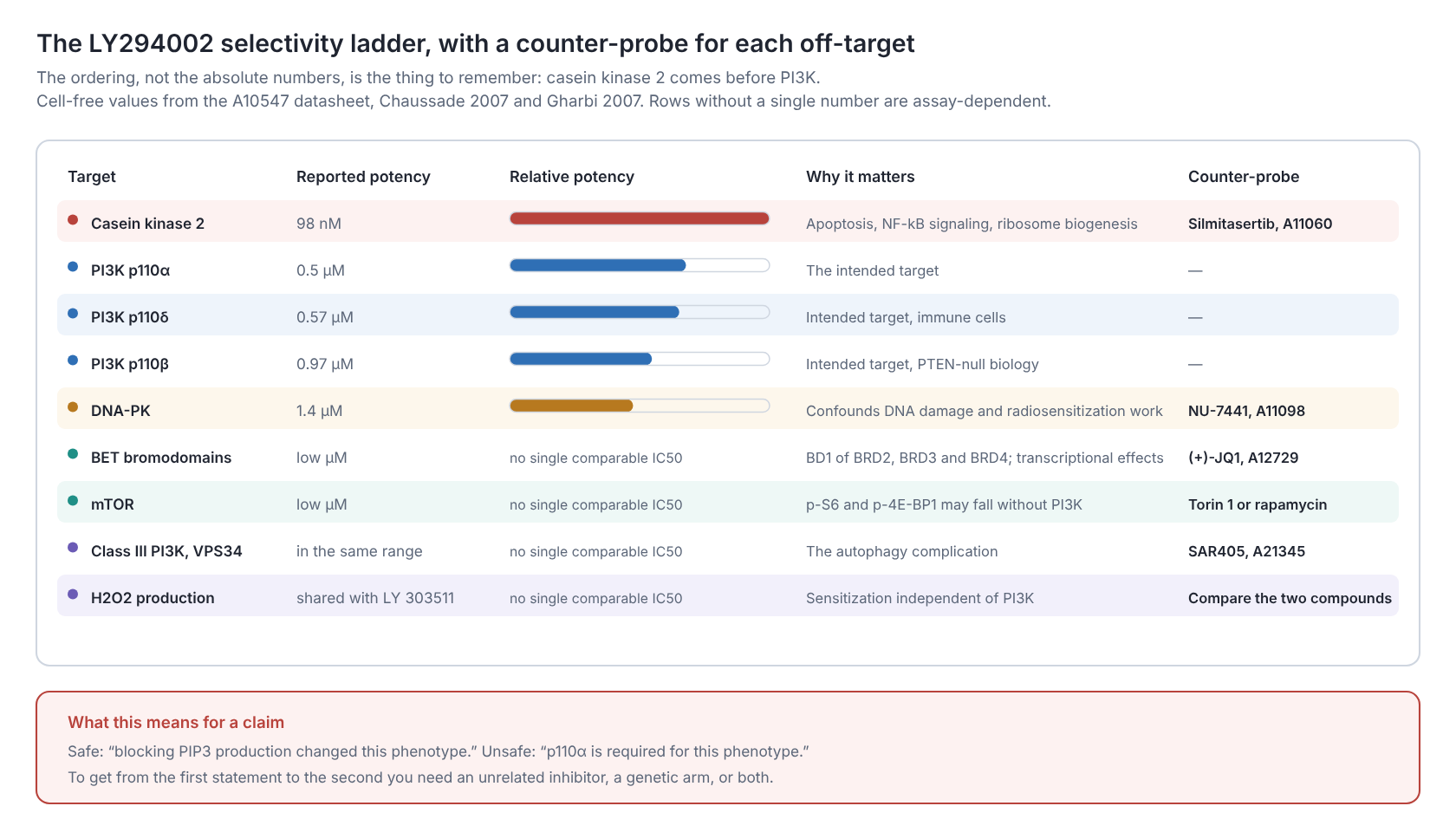
| Cell-free IC50 values on the A10547 datasheet | p110α 0.5 µM, p110δ 0.57 µM, p110β 0.97 µM, DNA-PK 1.4 µM, human CK2 98 nM |
| Cellular potency | Pathway effects usually need 10-50 µM; published antiproliferative IC50 values span roughly 5 to 90 µM depending on cell line and assay length |
| Solubility | DMSO 31 mg/mL (100.86 mM); ethanol 18 mg/mL (58.56 mM); insoluble in water |
| Salt form | LY294002 hydrochloride, CAS 934389-88-5, C19H18ClNO3, 343.8 g/mol. Same active molecule, different molecular weight on the balance |
| Inactive analog | LY 303511 (also written LY303511), Cat. No. A15147: no PI3K activity, and not biologically inert either |
| Storage | Powder at -20 °C, desiccated, stable about 36 months; DMSO stocks at -20 °C, use within one month |
| Clinical status | Never developed as a drug. Its RGDS-peptide prodrug SF1126 reached phase II, and the follow-on trials were terminated |
LY294002 is the compound that made the PI3K pathway tractable. It is cheap, chemically stable, reversible, soluble in DMSO, and it works in every cell type, which is why it appears in tens of thousands of papers. It is also the compound the chemical-probe community now holds up as a cautionary example, because the concentrations that block PI3K signaling in cells also hit casein kinase 2, the BET bromodomains, DNA-PK and mTOR. Both things are true at once, and an experiment designed with that in mind is still a good experiment.
1. What LY294002 is
1.1 One molecule, several spellings
LY294002 came out of a medicinal chemistry program at Eli Lilly that started from quercetin, a promiscuous flavonoid that inhibits PI3K among many other things. Replacing the flavone with a chromen-4-one (benzopyran-4-one) scaffold carrying a morpholine at C2 and a phenyl group at C8 gave a compound that was far more selective than quercetin and far easier to handle than wortmannin [1]. You will see it written LY294002, LY-294002, LY 294002 and occasionally LY294,002; they are all the same molecule, CAS 154447-36-6. Adooq supplies it as LY294002, catalog number A10547, in sizes from 5 mg to 500 mg and as a ready-made 10 mM DMSO solution.
Two things it is not. It is not an AKT inhibitor: it acts one step upstream, and phospho-AKT falls because PIP3 is no longer made, not because AKT is bound. If you need to hit AKT itself, MK-2206 is the allosteric reference compound. And LY294002 is not the same thing as LY294002 hydrochloride. The hydrochloride exists as a separate catalog form, CAS 934389-88-5, C19H18ClNO3, 343.8 g/mol, carrying the same active molecule; Adooq supplies A10547 as the free compound at 307.3 g/mol, so weigh against the molecular weight of the form you actually hold. A third entry that turns up in the same searches is LY 303511 hydrochloride, which is the salt of the PI3K-inactive analog and is a different molecule altogether.
1.2 Structure and physical properties
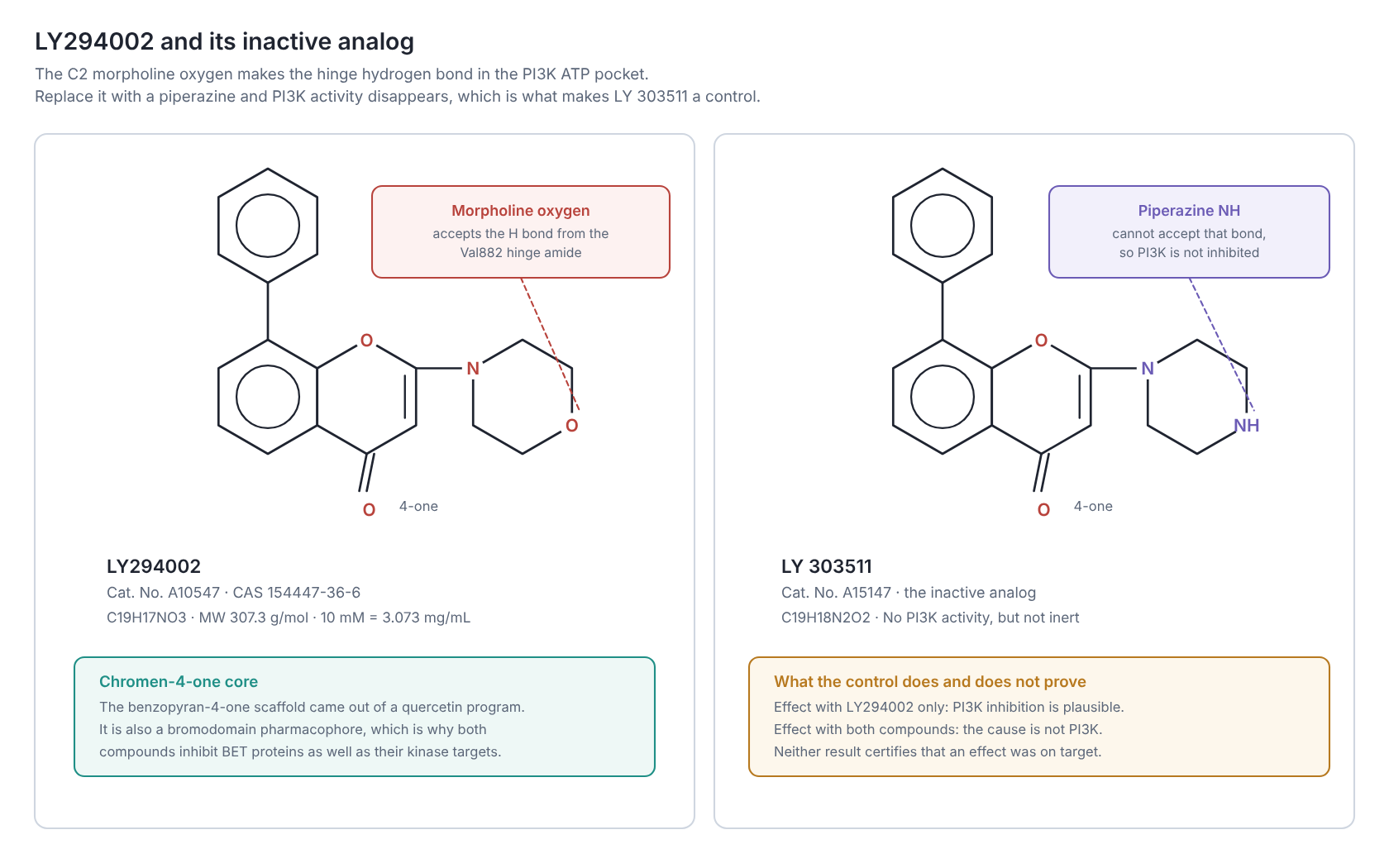
Three features matter at the bench.
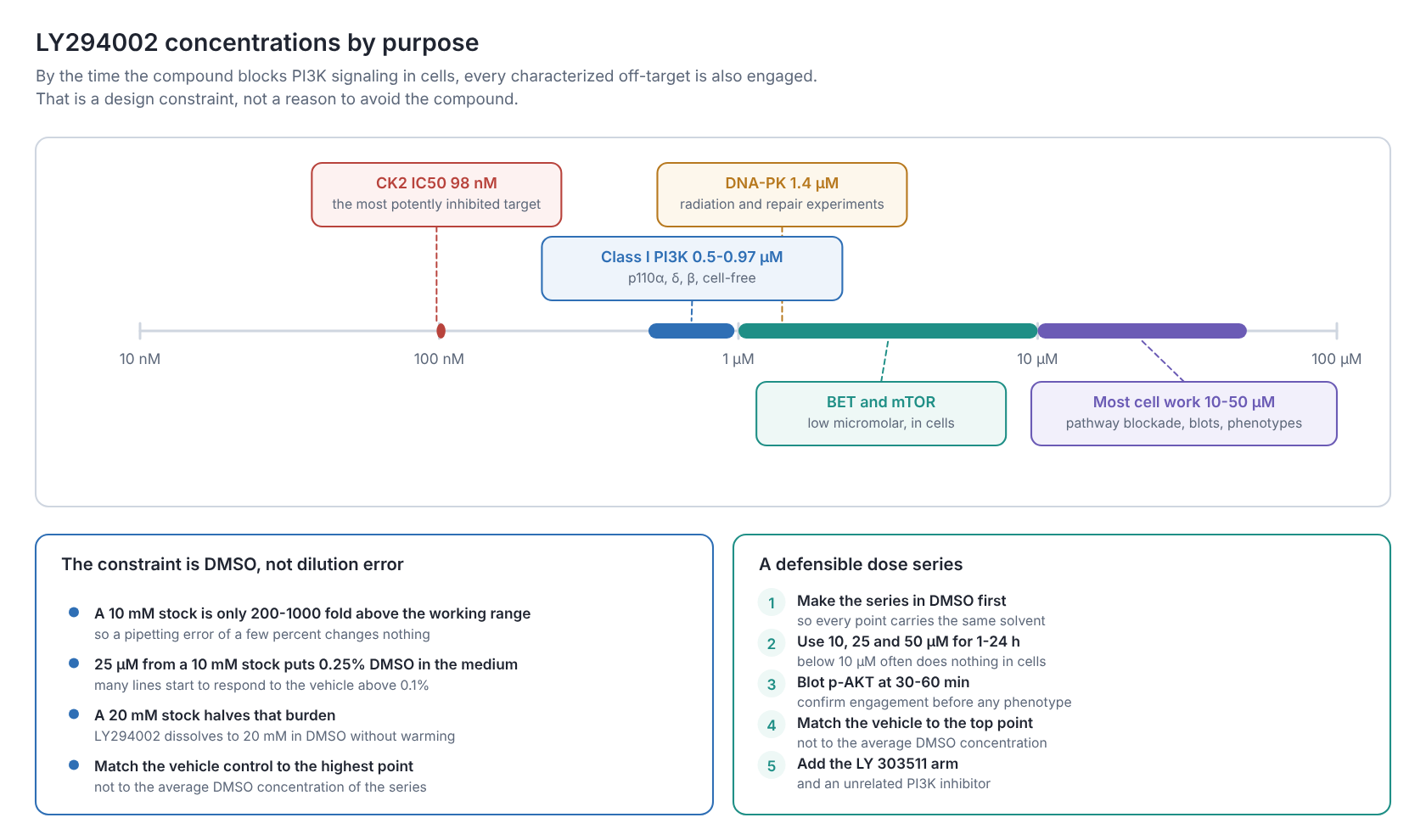
- Molecular weight 307.3 (307.35 if you want the exact figure, which is what the solubility conversions below use) means a 10 mM stock is 3.073 mg/mL, so a 5 mg vial makes 1.63 mL of 10 mM stock. The hydrochloride is 343.8 g/mol, and using 307.3 for it overstates your concentration by 12%. Because working concentrations are in the tens of micromolar, the dilution from stock to medium is only 200- to 1000-fold, which is unusually gentle for a small-molecule inhibitor and is the reason the DMSO burden needs watching rather than the dilution error.
- The C2 morpholine is the business end. Its oxygen accepts a hydrogen bond from the kinase hinge in the ATP pocket. Remove it and activity goes with it, which is exactly what defines the control compound described in the LY 303511 section.
- It is insoluble in water at useful concentrations and only moderately soluble in ethanol, so DMSO is the practical solvent. See solubility and working concentration.
2. LY294002 mechanism of action
2.1 Where it binds
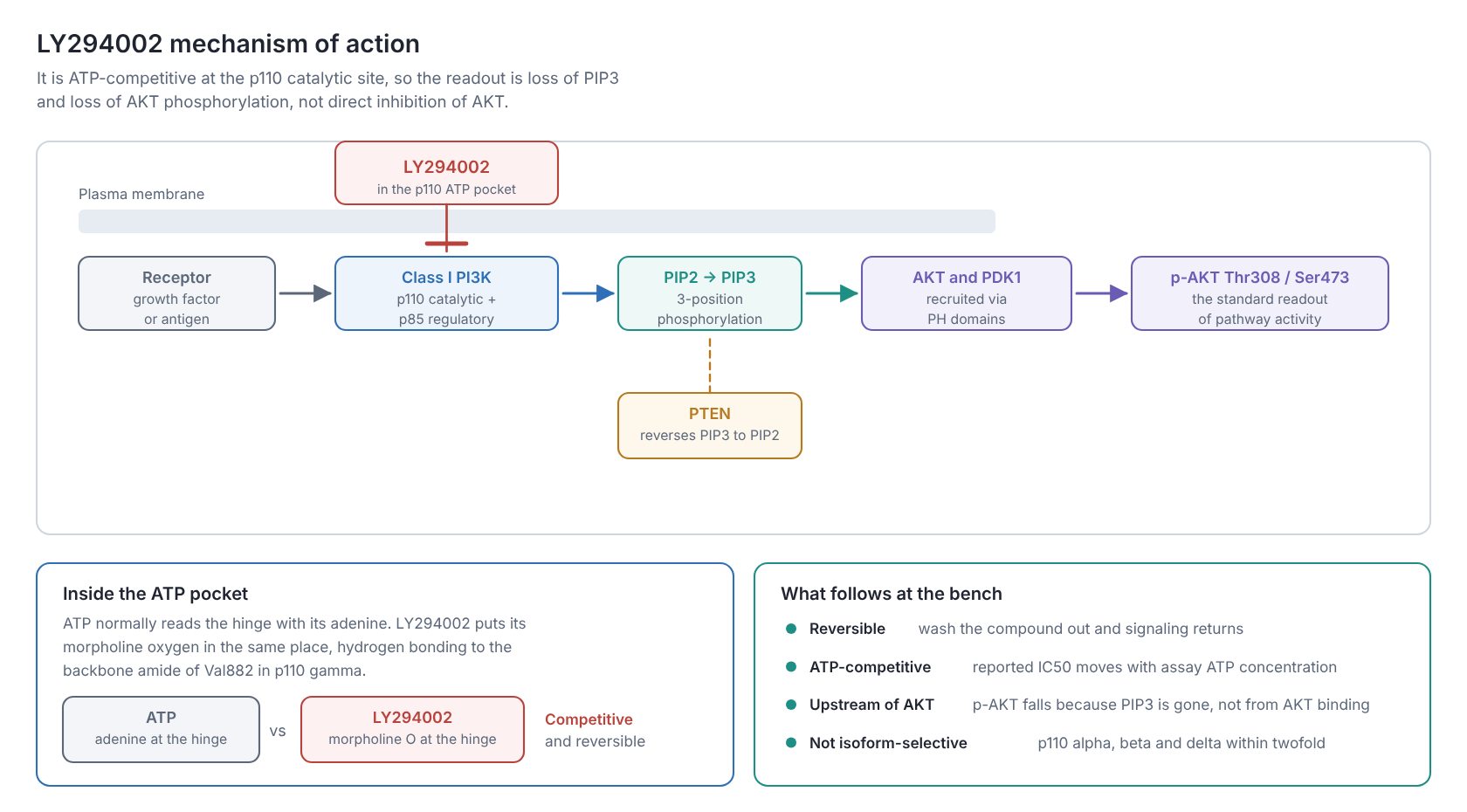
Class I PI3Ks are lipid kinases: a p110 catalytic subunit phosphorylates the 3-position of phosphatidylinositol 4,5-bisphosphate (PIP2) to make phosphatidylinositol 3,4,5-trisphosphate (PIP3). PIP3 recruits PH-domain proteins to the membrane, among them AKT and PDK1, which is how a lipid becomes a signal [2]. The catalytic machinery is a protein-kinase-like fold with a conventional ATP-binding cleft, and that cleft is what LY294002 occupies.
Walker and colleagues settled the question structurally by crystallizing PI3Kγ with LY294002, wortmannin, quercetin, myricetin and staurosporine in the same study [3]. LY294002 sits in the ATP pocket with the morpholine oxygen hydrogen-bonded to the backbone amide of Val882, the hinge residue that normally reads the adenine of ATP. Inhibition is therefore competitive with ATP, and reversible: wash the compound out and activity returns. That single structural fact explains most of the compound's practical behavior, including why reported IC50 values move when assay ATP concentrations move.
2.2 The IC50 question
"What is the IC50 of LY294002?" has no single answer, and the spread is not sloppiness in the literature. It is three real effects stacked on top of each other: which assay format was used, how much ATP was in it, and whether the number describes enzyme inhibition or a cellular phenotype.
| Measurement | Reported value | What it describes |
|---|---|---|
| PI 3-kinase, original report | 1.40 µM (0.43 µg/mL) [1] | Partially purified enzyme, 1994 assay conditions |
| Recombinant p110α | 0.5 µM [4]; mean 0.186 µM in a separate specificity study [5] | Cell-free, low ATP. Two different labs, two different numbers for the same isoform |
| Recombinant p110δ | 0.57 µM [4] | Cell-free |
| Recombinant p110β | 0.97 µM [4] | Cell-free |
| Recombinant p110γ | Low micromolar, weaker than the class IA isoforms | The class IB isoform, rarely quoted but not spared |
| Human CK2 | Mean 0.098 µM, that is 98 nM [5] | A protein kinase, not a lipid kinase |
| DNA-PK | 1.4 µM on the A10547 datasheet | PIKK family. Values for DNA-PK move with assay ATP, so treat this as an order of magnitude |
| Cellular antiproliferation | about 5 to 90 µM across published cell lines and assay lengths | Phenotype, not target engagement |
Two readings follow. First, the isoform values and the CK2 value come from different laboratories, so the fold-differences between them are not measured ratios; only numbers from the same study can be divided. Second, and even within one study, the most potently inhibited target in a cell-free assay is not PI3K at all. Section selectivity and off-targets deals with what that means for interpretation. For now the practical reading is that the enzyme IC50 near 0.5 µM and the cellular working concentration near 10-50 µM are separated by one to two orders of magnitude, and everything interesting happens in that gap.
2.3 It is not isoform-selective, and that is sometimes the point
LY294002 inhibits p110α, p110β and p110δ within a factor of two of each other, and p110γ, the class IB isoform, in the same low-micromolar region, so it cannot tell you which isoform carries a signal. The crystal structure that defines its binding mode was in fact solved with p110γ [3]. Isoform-specific PI3K biology is real and well mapped [6], and Knight and colleagues built the pharmacological map that made isoform assignment possible by profiling a panel of inhibitors with distinct selectivity fingerprints [7]. If your question is "which isoform", you need a selective compound: alpelisib (BYL719) for p110α, TGX-221 for p110β, idelalisib (CAL-101) for p110δ.
If your question is "does this phenotype need PI3K signaling at all", pan-inhibition is the right tool, because a single selective compound can be compensated by the other isoforms and give you a false negative.
3. What a PI3K/AKT pathway experiment actually measures
The PI3K/AKT axis is the most over-blotted pathway in biology, and most of the confusion comes from treating one phospho-site as the pathway. A clean LY294002 experiment uses a short chain of readouts.
| Readout | What it tells you | Timing |
|---|---|---|
| Phospho-AKT Ser473 and Thr308 | Target engagement upstream of AKT | 15-60 min; this is the fastest honest readout |
| Phospho-GSK3β, phospho-FOXO, phospho-PRAS40 | AKT is actually inhibited, not just one epitope | 30 min to 2 h |
| Phospho-S6 and phospho-4E-BP1 | mTORC1 output, which LY294002 also hits directly (see selectivity) | 1-4 h |
| Total AKT | Loading control; phospho signal without it is uninterpretable | Every blot |
| Proliferation, apoptosis, migration | Phenotype, which is many steps and many hours downstream | 24-96 h |
Three things worth knowing before you plan the time course.
- Phospho-AKT recovers. PI3K pathway output is under negative feedback, and a reversible inhibitor with a short cellular residence time does not hold the pathway down indefinitely. In Jurkat cells, 30 µM LY294002 lowered phospho-AKT at 24 h and the signal had drifted back toward baseline by 48 h; the same study showed the recovery depended on the genetic background, because BRAP2-deficient cells barely responded at all [8]. If your readout is at 48 or 72 h, you are measuring the consequences of a transient pathway block, not a sustained one.
- Loss of phospho-AKT is not proof that PI3K was the relevant target. It is proof that PIP3 production fell. Whether the phenotype you then measure is caused by that, or by CK2 or BET inhibition at the same concentration, is a separate question, and the answer is a control, not an argument.
- PTEN status sets the baseline. In PTEN-null cells PIP3 is high and basal phospho-AKT is high, which usually makes the inhibitor effect larger and easier to see. In PTEN wild-type cells grown in serum, basal phospho-AKT may already be near the floor, and your window can be small.
4. Research applications and published designs
LY294002 is used for four distinct jobs, and the experimental design differs for each.
4.1 Asking whether a phenotype needs PI3K signaling
The commonest use, and the one that most needs controls. Published designs cluster around 10-50 µM for 24-72 h. Two examples with the numbers stated: 30 µM in Jurkat cells for 24-48 h, with cell-cycle, cell-count and MTT readouts in parallel [8]; 20 µM in HL-60 and NB4 leukemia cells, as one arm of a comparison with a Hedgehog-pathway inhibitor [9]. Note that both are qualitative immunoblot studies: they establish that the pathway moved, not the size of the effect. Adherent epithelial models sit in the same band: MCF10A and MDA-MB-231 work is normally done between 10 and 50 µM, with the lower end for short growth-factor-stimulation experiments and the upper end for proliferation and migration endpoints over one to three days.
4.2 Combination and sensitization experiments
LY294002 is frequently added to a cytotoxic or targeted agent to ask whether PI3K signaling supports survival. Fujiwara and colleagues ran the canonical version in pancreatic cancer, combining it with cisplatin in vitro and in AsPC-1 xenografts [10]. This design has a specific trap: a compound that produces intracellular hydrogen peroxide independently of PI3K will also sensitize cells to a cytotoxic drug, and LY294002 does exactly that [11]. A sensitization result therefore needs the LY 303511 arm described in the control section before PI3K can be named as the mechanism.
4.3 Cell biology where PI3K is scaffolding, not signaling
Membrane traffic, phagocytosis, macropinocytosis, cell migration and chemotaxis all depend on PI3K products at membranes. In migration assays, concentrations tend to be lower and exposures shorter, because the phenotype is measured over hours and the compound is only needed for that window.
4.4 Stem cell and differentiation protocols
PI3K inhibition shifts the balance between self-renewal and differentiation in several systems, and LY294002 appears in differentiation media at 10-20 µM. Here a reversible inhibitor is an advantage, because the pathway can be switched back on by a medium change, which a covalent inhibitor like wortmannin does not permit.
5. LY294002 and autophagy
This is where the compound is most often misused, because PI3K sits on both sides of autophagy regulation.
- Class I PI3K signaling suppresses autophagy, through AKT and mTORC1. Inhibiting it should therefore induce autophagy.
- Class III PI3K (VPS34) is required to build the autophagosome. Inhibiting it blocks autophagy at the initiation step.
LY294002 hits both. Petiot and colleagues separated the two arms pharmacologically in HT-29 cells and showed that the class III product PI(3)P is the one autophagic sequestration needs, while class I signaling is inhibitory [12]. Blommaart and colleagues had already shown in isolated rat hepatocytes that wortmannin and LY294002 inhibit autophagic sequestration rather than stimulate it [13]. In practice, net blockade usually wins at the concentrations labs use, so LY294002 commonly reads out as an autophagy inhibitor, and an LC3-II increase in the presence of LY294002 is not evidence of induced flux.
Three consequences.
- Never infer flux from LC3-II alone. Use a lysosomal inhibitor arm and interpret LC3-II turnover, not level.
- For a clean class III block, use a VPS34-selective compound. SAR405 is selective for VPS34; 3-methyladenine is the classic but blunt alternative, and it also hits class I. The whole set is on the autophagy product category.
- Remember mTOR. LY294002 inhibits mTOR directly, not only through PI3K; Brunn and colleagues demonstrated direct inhibition of mTOR signaling functions by both wortmannin and LY294002 [14]. So an autophagy experiment using LY294002 has two inhibitors in one tube.
6. Solubility, stock solutions and working concentration
6.1 Dissolving it
| Solvent | Reported solubility |
|---|---|
| DMSO | 31 mg/mL (100.86 mM) |
| Ethanol | 18 mg/mL (58.56 mM) |
| Water | Insoluble |
DMSO is the working solvent, and A10547 is also stocked as a ready-made 10 mM solution in DMSO if you would rather not weigh it. A 10 mM stock is 3.073 mg/mL and dissolves without warming; 50 mM is achievable but close enough to the solubility ceiling that it will precipitate on a cold bench, so 10 mM or 20 mM is the sensible stock. Add solvent to the vial, vortex, and check the solution is optically clear against a dark background before aliquoting.
6.2 Working concentration, and the DMSO problem
Here is the arithmetic that catches people. Working concentrations are 10-50 µM. From a 10 mM stock, 25 µM means a 1:400 dilution, which puts 0.25% DMSO in the medium. From a 20 mM stock it is 0.125%. Many primary cells, and most differentiation protocols, are unhappy above 0.1%.
| Target concentration | From 10 mM stock | DMSO in medium | From 20 mM stock | DMSO in medium |
|---|---|---|---|---|
| 10 µM | 1:1000 | 0.1% | 1:2000 | 0.05% |
| 20 µM | 1:500 | 0.2% | 1:1000 | 0.1% |
| 25 µM | 1:400 | 0.25% | 1:800 | 0.125% |
| 50 µM | 1:200 | 0.5% | 1:400 | 0.25% |
Two rules follow. Match the vehicle control to the highest DMSO concentration in the experiment, not to an average. And if a dose series spans 1 to 50 µM, dilute every point to the same final DMSO, by making the series in DMSO first and then diluting each point identically into medium.
6.3 Storage and handling
- Powder: -20 °C, desiccated. Stable for about 36 months.
- DMSO stock: -20 °C, used within one month; at -80 °C, sealed and protected from light in single-use aliquots, several months is the figure most labs work to, with the certificate of analysis for your lot as the authority. Aliquot into single-use volumes either way; repeated freeze-thaw with condensed water in the vial is the usual reason an old stock underperforms.
- In medium: make fresh. Do not store diluted compound in aqueous medium.
- Documents: the datasheet, SDS and handling instructions are linked at the top of the A10547 product page. SDS documents are supplier- and lot-specific, so take the one for the catalog number you actually received.
7. The LY 303511 control, and what it does and does not control for
LY 303511, catalog number A15147, is LY294002 with the C2 morpholine replaced by a piperazine. It has no PI3K activity, which is why it became the standard negative control for LY294002 experiments, and the reason it works as one is visible in Figure 1: without the morpholine oxygen there is no hinge hydrogen bond.
It is not, however, biologically inert, and this matters.
- LY 303511 raises intracellular hydrogen peroxide and sensitizes tumor cells to drug-induced apoptosis, independently of the PI3K-AKT pathway. Poh and Pervaiz showed this for both LY294002 and LY 303511, which means a sensitization phenotype shared by the two compounds is evidence against a PI3K mechanism, not for one [11].
- LY 303511 inhibits BET bromodomains about as well as LY294002 does, and shows anti-inflammatory and antiproliferative effects of the kind BET inhibitors produce [15].
- The affinity-matrix work that identified casein kinase 2 as an LY294002 target found that LY 303511 competes for CK2, and for GSK3β, at low concentrations [5]. A CK2-driven readout therefore moves in the control arm too, which is what makes the control informative, but it also means the control arm is not an undisturbed baseline.
- Both compounds directly block voltage-gated potassium channels, and here the potencies are not matched: in MIN6 insulinoma cells LY294002 blocked Kv currents with an IC50 of 9.0 µM against 64.6 µM for LY 303511, roughly sevenfold apart, and 25 µM LY294002 inhibited Kv currents in rat beta cells by 92% [16]. At an ordinary 10-25 µM working concentration, an electrophysiological, neuronal or cardiac readout can therefore move with LY294002 and barely move with LY 303511 for reasons that have nothing to do with PI3K. An asymmetric off-target is the one case where the control actively misleads.
So the correct way to read the control is narrow and useful: if an effect appears with LY294002 but not with LY 303511, PI3K inhibition is a plausible cause. If it appears with both, the cause is something the chromen-4-one scaffold does that is not PI3K. Either answer is informative. What the control cannot do is certify that LY294002's effect was "on-target", because the two compounds share several off-targets.
8. In vivo use, half-life and the SF1126 prodrug
LY294002 was never developed as a drug, and the reasons are pharmacokinetic rather than pharmacological: poor aqueous solubility, rapid clearance and a short plasma half-life, which together make sustained pathway suppression in an animal hard to achieve. It is still used in rodents for proof-of-concept work. The product page gives a 2 mg/mL formulation in 5% DMSO, 40% PEG 300, 5% Tween 80 and 50% water; the pancreatic xenograft study cited above used 25 mg/kg intraperitoneally twice weekly and reported a modest rise in terminal serum ALT when the compound was combined with cisplatin [10].
The interesting sequel is SF1126, catalog number A12704: LY294002 conjugated to an RGDS peptide so that it is delivered as a prodrug and released at integrin-rich tumor vasculature. Garlich and colleagues reported antitumor and antiangiogenic activity for this vascular-targeted pan-PI3K prodrug [17], and it completed a phase I study in advanced solid tumors and B-cell malignancies [18]. It then went further than phase I: a phase II trial in recurrent or progressive head and neck squamous cell carcinoma with PI3K-pathway mutations (NCT02644122), a phase I trial in relapsed or refractory neuroblastoma (NCT02337309), and a phase I combination trial in advanced hepatocellular carcinoma (NCT03059147). All three were terminated, for slow accrual or a change of sponsor priorities rather than for a reported safety signal. SF1126 is the clearest demonstration that the LY294002 pharmacophore was never the problem; delivery, and then enrollment, was.
9. Selectivity: what else LY294002 hits
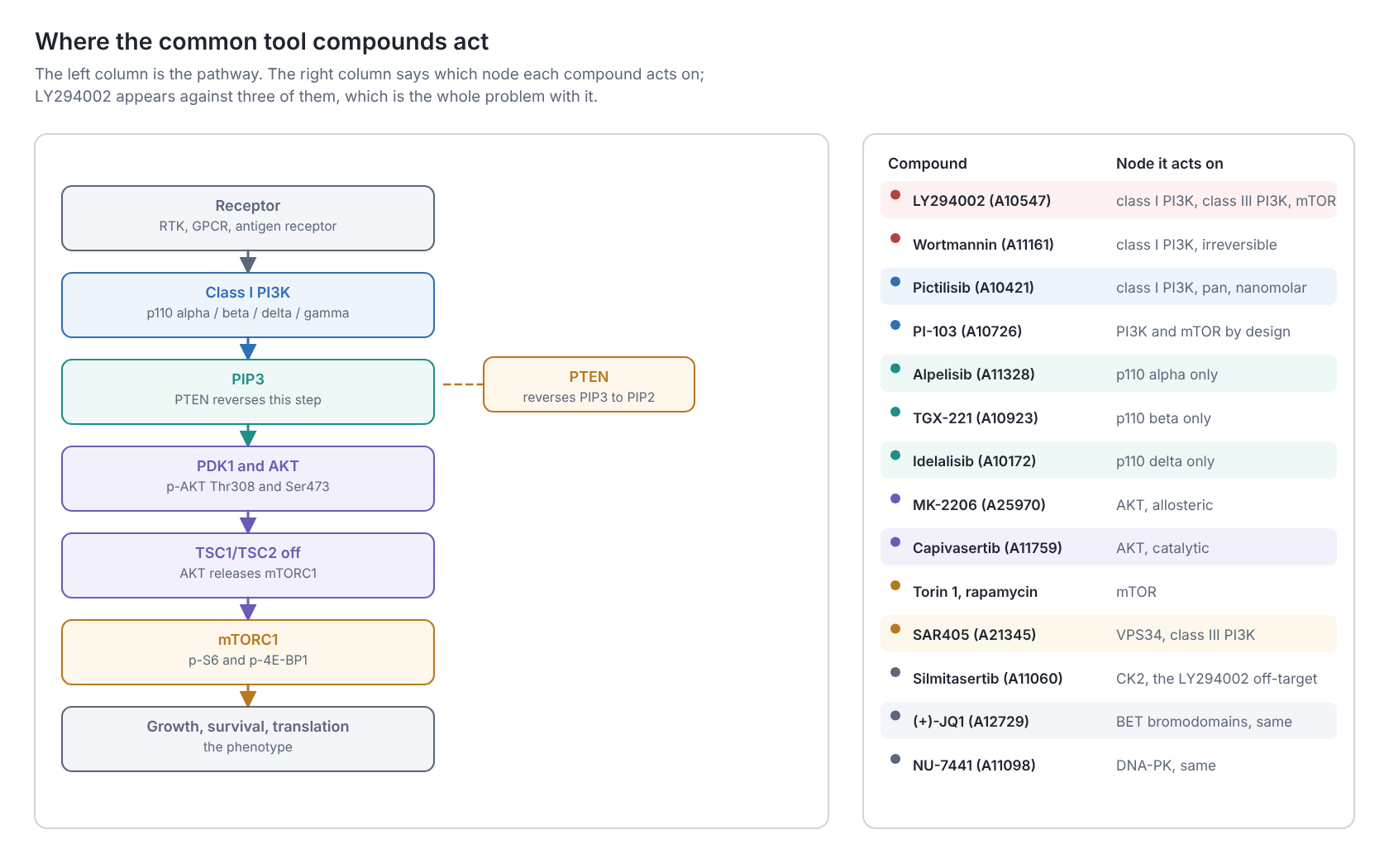
Gharbi and colleagues set out to answer this properly. They immobilized PI828, a close LY294002 analog, on beads, used it to pull targets out of cell extracts, and identified what came off by mass spectrometry. LY294002 bound class I PI3Ks and other PI3K-related kinases as expected, and also proteins unrelated to the PI3K family [5]. The headline from that work is casein kinase 2, inhibited with a mean IC50 of 0.098 µM. In the same study recombinant p110α gave a mean IC50 of 0.186 µM, so CK2 is about twice as sensitive as the intended target when the two are measured side by side, and roughly five-fold below the 0.5 µM p110α figure that other cell-free assays report [5], [4]. The exact factor matters less than its direction: a protein kinase with no relationship to the PI3K family is inhibited at least as well as PI3K itself.
| Off-target | Potency | Why it matters |
|---|---|---|
| Casein kinase 2 (CK2) | 98 nM, mean 0.098 µM [5] | A constitutively active kinase in apoptosis, NF-κB and ribosome biogenesis. Many phenotypes attributed to PI3K inhibition are CK2-compatible. Silmitasertib (CX-4945) is the CK2 counter-probe |
| BET bromodomains BRD2, BRD3, BRD4 | Competitive inhibition of acetyl-lysine binding at the first bromodomain, not the second [15] | Transcriptional effects on MYC and inflammatory genes. (+)-JQ1 is the counter-probe; see the bromodomain inhibitor guide |
| DNA-PK | 1.4 µM on the datasheet, and assay-dependent | Confounds any DNA-damage, radiosensitization or repair experiment. NU-7441 is the selective comparison |
| mTOR | Direct inhibition of mTOR signaling functions [14] | Phospho-S6 and phospho-4E-BP1 may fall through mTOR directly, not through PI3K |
| Class III PI3K (VPS34) and other PI3K-related kinases | Inhibited in the same range | The autophagy complication in the autophagy section |
| Intracellular hydrogen peroxide production | Shared with LY 303511 [11] | Sensitization and apoptosis phenotypes independent of PI3K |
| JNK | Not a reported direct target | A change in phospho-JNK after LY294002 is pathway crosstalk and stress response, not JNK inhibition. Treat a JNK readout as downstream, and confirm with a JNK inhibitor if the claim matters |
The BET result deserves a moment, because it is the one that most changes how the compound should be read. Dittmann and colleagues found that both LY294002 and LY 303511 competitively inhibit acetyl-lysine binding at the BD1 bromodomain of BET proteins, and solved structures showing the chromen-4-one scaffold as a new bromodomain pharmacophore [15]. That makes LY294002 a dual kinase and BET inhibitor, and it means transcriptional effects seen at 10-50 µM have two possible origins.
9.1 Is LY294002 still a usable probe?
Chemical-probe standards have tightened since 1994. The modern criteria ask for potency below 100 nM on the intended target, at least 30-fold selectivity over related targets, a structurally matched inactive control, and on-target cellular activity demonstrated at a stated concentration [19]. LY294002 fails the first two, and its inactive control shares off-targets with it, which is why the Chemical Probes Portal lists LY294002 among its unsuitable compounds rather than as a recommended PI3K probe.
That is a statement about what the compound can prove, not an instruction to stop using it. Three defensible uses remain.
- As a pathway-level perturbation, where the claim is "PIP3 production was blocked" rather than "PI3K α specifically does X".
- As one arm of an orthogonal set. Reproduce the phenotype with a structurally unrelated PI3K inhibitor and with genetic knockdown. Agreement across chemically unrelated agents is what makes a target claim credible. Choose the second compound carefully, because two of the obvious candidates reintroduce the problem you are trying to rule out:
- Pictilisib (GDC-0941) is the clean default: nanomolar, pan-class I, no shared chemistry with the chromen-4-ones. - An isoform-selective compound (alpelisib, TGX-221, idelalisib) is the right second arm when the question is which isoform. - PI-103 inhibits mTORC1, mTORC2 and DNA-PK at low nanomolar concentrations [7], which are exactly the LY294002 off-targets in question, so it cannot exonerate them. - Buparlisib (BKM120) inhibits tubulin polymerization above about 1 µM, and much of its antiproliferative effect comes from that rather than from PI3K [20], so it is a poor control for proliferation and cell-cycle phenotypes.
- As a historical benchmark, when you need to compare your system with a literature that was built almost entirely on this compound.
What is no longer defensible is a single-compound, single-concentration experiment presented as isoform-level evidence.
10. LY294002 vs wortmannin
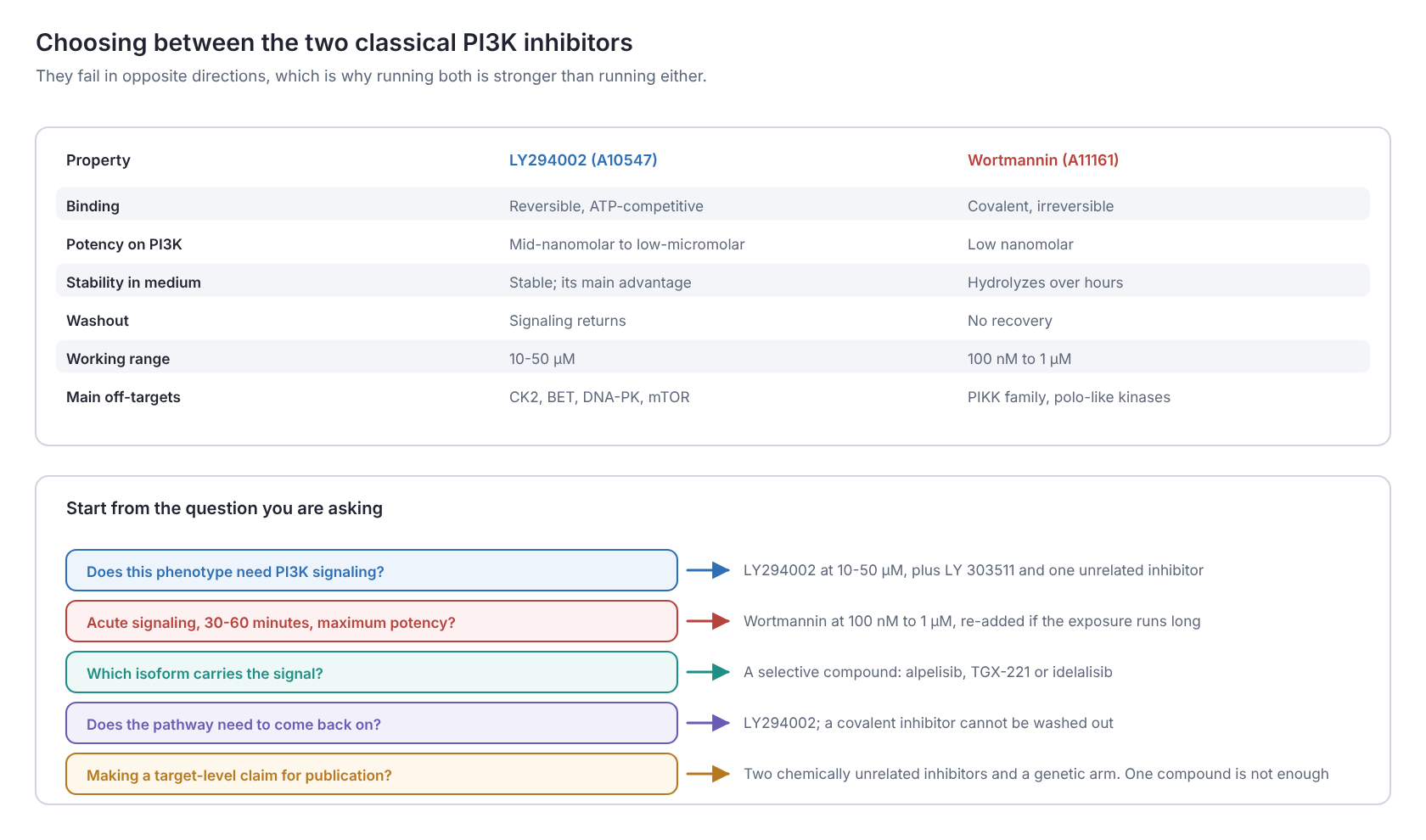
These two compounds built the field together, and they fail in opposite directions. They are complementary, not interchangeable.
| LY294002 (A10547) | Wortmannin (A11161) | |
|---|---|---|
| Origin | Synthetic, from a quercetin program [1] | Fungal natural product |
| Binding | Reversible, ATP-competitive at the p110 pocket [3] | Covalent, irreversible, via its furan ring to the catalytic lysine |
| Potency on PI3K | Mid-nanomolar to low-micromolar, assay-dependent | Low nanomolar |
| Stability in aqueous medium | Chemically stable; this is its main advantage | Hydrolyzes quickly; activity falls over hours |
| Washout | Pathway recovers after a medium change | No recovery; the enzyme is modified |
| Main off-targets | CK2, BET bromodomains, DNA-PK, mTOR | PIKK family, polo-like kinases, and reactive-electrophile effects at higher concentrations |
| Best used for | Experiments needing reversibility, long exposures, or a matched inactive control | Short, acute experiments where maximum potency matters |
| Working concentration | 10-50 µM | 100 nM to 1 µM, re-added if the exposure is long |
The practical decision rule: if the experiment runs longer than about six hours, or you need to restore signaling, use LY294002 and accept that you must control for the off-targets. If it is a 30-minute acute stimulation experiment and potency is what you need, use wortmannin and accept that it will be gone by morning. Running both, and requiring the phenotype to appear with each, is stronger than either alone.
11. Similar products and what replaced LY294002
LY294002 is still the default pan-PI3K tool, but the shelf next to it is now crowded, and most questions are better served by something else.
| Need | Compound | Why |
|---|---|---|
| Pan-class I PI3K, modern potency | Pictilisib (GDC-0941) | Nanomolar pan-class I, clean kinome profile, the usual modern replacement for LY294002 |
| Pan-PI3K with CNS exposure | Buparlisib (BKM120) | Pan-class I, crosses into brain in rodents |
| Dual PI3K/mTOR, deliberately | PI-103, dactolisib (BEZ235), omipalisib (GSK2126458) | When blocking both nodes is the design, not an accident |
| p110α only | Alpelisib (BYL719), inavolisib (GDC-0077) | PIK3CA-mutant biology; inavolisib also degrades mutant p110α |
| p110β only | TGX-221 | PTEN-null and platelet biology |
| p110δ only | Idelalisib (CAL-101) | B-cell work; the δ-selective reference compound |
| p110δ and p110γ together | Duvelisib (IPI-145) | A dual δ/γ inhibitor, not δ-selective, which is the point in myeloid and tumor-microenvironment work [21] |
| AKT instead of PI3K | MK-2206, capivasertib (AZD5363) | When the question is AKT itself |
| Irreversible, maximum potency | Wortmannin, sonolisib (PX-866) | Acute experiments; PX-866 is the stabilized wortmannin derivative |
| Counter-probes for the off-targets | Silmitasertib (CX-4945) for CK2, (+)-JQ1 for BET, NU-7441 for DNA-PK | Distinguishing which target produced your phenotype |
The full range is in the PI3K product category and the broader PI3K/AKT/mTOR category.
A note on the clinical side, because it shapes which compounds are easy to find literature for. The PI3K inhibitor class has had a hard decade: the US lymphoma indications granted to PI3Kδ inhibitors between 2014 and 2021 have since been withdrawn, including idelalisib's follicular lymphoma and SLL indications in 2022, so that by the start of 2025 no FDA-approved PI3Kδ lymphoma indication remained [22]. The withdrawals were indication-level rather than compound-level: idelalisib kept its chronic lymphocytic leukemia approval, and duvelisib kept CLL and SLL after its follicular lymphoma indication was withdrawn. The isoform-selective PI3Kα story went the other way: targeting mutant p110α in PIK3CA-mutated breast cancer has produced the class's most durable successes, and inhibitors have moved from pan-PI3K chemistry toward mutant-selective and degrading chemistry [23]. The clearest marker of that shift is inavolisib, which pairs p110α inhibition with degradation of the mutant protein and was approved in the United States in October 2024 on the strength of a randomized phase III trial in PIK3CA-mutated advanced breast cancer [24]. None of this changes LY294002's standing as a reagent, but it explains why the newer literature is written with selective compounds and why reviewers increasingly expect them.
12. Troubleshooting
Phospho-AKT does not go down. Check the concentration first: 1-5 µM is often not enough in cells, and 10-25 µM is the usual effective range. Then check timing, because 15-60 min is the window where the effect is largest; by 48 h the signal can recover [8]. Then check the baseline: in serum-starved cells basal phospho-AKT may already be too low to see a decrease, and a short growth-factor stimulation after inhibitor pre-treatment is the standard fix.
The compound precipitates when added to medium. Add the DMSO stock to pre-warmed medium while swirling, never to cold medium, and never add medium to the stock. If you are working above 25 µM, use a 20 mM stock so the dilution is larger and local supersaturation is smaller.
Vehicle control cells look sick. You are probably above 0.2% DMSO. Use a more concentrated stock, or reduce the top concentration.
The effect is identical with the LY 303511 control. That is a real result: whatever you are seeing is not PI3K-dependent. The scaffold's BET activity and hydrogen peroxide production are the first two things to consider [15], [11].
A reviewer asks for a more selective inhibitor. This is now a routine request. Reproduce the key panel with pictilisib, or with an isoform-selective compound if the question is isoform-level, plus a knockdown. Do not reach for PI-103 or buparlisib for this purpose; see section 9.1 for why.
Old stock seems weaker. DMSO stocks are good for about a month at -20 °C. Water uptake by hygroscopic DMSO across repeated freeze-thaw is the usual culprit, not chemical degradation of the compound.
13. Frequently asked questions
What is the mechanism of action of LY294002?
It binds the ATP pocket of the p110 catalytic subunit of class I PI3K, competing with ATP, with the morpholine oxygen hydrogen-bonded to the kinase hinge [3]. PIP2 is not converted to PIP3, so AKT and PDK1 are not recruited to the membrane and AKT phosphorylation falls. Inhibition is reversible.
What is the IC50 of LY294002?
Against purified PI3K, 1.40 µM in the original report, which quotes it as 0.43 µg/mL [1], and about 0.5 µM for recombinant p110α in cell-free assays, with p110β and p110δ within a factor of two. In cells, 10-50 µM is normally needed for pathway blockade, and antiproliferative IC50 values run from roughly 5 to 90 µM depending on line and assay length. See the IC50 section for why the numbers differ.
Is LY294002 selective for PI3K?
No. It inhibits casein kinase 2 more potently than PI3K, and it also inhibits BET bromodomains, DNA-PK and mTOR within the range used in cells [5], [15], [14]. Treat it as a pathway-level perturbation and pair it with an unrelated inhibitor.
What concentration of LY294002 should I use in cell culture?
Start with a 10, 25 and 50 µM series for 1-24 h, with DMSO matched across all points, and read phospho-AKT at 30-60 min to confirm engagement before measuring any phenotype. Sensitive primary cells may need the top concentration dropped to keep DMSO at or below 0.1%.
Does LY294002 induce or inhibit autophagy?
Both mechanisms are present, and blockade usually wins at normal working concentrations, because class III PI3K is needed to form the autophagosome [12], [13]. Do not read an LC3-II change as flux; use a lysosomal inhibitor arm, or a VPS34-selective compound such as SAR405 if you want a clean block.
Is there an LY294002 hydrochloride?
Yes. LY294002 hydrochloride is a real catalog form, CAS 934389-88-5, C19H18ClNO3, 343.8 g/mol, and it releases the same active molecule. Adooq supplies A10547 as the free compound, CAS 154447-36-6, 307.3 g/mol, so use the molecular weight that matches your vial. Do not confuse either with LY 303511 hydrochloride, the salt of the inactive analog.
What is the difference between LY294002 and LY 303511?
The C2 morpholine is replaced by a piperazine, which removes PI3K activity. It is the standard inactive control, but it is not inert: it shares BET bromodomain inhibition and hydrogen peroxide production with LY294002 [15], [11]. See the control section.
Was LY294002 ever in clinical trials?
LY294002 itself was not developed clinically. Its RGDS-peptide prodrug SF1126 was: it completed a phase I study in advanced solid tumors and B-cell malignancies [18], then went on to a phase II trial in head and neck squamous cell carcinoma (NCT02644122) and two further phase I trials (NCT02337309, NCT03059147). All three were terminated, for slow accrual or a change of sponsor priorities rather than a reported safety signal.
How should LY294002 be stored?
Powder at -20 °C and desiccated, stable for about 36 months; DMSO stocks at -20 °C in single-use aliquots, used within one month.
References
- Vlahos CJ, Matter WF, Hui KY, Brown RF. A specific inhibitor of phosphatidylinositol 3-kinase, 2-(4-morpholinyl)-8-phenyl-4H-1-benzopyran-4-one (LY294002). Journal of Biological Chemistry 1994. PMID 8106507
- Fruman DA, Chiu H, Hopkins BD, et al. The PI3K Pathway in Human Disease. Cell 2017. PMID 28802037
- Walker EH, Pacold ME, Perisic O, et al. Structural determinants of phosphoinositide 3-kinase inhibition by wortmannin, LY294002, quercetin, myricetin, and staurosporine. Molecular Cell 2000. PMID 11090628
- Chaussade C, Rewcastle GW, Kendall JD, et al. Evidence for functional redundancy of class IA PI3K isoforms in insulin signalling. Biochemical Journal 2007. PMID 17362206
- Gharbi SI, Zvelebil MJ, Shuttleworth SJ, et al. Exploring the specificity of the PI3K family inhibitor LY294002. Biochemical Journal 2007. PMID 17302559
- Vanhaesebroeck B, Guillermet-Guibert J, Graupera M, Bilanges B. The emerging mechanisms of isoform-specific PI3K signalling. Nature Reviews Molecular Cell Biology 2010. PMID 20379207
- Knight ZA, Gonzalez B, Feldman ME, et al. A pharmacological map of the PI3-K family defines a role for p110alpha in insulin signaling. Cell 2006. PMID 16647110
- Sakai H, Shiina I, Shinomiya T, Nagahara Y. BRAP2 inhibits the Ras/Raf/MEK and PI3K/Akt pathways in leukemia cells, thereby inducing apoptosis and inhibiting cell growth. Experimental and Therapeutic Medicine 2021. PMID 33747195
- Liang H, Zheng QL, Fang P, et al. Targeting the PI3K/AKT pathway via GLI1 inhibition enhanced the drug sensitivity of acute myeloid leukemia cells. Scientific Reports 2017. PMID 28098170
- Fujiwara M, Izuishi K, Sano T, et al. Modulating effect of the PI3-kinase inhibitor LY294002 on cisplatin in human pancreatic cancer cells. Journal of Experimental & Clinical Cancer Research 2008. PMID 19032736
- Poh TW, Pervaiz S. LY294002 and LY303511 sensitize tumor cells to drug-induced apoptosis via intracellular hydrogen peroxide production independent of the phosphoinositide 3-kinase-Akt pathway. Cancer Research 2005. PMID 16024628
- Petiot A, Ogier-Denis E, Blommaart EF, Meijer AJ, Codogno P. Distinct classes of phosphatidylinositol 3'-kinases are involved in signaling pathways that control macroautophagy in HT-29 cells. Journal of Biological Chemistry 2000. PMID 10625637
- Blommaart EF, Krause U, Schellens JP, Vreeling-Sindelarova H, Meijer AJ. The phosphatidylinositol 3-kinase inhibitors wortmannin and LY294002 inhibit autophagy in isolated rat hepatocytes. European Journal of Biochemistry 1997. PMID 9030745
- Brunn GJ, Williams J, Sabers C, et al. Direct inhibition of the signaling functions of the mammalian target of rapamycin by the phosphoinositide 3-kinase inhibitors, wortmannin and LY294002. The EMBO Journal 1996. PMID 8895571
- Dittmann A, Werner T, Chung CW, et al. The commonly used PI3-kinase probe LY294002 is an inhibitor of BET bromodomains. ACS Chemical Biology 2014. PMID 24533473
- El-Kholy W, MacDonald PE, Lin JH, et al. The phosphatidylinositol 3-kinase inhibitor LY294002 potently blocks K(V) currents via a direct mechanism. The FASEB Journal 2003. PMID 12586735
- Garlich JR, De P, Dey N, et al. A vascular targeted pan phosphoinositide 3-kinase inhibitor prodrug, SF1126, with antitumor and antiangiogenic activity. Cancer Research 2008. PMID 18172313
- Mahadevan D, Chiorean EG, Harris WB, et al. Phase I pharmacokinetic and pharmacodynamic study of the pan-PI3K/mTORC vascular targeted pro-drug SF1126 in patients with advanced solid tumours and B-cell malignancies. European Journal of Cancer 2012. PMID 22921184
- Arrowsmith CH, Audia JE, Austin C, et al. The promise and peril of chemical probes. Nature Chemical Biology 2015. PMID 26196764
- Bohnacker T, Prota AE, Beaufils F, et al. Deconvolution of Buparlisib's mechanism of action defines specific PI3K and tubulin inhibitors for therapeutic intervention. Nature Communications 2017. doi
- Winkler DG, Faia KL, DiNitto JP, et al. PI3K-delta and PI3K-gamma inhibition by IPI-145 abrogates immune responses and suppresses activity in autoimmune and inflammatory disease models. Chemistry & Biology 2013. PMID 24211136
- Hao Z, Arnold S, Kolesar J. Targeting PI3Kdelta in cancer: a setback or the end. Frontiers in Oncology 2025. PMID 41256311
- Vanhaesebroeck B, Perry MWD, Brown JR, Andre F, Okkenhaug K. PI3K inhibitors are finally coming of age. Nature Reviews Drug Discovery 2021. PMID 34127844
- Turner NC, Im SA, Saura C, et al. Inavolisib-Based Therapy in PIK3CA-Mutated Advanced Breast Cancer. New England Journal of Medicine 2024. PMID 39476340