Rhodamine Dyes

Explore rhodamine dyes and derivatives with product-specific family evidence. Compare individual reagent forms, specifications and package options.

Derivatives can have different properties and uses. Family membership alone does not establish membrane staining, calcium indication or biomolecule-labeling suitability.

Items 101-113 of 113

  • Tamra azide
    Cat. No.
    B11019

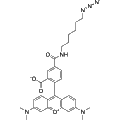
    Tamra azide

    Tamra azide is a versatile, azide-terminated fluorescent dye utilized primarily in click chemistry applications. It participates in CuI-catalyzed cycloaddition reactions with alkyne-functionalized nanodiamonds, enabling stable conjugation. Once attached, Tamra azide acts as a fluorescent label, exhibiting characteristic luminescence when excited at a wavelength of 555 nm with emission at 580 nm. This compound is valuable for a variety of imaging and labeling applications in chemical biology and materials science.

    1 mg
    $70.00
    5 mg
    $180.00
    All 6 sizes
  • (Z-Ala-Ala-Ala-Ala)2Rh110
    Cat. No.
    B11078

    (Z-Ala-Ala-Ala-Ala)2Rh110

    Synonyms: (Z-Ala-Ala-Ala-Ala)2Rhodamine110; bis-CBZ-L-alanyl-L-arginine amide Rhodamine 110

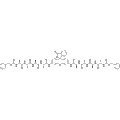
    (Z-Ala-Ala-Ala-Ala)2Rh110 is a fluorogenic elastase substrate that exhibits high sensitivity. Initially colorless and nonfluorescent, this compound is specifically cleaved by elastase, resulting in the production of the fluorescent rhodamine 110, which can be effectively measured at an excitation wavelength of 485 nm and an emission wavelength of 525 nm. This substrate is valuable for studying elastase activity and can be applied in various biochemical assays and research applications focused on protease activity.

    1 mg
    $75.00
    All 1 sizes
  • DAR-4M
    Cat. No.
    B11116

    DAR-4M

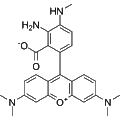
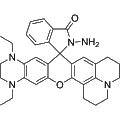
    DAR-4M is a fluorescent indicator specifically designed for the detection of nitric oxide (NO), utilizing the rhodamine chromophore. With excitation and emission wavelengths of 550 nm and 572 nm, respectively, this reagent enables sensitive and selective measurement of NO levels in biological systems. It is particularly useful in fluorescence microscopy and cellular studies involving nitric oxide signaling pathways.

    1 mg
    $470.00
    All 1 sizes
  • BP Fluor 488 DBCO
    Cat. No.
    B11118

    BP Fluor 488 DBCO

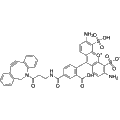
    BP Fluor 488 DBCO is a fluorescent dye designed for use in copper-free Click Chemistry reactions, specifically targeting azide-containing biomolecules such as antibodies, proteins, and peptides. It exhibits strong fluorescent properties, with an excitation peak at 499 nm and an emission peak at 520 nm, making it suitable for applications in microscopy and flow cytometry. This dye is derived from a pure 5-sulfonated rhodamine molecule, ensuring consistent performance and minimizing lot-to-lot variability caused by isomer ratio differences.

    5 mg
    $600.00
    10 mg
    $985.00
    All 4 sizes
  • TAMRA amine, 5-isomer hydrochloride
    Cat. No.
    B11124

    TAMRA amine, 5-isomer hydrochloride

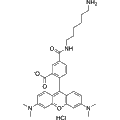
    TAMRA amine, 5-isomer hydrochloride is a fluorescent dye with excitation and emission maxima at 553 nm and 575 nm, respectively. The primary mechanism involves the amine group, which exhibits reactivity towards carboxylic acids, activated NHS esters, and carbonyl groups, including ketones and aldehydes. This versatility enables its application in a variety of labeling and tagging studies, facilitating visualization in biochemical assays and cellular imaging.

    5 mg
    $130.00
    10 mg
    $175.00
    All 3 sizes
  • ONOO-LysopH
    Cat. No.
    B11201

    ONOO-LysopH

    ONOO-LysopH is a Rhodamine-based near-infrared fluorescent dye specifically designed to target lysosomal pH and detect peroxynitrite (ONOO−). This probe exhibits a significant fluorescence enhancement at approximately 686 nm under acidic conditions, while showing a rapid NIR turn-on at around 678 nm in the presence of ONOO− at physiological pH. ONOO-LysopH is ideal for live cell imaging to monitor lysosomal pH fluctuations and to visualize endogenous or exogenous peroxynitrite levels, thereby providing valuable insights into cellular processes.

    Out of stock

    All 3 sizes
  • 5(6)-Carboxyrhodamine 110
    Cat. No.
    B11205

    5(6)-Carboxyrhodamine 110

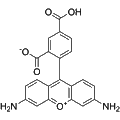
    5(6)-Carboxyrhodamine 110 is an amine-reactive fluorescent probe that targets nucleic acids, proteins, and cells, exhibiting excitation and emission maxima at 498 nm and 530 nm, respectively. This compound is widely utilized in various applications, including fluorescence microscopy, flow cytometry, and cellular imaging, facilitating studies of biomolecular interactions and cellular processes. The stability and brightness of 5(6)-Carboxyrhodamine 110 make it an invaluable tool in molecular biology and biochemistry research.

    Out of stock

    All 3 sizes
  • Palmitic acid - lissamine rhodamine
    Cat. No.
    B11279

    Palmitic acid - lissamine rhodamine

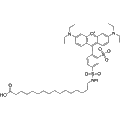
    Palmitic acid-lissamine rhodamine is a fluorescent lipid compound where palmitic acid is conjugated to lissamine rhodamine. This reagent is primarily utilized as a fluorescent probe in cellular imaging studies to track lipid dynamics and localization within biological membranes. Its strong fluorescence properties enable effective visualization and analysis of lipid interactions in various cellular contexts, making it valuable for studies in cell biology and lipid metabolism.

    Out of stock

    All 3 sizes
  • BP Fluor 488 Alkyne
    Cat. No.
    B11305

    BP Fluor 488 Alkyne

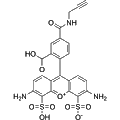
    BP Fluor 488 Alkyne is a fluorescent dye specifically designed for labeling in Click Chemistry reactions. It conjugates effectively with azide-modified biomolecules, including antibodies, proteins, peptides, and amino-modified oligonucleotides. With an excitation peak at 499 nm and emission peak at 520 nm, this dye allows for enhanced visualization in applications such as microscopy and flow cytometry. BP Fluor 488 Alkyne is a pure 5-sulfonated rhodamine derivative, providing consistent results free from lot-to-lot variation.

    Out of stock

    All 3 sizes
  • Rhodamine B carbohydrazide
    Cat. No.
    B11330

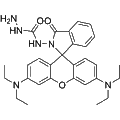
    Rhodamine B carbohydrazide

    Rhodamine B carbohydrazide is a fluorescent dye that utilizes the spirocyclic structure of Rhodamine B to target specific reactive species. This compound exhibits strong fluorescence and is applicable for the detection of copper ions (Cu2+), mercury ions, peroxynitrite, hydroxyl radicals, and nitric oxide (NO). Its utility in biological research includes fluorescence imaging and monitoring oxidative stress, making it valuable for studies in environmental monitoring and cellular processes.

    Out of stock

    All 3 sizes
  • R6G phosphoramidite, 6-isomer
    Cat. No.
    B11356

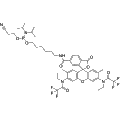
    R6G phosphoramidite, 6-isomer

    R6G phosphoramidite, 6-isomer, is a fluorescent dye that serves as a versatile building block for oligonucleotide synthesis. This xanthene dye from the rhodamine family exhibits a high fluorescence quantum yield and a significant molar extinction coefficient, making it ideal for a variety of labeling applications. With absorption and emission maxima shifted to longer wavelengths at 518 nm and 542 nm, respectively, R6G is particularly suitable for applications requiring enhanced fluorescence sensitivity and stability in nucleic acid studies and other biotechnological fields.

    Out of stock

    All 3 sizes
  • 6-TAMRA cadaverine
    Cat. No.
    B11362

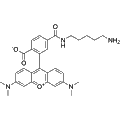
    6-TAMRA cadaverine

    6-TAMRA cadaverine is a fluorescent dye primarily utilized for oligonucleotide labeling and automated DNA sequencing. The amino group (NH2) exhibits reactivity with carboxylic acids, activated NHS esters, and carbonyls, including ketones and aldehydes. This versatility makes 6-TAMRA cadaverine a valuable tool for various molecular biology applications, facilitating the visualization and characterization of nucleic acids.

    Out of stock

    All 3 sizes
  • TAMRA-PEG4-t-butyl ester
    Cat. No.
    B11375

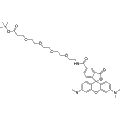
    TAMRA-PEG4-t-butyl ester

    TAMRA-PEG4-t-butyl ester is a fluorescent dye that targets red fluorescence, with an excitation and emission maxima of 553 nm and 575 nm, respectively. This compound features a t-butyl protected carboxyl group that is readily deprotected under acidic conditions. It is primarily utilized in cellular imaging and labeling applications, contributing to the study of biochemical processes and interactions within biological systems.

    Out of stock

    All 3 sizes

Items 101-113 of 113

Added to your cart

View Cart Checkout

    Loading...