All Dyes

All Dyes is the single product list for the Fluorescent Dyes, Probes & Stains section. Many dyes here have no application or dye-family subcategory, so the list is the broadest way to browse the range. It suits searches by product name when the required dye is already known. Examples range from the near-infrared cyanine indocyanine green and the ratiometric calcium indicator Fura-2 pentapotassium to the nucleic acid stains Hoechst 33258 trihydrochloride and SYBR Green II. Classical stains such as hematoxylin, reactive labeling dyes and enzyme substrates are listed alongside them. For selection by task or by core structure, the parent Fluorescent Dyes, Probes & Stains page groups dyes by application and dye family.

Items 1551-1575 of 2505

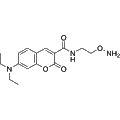
  • N-(2-Aminooxyethyl)-7-DCCAm
    Cat. No.
    A45383

    N-(2-Aminooxyethyl)-7-DCCAm

    N-(2-Aminooxyethyl)-7-DCCAm is a fluorescent dye designed for effective protein labeling. It exhibits strong fluorescence properties, facilitating the visualization and tracking of proteins in various biological assays. This compound is suitable for applications in cellular imaging and protein interaction studies, providing valuable insights into biological processes.

    Out of stock

    All 3 sizes
  • (5)6-Carboxytetramethylrhodamine
    Cat. No.
    A45384

    (5)6-Carboxytetramethylrhodamine

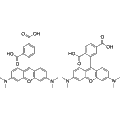
    (5)6-Carboxytetramethylrhodamine is a fluorescent dye designed for use in bioconjugation. Its carboxylic acid functionality allows for specific reactions with primary amines through carbodiimide activation, facilitating the formation of conjugates. This dye exhibits bright orange fluorescence, with absorption and emission maxima of approximately 555 nm and 580 nm, respectively, making it suitable for various applications in cellular imaging and molecular biology assays.

    5 mg
    $40.00
    10 mg
    $65.00
    All 2 sizes
  • Sodium-binding benzofuran isophthalate
    Cat. No.
    A45385

    Sodium-binding benzofuran isophthalate

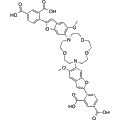
    Sodium-binding benzofuran isophthalate (SBFI) is a cell-impermeant fluorescent dye primarily used for the detection of sodium ions (Na+). Excitable at 340 nm, SBFI emits fluorescence at 450 nm, allowing for sensitive detection of sodium concentrations in biological samples. This compound exhibits selectivity for Na+ over potassium ions (K+), with dissociation constants (Kd) of 20 mM and 120 mM, respectively. SBFI is valuable for research applications involving ion transport and signaling in cellular environments.

    Out of stock

    All 3 sizes
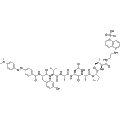
  • Dabcyl-YVADAPV-EDANS
    Cat. No.
    A45386

    Dabcyl-YVADAPV-EDANS

    Dabcyl-YVADAPV-EDANS is a fluorogenic substrate specifically designed for the interleukin-1β converting enzyme (ICE) to monitor ICE-like protease activity. It exhibits fluorescence upon cleavage, with excitation at 360 nm and emission at 480 nm, facilitating sensitive detection. This substrate is instrumental in studying K+ deprivation-induced apoptosis in cerebellar granule neurons, making it a valuable tool for apoptosis and protease research.

    1 mg
    $245.00
    All 1 sizes
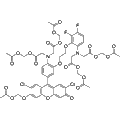
  • Fluo-3FF AM
    Cat. No.
    A45387

    Fluo-3FF AM

    Fluo-3FF AM is a calcium indicator with a low affinity for calcium ions (Kd = 42 μM), designed to allow for the monitoring of intracellular calcium levels. With an absorption/emission maximum of 462 nm/526 nm, it remains non-fluorescent until it enters cells and binds to calcium, resulting in a marked fluorescence enhancement. Fluo-3FF AM is insensitive to magnesium ions and demonstrates relative photostability, making it suitable for various biological research applications involving calcium signaling pathways.

    Out of stock

    All 3 sizes
  • SYBR Green II (Ionic form)
    Cat. No.
    A45388

    SYBR Green II (Ionic form)

    SYBR Green II (Ionic form) is a fluorescent nucleic acid dye that selectively binds to single-stranded nucleotides. It demonstrates high sensitivity for detecting oligonucleotides and larger nucleic acid polymers across various cell types and gel matrices. This reagent is particularly useful for investigating cell structure, assessing membrane integrity and function, as well as analyzing cell cycle distribution. Emission and excitation wavelengths are 484 nm and 515 nm, respectively.

    Out of stock

    All 3 sizes
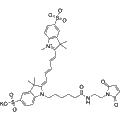
  • Sulfo-Cy5-Mal potassium
    Cat. No.
    A45389

    Sulfo-Cy5-Mal potassium

    Sulfo-Cy5-Mal potassium is a fluorescent dye that targets proteins for labeling applications. Its strong fluorescent properties allow for enhanced visibility in various biochemical assays, making it valuable in studies of protein interactions, localization, and dynamics. This compound is commonly employed in fluorescence microscopy, flow cytometry, and other imaging techniques to facilitate detailed analysis of biological samples.

    Out of stock

    All 3 sizes
  • Sulfo-Cy7 carboxylic acid
    Cat. No.
    A45390

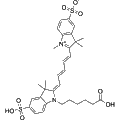
    Sulfo-Cy7 carboxylic acid

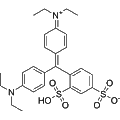
    Sulfo-Cy7 carboxylic acid is a fluorescent dye that belongs to the cyanine family. It exhibits strong near-infrared absorption and fluorescence, making it a valuable tool for a variety of biological imaging applications, including in vivo imaging and cellular assays. Its excellent photostability and solubility in aqueous solutions enhance its utility in research settings, enabling precise detection and quantification of biomolecules.

    Out of stock

    All 3 sizes
  • Sulfo-Cy5 carboxylic acid
    Cat. No.
    A45391

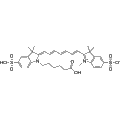
    Sulfo-Cy5 carboxylic acid

    Sulfo-Cy5 carboxylic acid is a derivative of the Cy5 fluorescent dye, primarily utilized in chemical synthesis and bioconjugation. This compound exhibits strong red fluorescence with excitation/emission maxima at 642/670 nm, making it suitable for various imaging applications. It is particularly valuable in cellular and molecular biology for labeling and visualizing biomolecules in complex biological samples.

    1 mg
    $155.00
    5 mg
    $395.00
    All 2 sizes
  • Sulfo-cyanine3 azide
    Cat. No.
    A45392

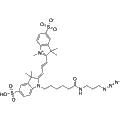
    Sulfo-cyanine3 azide

    Sulfo-cyanine3 azide is a fluorescent dye characterized by its azide functionality, with excitation and emission maxima at 548 nm and 563 nm, respectively. This compound serves as a valuable probe in biological imaging and research applications, particularly in studying cellular processes and interactions. It can participate in copper-catalyzed azide-alkyne cycloaddition (CuAAc) with alkyne-containing molecules, as well as in strain-promoted alkyne-azide cycloaddition (SPAAC) with DBCO or BCN groups, making it a versatile tool for chemical labeling and bioorthogonal reactions.

    1 mg
    $65.00
    5 mg
    $145.00
    All 5 sizes
  • Cy5 Phosphoramidite
    Cat. No.
    A45393

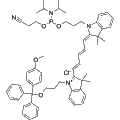
    Cy5 Phosphoramidite

    Cy5 Phosphoramidite is a fluorescent dye that serves as a critical building block in the synthesis of labeled oligonucleotides. It exhibits strong fluorescence in the near-infrared region, making it suitable for applications in molecular biology, genomics, and diagnostics. This reagent enhances the detection and quantification of nucleic acids in various assays, including real-time PCR and microarray analysis.

    Out of stock

    All 3 sizes
  • Eriochrome cyanine R indicator (C.I. 43820)
    Cat. No.
    A45394

    Eriochrome cyanine R indicator (C.I. 43820)

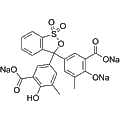
    Eriochrome cyanine R indicator (C.I. 43820) is a biochemical assay reagent primarily used for metal ion detection, particularly in complexometric titrations. This compound exhibits high sensitivity and selectivity, making it valuable for quantifying various metal ions in biological samples and environmental analyses. Its applications are essential in studies involving metalloproteins, trace metal analysis, and water quality assessment.

    Out of stock

    All 3 sizes
  • Cyanine 3 bihexanoic acid dye potassium
    Cat. No.
    A45403

    Cyanine 3 bihexanoic acid dye potassium

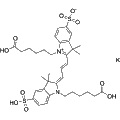
    Cyanine 3 bihexanoic acid dye potassium is a biochemical assay reagent primarily used for fluorescence labeling in biological research. This compound exhibits strong fluorescence properties, making it suitable for applications such as imaging and detection of biomolecules. Its hydrophobic tail enhances membrane permeability, facilitating the study of cellular processes. Researchers can utilize this dye in various assays to improve signal detection in fluorescence techniques.

    0.5 mg
    $250.00
    1 mg
    $440.00
    All 3 sizes
  • Acid blue 1 free acid
    Cat. No.
    A45407

    Acid blue 1 free acid

    Synonyms: Xylene blue free acid; C.I. Acid blue 1 free acid

    Acid Blue 1 Free Acid is a biological dye primarily used for intraocular applications, specifically in retinectomy procedures. Its ability to effectively stain retinal premembranous structures facilitates the complete removal of the inner limiting membrane (ILM) during vitreoretinal surgery. Spectral analysis indicates strong absorption characteristics, exhibiting a blue-green hue, with significant absorption below 450 nm and above 600 nm. Additionally, Acid Blue 1 Free Acid serves as a valuable marker in lymphangiography for the resection of neoplastic lymph nodes.

    5 mg
    $20.00
    10 mg
    $30.00
    All 6 sizes
  • Resorufin benzyl ether
    Cat. No.
    A45409

    Resorufin benzyl ether

    Synonyms: BzRes; 7-Benzyloxyresorufin; 7-Benzyloxyphenoxazone

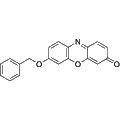
    Resorufin benzyl ether is a fluorogenic substrate primarily utilized for the detection of CYP3A4 enzyme activity. This compound can be further modified with a boronate moiety to enable detection of peroxynitrite (ONOO-) through a self-immolation mechanism. The fluorescence emission occurs at 590 nm when excited between 530 and 570 nm, making it a valuable tool for studies involving enzymatic activity and oxidative stress.

    1 mg
    $30.00
    5 mg
    $135.00
    All 3 sizes
  • Fluorescent brightener 24
    Cat. No.
    A45410

    Fluorescent brightener 24

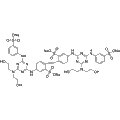
    Fluorescent Brightener 24 is a stilbene-based fluorescent brightening agent that enhances the brightness of various substrates. Its primary mechanism involves the absorption of ultraviolet light and re-emission as visible light, thereby improving the overall fluorescence. This compound is commonly utilized in textile and paper industries as well as in biological assays to enhance signal detection and contrast in fluorescence microscopy.

    25 mg
    $1,275.00
    All 1 sizes
  • diSulfo-Cy3 alkyne
    Cat. No.
    A45411

    diSulfo-Cy3 alkyne

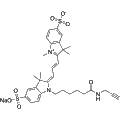
    diSulfo-Cy3 alkyne is a water-soluble dye that functions as a Click Chemistry reagent featuring an alkyne group. With absorption and emission characteristics comparable to those of the Cy3 fluorophore, it is suitable for precise labeling of proteins and other biological structures in aqueous environments. This compound is valuable for applications in fluorescence microscopy and bioconjugation studies, enhancing visualization and tracking of target biomolecules in diverse biological research.

    Out of stock

    All 3 sizes
  • Sulfo-Cy5-TCO
    Cat. No.
    A45412

    Sulfo-Cy5-TCO

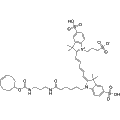
    Sulfo-Cy5-TCO is a water-soluble fluorescent dye that incorporates a trans-cyclooctene (TCO) moiety, facilitating rapid and efficient click chemistry reactions with tetrazines and methyltetrazines. This reagent is designed for use in bioconjugation applications, offering high reactivity and speed that enhances labeling efficiency in various biological experiments. Its unique properties make Sulfo-Cy5-TCO valuable for researchers in fields such as cellular imaging, biomolecule tracking, and targeted drug delivery.

    1 mg
    $315.00
    All 1 sizes
  • 1-[3-(Succinimidyloxycarbonyl)benzyl]-4-[2-(3,4-dihydro-2H-1-benzopyran-6-yl)-5-oxazolyl]pyridinium bromide
    Cat. No.
    A45413

    1-[3-(Succinimidyloxycarbonyl)benzyl]-4-[2-(3,4-dihydro-2H-1-benzopyran-6-yl)-5-oxazolyl]pyridinium bromide

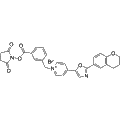
    1-[3-(Succinimidyloxycarbonyl)benzyl]-4-[2-(3,4-dihydro-2H-1-benzopyran-6-yl)-5-oxazolyl]pyridinium bromide functions as a fluorescent dye with robust optical properties. This compound is designed for applications in biological imaging and tracking, facilitating the visualization of cellular processes and interactions. Its unique chemical structure enables effective conjugation to biomolecules, enhancing its utility in various research studies, including drug delivery and probe development.

    Out of stock

    All 3 sizes
  • Sulforhodamine G
    Cat. No.
    A45415

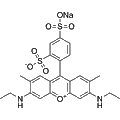
    Sulforhodamine G

    Sulforhodamine G is a fluorescent stain that exhibits a broad dynamic range, making it suitable for diverse applications in biological research. This compound is primarily utilized for protein staining, enabling sensitive detection and quantification of proteins in various samples. Its robust fluorescence properties make it an essential tool in studies involving cell biology, biochemistry, and molecular biology.

    Out of stock

    All 3 sizes
  • MCA succinimidyl ester
    Cat. No.
    A45416

    MCA succinimidyl ester

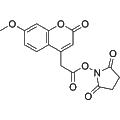
    MCA succinimidyl ester is a reactive fluorescent dye that targets amines through its succinimidyl ester functionality. It is capable of forming stable conjugates with amine-containing compounds, making it suitable for various labeling applications. This reagent is commonly used in fluorescence resonance energy transfer (FRET) studies, facilitating the investigation of peptide interactions and dynamics in biological research.

    25 mg
    $120.00
    50 mg
    $175.00
    All 4 sizes
  • BODIPY FL Verapamil hydrochloride
    Cat. No.
    A45418

    BODIPY FL Verapamil hydrochloride

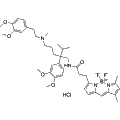
    BODIPY FL Verapamil hydrochloride is a fluorescent dye that serves as a molecular probe for the labeling of tissues and cells. This compound acts as a substrate for the ATP-binding cassette transporters ABCB1 and ABCC1, making it valuable for investigating drug transport mechanisms and cellular uptake processes in pharmacological and biochemical studies. Its fluorescent properties facilitate visualization in various biological applications.

    5 mg
    $520.00
    10 mg
    $800.00
    All 3 sizes
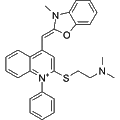
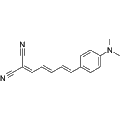
  • DCDAPH
    Cat. No.
    A45419

    DCDAPH

    DCDAPH is a specialized near-infrared fluorescent (NIRF) probe designed for the detection of β-amyloid (Aβ) plaques, with excitation and emission wavelengths of 597 nm and 665 nm, respectively, in phosphate-buffered saline. This compound demonstrates a notably high affinity for Aβ aggregates, with a dissociation constant (Kd) of 27 nM and an inhibition constant (Ki) of 37 nM. DCDAPH is capable of effectively permeating the blood-brain barrier, making it suitable for both in vitro and in vivo studies in Alzheimer's disease research.

    25 mg
    $1,370.00
    50 mg
    $1,810.00
    All 3 sizes
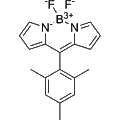
  • 8-(2,4,6-Trimethylphenyl)-BODIPY
    Cat. No.
    A45420

    8-(2,4,6-Trimethylphenyl)-BODIPY

    8-(2,4,6-Trimethylphenyl)-BODIPY is a highly fluorescent dye that exhibits strong absorption at 502 nm and emission at 516 nm. This compound serves as a versatile photosensitizer and is suitable for the synthesis of various BODIPY-based photosensitizers. Its robust fluorescence properties make it particularly useful in biological imaging and photodynamic therapy research applications.

    25 mg
    $1,275.00
    50 mg
    $1,625.00
    All 3 sizes
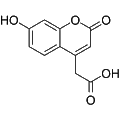
  • 7-Hydroxycoumarin-4-acetic acid
    Cat. No.
    A45421

    7-Hydroxycoumarin-4-acetic acid

    7-Hydroxycoumarin-4-acetic acid serves as a pH-indicator dye that exhibits fluorescence changes in response to pH variations. This compound is covalently attached to bovine serum albumin (BSA) at reactive amino group positions, allowing for enhanced stability and utility in biological systems. With an absorption maximum at 326 nm, it is applicable in studies requiring precise pH measurement and monitoring in various biochemical assays.

    250 mg
    $20.00
    500 mg
    $30.00
    All 5 sizes

Items 1551-1575 of 2505

Added to your cart

View Cart Checkout

    Loading...