
- Cat. No.
- A19809
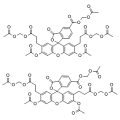
BCECF-AM
BCECF-AM is a cell membrane permeable compound, widely used as a fluorescent indicator for intracellular pH.
In stock
View Details
Search by product name, CAS, target or catalog number. Press Down Arrow to reach product suggestions, Tab to move between links, and Escape to close suggestions.
All Dyes is the single product list for the Fluorescent Dyes, Probes & Stains section. Many dyes here have no application or dye-family subcategory, so the list is the broadest way to browse the range. It suits searches by product name when the required dye is already known. Examples range from the near-infrared cyanine indocyanine green and the ratiometric calcium indicator Fura-2 pentapotassium to the nucleic acid stains Hoechst 33258 trihydrochloride and SYBR Green II. Classical stains such as hematoxylin, reactive labeling dyes and enzyme substrates are listed alongside them. For selection by task or by core structure, the parent Fluorescent Dyes, Probes & Stains page groups dyes by application and dye family.
BCECF-AM is a cell membrane permeable compound, widely used as a fluorescent indicator for intracellular pH.
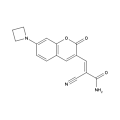
Synonyms: Real Thiol-NH2
RT-NH2 is a RealThiol prototype without the carboxylic acid groups. RT-NH2 is fairly hydrophobic and cannot distribute in the nucleus, which is a hallmark of protein binding for fluorescent probe.
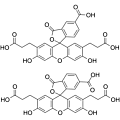
Synonyms: 2,7-Bis(2-carboxyethyl)-5(6)-carboxyfluorescein
Cardiogreen is fluorescent agent with low toxicity has been widely used in medical diagnostics.
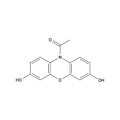
ADHP is a fluorogenic peroxidase substrate (λex=530 nm, λem=590 nm).
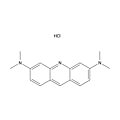
Acridine Orange hydrochloride is a cell-permeable fluorescent dye that binds to nucleic acids, resulting in an altered spectral emission.
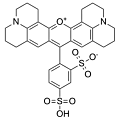
Synonyms: SR101; Sulforhodamine 101
Sulforhodamine 101 is a red fluorescent dye.
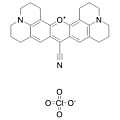
Rhodamine 800 is a near-infrared fluorescent dye.
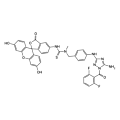
JAK2 JH2 Tracer is a fluorescent probe for the JAK2 JH2 domain, with Kd of 0.2 μM.
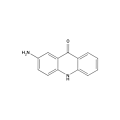
2-Aminoacridone is a widely used fluorophore (λexc=428 nm, λem=525 nm).
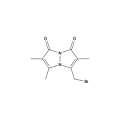
Synonyms: Monobromobimane
Bromobimane is essentially nonfluorescent and converts into fluorescent products when reacts with small thiols.
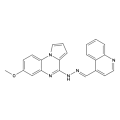
PrPSc-IN-1 is a fluorescent probe, binds to the misfolded protein PrPSc, inhibits its accumulation, with an IC50 of 1.6 μM. Anti-prion activity.
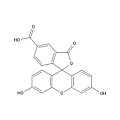
Synonyms: 5-Carboxyfluorescein
5-FAM (5-Carboxyfluorescein) contains a carboxylic acid that can be used to react with primary amines via carbodiimide activation of the carboxylic acid. Fluorescein is the most common fluorescent derivatization reagent for labeling biomolecules.
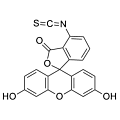
Synonyms: 6-Fluorescein Isothiocyanate
6-FITC (6-Fluorescein Isothiocyanate) is a derivative of fluorescein used in wide-ranging applications including flow cytometry.
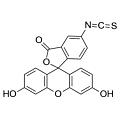
Synonyms: Fluorescein 5-isothiocyanate
FITC is a derivative of fluorescein for the labeling of amines.
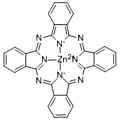
Synonyms: ZnPc
Zinc phthalocyanine is commonly applied in industry (catalysts, photoconductors) and biomedical (photodynamic therapy, PDT). Zinc phthalocyanine can be used to photooxidise cyclohexane.
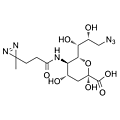
9-Azido-Neu5DAz is a non-natural bifunctional carbohydrates as imaging agent.
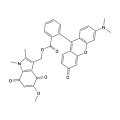
IQ-R is a novel hypoxia-sensitive fluorescent probe, consisting of an indolequinone unit and a rhodol fluorophore.
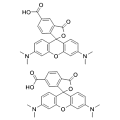
Synonyms: 5(6)-Carboxytetramethylrhodamine
5(6)-TAMRA contains a carboxylic acid that can be used to react with primary amines via carbodiimide activation of the carboxylic acid; bright, orange-fluorescent dye produces conjugates with absorption/emission maxima of ~555/580 nm.
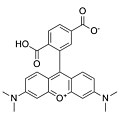
Synonyms: 6-Carboxytetramethylrhodamine
6-TAMRA has been a widely used fluorophore for preparing bioconjugates, especially fluorescent antibody and avidin derivatives used in immunochemistry.
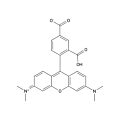
Synonyms: 5-Carboxytetramethylrhodamine
5-TAMRA (5-Carboxytetramethylrhodamine), SE and its conjugates yield bright, pH-insensitive orange-red fluorescence (approximate excitation/emission maxima ~546/579) with good photostability.
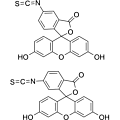
Synonyms: Fluorescein 5(6)-isothiocyanate; Fluorescein isothiocyanate 5- and 6- isomers
5(6)-FITC (Fluorescein 5(6)-isothiocyanate) is an amine-reactive derivative of fluorescein dye that has wide-ranging applications as a label for antibodies and other probes, for use in fluorescence microscopy, flow cytometry and immunofluorescence-based assays such as Western blotting and ELISA.
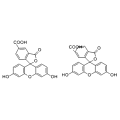
Synonyms: 5(6)-FAM; 5-(and-6)-Carboxyfluorescein mixed isomers
5(6)-Carboxyfluorescein contains a carboxylic acid that can be used to react with primary amines via carbodiimide activation of the carboxylic acid; cell-impermeant 5,6-FAM can also be used as a nonfixable polar tracer to investigate fusion, lysis and gap-junctional communication and to detect changes in cell or liposome volume.
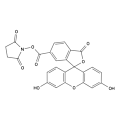
6-FAM SE is another isomer of carboxyfluorescein. 6-FAM, SE is mainly used in sequencing of nucleic acids and labeling nucleotides.
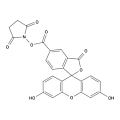
5-FAM SE is a single isomer, it is one of the most popular green fluorescent reagents used for labeling peptides, proteins and nucleotides. It has also been used to prepare various small fluorescent molecules.
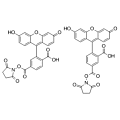
Synonyms: 5(6)-Carboxyfluorescein N-hydroxysuccinimide ester; FLUOS; 5(6)-Carboxyfluorescein succinimidyl ester mixed isomers
5(6)-FAM SE is an amine-reactive green fluorescent dye widely used for labeling proteins or other molecules that contain a primary or secondary aliphatic amine.