Search by product name, CAS, target or catalog number. Press Down Arrow to reach product suggestions, Tab to move between links, and Escape to close suggestions.
USD – US Dollar✓Current currency
Account
Fluorescent Labeling Dyes
Begin with the molecule you want to label and the functional group available for reaction. The examples below compare the free-acid and succinimidyl-ester forms of 5(6)-TAMRA using documented coupling examples. [1][2] Check whether activation is required and whether the reaction partner matches the method. Treat general coupling chemistry as a planning principle, not a promise of performance, and assess the resulting conjugate separately from the starting dye. [2][3]
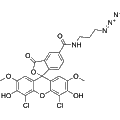
5-JOE azide is a fluorescent dye that emits in the yellow region of the spectrum. It features an azide group that participates in Click Chemistry reactions with alkynes, BCN, or DBCO, resulting in a stable triazole linkage. This compound is valuable for various biological applications, including labeling and tracking of biomolecules in cellular and molecular biology studies.
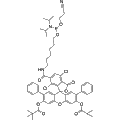
SIMA phosphoramidite, 6-isomer, is a xanthene-based fluorescent dye exhibiting spectral properties comparable to HEX, combined with an enhanced quantum yield. This compound demonstrates superior stability during deprotection in alkaline environments, making it an ideal choice for applications in nucleic acid labeling and fluorescent assays. Its robust performance enables reliable detection in various research settings.
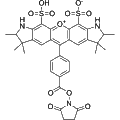
BP Fluor 532 NHS ester is an amine-reactive fluorescent dye designed for labeling biomolecules, particularly proteins and antibodies, through primary amines. It exhibits bright yellow fluorescence and maintains stable emission across a wide pH range (4 to 10), making it suitable for diverse biological applications. The dye forms a stable covalent amide bond, with optimal labeling efficiency achieved at pH 7-9. BP Fluor 532 is compatible with frequency-doubled Nd:YAG laser excitation and is widely utilized in imaging techniques and flow cytometry to enhance signal stability.
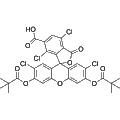
6-TET Dipivaloate is a nucleic acid sequencing probe designed for efficient labeling and detection of nucleic acids during sequencing reactions. This compound exhibits high stability and compatibility with various sequencing platforms, making it suitable for applications in genomics and molecular biology research. Its primary mechanism involves binding to nucleic acid structures, facilitating accurate and reliable sequencing results.
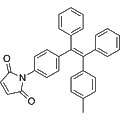
TPE-MI (Tetraphenylethene maleimide) is a fluorogenic dye that serves as a thiol probe for evaluating unfolded protein load and proteostasis in cellular contexts. Its excitation and emission wavelengths at 350 nm and 470 nm respectively enable sensitive detection of proteostasis imbalances in induced pluripotent stem cell models of Huntington’s disease, as well as in cells expressing mutant Huntington exon 1 prior to aggregate formation. Additionally, TPE-MI is valuable for assessing protein damage in studies involving dihydroartemisinin and the malaria parasite Plasmodium falciparum.
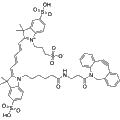
Cy5-DBCO is a near-infrared fluorescent dye that features an absorption maximum at 646 nm and emission maximum at 670 nm. This compound functions as a click chemistry reagent, containing a DBCO group that readily participates in strain-promoted alkyne-azide cycloaddition (SPAAC) with azide-containing molecules. It is particularly useful in bioconjugation applications, facilitating the labeling of proteins and other biomolecules for imaging and tracking studies, although it is not recommended for staining intracellular components in permeabilized cells due to potential high background.
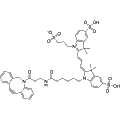
DBCO-Cy3 is an orange fluorescent dye derived from the Cyanine3 fluorophore, exhibiting stable fluorescence across a pH range of 4-10. It has an excitation maximum at 555 nm and an emission maximum at 580 nm, making it suitable for various fluorescence applications. DBCO-Cy3 features rapid reaction kinetics and is compatible with standard fluorescence instruments. As a click chemistry reagent, it contains a DBCO group that facilitates strain-promoted alkyne-azide cycloaddition (SPAAC) with azide-containing molecules, enabling targeted labeling and imaging in biochemical research.
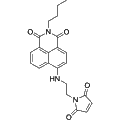
Naph-EA-mal is a thiol fluorescence probe that facilitates the rapid detection and ultrafast turn-on of thiol groups for protein labeling and bioimaging applications. This reagent is capable of detecting thiols in live cells, labeling protein thiols, quantifying total thiol concentration in cell lysates, and assessing reversible protein thiol oxidation in fixed cells. With an excitation wavelength of 488 nm and an emission wavelength of 540 nm, Naph-EA-mal provides a valuable tool for researchers studying thiol modification and redox biology.
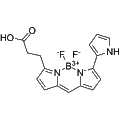
BODIPY 576/589 is a near-infrared (NIR) fluorophore that exhibits strong fluorescence with an emission and excitation maximum at 589 nm and 576 nm, respectively. This compound features a free carboxylic acid (-COOH) group, making it suitable for various bioconjugation applications. BODIPY 576/589 is particularly useful in fluorescence imaging, enabling sensitive detection of biomolecules in live cells and tissues. Its long-wavelength properties allow for reduced background fluorescence, facilitating enhanced signal visibility in biological assays.
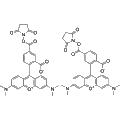
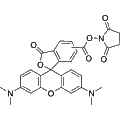
5(6)-TAMRA SE is a fluorescent dye that emits red fluorescence, primarily targeting oligonucleotides. Its ability to bind specifically to these molecules makes it ideal for applications in DNA sequencing, facilitating the analysis of genetic material. Additionally, 5(6)-TAMRA SE is employed in cancer research, with optimal excitation and emission wavelengths at 565 nm and 580 nm, respectively.
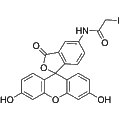
5-IAF (5-Iodoacetamidofluorescein) is a fluorescent probe that selectively labels proteins and other molecules containing free thiols, particularly cysteine side chains. Its utility in labeling enables the visualization and tracking of thiol-containing biomolecules in various biological studies. This compound is instrumental in protein interaction studies and cellular imaging applications, providing insights into protein dynamics and cellular processes.
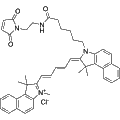
Cyanine5.5 maleimide chloride is a fluorescent dye known for its ability to label biomolecules effectively. This dye exhibits long wavelength absorption and emission profiles, high extinction coefficients, and water solubility, making it suitable for various applications in biological research. It is commonly used for the labeling of proteins, antibodies, and small molecular compounds through straightforward coupling reactions. Cyanine5.5 maleimide chloride facilitates enhanced visualization in fluorescence microscopy and flow cytometry, enabling researchers to study protein interactions and cellular processes with precision.
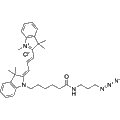
Cyanine3 azide chloride is a fluorescent dye that serves as a versatile tool for bioorthogonal labeling through click chemistry. Featuring an azide group, it facilitates copper-catalyzed azide-alkyne cycloaddition (CuAAc) with alkyne-labeled proteins and can also participate in strain-promoted alkyne-azide cycloaddition (SPAAC) with DBCO or BCN groups. This reagent emits strong fluorescence with an excitation wavelength of 684 nm and an emission wavelength of 710 nm, making it suitable for applications in cellular imaging, protein labeling, and various bioconjugation techniques.
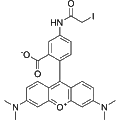
Tetramethylrhodamine-5-iodoacetamide (5-TMRIA) is a thiol-selective reactive dye that interacts primarily with cysteine residues in proteins, facilitating non-specific labeling. This compound is effectively utilized for covalently labeling proteins, which is crucial for tracking and studying protein interactions and dynamics. Additionally, 5-TMRIA can also be employed for covalent labeling of DNA fragments, expanding its application in various molecular biology and biochemical research studies.
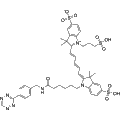
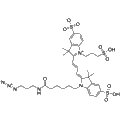
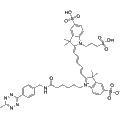
Sulfo-Cy5-tetrazine is a Cy5 derivative featuring a tetrazine moiety that serves as a potent click chemistry reagent. This compound exhibits fluorescence properties similar to Cy5, with excitation/emission maxima at 633/647 nm. Sulfo-Cy5-tetrazine is optimized for use in biochemical applications requiring selective labeling, enabling the visualization of biomolecules through inverse electron demand Diels-Alder reactions with trans-cyclooctene (TCO) functionalized partners. This reagent is ideal for use in various biological research contexts, including molecular imaging and assay development.
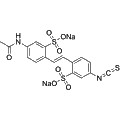
4-Acetamido-4'-isothiocyanatostilbene-2,2'-disulfonic acid disodium is a fluorescent dye that targets cellular structures for imaging applications. It exhibits strong fluorescence, making it suitable for demonstrating retrograde axonal transport and labeling secondary antibodies. Additionally, this compound can be employed as a fluorescent whole cell stain in various biological research applications, facilitating the visualization of cellular processes.
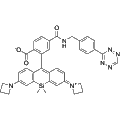
Janelia Fluor® 646, Tetrazine is a red fluorescent dye characterized by its tetrazine moiety. This compound serves as a versatile click chemistry reagent, enabling efficient labeling through inverse electron demand Diels-Alder (iEDDA) reactions with TCO-containing molecules. Its robust fluorescent properties make JF646, Tetrazine suitable for applications in cellular imaging, facilitating the visualization of dynamic biological processes in live cells.
Sulfo-Cy3 Azide is a water-soluble fluorogenic azide dye designed for Click Chemistry applications. By incorporating an azide group, it facilitates the selective labeling of sensitive bioconjugates, including proteins, through copper-catalyzed azide-alkyne cycloaddition (CuAAc) with alkyne-containing molecules. Additionally, it can participate in ring strain-promoted alkyne-azide cycloaddition (SPAAC) with DBCO or BCN functionalized compounds, making it a versatile tool for biochemical and imaging studies.
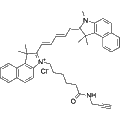
Cyanine5.5 alkyne chloride is a near-infrared fluorescent dye that exhibits excitation at 678 nm and emission at 694 nm. This alkynyl-modified compound is particularly effective for click chemistry applications, enabling efficient labeling through reactions with azides. Its properties make it suitable for a variety of biological research applications, including imaging and tracking in live cells and tissues.
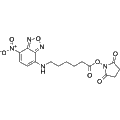
NBD-X, SE is an acceptor fluorophore that exhibits sensitivity to environmental changes, making it suitable for the development of bioconjugates. Its unique photophysical properties enable effective fluorescence resonance energy transfer (FRET) applications in biochemical assays and imaging studies. Researchers can leverage NBD-X, SE for monitoring molecular interactions and conformational changes in various biological systems.
NHS-5(6)Carboxyrhodamine is a fluorescent dye that facilitates precise labeling of proteins in various biological assays. This reagent is ideal for fluorescence microscopy and flow cytometry applications, enabling researchers to achieve accurate dye-to-protein ratios while maintaining native biological conditions. Its exceptional brightness and stability make it a valuable tool for visualizing and tracking proteins in a range of experimental setups.
Sulfo-Cy5-Methyltetrazine is a click chemistry reagent characterized by a methyltetrazine functionality. This compound serves as a fluorophore linker for trans-cyclooctene-based labeling applications, facilitating the visual tracking of biomolecules. It exhibits excellent stability at physiological pH and demonstrates high reactivity towards cyclooctene, making it suitable for a variety of biological and biochemical research applications, including target identification and protein labeling.
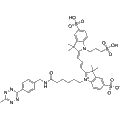
Sulfo-Cy3-Methyltetrazine is a click chemistry reagent characterized by its methyltetrazine functionality and a water-soluble fluorescent dye. It exhibits excellent stability under physiological pH conditions, making it suitable for various biological applications. This reagent effectively couples with trans-cyclooctene and shows a high reactivity towards cyclooctene, enabling precise labeling and detection in live-cell imaging and other bioorthogonal applications.
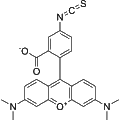
Tetramethylrhodamine-5-isothiocyanate is a highly effective fluorescent dye that targets proteins for visualization and analysis. This reagent is particularly useful for labeling antibodies, such as PG-M3, facilitating the rapid diagnosis of acute promyelocytic leukemia (APL). Additionally, it serves as a valuable probe for quantifying the biodistribution of nanoparticles, including PLGA (poly(lactic-co-glycolic) acid) and PLGA/chitosan formulations, in in vivo studies.
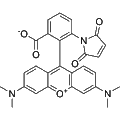
Tetramethylrhodamine-6-maleimide is a fluorescent dye with a reactive maleimide group specific for sulfhydryl modifications. It enables the covalent labeling of cysteine residues in proteins, allowing real-time detection of local protein dynamics. This reagent is particularly useful for studying the functional activity of the Na+/K+-ATPase and other proteins involving cysteine interactions in various biological research applications.
The free acid and succinimidyl ester are different reagents. A study coupled 5(6)-TAMRA-COOH to a cyclic beta-tripeptide using PyBOP-mediated activation. A separate study used 5(6)-succinimidyl TAMRA with cystamine. These examples establish specific reactions, not universal labeling conditions. [1][2]
Identify the reaction partner.
For amine coupling, distinguish activation of a carboxylic acid from reaction of an already activated ester. For azide chemistry more generally, copper-catalyzed and strain-promoted azide–alkyne routes have different partner and catalyst requirements. These are general principles, separate from the specific examples in the table. [3]
Evaluate the product of labeling.
TAMRA derivative formation changed optical behavior in the cited dimer study. Do not assign a conjugate’s reported fluorescence to the starting reagent or transfer performance between different isomer forms. [2]
Representative Reagent Comparison
Selected examples for this topic; independent of the current product page or filters.
Representative reagents and selection considerations
Attachment to an amine-bearing cyclic beta-tripeptide scaffold.
The reported synthesis used PyBOP and DIEA for coupling. This is an activation-dependent example, not a ready-made NHS ester or a universal biomolecule-labeling recipe. [1]
Reaction with cystamine hydrochloride to prepare a TAMRA disulfide dimer.
Already supplied as an activated ester. The paper supports this specific derivatization; the dimer’s optical properties should not be assigned to the starting ester. [2]
Attachment to an amine-bearing cyclic beta-tripeptide scaffold.
Activation / selection boundary
The reported synthesis used PyBOP and DIEA for coupling. This is an activation-dependent example, not a ready-made NHS ester or a universal biomolecule-labeling recipe. [1]
Reaction with cystamine hydrochloride to prepare a TAMRA disulfide dimer.
Activation / selection boundary
Already supplied as an activated ester. The paper supports this specific derivatization; the dimer’s optical properties should not be assigned to the starting ester. [2]
Check the reagent form, reaction partner and method requirements before labeling. These examples do not promise labeling efficiency or compatibility with every sample.