Search by product name, CAS, target or catalog number. Press Down Arrow to reach product suggestions, Tab to move between links, and Escape to close suggestions.
USD – US Dollar✓Current currency
Account
Fluorescent Labeling Dyes
Begin with the molecule you want to label and the functional group available for reaction. The examples below compare the free-acid and succinimidyl-ester forms of 5(6)-TAMRA using documented coupling examples. [1][2] Check whether activation is required and whether the reaction partner matches the method. Treat general coupling chemistry as a planning principle, not a promise of performance, and assess the resulting conjugate separately from the starting dye. [2][3]
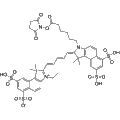
Cy5.5-SE (Cyanine5.5 NHS ester) is a fluorescent dye designed for biochemical labeling applications. It features a long wavelength profile with adjustable absorption and emission, high extinction coefficient, and excellent water solubility, making it suitable for sensitive detection in diverse assays. Cy5.5-SE is commonly used for labeling proteins, antibodies, and small molecular compounds, allowing for straightforward conjugation via a simple mixing method. This dye is ideal for applications in imaging, flow cytometry, and other fluorescence-based techniques.
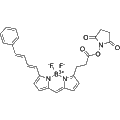
BODIPY-581/591 NHS ester is a hydrophobic fluorescent dye that exhibits bright red fluorescence with an excitation maximum at 581 nm and emission maximum at 591 nm. This reactive dye is ideal for the labeling of amine-containing biomolecules, facilitating visualization in various biological applications. Its intense fluorescence makes it suitable for imaging and tracking studies in cellular and molecular biology research.
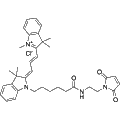
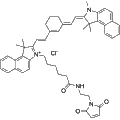
Cy3 maleimide chloride is a fluorescent dye derivative of Cyanine 3 (Cy3) featuring maleimide functional groups. It exhibits fluorescence in the green to orange wavelength range and is primarily utilized for labeling biological molecules. The maleimide group facilitates covalent bonding with thiol-containing compounds, allowing for stable conjugation with proteins and antibodies. This property makes Cy3 maleimide chloride an essential tool for tracking protein localization and dynamics in various biological assays and imaging applications.
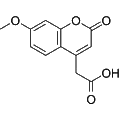
MCA (7-Methoxycoumarin-4-acetic acid) is a fluorescent dye targeting platelet-activating factor (PAF). It is utilized in high-performance liquid chromatography with fluorescent detection to quantify PAF levels. Additionally, MCA can be employed to modify Förster resonance energy transfer (FRET) peptide substrates, facilitating the analysis of protease activities in various biological research applications.
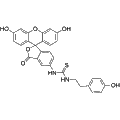
5-FITC tyramide is a green fluorescent dye that combines fluorescein isothiocyanate (FITC) with tyramide, exhibiting excitation at 488 nm and emission at 525 nm. This compound serves as a reporter substrate in horseradish peroxidase (HRP)-catalyzed processes, facilitating tyramide signal amplification (TSA). 5-FITC tyramide is particularly effective in multiplex immunohistochemistry (mIHC), enabling enhanced sensitivity and specificity in detecting multiple antigens within tissue samples.
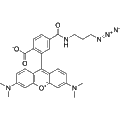
TAMRA azide, 6-isomer is a fluorescent dye belonging to the xanthene family, characterized by its orange emission properties. This compound is primarily utilized in bioorthogonal labeling techniques due to the presence of the azide functional group, facilitating targeted imaging and tracking of biomolecules in various research applications. Researchers can leverage its high fluorescence intensity for sensitive detection in cellular and molecular assays.
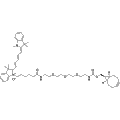
Cy5-PEG3-endo-BCN is a fluorochrome dye that features the Cyanine 5 (Cy5) structure with three polyethylene glycol (PEG) units. This compound includes the hydrophilic bidentate macrocyclic ligand endo-BCN, enabling the synthesis of macrocyclic complexes. In the context of click chemistry, endo-BCN readily reacts with azide-containing molecules to form stable triazole linkages without the need for catalytic conditions, making it a valuable tool for bioconjugation and labeling applications in chemical biology and biomedical research.
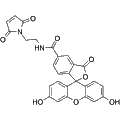
5-FAM maleimide is a fluorescein derivative that serves as a reactive labeling agent. This compound facilitates the conjugation of fluorescent tags to thiol-containing biomolecules, enabling sensitive detection in various applications. Ideal for labeling non-transduced cells, 5-FAM maleimide is useful in fluorescence microscopy, flow cytometry, and other analytical techniques where visualization and tracking of cellular components are essential.
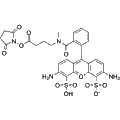
Alexa Fluor 647 NHS Ester is a fluorescent dye designed for the covalent labeling of primary amines (R-NH2) in proteins, amine-modified oligonucleotides, and other amine-containing biomolecules. The NHS ester functional group facilitates efficient conjugation, enabling the visualization of targets in various fluorescence applications. This reagent is ideal for studies in immunofluorescence, flow cytometry, and molecular imaging, providing a robust tool for researchers focusing on protein dynamics and cellular interactions.
Cy7.5 maleimide is a near-infrared fluorescent (NIRF) dye that targets thiol groups for protein labeling. Characterized by its long wavelength and high extinction coefficient, this cyanine dye exhibits excellent water solubility and can be synthesized easily. Cy7.5 maleimide is particularly useful for the labeling of proteins, antibodies, and small molecules, facilitating a straightforward mixing reaction for conjugation. Its properties make it an ideal choice for applications in in vivo imaging, biomolecular studies, and diagnostics.
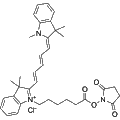
Cyanine5 NHS ester chloride is a red-emitting fluorescent dye designed for the labeling of amino groups in peptides, proteins, and oligonucleotides. This reagent facilitates the detection and visualization of biomolecules in various applications, including fluorescence microscopy and flow cytometry. The reactive NHS ester group ensures efficient conjugation, making it suitable for diverse biochemical research.
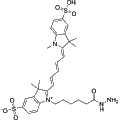
Sulfo-Cy5 hydrazide is a fluorescent dye characterized by its hydrazide functional group and exhibits excitation and emission wavelengths of 646 nm and 662 nm, respectively. This compound is primarily used in various bioconjugation applications, facilitating the labeling of biomolecules for imaging and detection purposes. Its high fluorescence intensity makes it an essential tool for researchers in the fields of molecular biology and biochemistry.
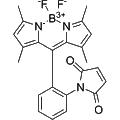
BODIPY Green 8-P2M is a thiol-reactive fluorescence probe leveraging the BODIPY fluorophore. This probe exhibits strong fluorescence quenching through dynamic photoinduced electron transfer (d-PeT), which is restored upon reaction with thiol groups, yielding an enhanced signal-to-noise ratio. BODIPY Green 8-P2M is particularly valuable for the detection of low concentrations of proteins following SDS-PAGE, facilitating sensitive analysis in biochemical research.
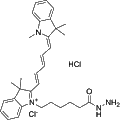
Cy 5 hydrazide is a fluorescent dye that specifically targets aldehydes and ketones. This compound is commonly utilized for labeling proteins, enabling the visualization and tracking of biomolecules in various biological research applications. Its strong fluorescence makes it a valuable tool for studies in molecular biology and biochemistry.
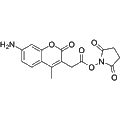
AMCA,SE (7-Amino-4-methyl-3-coumarinacetic acid N-succinimidyl ester) is a fluorescent dye with amine-reactive labeling capabilities. It is commonly utilized in biological research for the conjugation of proteins and antibodies, facilitating visualization in fluorescence microscopy and flow cytometry. This reagent is ideal for studying cellular processes and interactions through targeted fluorescent labeling.
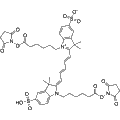
Cy5-bifunctional dye is a fluorescent dye characterized by its two NHS ester groups, enabling efficient labeling of primary amines (R-NH2) in proteins, amine-modified oligonucleotides, and other amine-containing molecules. This reagent is essential for applications in bioconjugation and fluorescence imaging, facilitating the study of biomolecular interactions and cellular processes in research settings. The incorporation of Cy5 enhances the detection capabilities in various assays and enables visualization in complex biological samples.
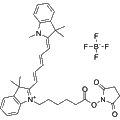
Cyanine 5 NHS ester tetrafluoroborate is a fluorescent dye that targets macromolecules for detection purposes. Exhibiting an excitation wavelength of 638 nm, this compound is suitable for a variety of applications in biological research, including fluorescence microscopy and flow cytometry. Its reactive NHS ester group allows for efficient conjugation to proteins and other biomolecules, facilitating enhanced imaging and analysis in various experimental contexts.
ATTO 488 NHS ester is a highly efficient fluorescent dye designed for labeling proteins and antibodies via its reactive NHS ester functional group. This reagent exhibits strong absorption properties and a high fluorescence quantum yield, making it ideal for applications in single molecule detection and high-resolution microscopy. Its exceptional thermal and photochemical stability ensures reliable performance in various biological assays, enhancing visualization and analysis in research settings.
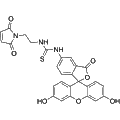
Fluorescein-maleimide is a thiol-reactive fluorescent derivatization reagent that specifically labels protein thiol groups through covalent binding. This compound effectively interacts with protein amino and imidazole groups under neutral pH, making it suitable for diverse biological applications. It is widely used for the fluorescent labeling of proteins, nucleic acids, or other molecules containing one or more thiol groups, with an excitation/emission peak at 494/519 nm, facilitating visualization and analysis in various research settings.
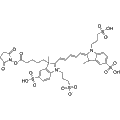
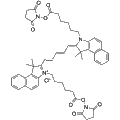
Cy5.5 bis-NHS ester is a reactive cyanine dye that utilizes an NHS ester functionality to effectively label amine groups in biomolecules such as peptides, proteins, and oligonucleotides. This fluorescent dye exhibits strong luminescence properties, making it suitable for a variety of applications in biological imaging and diagnostic assays. Its ability to form stable conjugates allows for enhanced visualization in fluorescence microscopy and flow cytometry studies.
BODIPY FL-X, SE is a fluorescent green dye specifically designed for labeling amine groups. It exhibits a high fluorescence quantum yield and is relatively insensitive to pH variations, making it a versatile tool in fluorescence applications. This dye serves as an effective alternative to commonly used labels such as FAM, Cy2, and FITC, with an absorption maximum at 504 nm and an emission maximum at 510 nm. BODIPY FL-X, SE is suitable for a variety of research applications, including cellular imaging and biomolecular interactions.
PA Janelia Fluor® 646, SE is a photoactivatable fluorescent dye designed for targeted coupling to primary amine groups through its NHS ester form. This dye remains non-fluorescent until activated with a 365 nm light source, enabling its application in self-labeling tag systems such as HaloTag® and SNAP-tag®. PA Janelia Fluor® 646, SE is ideal for single molecule tracking and super-resolution microscopy in live cells, particularly in live cell sptPALM and fixed cell PALM techniques, with an excitation/emission wavelength of approximately 650/664 nm.
IR-825 is a near-infrared fluorescent dye with an active carboxyl (COOH) group that facilitates conjugation with other molecules. This compound exhibits strong fluorescence, making it suitable for imaging applications in biological systems. IR-825 is particularly useful in tumor photothermal studies, allowing for effective visualization and monitoring of tumor dynamics in research settings.
TAMRA-PEG2-Maleimide is a fluorochrome dye that incorporates a maleimide moiety, allowing for selective labeling of thiol-containing biomolecules through a stable covalent bond. The inclusion of two PEG units enhances its solubility and biocompatibility, making it suitable for various biological applications. This reagent is commonly used in protein labeling, fluorescence microscopy, and other biochemical assays, facilitating the study of protein interactions and localization in live cells.
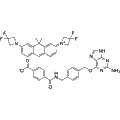
BG-JF585 is a Benzylguanine-conjugated JF585 fluorophore, which serves as a substrate for SNAP tags. With an absorption maximum at 593 nm and an emission maximum at 611 nm, this compound provides strong fluorescence suitable for various imaging applications. BG-JF585 is invaluable for monitoring protein localization and dynamics in live-cell imaging experiments, facilitating advanced studies in cellular biology and protein function.
The free acid and succinimidyl ester are different reagents. A study coupled 5(6)-TAMRA-COOH to a cyclic beta-tripeptide using PyBOP-mediated activation. A separate study used 5(6)-succinimidyl TAMRA with cystamine. These examples establish specific reactions, not universal labeling conditions. [1][2]
Identify the reaction partner.
For amine coupling, distinguish activation of a carboxylic acid from reaction of an already activated ester. For azide chemistry more generally, copper-catalyzed and strain-promoted azide–alkyne routes have different partner and catalyst requirements. These are general principles, separate from the specific examples in the table. [3]
Evaluate the product of labeling.
TAMRA derivative formation changed optical behavior in the cited dimer study. Do not assign a conjugate’s reported fluorescence to the starting reagent or transfer performance between different isomer forms. [2]
Representative Reagent Comparison
Selected examples for this topic; independent of the current product page or filters.
Representative reagents and selection considerations
Attachment to an amine-bearing cyclic beta-tripeptide scaffold.
The reported synthesis used PyBOP and DIEA for coupling. This is an activation-dependent example, not a ready-made NHS ester or a universal biomolecule-labeling recipe. [1]
Reaction with cystamine hydrochloride to prepare a TAMRA disulfide dimer.
Already supplied as an activated ester. The paper supports this specific derivatization; the dimer’s optical properties should not be assigned to the starting ester. [2]
Attachment to an amine-bearing cyclic beta-tripeptide scaffold.
Activation / selection boundary
The reported synthesis used PyBOP and DIEA for coupling. This is an activation-dependent example, not a ready-made NHS ester or a universal biomolecule-labeling recipe. [1]
Reaction with cystamine hydrochloride to prepare a TAMRA disulfide dimer.
Activation / selection boundary
Already supplied as an activated ester. The paper supports this specific derivatization; the dimer’s optical properties should not be assigned to the starting ester. [2]
Check the reagent form, reaction partner and method requirements before labeling. These examples do not promise labeling efficiency or compatibility with every sample.