Search by product name, CAS, target or catalog number. Press Down Arrow to reach product suggestions, Tab to move between links, and Escape to close suggestions.
USD – US Dollar✓Current currency
Account
Fluorescent Labeling Dyes
Begin with the molecule you want to label and the functional group available for reaction. The examples below compare the free-acid and succinimidyl-ester forms of 5(6)-TAMRA using documented coupling examples. [1][2] Check whether activation is required and whether the reaction partner matches the method. Treat general coupling chemistry as a planning principle, not a promise of performance, and assess the resulting conjugate separately from the starting dye. [2][3]
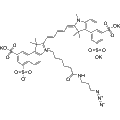
Sulfo-Cyanine5.5 azide tripotassium is a near-infrared (NIR) fluorescent dye characterized by its azide functionality (Ex=678 nm, Em=694 nm). This reagent is particularly suited for Click Chemistry applications, enabling efficient labeling through copper-catalyzed azide-alkyne cycloaddition (CuAAc) with alkyne-containing molecules. Additionally, it can participate in ring strain-promoted alkyne-azide cycloaddition (SPAAC) with DBCO or BCN functionalized substances, making it a valuable tool for bioimaging and labeling studies in chemical biology.
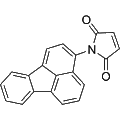
N-(3-Fluoranthenyl)maleimide is a thiol-reactive fluorescent probe utilized for studying biopolymer interactions. With a fluorescence lifetime of 20 ns and a maximum excitation wavelength of 370 nm, it enables precise analysis of time-dependent processes. This compound is particularly valuable in research applications involving thiol-containing biomolecules, facilitating insights into dynamic biological systems.
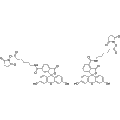
5(6)-SFX, SE is a fluorescent dye designed for the labeling of primary amines and nascent proteins. Its high fluorescence intensity enables sensitive detection and visualization in various biological assays. This reagent is ideal for applications in proteomics, cell biology, and molecular imaging, facilitating the study of protein dynamics and interactions in live cells.
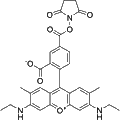
5-Carboxyrhodamine 6G succinimidyl ester is an amine-reactive fluorescent dye with a high quantum yield. It is commonly utilized in various biological research applications, including cellular imaging, protein labeling, and tracking biomolecular interactions. The dye facilitates the visualization of biological structures and processes due to its bright fluorescence, making it an essential tool for studies involving live cells and tissue samples.
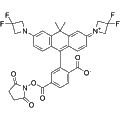
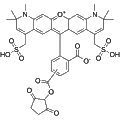
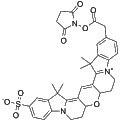
Janelia Fluor® 585, SE is an orange fluorescent dye featuring an NHS ester, enabling efficient conjugation with primary amine groups for labeling applications. This compound is particularly suited for structured illumination microscopy (SIM) and stimulated emission depletion (STED) imaging. Additionally, Janelia Fluor 585, SE can be modified into a photoactivatable derivative, making it valuable for single-molecule localization microscopy (SMLM) experiments.
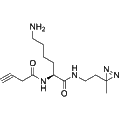
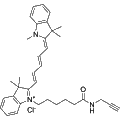
Alkyne-probe 1 is a fluorescent probe designed for click chemistry applications. Featuring an alkyne group, this reagent is capable of undergoing copper-catalyzed azide-alkyne cycloaddition (CuAAc) with azide-containing molecules. Its ability to facilitate efficient labeling makes it a valuable tool for studying biomolecular interactions and visualizing cellular processes in various research applications.
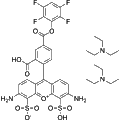
TFAX 488, TFP is a green fluorescent dye that exhibits pH insensitivity across a broad pH range of 4 to 10. This compound produces exceptionally bright and photostable conjugates with proteins and antibodies, making it valuable for applications in immunofluorescence and flow cytometry. Its robust performance enables reliable visualization in various biological research settings.
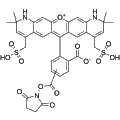
TFAX 568, SE is an orange fluorescent dye that is pH-insensitive across a broad range of pH 4 to 10. It produces exceptionally bright and photostable conjugates with proteins and antibodies, making it an invaluable tool for various applications in fluorescence microscopy and imaging. This dye is particularly useful for labeling goat anti-mouse IgG, facilitating enhanced visibility in cellular assays and biological studies.
TFAX 594,SE is a red fluorescent dye known for its pH-insensitivity across a wide range of pH (4-10). This dye produces exceptionally bright and photostable conjugates with proteins or antibodies, including goat anti-mouse IgG. It is ideal for applications in cellular imaging and fluorescence-based assays, enhancing the sensitivity and clarity of experimental results.
DY-680-NHS ester is a hydrophilic fluorescent dye that reacts with amines to enable the conjugation with antibodies. It maintains a high dye-to-protein (D/P) ratio while minimizing fluorescence quenching and conjugate precipitation. This versatile dye is suitable for a range of applications, including Western blotting, microscopy, flow cytometry, and various cell-based assays, featuring an excitation wavelength of 690 nm and an emission wavelength of 709 nm.
NIR-641 N-succinimidyl ester is a fluorescent dye that operates through the formation of covalent bonds with amine-containing biomolecules. It exhibits strong near-infrared fluorescence, making it suitable for sensitive detection and imaging applications in biological research. This reagent is particularly valuable for labeling proteins and other cellular components, facilitating advanced studies in fluorescence microscopy and molecular imaging.
Rf470DL is a rotor-fluorogenic D-amino acid (RfDAA) that serves as a potent bacteria labeling agent. Exhibiting excitation at 470 nm and emission at 640 nm, it enables selective visualization of bacterial cells in various research applications. Its unique properties allow for effective tracking and imaging of bacterial populations in live-cell studies and microbiological research.
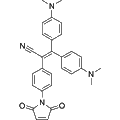
NTPAN-MI is a fluorescent probe that operates through selective activation upon labeling unfolded proteins with exposed thiols. Functioning as a sensitive indicator of protein homeostasis, NTPAN-MI emits fluorescence at an excitation wavelength of 405 nm. This probe is invaluable for researchers investigating protein folding, stability, and the cellular stress response in various biological systems.
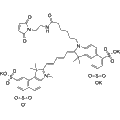
Sulfo-Cyanine5.5 maleimide potassium is a near-infrared (NIR) fluorescent dye that targets sensitive biomolecules for effective labeling. With an excitation maximum at 675 nm and an emission maximum at 694 nm, it is well-suited for visualizing proteins, nanoparticles, and hydrophilic biopolymers in various biological research applications. This reagent is particularly advantageous in fluorescence imaging and tracking studies, enabling advanced investigations in cellular and molecular biology.
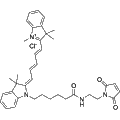
Cy5 maleimide is a cyanine-based fluorescent dye that covalently binds to thiol groups in proteins and other biomolecules. Characterized by its long wavelength emission, high extinction coefficient, and excellent water solubility, Cy5 maleimide is ideal for applications in fluorescence microscopy, flow cytometry, and other labeling techniques. The straightforward mixing reaction facilitates efficient labeling of proteins and antibodies, making it a valuable tool for various biological research applications, including immunoassays and in vivo imaging studies.
CY7-SE is a fluorescent dye from the Cyanine family, characterized by its long wavelength and high extinction coefficient. This compound exhibits adjustable absorption and emission properties, as well as excellent water solubility, making it ideal for labeling applications in biological research. CY7-SE is commonly utilized for the labeling of proteins, antibodies, and small molecules, facilitating efficient conjugation through straightforward mixing reactions. Its versatile properties enable its application in a variety of fluorescence-based assays and imaging techniques.
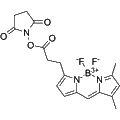
BODIPY-FL NHS ester is a cell membrane-permeable, amine-reactive fluorescent probe that exhibits strong fluorescence with a maximum excitation wavelength of 502 nm and an emission wavelength of 511 nm. This reagent demonstrates exceptional stability and is resistant to changes in polarity, pH, and solvent type, ensuring consistent fluorescence under diverse experimental conditions. BODIPY-FL NHS ester is ideal for applications such as live cell imaging, protein labeling, immunoassays, and the synthesis of protease substrates, making it a versatile tool for fluorescent-based research.
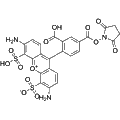
AF488 NHS ester is an amine-reactive fluorescence probe with an emission maximum of 525 nm. This compound specifically reacts with amines and sulfhydryl groups in aqueous and biological samples, leading to a change in chemical structure and fluorescence properties upon derivatization. It is widely used in a variety of biological research applications, including labeling proteins and biomolecules for fluorescence microscopy and flow cytometry.
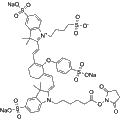
800CW NHS ester is a near-infrared fluorescent dye featuring an active ester moiety, enabling efficient conjugation with amine-containing small molecules, antibodies, and peptides to create fluorescent conjugates. This reagent is characterized by a high fluorescence quantum yield and minimal non-specific binding. 800CW NHS ester is suitable for various biomedical research applications, including microbial infection imaging, tumor visualization, and biochemical detection assays.
Cy7.5 NHS ester is a fluorescent dye that primarily targets biological imaging applications. Its reactive NHS ester enables efficient conjugation to various biomolecules, such as mPEG-b-PDPA, to create fluorescent copolymers. Cy7.5 NHS ester is suitable for fluorescent imaging studies, with excitation and emission wavelengths at 780 nm and 820 nm, respectively, facilitating high-resolution visualization in research settings.
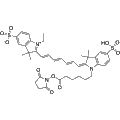
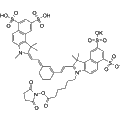
Sulfo-Cy7.5 NHS ester is a hydrophilic near-infrared (NIR) dye designed for the modification of amine groups through its NHS ester functionality. Featuring a trimethylene bridge with a linker arm, this compound enables efficient attachment to proteins, peptides, and other biomolecules. Sulfo-Cy7.5 NHS ester is an invaluable tool for research applications involving NIR imaging, facilitating advanced studies in biological and biomedical fields.
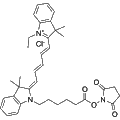
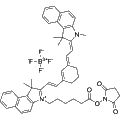
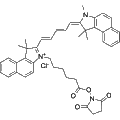
Cyanine5.5 NHS ester chloride is a reactive dye designed for the labeling of proteins, antibodies, and small molecular compounds. It functions through covalent bonding to primary amines, allowing for the development of sensitive and specific assays. This dye is particularly useful in fluorescence imaging and various biochemical assays, enabling enhanced visualization of biological samples in research applications.
Cyanine5 alkyne is a fluorescent dye that functions as an OXPHOS inhibitor, targeting mitochondrial respiration. This compound is primarily utilized in click chemistry applications, allowing for the labeling of azide-containing proteins and analysis of post-translational modifications, including glycosylation. Additionally, Cyanine5 alkyne has demonstrated potential to inhibit the growth of cancer stem cells, making it a valuable tool in cancer research and cellular biology studies.
Cy3B NHS ester is a fluorescent dye that targets amino functional groups in biomolecules, such as proteins, antibodies, and peptides. This reagent is widely utilized in biomarking and fluorescent labeling experiments, enabling sensitive detection and visualization of biomolecules in various research applications. Its high fluorescence properties make it suitable for advanced imaging techniques.
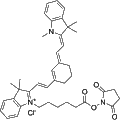
Cy7 NHS ester is a fluorescent dye that targets amine groups, facilitating covalent labeling of proteins, peptides, and other biomolecules. This compound exhibits strong near-infrared fluorescence, making it suitable for applications in fluorescent imaging and biological assays. Its properties enable enhanced sensitivity and specificity in the detection and visualization of various biological samples.
The free acid and succinimidyl ester are different reagents. A study coupled 5(6)-TAMRA-COOH to a cyclic beta-tripeptide using PyBOP-mediated activation. A separate study used 5(6)-succinimidyl TAMRA with cystamine. These examples establish specific reactions, not universal labeling conditions. [1][2]
Identify the reaction partner.
For amine coupling, distinguish activation of a carboxylic acid from reaction of an already activated ester. For azide chemistry more generally, copper-catalyzed and strain-promoted azide–alkyne routes have different partner and catalyst requirements. These are general principles, separate from the specific examples in the table. [3]
Evaluate the product of labeling.
TAMRA derivative formation changed optical behavior in the cited dimer study. Do not assign a conjugate’s reported fluorescence to the starting reagent or transfer performance between different isomer forms. [2]
Representative Reagent Comparison
Selected examples for this topic; independent of the current product page or filters.
Representative reagents and selection considerations
Attachment to an amine-bearing cyclic beta-tripeptide scaffold.
The reported synthesis used PyBOP and DIEA for coupling. This is an activation-dependent example, not a ready-made NHS ester or a universal biomolecule-labeling recipe. [1]
Reaction with cystamine hydrochloride to prepare a TAMRA disulfide dimer.
Already supplied as an activated ester. The paper supports this specific derivatization; the dimer’s optical properties should not be assigned to the starting ester. [2]
Attachment to an amine-bearing cyclic beta-tripeptide scaffold.
Activation / selection boundary
The reported synthesis used PyBOP and DIEA for coupling. This is an activation-dependent example, not a ready-made NHS ester or a universal biomolecule-labeling recipe. [1]
Reaction with cystamine hydrochloride to prepare a TAMRA disulfide dimer.
Activation / selection boundary
Already supplied as an activated ester. The paper supports this specific derivatization; the dimer’s optical properties should not be assigned to the starting ester. [2]
Check the reagent form, reaction partner and method requirements before labeling. These examples do not promise labeling efficiency or compatibility with every sample.