Search by product name, CAS, target or catalog number. Press Down Arrow to reach product suggestions, Tab to move between links, and Escape to close suggestions.
USD – US Dollar✓Current currency
Account
Fluorescent Labeling Dyes
Begin with the molecule you want to label and the functional group available for reaction. The examples below compare the free-acid and succinimidyl-ester forms of 5(6)-TAMRA using documented coupling examples. [1][2] Check whether activation is required and whether the reaction partner matches the method. Treat general coupling chemistry as a planning principle, not a promise of performance, and assess the resulting conjugate separately from the starting dye. [2][3]
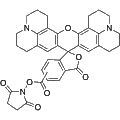
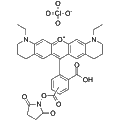
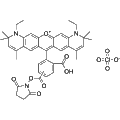
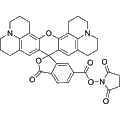
5(6)-Carboxy-X-rhodamin N-succinimidyl ester is a fluorescent dye that targets various biomolecules in biological research applications. This compound is primarily used for labeling proteins, nucleic acids, and other cellular components, aiding in the visualization and analysis of cell structures and functions. Its versatility allows for applications in cellular imaging, tracking of biomolecules, and distinguishing cell types, as well as in studies of tissue pathology and microorganism monitoring. Additionally, this dye is useful in newer fields such as functional textiles and dye-sensitized solar cells.
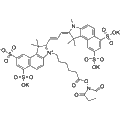
Sulfo-cyanine3.5 NHS ester tripotassium is a water-soluble fluorescent dye characterized by its NHS ester functionality, enabling amino-targeted conjugation. This compound exhibits high fluorescence intensity, making it suitable for various applications in biochemical assays and cellular imaging. Its ability to label proteins and other biomolecules allows researchers to visualize and track biological processes with precision.
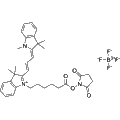
Cyanine3 NHS ester tetrafluoroborate is a fluorescent dye primarily used for protein labeling applications. Its structure allows for long-wavelength absorption and emission, combined with high extinction coefficients and excellent water solubility. This reagent facilitates the labeling of proteins, antibodies, and small molecules through straightforward mixing reactions, making it an essential tool for various bioconjugation and imaging studies. The versatility of Cyanine3 enables its use in a wide array of research disciplines, including cell biology and molecular diagnostics.
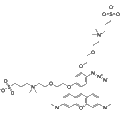
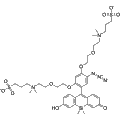
CalFluor 555 azide is a fluorogenic azide probe designed for selective detection in chemical biology applications. This compound remains non-fluorescent until it reacts with alkynes, with an excitation wavelength of 555 nm. Its utility extends to applications such as live-cell imaging and bioconjugation, facilitating the study of metabolic processes and biomolecular interactions.
CalFluor 580 azide is a fluorogenic azide probe that functions through Cu-catalyzed or metal-free click reactions. This compound remains non-fluorescent until it reacts with alkynes, making it an effective tool for bioorthogonal labeling. Its unique properties facilitate applications in imaging and tracking biomolecules, allowing for precise studies in chemical biology and cellular research.
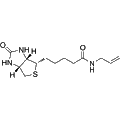
Biotin-olefin is a biotin probe that facilitates the photoimmobilization process on thiol-functionalized surfaces. This compound is instrumental in a variety of applications, including bioconjugation and surface functionalization studies. Its unique properties enable researchers to effectively study protein interactions and enhance sensory device functionality.
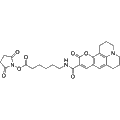
Coumarin 343 X NHS ester is a fluorochrome dye that acts as a hydrophilic fluorescent probe. It is particularly useful in microfluidic applications, enabling the visualization of biological processes through its fluorescent properties. This reagent can be employed in various research fields, including cell imaging and fluorescence-based assays. The NHS ester functional group facilitates covalent labeling of amino groups in biomolecules, enhancing its utility in chemical biology and bioconjugation studies.
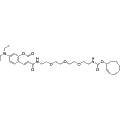
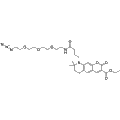
Coumarin-PEG3-TCO is a fluorochrome dye that incorporates three PEG units to enhance solubility and stability. Its TCO group facilitates an inverse electron demand Diels-Alder reaction (iEDDA) with tetrazine-bearing molecules, making it ideal for bioorthogonal labeling applications. This reagent is particularly useful in fluorescence microscopy and tracking cellular processes in live cells.
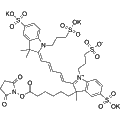
AF647-NHS ester tripotassium is a fluorescent dye that employs the NHS ester mechanism for covalent attachment to amine-containing biomolecules, including proteins and antibodies. This compound exhibits bright far-red fluorescence with an excitation wavelength of 635 nm, making it suitable for various fluorescence detection applications. Its robust properties make it an excellent choice for labeling and tracking biological molecules in imaging and diagnostic research. Store protected from light to maintain stability and performance.
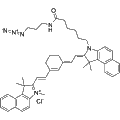
Cyanine7.5 azide chloride is a near-infrared fluorescent dye derivative of Cyanine 7.5, featuring an azide functional group. This compound is primarily utilized as a biolabeling agent for cell imaging, facilitating the covalent bonding with molecules that possess alkyne functionality through click chemistry. Cyanine7.5 azide chloride enables the tracking of biomolecules, including proteins and antibodies, to study their localization and dynamic changes within biological samples.
ATTO 740 NHS ester is a fluorescent dye that functions as an NHS ester derivative of ATTO 740. This compound exhibits strong absorption and a high fluorescence quantum yield, along with exceptional thermal and photochemical stability. It is primarily used for labeling proteins and antibodies, making it suitable for applications in single molecule detection and high-resolution microscopy.
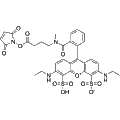
ATTO 532 maleimide is a fluorescent dye designed for protein and antibody labeling, featuring a maleimide reactive group for specific conjugation. This compound exhibits strong absorption properties along with a high fluorescence quantum yield, ensuring optimal signal detection in various applications. With excellent thermal and photochemical stability, ATTO 532 maleimide is ideal for single molecule detection and high-resolution microscopy, making it a valuable tool for advanced biological imaging and research.
ATTO 532 NHS ester is a fluorescent dye that utilizes the Rhodamine structure for effective labeling applications. It exhibits strong absorption and a high fluorescence quantum yield, along with enhanced thermal and photochemical stability. This compound is ideal for single molecule detection and high-resolution microscopy. The NHS ester functional group allows for efficient conjugation to proteins or antibodies, facilitating versatile applications in biochemical research and imaging studies.
ATTO 565 NHS ester is a fluorescent dye that primarily targets proteins and antibodies through covalent labeling. As a derivative of Rhodamine, it exhibits strong absorption characteristics, a high fluorescence quantum yield, and exceptional thermal and photochemical stability. This makes ATTO 565 NHS ester especially suitable for applications in single molecule detection and high-resolution microscopy, enabling precise visualization in various biological research contexts.
ATTO 465 NHS ester is a fluorescent dye that serves as a powerful tool for labeling proteins and antibodies through its NHS ester functional group. With robust absorption and a high fluorescence quantum yield, this compound exhibits excellent thermal and photochemical stability, making it suitable for applications in single molecule detection and high-resolution microscopy. Its unique properties enable precise visualization in various biological research settings.
ATTO 590 NHS ester is a fluorescent dye derived from the Rhodamine structure, featuring strong absorption and high fluorescence quantum yield. This compound offers excellent thermal and photochemical stability, making it ideal for applications such as single molecule detection and high-resolution microscopy. The NHS ester functionality enables effective labeling of proteins or antibodies, facilitating advanced studies in molecular biology and biochemistry.
ROX NHS ester, 6-isomer is a highly fluorescent rhodamine dye that serves as a valuable fluorochrome for a variety of applications. This reactive dye is specifically designed for the labeling of amino groups in peptides, proteins, and amino-oligonucleotides, making it ideal for use in quantitative PCR (qPCR) assays, where it can be detected in the dedicated ROX channel of qPCR instruments. It is supplied as a pure single isomer, ensuring consistent performance in fluorescence-based research.
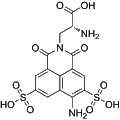
YADA (Lucifer Yellow 3-amino-D-alanine) is a fluorochrome designed for the specific labeling of peptidoglycans in living bacterial cells. This green-yellow fluorescent dye features a significant Stokes shift and an extensive emission spectrum, facilitating excitation with purple light and detection through green filters. YADA demonstrates excellent water solubility, along with stability against light and thermal conditions, making it a valuable tool for research applications involving bacterial cell wall synthesis and live cell imaging.
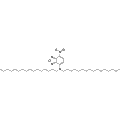
NBD Dihexadecylamine is a fluorochrome that acts as a fluorescent probe for the labeling of phospholipids. This compound facilitates the visualization of cellular membranes and lipid domains in various biological contexts. Its applications extend to studies involving membrane dynamics, lipid interactions, and cellular localization, making it a valuable tool for researchers in cell biology and biochemistry.
ATTO 425 Azide is a fluorochrome dye designed for use in click chemistry applications, featuring a maximum excitation and emission wavelength of 439/489 nm. This compound contains an azide functional group that enables it to participate in copper-catalyzed azide-alkyne cycloaddition (CuAAc) with alkyne-containing molecules. Additionally, ATTO 425 Azide can engage in strain-promoted alkyne-azide cycloaddition (SPAAC) reactions with DBCO or BCN-functionalized compounds, making it valuable for labeling and imaging applications in biochemical research.
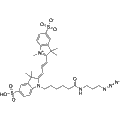
Sulfo-cyanine3 azide is a fluorescent dye characterized by its azide functionality, with excitation and emission maxima at 548 nm and 563 nm, respectively. This compound serves as a valuable probe in biological imaging and research applications, particularly in studying cellular processes and interactions. It can participate in copper-catalyzed azide-alkyne cycloaddition (CuAAc) with alkyne-containing molecules, as well as in strain-promoted alkyne-azide cycloaddition (SPAAC) with DBCO or BCN groups, making it a versatile tool for chemical labeling and bioorthogonal reactions.
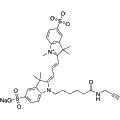
diSulfo-Cy3 alkyne is a water-soluble dye that functions as a Click Chemistry reagent featuring an alkyne group. With absorption and emission characteristics comparable to those of the Cy3 fluorophore, it is suitable for precise labeling of proteins and other biological structures in aqueous environments. This compound is valuable for applications in fluorescence microscopy and bioconjugation studies, enhancing visualization and tracking of target biomolecules in diverse biological research.
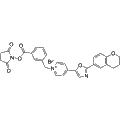
1-[3-(Succinimidyloxycarbonyl)benzyl]-4-[2-(3,4-dihydro-2H-1-benzopyran-6-yl)-5-oxazolyl]pyridinium bromide functions as a fluorescent dye with robust optical properties. This compound is designed for applications in biological imaging and tracking, facilitating the visualization of cellular processes and interactions. Its unique chemical structure enables effective conjugation to biomolecules, enhancing its utility in various research studies, including drug delivery and probe development.
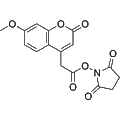
MCA succinimidyl ester is a reactive fluorescent dye that targets amines through its succinimidyl ester functionality. It is capable of forming stable conjugates with amine-containing compounds, making it suitable for various labeling applications. This reagent is commonly used in fluorescence resonance energy transfer (FRET) studies, facilitating the investigation of peptide interactions and dynamics in biological research.
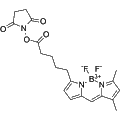
BODIPY FL-C5 NHS Ester is a green-fluorescent dye that primarily targets primary amines on biomolecules, including peptides, proteins, modified nucleotides, and biopolymers. This reactive dye facilitates the conjugation process, enabling researchers to label and visualize biomolecules in various applications. Its strong fluorescence and stability make it suitable for imaging, tracking, and studying the dynamics of biological systems.
The free acid and succinimidyl ester are different reagents. A study coupled 5(6)-TAMRA-COOH to a cyclic beta-tripeptide using PyBOP-mediated activation. A separate study used 5(6)-succinimidyl TAMRA with cystamine. These examples establish specific reactions, not universal labeling conditions. [1][2]
Identify the reaction partner.
For amine coupling, distinguish activation of a carboxylic acid from reaction of an already activated ester. For azide chemistry more generally, copper-catalyzed and strain-promoted azide–alkyne routes have different partner and catalyst requirements. These are general principles, separate from the specific examples in the table. [3]
Evaluate the product of labeling.
TAMRA derivative formation changed optical behavior in the cited dimer study. Do not assign a conjugate’s reported fluorescence to the starting reagent or transfer performance between different isomer forms. [2]
Representative Reagent Comparison
Selected examples for this topic; independent of the current product page or filters.
Representative reagents and selection considerations
Attachment to an amine-bearing cyclic beta-tripeptide scaffold.
The reported synthesis used PyBOP and DIEA for coupling. This is an activation-dependent example, not a ready-made NHS ester or a universal biomolecule-labeling recipe. [1]
Reaction with cystamine hydrochloride to prepare a TAMRA disulfide dimer.
Already supplied as an activated ester. The paper supports this specific derivatization; the dimer’s optical properties should not be assigned to the starting ester. [2]
Attachment to an amine-bearing cyclic beta-tripeptide scaffold.
Activation / selection boundary
The reported synthesis used PyBOP and DIEA for coupling. This is an activation-dependent example, not a ready-made NHS ester or a universal biomolecule-labeling recipe. [1]
Reaction with cystamine hydrochloride to prepare a TAMRA disulfide dimer.
Activation / selection boundary
Already supplied as an activated ester. The paper supports this specific derivatization; the dimer’s optical properties should not be assigned to the starting ester. [2]
Check the reagent form, reaction partner and method requirements before labeling. These examples do not promise labeling efficiency or compatibility with every sample.