Search by product name, CAS, target or catalog number. Press Down Arrow to reach product suggestions, Tab to move between links, and Escape to close suggestions.
USD – US Dollar✓Current currency
Account
Fluorescent Labeling Dyes
Begin with the molecule you want to label and the functional group available for reaction. The examples below compare the free-acid and succinimidyl-ester forms of 5(6)-TAMRA using documented coupling examples. [1][2] Check whether activation is required and whether the reaction partner matches the method. Treat general coupling chemistry as a planning principle, not a promise of performance, and assess the resulting conjugate separately from the starting dye. [2][3]
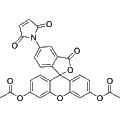
Fluorescein diacetate 5-maleimide is a fluorescent dye that serves as a versatile labeling agent for biomolecules. It exhibits strong fluorescence upon hydrolysis, facilitating the detection of cellular components and the study of cellular viability. This compound is particularly useful in applications involving flow cytometry, live-cell imaging, and tracking molecular interactions in various biological research contexts.
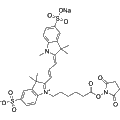
Sulfo-cyanine3 NHS ester sodium is a water-soluble fluorescent dye featuring NHS ester groups, enabling efficient conjugation to amine-containing biomolecules. This compound is widely utilized in bioconjugation applications for labeling proteins, peptides, and nucleic acids, facilitating sensitive detection in various biological assays. Its strong fluorescent properties make it suitable for applications in cellular imaging, flow cytometry, and other fluorescence-based techniques in research.
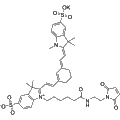
Sulfo-Cyanine7 maleimide potassium is a hydrophilic near-infrared fluorescent dye designed to facilitate high-sensitivity imaging and detection in various biological applications. This fluorescent compound is utilized extensively for labeling biomolecules such as proteins and peptides, allowing for enhanced visualization in live-cell imaging and in vitro assays. Its unique properties make it suitable for applications in both research and diagnostic settings, contributing to advancements in cellular and molecular biology.
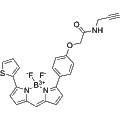
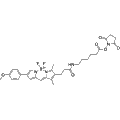
Bodipy TR alkyne is a boron dipyrromethene-based fluorescent dye designed for applications in the ROX (Texas Red) channel. This versatile fluorophore exhibits strong fluorescence, making it suitable for use in microscopy and fluorescence polarization assays. The terminal alkyne moiety facilitates efficient incorporation into biomolecular probes via copper-catalyzed click chemistry, enabling a wide range of research applications including cellular imaging and labeling studies.
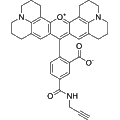
5-ROX-alkyne is a rhodamine-based fluorescent dye designed for the labeling of DNA fragments. It exhibits strong fluorescence, facilitating the visualization of results in capillary electrophoresis genotyping and gel shift assays. This reagent is essential for applications in nucleic acid analysis and characterization, enabling researchers to obtain precise and reliable data in molecular biology experiments.
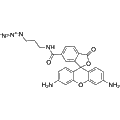
R110 azide, 6-isomer is a fluorescent dye featuring an azide functional group, allowing for the selective labeling of DNA fragments. This compound is particularly useful in visualizing results from capillary electrophoresis genotyping and gel shift assays, facilitating the study of nucleic acid interactions and dynamics. Its unique structure enhances fluorescent properties, making it a valuable tool in molecular biology and genetic research applications.
BODIPY TMR NHS ester is a highly luminescent fluorescent dye that exhibits excitation and emission maxima at 544 nm and 570 nm, respectively. This NHS ester derivative facilitates efficient conjugation to proteins, antibodies, and amine-modified oligonucleotides by targeting primary amines (R-NH2). Its robust fluorescence properties make it suitable for various applications in cellular imaging, biochemical assays, and protein labeling studies.
ATTO 488 azide is a fluorochrome dye designed for click chemistry applications, featuring excitation and emission maxima at 500 nm and 520 nm, respectively. This reagent contains an azide group, enabling it to participate in copper-catalyzed azide-alkyne cycloaddition (CuAAc) reactions with alkyne-containing molecules. Additionally, ATTO 488 azide can undergo strain-promoted alkyne-azide cycloaddition (SPAAC) reactions with dibenzocyclooctyne (DBCO) or bicyclononyne (BCN) groups, making it suitable for a variety of labeling and imaging studies in biological research.
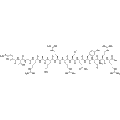
HYNIC-UBI29-41 is a bifunctional chelator conjugated to the antimicrobial peptide UBI 29-41, designed as an infection imaging agent. This compound maintains the antibacterial properties of UBI 29-41 while demonstrating strong affinity for both Gram-positive and Gram-negative bacteria. When labeled with technetium-99m (99mTc), HYNIC-UBI29-41 serves as a valuable tool for imaging bacterial infections in mouse models, facilitating research on infection pathogenesis and treatment efficacy.
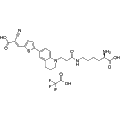
Rf470 TFA is a FMR-probe-D-lysine conjugate that serves as a fluorescent reporter for monitoring peptidoglycan biosynthesis. This compound exhibits minimal fluorescence in its free state, but shows significant fluorescence enhancement upon incorporation into peptidoglycan by transpeptidases. Rf470 TFA is utilized in real-time assays for transpeptidase activity detection and the screening of antibacterial agents, making it a valuable tool for researchers studying bacterial cell wall synthesis and antibiotic action.
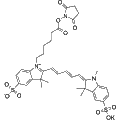
Sulfo-CY5-NHS ester potassium is a reactive dye that functions through the formation of stable amide bonds with primary amines on proteins and nucleic acids. This compound is primarily utilized for fluorescent labeling in biological research, enabling the visualization and tracking of biomolecules in various assays. Its high brightness and long-wavelength emission make it suitable for multiplexing applications and enhanced signal detection in imaging techniques.
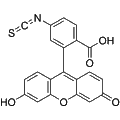
6-Isothiocyanato-Fluorescein (FITC Isomer II) is a fluorescent dye used primarily as a biochemical assay reagent. It targets amine groups, enabling covalent labeling of proteins and other biomolecules. This property makes it valuable for various applications in cell biology, immunology, and fluorescence microscopy, facilitating the study of cellular processes and protein interactions.
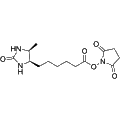
Desthiobiotin-NHS ester is a biotinylated reagent that selectively targets amine groups, particularly those found in lysine residues, to form stable amide bonds. This compound serves as a valuable probe for metalloproteins, facilitating the study of their structure and function in biochemical assays. Its utility extends to various applications in protein analysis and labeling in life science research.
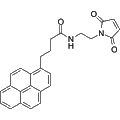
Pyrene maleimide functions as a fluorescent probe with a terminal maleimide group that selectively reacts with thiol groups to form covalent bonds. This characteristic makes it valuable for labeling and tracking biomolecules in biochemical assays. It is widely utilized in studies involving protein conjugation, localization, and dynamics, enhancing the understanding of cellular processes and interactions.
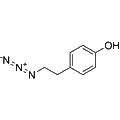
4-(2-Azidoethyl)phenol is a clickable APEX2 probe designed for the study of protein interactions and cellular processes. This compound demonstrates effective labeling capabilities that facilitate biotinylation strategies for downstream applications, enhancing the investigation of protein dynamics within live cells. Its unique azide functionality allows for site-specific conjugation, making it a valuable tool in chemical biology and biochemistry research.
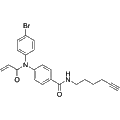
KB05yne is a specially designed alkyne-functionalized electrophilic probe that selectively targets cysteine residues in proteins. It exhibits strong labeling of wild-type target proteins such as CDKN2AIP and HPCAL1, while showing no reactivity with their cysteine-to-alanine mutants, thereby confirming its site-specific reactivity. KB05yne is a valuable tool for covalent ligand discovery and optimization, making it particularly useful in research involving cysteine residues in cancer-related proteins or those that are challenging to purify.
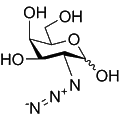
2-Azido-2-deoxy-D-galactose primarily functions as a glycosyl donor in glycosylation reactions. This reagent is essential in glycobiology for the synthesis of glycoconjugates and can be effectively glycosylated by glycopeptides. Its unique azide group facilitates click chemistry applications, enhancing the study of glycan-protein interactions and labeling in various biological research contexts.
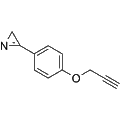
3-[4-(2-Propyn-1-yloxy)phenyl]-2H-azirine is a reactive probe designed for chemoselective bioconjugation targeting carboxyl residues in proteins. This compound demonstrates exceptional labeling efficiency and specificity, making it suitable for both in vitro experiments and in situ applications within live cells. Its utility in protein labeling facilitates a range of biological research applications, including studies involving protein interactions and cellular processes.
Sulfo-TAG COOH disodium is an electrohemiluminescent label tag designed for the specific labeling of antibodies. This reagent facilitates sensitive detection methods in immunoassays and enables enhanced visualization of protein interactions. It is particularly useful in various research applications, including biomarker studies and diagnostic development, where high specificity and low background signals are essential.
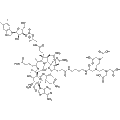
DTPA-adenosylcobalamin is a conjugate of adenosylcobalamin and pentetic acid, serving as a radioactive probe. It is utilized to investigate the absorption of vitamin B12 in tumor tissues, aiding in the diagnosis and understanding of various oncological conditions. This compound is valuable for research applications focused on vitamin B12 metabolism and its implications in cancer biology.
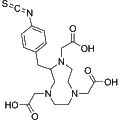
P-SCN-Bn-NOTA is a metal chelator and a precursor for molecular imaging probes, enabling radiolabeling with Gallium-68. This compound can be conjugated to CD70-specific antibodies such as B3, B6, ABDB3, and ABDB6 to generate NOTA-labeled derivatives. P-SCN-Bn-NOTA is primarily utilized in preclinical PET/CT imaging studies targeting CD70-expressing tumors in NCG mouse patient-derived xenograft (PDX) models, making it valuable for research on CD70-positive malignancies.
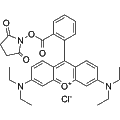
Rhodamine B NHS ester is an amine-reactive fluorescent probe that efficiently labels amine-containing biomolecules. With excitation and emission wavelengths of 564 nm and 589 nm, respectively, it is widely utilized in various biological applications, including protein tagging and cellular imaging. This reagent can specifically react with primary amines, enabling researchers to study protein interactions and localization in live cells and complex biological systems.
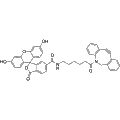
FAM DBCO, 6-isomer is a fluorescent dye that incorporates a terminal dibenzocyclooctyne (DBCO) group, allowing for copper-free Click Chemistry applications. This compound exhibits high reactivity due to its strained structure, facilitating the efficient formation of covalent bonds in bioconjugation reactions. FAM DBCO can be utilized in a variety of biological applications, including cell labeling, tracking, and imaging studies.
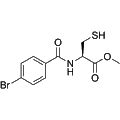
Cysteine Thiol Probe is a thiol-based reagent designed for the selective labeling of electrophilic natural products. It features an ideal pharmacophore with a chromophore, enabling effective engagement with enone, β-lactam, and β-lactone electrophilic metabolites. This probe is particularly useful in studies investigating protein interactions and the biochemical characterization of reactive species.
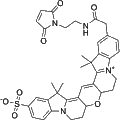
Cy3B maleimide is a mono-reactive fluorescent dye that targets thiol groups, enabling the selective conjugation of the Cyanine3B fluorophore to proteins and peptides with cysteine residues, as well as to other thiolated compounds, including thiol-containing oligonucleotides. This dye exhibits enhanced fluorescence quantum yield and superior photostability compared to traditional Cy3 dyes, making it an excellent choice for applications in fluorescence microscopy, flow cytometry, and various labeling studies in biochemical research. The versatility and efficiency of Cy3B maleimide offer valuable tools for studying protein interactions and intracellular processes.
The free acid and succinimidyl ester are different reagents. A study coupled 5(6)-TAMRA-COOH to a cyclic beta-tripeptide using PyBOP-mediated activation. A separate study used 5(6)-succinimidyl TAMRA with cystamine. These examples establish specific reactions, not universal labeling conditions. [1][2]
Identify the reaction partner.
For amine coupling, distinguish activation of a carboxylic acid from reaction of an already activated ester. For azide chemistry more generally, copper-catalyzed and strain-promoted azide–alkyne routes have different partner and catalyst requirements. These are general principles, separate from the specific examples in the table. [3]
Evaluate the product of labeling.
TAMRA derivative formation changed optical behavior in the cited dimer study. Do not assign a conjugate’s reported fluorescence to the starting reagent or transfer performance between different isomer forms. [2]
Representative Reagent Comparison
Selected examples for this topic; independent of the current product page or filters.
Representative reagents and selection considerations
Attachment to an amine-bearing cyclic beta-tripeptide scaffold.
The reported synthesis used PyBOP and DIEA for coupling. This is an activation-dependent example, not a ready-made NHS ester or a universal biomolecule-labeling recipe. [1]
Reaction with cystamine hydrochloride to prepare a TAMRA disulfide dimer.
Already supplied as an activated ester. The paper supports this specific derivatization; the dimer’s optical properties should not be assigned to the starting ester. [2]
Attachment to an amine-bearing cyclic beta-tripeptide scaffold.
Activation / selection boundary
The reported synthesis used PyBOP and DIEA for coupling. This is an activation-dependent example, not a ready-made NHS ester or a universal biomolecule-labeling recipe. [1]
Reaction with cystamine hydrochloride to prepare a TAMRA disulfide dimer.
Activation / selection boundary
Already supplied as an activated ester. The paper supports this specific derivatization; the dimer’s optical properties should not be assigned to the starting ester. [2]
Check the reagent form, reaction partner and method requirements before labeling. These examples do not promise labeling efficiency or compatibility with every sample.