Search by product name, CAS, target or catalog number. Press Down Arrow to reach product suggestions, Tab to move between links, and Escape to close suggestions.
USD – US Dollar✓Current currency
Account
Fluorescent Labeling Dyes
Begin with the molecule you want to label and the functional group available for reaction. The examples below compare the free-acid and succinimidyl-ester forms of 5(6)-TAMRA using documented coupling examples. [1][2] Check whether activation is required and whether the reaction partner matches the method. Treat general coupling chemistry as a planning principle, not a promise of performance, and assess the resulting conjugate separately from the starting dye. [2][3]
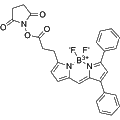
BODIPY 530/550 NHS ester is a fluorescent dye that targets proteins through covalent labeling. This reagent is widely utilized in fluorescence imaging applications, including oblique illumination microscopy (OIM), to visualize protein localization and dynamics within biological samples. Its excellent photostability and intense fluorescence make it suitable for various research applications in cellular and molecular biology.
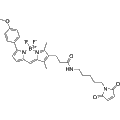
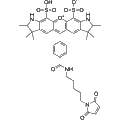
BODIPY TMR C5-maleimide is a fluorescent dye characterized by a high quantum yield, making it suitable for various imaging applications. This compound can efficiently couple with peptides, enabling visualization of biomolecules in biochemical assays and cellular studies. Its properties make it a valuable tool for researchers in the fields of biochemistry and molecular biology, particularly for tracking and studying protein interactions and dynamics in live-cell imaging.
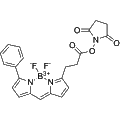
BODIPY R6G NHS ester is a borondipyrromethene dye that serves as a versatile fluorescent labeling reagent. It features an NHS ester group, enabling efficient conjugation with proteins and other biomolecules for enhanced fluorescent tracking. This compound is particularly valuable for intracellular imaging and tracing applications in various biological research settings.
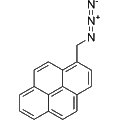
1-(Azidomethyl)pyrene is a fluorescent dye that serves as a versatile reagent in click chemistry. It contains an azide functional group, enabling it to participate in copper-catalyzed azide-alkyne cycloaddition (CuAAc) with alkyne-bearing molecules. Additionally, it can undergo strain-promoted alkyne-azide cycloaddition (SPAAC) reactions with dibenzocyclooctyne (DBCO) or bicyclononyne (BCN) conjugates. This compound is valuable for applications in bioconjugation and the development of fluorescently labeled biomolecules for imaging and tracking in biological research.
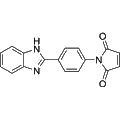
N-[4-(2-Benzimidazolyl)phenyl]maleimide is a highly effective fluorescent probe primarily designed for the detection of thiol compounds. It exhibits an excitation maximum at 315 nm and an emission maximum at 360 nm, which enables precise fluorometric measurements. This compound is essential for applications in biochemical research involving the quantification and analysis of thiol groups in various biological samples.
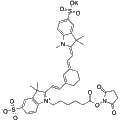
Sulfo-Cyanine7 NHS ester potassium is a highly reactive dye reagent designed for the conjugation to amine-containing biomolecules. This succinimide ester enables the efficient preparation of sulfo-Cyanine7-labeled proteins and other biomolecules. The resulting dye-labeled conjugates are widely utilized in fluorescence imaging, flow cytometry, and other applications in chemical and biological research.
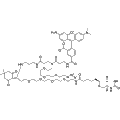
Biotin-PEG4-Dde-TAMRA-PEG3-Azide is a fluorescent dye modified with a cleavable biotin group, designed for efficient labeling and detection. This compound features an azide functional group, enabling it to participate in copper-catalyzed azide-alkyne cycloaddition (CuAAc) and strain-promoted alkyne-azide cycloaddition (SPAAC) reactions with alkyne-containing molecules. Its applications include bioconjugation, fluorescence imaging, and protein labeling in various biological research settings.
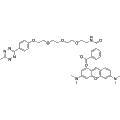
TAMRA-PEG4-methyltetrazine is a fluorescent dye derivative that features a tetrazine moiety for selective labeling applications. The presence of four polyethylene glycol (PEG) units enhances solubility and stability. This compound is designed to undergo inverse electron demand Diels-Alder (iEDDA) reactions with trans-cyclooctene (TCO) partners, making it suitable for bioconjugation and imaging studies in chemical biology research.
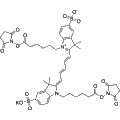
Cy5-bifunctional dye potassium is a water-soluble fluorescent dye featuring two terminal NHS ester functionalities. This reagent enables selective and efficient reactions with primary amines, such as those found in lysine residues or aminosilane-coated surfaces, under neutral to slightly basic conditions, resulting in stable covalent bonds. Its bifunctional nature makes it suitable for cross-conjugation of amines and a variety of advanced labeling applications in chemical and biological research.
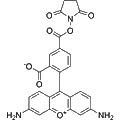
5-Carboxyrhodamine 110 NHS ester is a fluorescent dye known for its bright and photostable green fluorescence, with excitation and emission maxima at approximately 502 nm and 527 nm, respectively. This amine-reactive dye is ideal for creating highly fluorescent bioconjugates and is preferred for applications requiring exceptional photostability and pH insensitivity within a range of 4 to 9. Its single isomer form facilitates improved resolution in HPLC purification, making it suitable for labeling proteins, peptides, and nucleotides in various biochemical research applications.
BP Fluor 405 NHS Ester is a water-soluble blue-fluorescent dye designed for use in multi-color applications such as flow cytometry and super-resolution microscopy, particularly STORM. Its excitation wavelength of 407 nm makes it well-suited for use with krypton lasers and violet laser diodes. The NHS ester group enables efficient labeling of primary amines in proteins, amine-modified oligonucleotides, and other amine-containing biomolecules, facilitating high-molar-conjugation without significant self-quenching. BP Fluor 405 conjugates are optimal for sensitive detection of target abundances in various research applications.
DyLight 550 NHS ester is a fluorescent dye designed for advanced labeling applications in biochemical research. This vibrant orange-to-red fluorochrome exhibits superior performance compared to traditional rhodamine derivatives, facilitating enhanced detection and analysis. Its high water solubility allows for an optimal dye-to-protein ratio, ensuring efficient conjugation without precipitation of the labeled conjugates. DyLight 550 is ideal for applications such as immunofluorescence, flow cytometry, and live cell imaging.
BP Fluor 532 maleimide is a fluorescent dye that emits bright yellow fluorescence and remains photostable across a pH range of 4 to 10. Its excitation properties are optimal for the frequency-doubled Nd:YAG laser line, making it suitable for various applications in imaging and flow cytometry. The maleimide group allows for efficient conjugation with sulfhydryl-containing biomolecules such as proteins and peptides, creating stable thioether bonds and resulting in enhanced fluorescence intensity and photostability compared to other fluorophores.
5(6)-Carboxyrhodamine 110 NHS Ester is a fluorescent dye characterized by its amine-reactive functionality, enabling the formation of highly luminous and photostable green-fluorescent bioconjugates. With excitation and emission maxima at approximately 502 nm and 527 nm, respectively, this dye is particularly suited for applications in Fluorescence Correlation Spectroscopy (FCS). Its properties make it an excellent choice for studies requiring sensitive and reliable fluorescence detection in biological research.
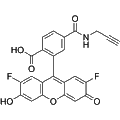
OG 488 alkyne is a highly sensitive green-fluorescent dye designed for imaging azide-labeled biomolecules. It participates in copper-catalyzed azide-alkyne cycloaddition (CuAAC) to create a stable triazole linkage. This reagent is valuable for visualizing biomolecular interactions and dynamics, making it suitable for various applications in cellular imaging and bioconjugation studies.
BP Light 550 carboxylic acid is a fluorescent dye characterized by its vibrant orange-to-red emission spectra. This compound displays superior brightness and photostability compared to other rhodamine derivatives, making it ideal for advanced fluorescent applications. Its high water solubility facilitates efficient conjugation, enabling a high dye-to-protein ratio without precipitate formation, which is crucial for maintaining sample integrity in various research settings.
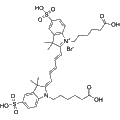
Sulfo-Bis-(N,N'-carboxylic acid)-Cy5 is a fluorescent dye that displays the same absorbance and emission spectra as the Cy5 fluorophore. Its free unactivated carboxylic acid functional groups facilitate conjugation with biomolecules, making it suitable for various labeling applications in biological research. This compound is particularly useful in fluorescence microscopy, flow cytometry, and other imaging techniques requiring high sensitivity and specificity.
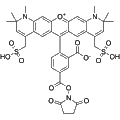
BP Fluor 594 NHS ester is a fluorescent dye that targets primary amines in proteins, antibodies, and amine-modified oligonucleotides for efficient labeling. It forms stable, covalent amide bonds at pH 7-9, allowing for high molar ratio conjugations without significant self-quenching. This results in brighter conjugates conducive to sensitive detection applications. BP Fluor 594 exhibits excellent water solubility and is pH-insensitive from 4 to 10, with absorption and emission maxima at 590 nm and 617 nm, respectively. It is suitable for use with 561 nm and 594 nm laser lines, making it ideal for imaging and flow cytometry.
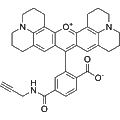
ROX alkyne, 6-isomer is an alkyne derivative of the red-emitting fluorescent dye ROX (Rhodamine X, Rhodamine 101), known for its high quantum yield. This compound is particularly useful for fluorescent labeling of azide-containing biomolecules through copper-catalyzed click chemistry. Its applications include quantitative PCR and microscopy, making it an essential reagent for advanced imaging and detection in biochemical research.
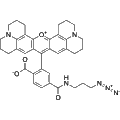
ROX azide, 6-isomer is a reactive derivative of the Rhodamine X dye, specifically designed for use with alkyne-reactive applications. This pure 6-isomer fluorophore exhibits high brightness and fluorescence quantum yield, making it an excellent choice for biological imaging. It facilitates the labeling of alkyne and cycloalkyne-containing biomolecules through copper-catalyzed and copper-free click chemistry reactions, enabling precise tracking and visualization in various research applications.
BP Light 800 NHS ester is a hydrophilic fluorescent dye that reacts with amines, allowing for effective conjugation to antibodies. This compound exhibits strong fluorescent properties, making it suitable for various applications such as western blotting, microscopy, flow cytometry, and cell-based assays. Its high dye-to-protein ratio enhances detection sensitivity and specificity in biological research.
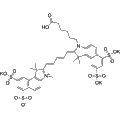
Sulfo-Cyanine5.5 carboxylic acid potassium is a fluorescent dye characterized by its excitation and emission wavelengths of 673 nm and 707 nm, respectively. The incorporation of a sulfite group significantly improves the compound's hydrophilicity, facilitating its application in aqueous environments. The terminal carboxylic acid group can readily react with primary amines, especially in the presence of coupling agents like EDC and HATU, enabling the formation of stable amide bonds for various biochemical applications, including labeling and tracking biomolecules in research studies.
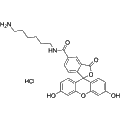
FAM amine, 5-isomer is a fluorescein-based fluorescent dye that features an amine group enhancing reactivity with carboxylic acids and activated NHS esters. This compound is primarily utilized in bioconjugation applications and fluorescent labeling techniques. Its ability to undergo enzymatic transamination facilitates the attachment to various biomolecules for effective visualization and tracking in biological research.
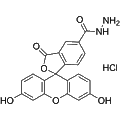
FAM hydrazide, 5-isomer is a fluorescent dye linker featuring a hydrazide functional group that facilitates conjugation with aldehydes to form stable hydrazone bonds. This compound exhibits bright fluorescence, making it suitable for various applications in biochemical assays and bioconjugation techniques. Its universal properties as a fluorescein dye allow for its use in a wide range of research settings, including cellular imaging and detection assays.
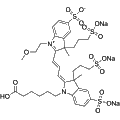
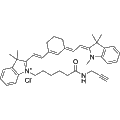
Cy7 alkyne chloride is a fluorescent dye derivative of Cyanine 7 (Cy7) featuring an alkyne functional group, with an excitation/emission wavelength of 740/770 nm. This reagent can undergo click chemistry reactions with azide-containing molecules, enabling the formation of stable covalent bonds. It is widely utilized in fluorescence imaging, bioconjugation applications, and cellular labeling studies, making it a valuable tool for researchers in bioorthogonal chemistry and related fields.
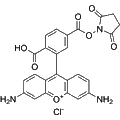
The free acid and succinimidyl ester are different reagents. A study coupled 5(6)-TAMRA-COOH to a cyclic beta-tripeptide using PyBOP-mediated activation. A separate study used 5(6)-succinimidyl TAMRA with cystamine. These examples establish specific reactions, not universal labeling conditions. [1][2]
Identify the reaction partner.
For amine coupling, distinguish activation of a carboxylic acid from reaction of an already activated ester. For azide chemistry more generally, copper-catalyzed and strain-promoted azide–alkyne routes have different partner and catalyst requirements. These are general principles, separate from the specific examples in the table. [3]
Evaluate the product of labeling.
TAMRA derivative formation changed optical behavior in the cited dimer study. Do not assign a conjugate’s reported fluorescence to the starting reagent or transfer performance between different isomer forms. [2]
Representative Reagent Comparison
Selected examples for this topic; independent of the current product page or filters.
Representative reagents and selection considerations
Attachment to an amine-bearing cyclic beta-tripeptide scaffold.
The reported synthesis used PyBOP and DIEA for coupling. This is an activation-dependent example, not a ready-made NHS ester or a universal biomolecule-labeling recipe. [1]
Reaction with cystamine hydrochloride to prepare a TAMRA disulfide dimer.
Already supplied as an activated ester. The paper supports this specific derivatization; the dimer’s optical properties should not be assigned to the starting ester. [2]
Attachment to an amine-bearing cyclic beta-tripeptide scaffold.
Activation / selection boundary
The reported synthesis used PyBOP and DIEA for coupling. This is an activation-dependent example, not a ready-made NHS ester or a universal biomolecule-labeling recipe. [1]
Reaction with cystamine hydrochloride to prepare a TAMRA disulfide dimer.
Activation / selection boundary
Already supplied as an activated ester. The paper supports this specific derivatization; the dimer’s optical properties should not be assigned to the starting ester. [2]
Check the reagent form, reaction partner and method requirements before labeling. These examples do not promise labeling efficiency or compatibility with every sample.