Search by product name, CAS, target or catalog number. Press Down Arrow to reach product suggestions, Tab to move between links, and Escape to close suggestions.
USD – US Dollar✓Current currency
Account
Fluorescent Labeling Dyes
Begin with the molecule you want to label and the functional group available for reaction. The examples below compare the free-acid and succinimidyl-ester forms of 5(6)-TAMRA using documented coupling examples. [1][2] Check whether activation is required and whether the reaction partner matches the method. Treat general coupling chemistry as a planning principle, not a promise of performance, and assess the resulting conjugate separately from the starting dye. [2][3]
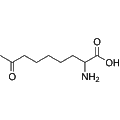
2-Amino-8-oxononanoic acid is a versatile protein labeling probe that facilitates the incorporation of modified residues into proteins in Escherichia coli. This amino acid enables the efficient site-specific labeling of proteins with various probes under mild conditions, closely mimicking physiological pH. It serves as a valuable tool for researchers in the fields of protein biochemistry and molecular biology, particularly in applications involving protein tagging and tracking.
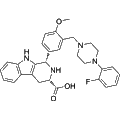
cis-Ned19 is a chemical probe that specifically targets NAADP signaling pathways. This compound effectively inhibits NAADP receptor activity and allows for fluorescent labeling, facilitating the study of NAADP-mediated cellular processes. Its unique properties make it valuable for research applications focused on calcium signaling and its implications in various cellular functions.
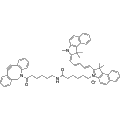
Cyanine 5.5 DBCO chloride is a versatile click chemistry reagent featuring a cycloalkyne moiety that enables efficient, copper-free bioconjugation. This compound serves as a linker for the Cyanine 5.5 fluorophore, providing excellent stability and fast reaction kinetics. With excitation and emission wavelengths of 680 nm and 715 nm, respectively, it is ideal for applications in fluorescent imaging and labeling of lipids and biomolecules in various biological research contexts.
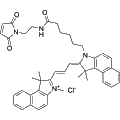
Cyanine 3.5 maleimide chloride is a fluorescent dye that targets thiol groups in proteins for specific labeling applications. It exhibits advantageous properties, including a long wavelength, adjustable absorption and emission spectra, high extinction coefficient, and good water solubility. This dye is commonly utilized in the labeling of proteins, antibodies, and small molecular compounds, facilitating the study of protein dynamics and interactions through fluorescence techniques. The labeling process is straightforward, typically involving a simple mixing reaction with the target biomolecule.
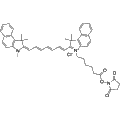
Cyanine 7.5 NHS chloride is a fluorescent dye that functions as a reactive electrophile, allowing for selective conjugation to amine-containing biomolecules. This compound is particularly useful in the development of fluorescent copolymers, such as mPEG-b-PDPA-Cy7.5, enhancing their imaging capabilities. Its fluorescent properties, with excitation and emission wavelengths of 780 nm and 820 nm respectively, make it suitable for various fluorescence imaging applications in biological research.
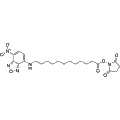
NBD dodecanoic acid N-succinimidyl ester is a fluorescent dye that incorporates a long-chain fatty acid moiety, enabling targeting of lipid-rich cellular environments. This compound can be utilized for labeling and tracking biological molecules, facilitating fluorescence microscopy and imaging studies. Its ability to stably conjugate to amine-containing biomolecules enhances its application in cellular and molecular biology research.
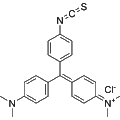
Malachite green isothiocyanate is an amine-reactive probe that reacts with amines to form thiourea derivatives. This reagent is widely utilized for quantifying protein concentrations in biochemical assays. Its reactivity with amine groups enables precise measurements, making it an essential tool in protein characterization and analysis.
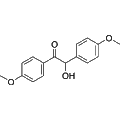
Anisoin (4,4'-Dimethoxybenzoin) is a fluorogenic labeling reagent designed for pre-chromatographic applications in liquid chromatography. This compound facilitates the detection and quantification of guanidino compounds with high sensitivity, exhibiting excitation and emission wavelengths of 325 nm and 435 nm, respectively. Anisoin is valuable for researchers focusing on analytical chemistry and biochemistry, enhancing the analysis and performance of guanidino compound assays.
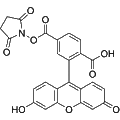
FAM NHS ester, 6-isomer is a hydrophilic fluorescent dye that enables effective labeling of biomolecules. Its N-hydroxysuccinimide (NHS) ester group selectively reacts with primary amines, including those found in lysine residues and aminosilane-coated surfaces, under neutral to slightly basic conditions to form stable covalent bonds. This property makes it suitable for diverse applications in fluorescence microscopy, flow cytometry, and target protein labeling in biochemical research.
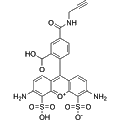
BP Fluor 488 Alkyne is a fluorescent dye specifically designed for labeling in Click Chemistry reactions. It conjugates effectively with azide-modified biomolecules, including antibodies, proteins, peptides, and amino-modified oligonucleotides. With an excitation peak at 499 nm and emission peak at 520 nm, this dye allows for enhanced visualization in applications such as microscopy and flow cytometry. BP Fluor 488 Alkyne is a pure 5-sulfonated rhodamine derivative, providing consistent results free from lot-to-lot variation.
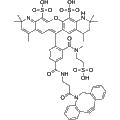
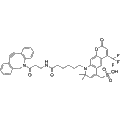
MB 543 DBCO is a fluorescent dye featuring a terminal DBCO group, which enables its application in copper-free Click Chemistry reactions through strain-promoted cycloaddition. This highly hydrophilic, water-soluble compound exhibits strong orange fluorescence with a maximum absorption at 543 nm and emission at 566 nm. Additionally, MB 543 DBCO demonstrates excellent stability across a broad pH range from 3 to 10, making it suitable for various biological imaging and labeling applications in research.
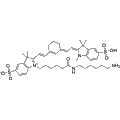
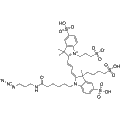
Sulfo-Cy7 amine is a near-infrared (NIR) fluorescent dye featuring a free amine group, allowing for conjugation with various reactive functionalities such as NHS esters and epoxides. This compound serves as an essential tool for labeling and tracking biological targets through electrophilic reactions and enzymatic transamination processes. Its capability to improve detection sensitivity makes it valuable in applications such as in vivo imaging and cell tracking in various research fields.
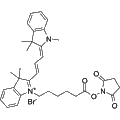
Cy3 NHS ester bromide is a cyanine dye characterized by its ability to covalently label biomolecules via amine groups. This compound exhibits strong long-wavelength fluorescence with high extinction coefficients, making it suitable for sensitive detection applications. Cy3 NHS ester is widely utilized in various research fields, including protein labeling, antibody conjugation, and small molecule tagging, facilitating advanced studies in cell biology, immunology, and molecular imaging. The labeling reaction is straightforward, enabling efficient coupling for diverse experimental setups.
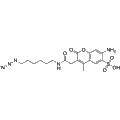
BP Fluor 350 Azide is a blue-fluorescent dye designed for bioorthogonal labeling, functioning primarily through copper-catalyzed azide-alkyne cycloaddition (CuAAC) and copper-free click chemistry with strained cyclooctynes to form stable triazole compounds. This water-soluble, moderately photostable probe is optimally excited at 350 nm and is ideal for applications in imaging and flow cytometry, providing robust signal generation for high-abundance target visualization. BP Fluor 350 is particularly suitable for experiments requiring direct imaging due to its outstanding brightness and stability.
BP Fluor 430 Azide is a water-soluble, green-fluorescent azide probe that targets terminal alkynes through copper-catalyzed azide-alkyne cycloaddition (CuAAC) and strained cyclooctynes via copper-free click chemistry, forming stable triazole compounds. It exhibits strong fluorescent properties with an excitation maximum at 432 nm and an emission maximum at 539 nm, demonstrating excellent brightness and photostability. This versatile probe remains pH-insensitive across a range of 4 to 10, making it suitable for a variety of biological applications, including the detection of low-abundance alkyne-tagged biomolecules.
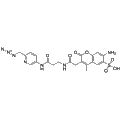
BP Fluor 350 Picolyl Azide is a blue-fluorescent azide-activated probe designed for efficient labeling of biomolecules via copper-catalyzed azide-alkyne cycloaddition (CuAAC). Additionally, it can react with strained cyclic alkynes through copper-free click chemistry to form stable triazole linkages. This compound is valuable for fluorescence imaging and in studies requiring precise biomolecular tagging, allowing researchers to visualize and track interactions in various biological systems.
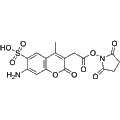
BP Fluor 350 NHS ester is a fluorescent dye that reacts with primary amines to form stable covalent amide bonds, functioning optimally at pH 7-9. This water-soluble, blue-emitting compound is ideal for labeling and tracking biomolecules in various biochemical assays. It is particularly suited for applications requiring specific modification of amine groups in proteins, peptides, and other amine-containing substrates, enhancing visualization in fluorescence-based experiments.
BP Fluor 555 Azide is a fluorescent dye designed for the labeling of biomolecules through copper-catalyzed or copper-free click chemistry. Exhibiting bright orange fluorescence, it has optimal excitation wavelengths of 532 nm and 555 nm, making it suitable for imaging applications with TRITC filter sets. The dye demonstrates pH insensitivity from pH 4 to pH 10, facilitating the detection of low-abundance targets when conjugated to antibodies, peptides, or proteins. Its high brightness and photostability enhance the visibility and reliability of fluorescent imaging techniques in various biological research applications.
BP Fluor 430 Alkyne is a green-fluorescent alkyne-activated probe designed for the imaging of azide-containing biomolecules with moderate to high abundance. It utilizes a copper-catalyzed azide-alkyne cycloaddition (CuAAC) reaction to produce a stable triazole linker. This probe exhibits bright and photostable fluorescence, optimally excited near 430 nm, and is water-soluble, maintaining pH-independent fluorescence across a wide range. Applications include cellular imaging and visualization of biomolecular interactions.
BP Fluor 405 DBCO is a blue-fluorescent dye that utilizes copper-free click chemistry for targeted labeling of azides, resulting in stable triazole formation. Its excitation wavelength is optimal for use with the 407 nm spectral line of the krypton laser or the 408 nm violet laser diode. This dye is particularly useful in multi-color applications such as flow cytometry and super-resolution microscopy techniques like STORM, enabling precise visualization in complex biological samples.
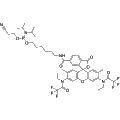
R6G phosphoramidite, 6-isomer, is a fluorescent dye that serves as a versatile building block for oligonucleotide synthesis. This xanthene dye from the rhodamine family exhibits a high fluorescence quantum yield and a significant molar extinction coefficient, making it ideal for a variety of labeling applications. With absorption and emission maxima shifted to longer wavelengths at 518 nm and 542 nm, respectively, R6G is particularly suitable for applications requiring enhanced fluorescence sensitivity and stability in nucleic acid studies and other biotechnological fields.
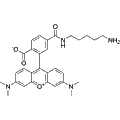
6-TAMRA cadaverine is a fluorescent dye primarily utilized for oligonucleotide labeling and automated DNA sequencing. The amino group (NH2) exhibits reactivity with carboxylic acids, activated NHS esters, and carbonyls, including ketones and aldehydes. This versatility makes 6-TAMRA cadaverine a valuable tool for various molecular biology applications, facilitating the visualization and characterization of nucleic acids.
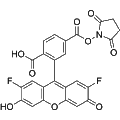
Difluorocarboxyfluorescein NHS Ester, 6-isomer is an amine-reactive fluorescent dye known for its enhanced photostability and lower pKa (approximately 4.7), which renders its fluorescence largely pH insensitive within physiological ranges. This dye is particularly suitable for the labeling of proteins, peptides, and nucleotides, offering significant improvements in resolution during HPLC purification when utilizing a single isomer. Researchers benefit from the dye's favorable characteristics in various applications, enabling precise tracking and analysis of biomolecules in complex biochemical studies.
BP Fluor 568 NHS ester is an amine-reactive fluorescent dye targeting primary amines in proteins, antibodies, and amine-modified oligonucleotides. With excitation and emission wavelengths of 578 nm and 602 nm, respectively, it enables robust labeling and tracking of biomolecules in various applications. This dye is ideal for use in fluorescence microscopy, flow cytometry, and other imaging techniques to study protein interactions and dynamics.
BP Fluor 430 DBCO is a fluorescent dye that reacts with azides through a copper-free click chemistry mechanism, resulting in stable triazole formations without the need for copper catalysts or elevated temperatures. This dye exhibits bright, photostable green fluorescence, with optimal excitation at 432 nm and an emission peak at 539 nm, remaining pH independent across a broad pH range. BP Fluor 430 DBCO is suitable for various labeling applications in bioimaging and bioconjugation, although it is not recommended for staining intracellular components of fixed and permeabilized cells due to potential high background fluorescence.
The free acid and succinimidyl ester are different reagents. A study coupled 5(6)-TAMRA-COOH to a cyclic beta-tripeptide using PyBOP-mediated activation. A separate study used 5(6)-succinimidyl TAMRA with cystamine. These examples establish specific reactions, not universal labeling conditions. [1][2]
Identify the reaction partner.
For amine coupling, distinguish activation of a carboxylic acid from reaction of an already activated ester. For azide chemistry more generally, copper-catalyzed and strain-promoted azide–alkyne routes have different partner and catalyst requirements. These are general principles, separate from the specific examples in the table. [3]
Evaluate the product of labeling.
TAMRA derivative formation changed optical behavior in the cited dimer study. Do not assign a conjugate’s reported fluorescence to the starting reagent or transfer performance between different isomer forms. [2]
Representative Reagent Comparison
Selected examples for this topic; independent of the current product page or filters.
Representative reagents and selection considerations
Attachment to an amine-bearing cyclic beta-tripeptide scaffold.
The reported synthesis used PyBOP and DIEA for coupling. This is an activation-dependent example, not a ready-made NHS ester or a universal biomolecule-labeling recipe. [1]
Reaction with cystamine hydrochloride to prepare a TAMRA disulfide dimer.
Already supplied as an activated ester. The paper supports this specific derivatization; the dimer’s optical properties should not be assigned to the starting ester. [2]
Attachment to an amine-bearing cyclic beta-tripeptide scaffold.
Activation / selection boundary
The reported synthesis used PyBOP and DIEA for coupling. This is an activation-dependent example, not a ready-made NHS ester or a universal biomolecule-labeling recipe. [1]
Reaction with cystamine hydrochloride to prepare a TAMRA disulfide dimer.
Activation / selection boundary
Already supplied as an activated ester. The paper supports this specific derivatization; the dimer’s optical properties should not be assigned to the starting ester. [2]
Check the reagent form, reaction partner and method requirements before labeling. These examples do not promise labeling efficiency or compatibility with every sample.