Search by product name, CAS, target or catalog number. Press Down Arrow to reach product suggestions, Tab to move between links, and Escape to close suggestions.
USD – US Dollar✓Current currency
Account
Fluorescent Labeling Dyes
Begin with the molecule you want to label and the functional group available for reaction. The examples below compare the free-acid and succinimidyl-ester forms of 5(6)-TAMRA using documented coupling examples. [1][2] Check whether activation is required and whether the reaction partner matches the method. Treat general coupling chemistry as a planning principle, not a promise of performance, and assess the resulting conjugate separately from the starting dye. [2][3]
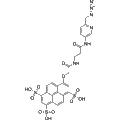
BP Fluor 405 Picolyl Azide is a fluorescent dye designed for enhanced detection in bioconjugation reactions, utilizing a copper-chelating motif to increase local Cu(I) concentrations. This innovative reagent significantly accelerates the copper-catalyzed azide-alkyne cycloaddition (CuAAC) reaction rate while minimizing the required copper catalyst concentration by at least tenfold. The incorporation of the picolyl azide moiety allows for greater sensitivity in alkyne detection, making it particularly advantageous for applications involving low-abundance targets or those requiring amplified signal intensity. This makes BP Fluor 405 an essential tool for researchers focusing on advanced fluorescent labeling techniques.
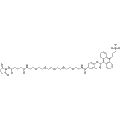
NSP-DMAE-HEG-Giu-NHS is an activated labeling reagent featuring an acridine ester, serving as a vital component in the development of Cyclosporine A tracers. This compound facilitates the selective labeling of biomolecules, enabling enhanced detection and visualization in biological studies. Its application is essential in research areas such as drug delivery and pharmacokinetics, where precise tracking of therapeutic agents is required.
The free acid and succinimidyl ester are different reagents. A study coupled 5(6)-TAMRA-COOH to a cyclic beta-tripeptide using PyBOP-mediated activation. A separate study used 5(6)-succinimidyl TAMRA with cystamine. These examples establish specific reactions, not universal labeling conditions. [1][2]
Identify the reaction partner.
For amine coupling, distinguish activation of a carboxylic acid from reaction of an already activated ester. For azide chemistry more generally, copper-catalyzed and strain-promoted azide–alkyne routes have different partner and catalyst requirements. These are general principles, separate from the specific examples in the table. [3]
Evaluate the product of labeling.
TAMRA derivative formation changed optical behavior in the cited dimer study. Do not assign a conjugate’s reported fluorescence to the starting reagent or transfer performance between different isomer forms. [2]
Representative Reagent Comparison
Selected examples for this topic; independent of the current product page or filters.
Representative reagents and selection considerations
Attachment to an amine-bearing cyclic beta-tripeptide scaffold.
The reported synthesis used PyBOP and DIEA for coupling. This is an activation-dependent example, not a ready-made NHS ester or a universal biomolecule-labeling recipe. [1]
Reaction with cystamine hydrochloride to prepare a TAMRA disulfide dimer.
Already supplied as an activated ester. The paper supports this specific derivatization; the dimer’s optical properties should not be assigned to the starting ester. [2]
Attachment to an amine-bearing cyclic beta-tripeptide scaffold.
Activation / selection boundary
The reported synthesis used PyBOP and DIEA for coupling. This is an activation-dependent example, not a ready-made NHS ester or a universal biomolecule-labeling recipe. [1]
Reaction with cystamine hydrochloride to prepare a TAMRA disulfide dimer.
Activation / selection boundary
Already supplied as an activated ester. The paper supports this specific derivatization; the dimer’s optical properties should not be assigned to the starting ester. [2]
Check the reagent form, reaction partner and method requirements before labeling. These examples do not promise labeling efficiency or compatibility with every sample.